
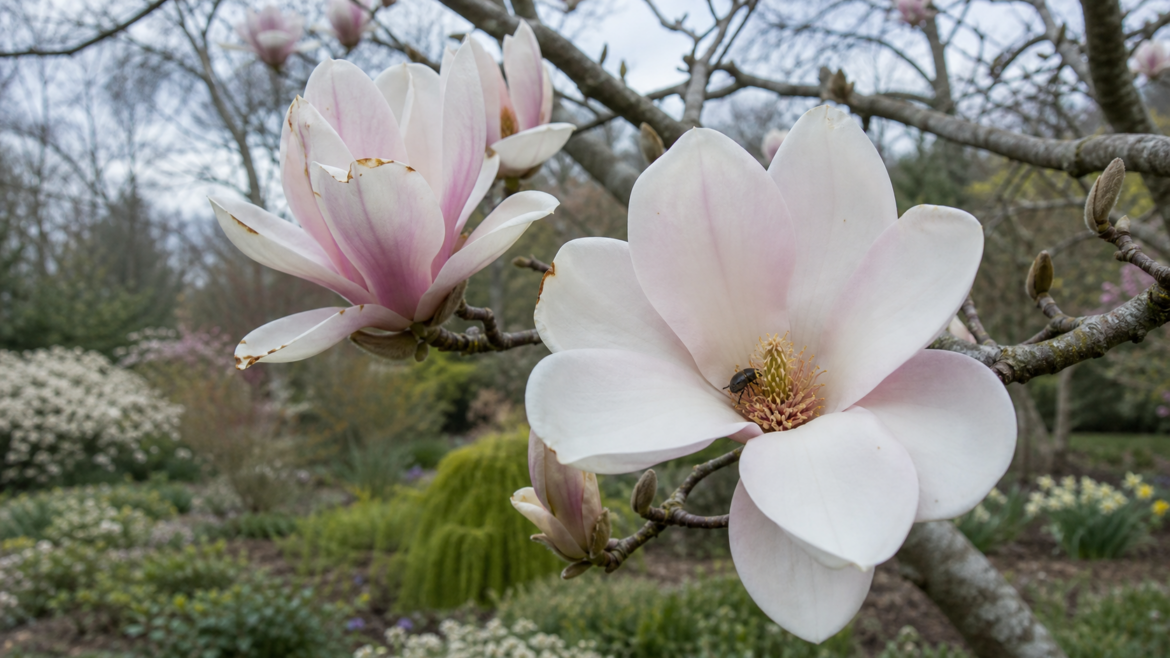
An April magnolia can look almost unreasonable. The grass is still thin, the perennials are barely showing, and the rest of the tree has not bothered with leaves. Then the branches open bowls of pink, cream, purple, or white into the cold air, as if the garden has skipped several pages and landed directly in bloom.
That early display is the charm of many deciduous magnolias. It is also the risk. One clear night can turn perfect petals brown at the edges. A hard freeze can collapse the whole show before the leaves have even arrived. To a gardener, it can feel like bad judgment on the tree’s part. Why make such large flowers so early, on bare wood, in weather that has not decided what season it is?
The answer is older and more interesting than simple impatience. Magnolias are not trying to behave like tulips, cherries, or summer roses. They belong to an early-diverging lineage among living flowering plants, and their flowers retain a pollination design associated with beetles, sturdy floral parts, and a spring calendar that rewards boldness but never guarantees safety.1
A flower built for beetles
Magnolia flowers are often described as ancient, which can make them sound like museum pieces. In the garden, they feel anything but dusty. A saucer magnolia flower can be large enough to cup in both hands. A star magnolia opens into many narrow white tepals. Sweetbay carries creamy fragrant flowers later, with glossy leaves and a different mood altogether.
The oldness is in the structure and the pollination story. University of Illinois Extension notes that magnolias arose early in flowering-plant history and developed flowers suited to beetles and flies, before many of the bees, butterflies, and moths gardeners now think of first.1 The flower is less a delicate landing platform for one specialist than a fragrant, generous room that tolerates rough traffic.
This is why the flower parts feel substantial. Magnolia’s petal-like parts are called tepals because sepals and petals are not clearly differentiated; star magnolia, for example, carries 12 to 18 strap-shaped tepals.2 Illinois Extension explains that beetle mouthparts are made for chewing, so floral parts may be eaten while the insects seek pollen or nectar.1 Fleshy tepals and densely arranged reproductive structures make more sense in that context than the image of a flower built for a single dainty landing.
If you find a beetle nosing around the center of a magnolia flower, do not assume that its presence calls for control. It may be feeding while also contacting anthers and stigmas, then carrying pollen to another flower. Observe the insect and the damage before deciding it is a pest. The interaction is not graceful, but beetle pollination has persisted across a very long evolutionary history.
Why bare branches make the flowers feel larger
Many of the magnolias that stop people on sidewalks bloom before their leaves expand. Star magnolia, saucer magnolia, Loebner magnolia, and the Little Girl hybrids all use bare or nearly bare branches as the stage. Without foliage, every flower is visible. There is no green background to soften the gesture. The tree becomes flower, bark, bud, and sky.
NC State Extension describes star magnolia as the earliest of the deciduous magnolias to flower, producing fragrant white flowers with many tepals before the leaves emerge.2 Saucer magnolia is similar in theater, with large cup-shaped flowers appearing before leaves in late winter or early spring.3 That leafless timing is why the display can feel so clean, but it is also why every damaged petal is visible.
The flower buds are not made in a hurry. NC State notes that saucer magnolia carries large, hairy terminal flower buds on stems one year ahead of bloom, while star magnolia’s pubescent floral buds are conspicuous in winter.32 Those coverings protect a dormant bud, not an open flower. Sun and warmth can stimulate opening before the last freeze has passed; once the tepals expand, the winter armor is gone.4
Frost is the price of the spectacle
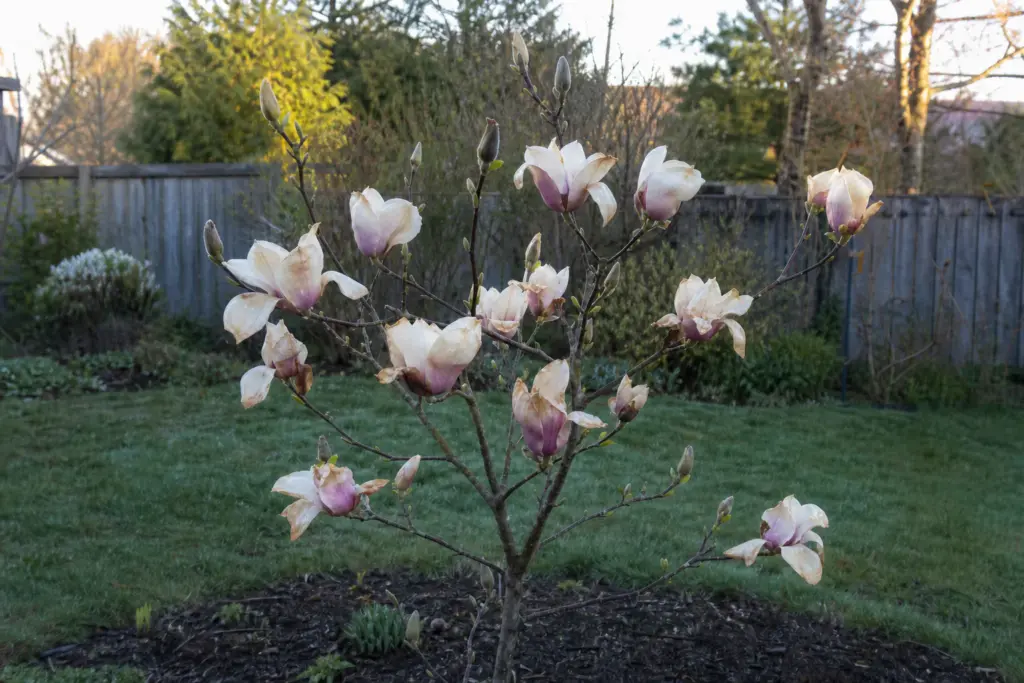
The most common heartbreak with early magnolias is not a sick tree. It is weather meeting tender tissue. University of Maryland Extension uses magnolia blossoms as an example of freeze-damaged flowers, explaining that late winter sun can stimulate premature opening and that late frosts or spring freezes can damage open flowers. Cold-injured flowers may first look water-soaked, then turn brown and die.4
This distinction matters. When cold injury is confined to the blossoms, brown flowers do not by themselves show that the trunk, branches, or roots have failed. The year’s floral display may be lost, but an otherwise healthy tree can still leaf out and grow. Wait for normal leaf emergence and new growth before deciding that damage extends beyond the flowers.
There is still some garden agency here. NC State warns that star magnolia flowers are subject to frost damage because they open early, and recommends protected sites while avoiding southern exposures that may warm buds too soon.2 Saucer magnolia guidance is similar: give the tree protection from strong winds and late frosts, and avoid warm southern exposures near structures that absorb and reradiate heat, because that extra warmth can push buds open before the next freeze.3
The odd lesson is that the warmest wall is not always the kindest place. A heat-storing wall in a strongly sunlit exposure may coax buds open early, then leave them exposed when the night temperature drops. In Northern Hemisphere gardens, a south-facing brick wall is the common example; elsewhere the warm orientation changes. The useful principle is to favor a steady microclimate over a pocket that races ahead on sunny winter days.
Choosing the right magnolia for your spring
Magnolias are not one garden personality. The word covers evergreen trees, native wetland species, compact shrubs, huge southern specimens, and many hybrids. The right one depends less on romance than on space, soil, hardiness, and how much risk you can tolerate in bloom season.
Star magnolia is often beloved because it stays relatively compact, opens early, and covers itself in pale fragrant flowers. NC State gives a typical mature size of 15 to 20 feet tall and 10 to 15 feet wide.2 Saucer magnolia is broader and bolder, commonly 15 to 33 feet tall and 15 to 25 feet wide, with flowers like porcelain cups on gray limbs.3 Both can be caught by spring weather. Mature dimensions, not the nursery pot, should decide whether either belongs beside a path, patio, or foundation.
For colder or more erratic spring climates, later-blooming choices deserve attention. NC State describes ‘Jane’ and the other Little Girl hybrids as flowering about two to four weeks later than their parent species, making them less likely to be damaged by frost.5 Later does not mean frost-proof, and local hardiness still matters, but bloom time is a useful trait to compare rather than treating every magnolia as the same gamble.
If your garden has moist or even wet acidic soil, sweetbay magnolia belongs in the conversation. NC State describes sweetbay as native to the coastal southeastern United States and north along the Atlantic coast to New York, occurring in open woodlands, shaded woods, and swamps. It prefers consistently moist to wet, acidic, organically rich soil and may flower sporadically from mid-spring into summer.6 It does not give the same bare-branch shock as saucer magnolia, but it can be a better plant for the place. Native range, cold hardiness, and mature form still need checking against the actual garden.
Planting for steadiness, not speed
Magnolias resent being treated as temporary decoration. Many have fleshy roots that are easily damaged, and they do not appreciate repeated disturbance. Choose the site with the mature size in mind, then let the tree settle. This is especially important near paths, patios, foundations, and underground utilities, where a small nursery plant can look harmless until it begins to become the tree it was always planning to be.
For star magnolia, NC State recommends moist, organically rich, acidic to neutral, well-drained loams, full sun for best flowering, consistent summer moisture, and mulch to retain soil moisture.2 Saucer magnolia asks for similar care: regular moisture, well-drained acidic loam, organic enrichment, and room for its fleshy root system.3 The pattern is clear. Magnolias like generous soil, steady moisture, and a root zone that is protected rather than cultivated.
Mulch matters, but not as a volcano against the trunk. University of Illinois Extension recommends a 2- to 3-inch organic layer around a new tree, pulled at least 4 inches away from the trunk.7 Check moisture in the root ball and surrounding soil, adjust watering for rainfall and drainage, and expand the watered area as roots establish. Prune lightly and only when there is a reason. NC State recommends pruning star magnolia only if needed, immediately after flowering.2 That timing also avoids cutting away next spring’s flower buds, which saucer magnolia carries on stems one year ahead of bloom.3
Can you save the flowers from a freeze?
Sometimes, if the tree is small enough. A young magnolia shrub or a compact Little Girl cultivar can be covered before a frost advisory. A mature saucer magnolia twenty feet tall cannot be tucked in by a sensible person without turning the evening into a ladder problem.
Covers are most useful for a marginal radiation frost on a calm, clear night. Colorado State University Extension notes that protection becomes questionable when a cold front brings a deeper, advective freeze. Dry blankets or sheets can retain some ground heat, while a supported cover keeps cold material from touching the plant; opaque covers must come off in daylight so the soil can warm again.8
For a small magnolia, set a simple frame before the cold night so fabric surrounds the canopy without pressing flowers flat. Bring the edges to the ground and secure them, keep household fabric dry, and remove it after temperatures rise. Treat an improvised cover as help during a marginal frost, not as protection with a guaranteed temperature rating, and do not climb a mature tree to wrap individual limbs. If the flowers have already browned, let the damaged tepals fall and judge the tree later by leaf-out and new growth.
Useful magnolia supplies
- Treegator slow-release watering bag: one way to deliver water slowly over the root ball of a newly planted magnolia; fill it according to actual soil moisture and rainfall, then expand the watered area as roots establish.7
- Luster Leaf Rapitest soil pH test kit: a home screening check if magnolia foliage is becoming chlorotic in a soil that may be alkaline; confirm a consequential result with a local laboratory soil test before amending.2
- Agfabric frost blanket: a lightweight cover for a small magnolia during a marginal radiation frost, with support and secured edges; it is not a guarantee against a hard, windy freeze.8
Final thoughts
Magnolias are dramatic because they do not hide their timing. They put flowers on bare wood, in unsettled air, before the garden has relaxed into green. That makes them vulnerable. It also makes them unforgettable.
The best way to grow them is not to demand certainty from spring. Choose a species or cultivar whose bloom time suits your climate. Plant it where the soil is generous, the wind is softened, and warmth does not rush the buds too early. Accept that some years will be clean and luminous, while others will be browned at the edges. A magnolia is not a cautious plant. It is an old one, still making its ancient bargain with beetles, weather, and the first real light of the year.
References
- University of Illinois Extension: Magnolia blooms, beetles are nature’s spring flower odd couple
- NC State Extension Gardener Plant Toolbox: Magnolia stellata
- NC State Extension Gardener Plant Toolbox: Magnolia x soulangeana
- University of Maryland Extension: Freeze damaged flowers on trees and shrubs
- NC State Extension Gardener Plant Toolbox: Magnolia ‘Jane’
- NC State Extension Gardener Plant Toolbox: Magnolia virginiana
- University of Illinois Extension: Care of newly planted trees
- Colorado State University Extension: Frost protection and extending the growing season