
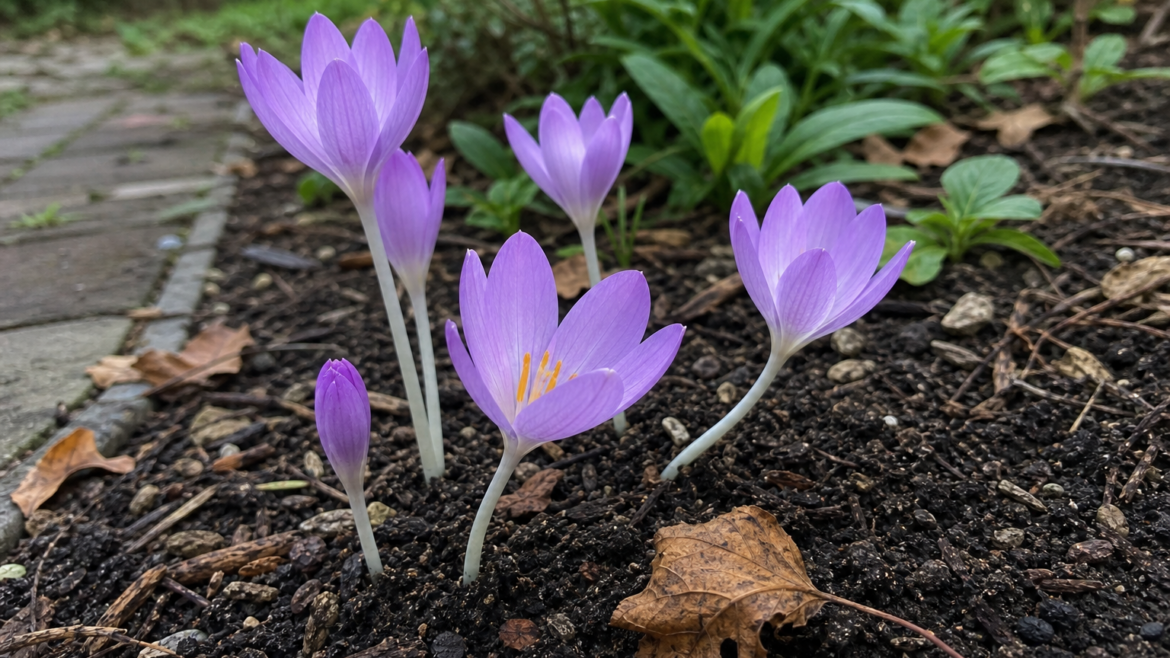
By mid-September, bare soil usually reads as an ending. Summer annuals are thinning. The cucumber vines are tired. Fallen leaves begin collecting in the small pockets where paths meet planting beds. Then, from a place that looked empty yesterday, a lilac flower rises without warning.
No leaves come with it. No green fan announces the plant. The flower simply appears from the ground, pale and glossy in the cooler light, as if the garden has forgotten the usual order of events. That is the small strangeness of autumn crocus. It does not bloom because it is confused. It blooms because its year is divided into two separate acts: leaves in spring, flowers in autumn.
A flower with its calendar split
“Autumn crocus” is a shared common name. In the U.S. garden trade it often means a Colchicum species or hybrid, and Colchicum autumnale is one of the most commonly grown, but some true Crocus species also flower in autumn.1 This article follows C. autumnale, also called meadow saffron or naked ladies. Missouri Botanical Garden describes it as a cormous perennial that sends up foliage in spring, goes dormant by early summer, and then produces leafless flowers in late summer to early fall.2
Missouri Botanical Garden places Colchicum autumnale in Colchicaceae and lists Europe as its native range.2 For the gardener, the useful point is where the plant’s continuity lives. The visible parts come and go. The underground corm keeps the account.
The corm holds a stored season, stored leaf work, and stored risk. When autumn crocus blooms from bare soil, it is spending energy made months earlier. The September flower is not a fresh start. It is spring sunlight returning in another form.
A crocus in name only
The common name is both charming and troublesome. Autumn crocus looks enough like a crocus to earn the name: low cups, soft purple-pink color, a habit of appearing when the rest of the bed is doing something else. But botanically, Colchicum autumnale is not a true crocus. Missouri Botanical Garden places it in Colchicaceae and notes that its flowers have six stamens, while true Crocus belongs to Iridaceae and has three.2
Wisconsin Horticulture makes the same practical distinction and adds the most important caution: colchicums should not be confused with saffron crocus, Crocus sativus.1 Both can bloom in fall. Both may be sold around the same season. Both can have lilac tones. Missouri Botanical Garden describes C. sativus as the Iridaceae corm whose three reddish-orange stigma branches yield saffron.3
For the gardener, the difference is more than a label. It changes where the plant belongs, how the leaves behave, and whether the flower has any place near the kitchen. NC State Extension classifies Colchicum autumnale as highly toxic and potentially fatal if ingested.4 Saffron crocus is grown for its stigmas. The names overlap just enough to demand attention.
Spring leaves do the autumn work
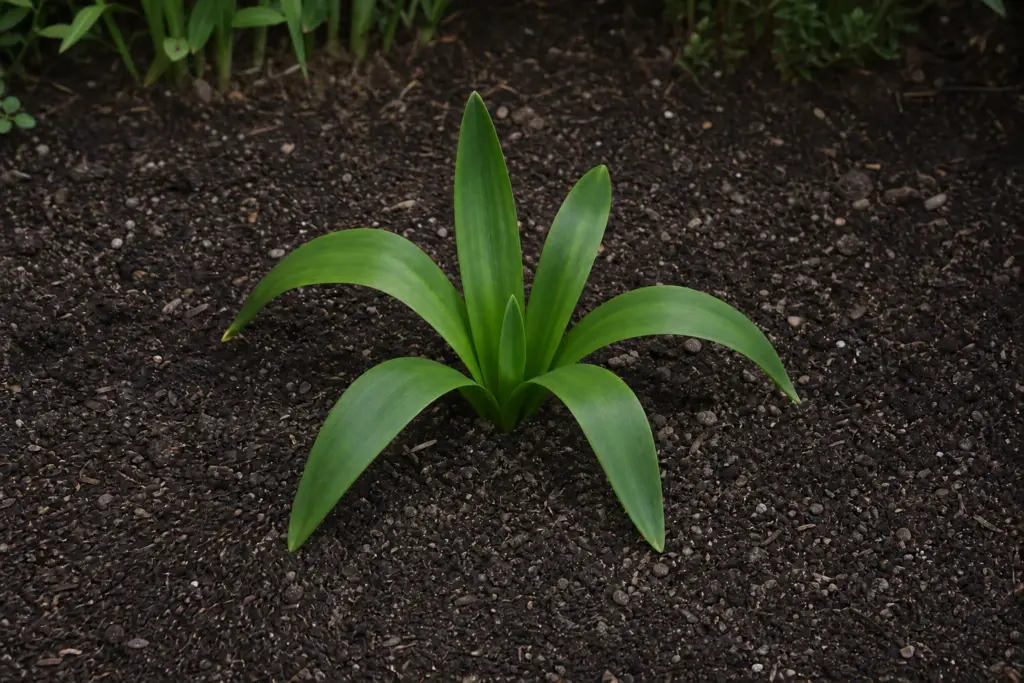
The leafless bloom is the showy part, but the spring leaves are the work crew. In spring, autumn crocus sends up a clump of broad green leaves. Wisconsin Horticulture notes that those leaves feed the corm and need to be left in place until they dry down.1 Cutting them early because they look awkward is like taking wages from the next bloom. The same storage logic explains why spring bulb leaves have to linger, even though a colchicum stores its reserves in a corm rather than a true bulb.
This is where the plant asks for a little patience. The foliage can be larger and coarser than the delicate autumn flowers make you expect. It may look fresh in April, useful in May, and increasingly untidy as summer approaches. Missouri Botanical Garden recommends reducing water when the foliage yellows and begins to die back, then resuming water again in late summer.2 That rhythm follows the plant’s own calendar: active spring growth, summer rest, autumn bloom.
If you only meet autumn crocus in flower, you might imagine it as a small, airy thing. Meet it in spring and you understand the bargain. The plant borrows space twice: first as leaves, later as flowers. A good planting site respects both appearances.
Planting a corm that may already be awake
Autumn crocus has to be planted earlier than many gardeners are mentally ready for bulbs. Missouri Botanical Garden recommends buying dormant corms in late summer and planting them immediately, about three inches deep and six inches apart, in organically rich, well-drained soil in full sun to part shade.2 NC State Extension gives a similar planting depth of roughly 7 to 10 centimeters and notes that the plant prefers a rich, well-drained loam in a sunny position, while tolerating partial shade.4
The timing matters because the flower bud is already part of the stored plan. Wisconsin Horticulture notes that corms can sometimes produce flowers even before they are planted.1 That can feel magical on a potting bench, but it is really a reminder not to leave them sitting in a bag. A corm can spend stored energy in the wrong place. Your job is to put it where roots can follow.
Sharp drainage is the quiet requirement. The Royal Horticultural Society notes that colchicums dislike overly wet or poorly drained soil, especially during dormancy.5 In a persistently wet clay site, choose a raised bed, slope, or container with dependable drainage rather than improving only a small planting pocket that can collect water. The plant needs adequate moisture while it is growing, but it should not sit waterlogged.
Designing for the awkward months
Autumn crocus is a better design plant when you stop treating it as a stand-alone specimen. The flowers are short, luminous, and easy to miss from across a large border. They belong where someone passes close enough to notice them: beside a path, near a patio edge, below an open shrub, or in a small drift where late-season light can catch the petals.
Missouri Botanical Garden suggests using colchicums in pockets where spring and summer plants are fading, around walks or patios, and with low ground covers that can help support weak stems.2 Wisconsin Horticulture adds that hardy geraniums and other perennials can hide the yellowing spring foliage, then be cut back in fall so the flowers show.1
That is good practical design. Let another plant carry June. Let the colchicum take September. Low thyme, ajuga, sedum, small geraniums, or the fading skirts of summer perennials can make the bare flowers look intentional rather than stranded. The trick is not to bury them under dense evergreen cover. They need a stage, but not an empty one.
They can also naturalize in grass or meadow-like plantings, but only where mowing can wait until both foliage and flowers have finished.1 A lawn with strict weekly mowing is usually the wrong place. A loose orchard edge, a path-side meadow strip, or an unmown pocket under deciduous shrubs is more sympathetic.
The warning inside the beauty
The most important fact about autumn crocus is not its bloom time. It is its toxicity. NC State Extension gives Colchicum autumnale high-severity poison characteristics, identifies colchicine as the toxic principle, and states that ingestion can be fatal; all parts are poisonous, especially the corm.4 Wisconsin Horticulture also warns never to substitute a colchicum for saffron.1
This does not mean the plant has no place in a garden. Many ornamental plants carry serious warnings. It does mean placement should be thoughtful. Do not plant it where children harvest pretend onions, where pets dig persistently, where livestock graze, or where edible bulbs and corms are stored and handled nearby. NC State flags the plant as a problem for cats, dogs, and horses and also records contact dermatitis.4 Wear gloves when handling corms, wash hands afterward, and keep planting stock clearly labeled and separate from food crops.
If anyone may have swallowed any part of the plant, seek poison-center advice immediately rather than waiting for symptoms. In the United States, Poison Control is available online or at 1-800-222-1222; elsewhere, use the local poison center or emergency service. Call emergency services immediately if the person collapses, has a seizure, has trouble breathing, or cannot be awakened.6
The old common name meadow saffron is especially unhelpful. It sounds edible. It is not. A garden can hold both beauty and danger, but it should not make the dangerous plant sound like pantry stock.
How to tell it from saffron crocus
Saffron crocus, Crocus sativus, is a different plant. Missouri Botanical Garden lists it in the iris family, Iridaceae, and describes its fall flowers as having three long reddish-orange stigma branches, the part harvested as saffron. Its narrow, grass-like leaves appear shortly before bloom.3
For Colchicum autumnale, look for the whole seasonal pattern: broad leaves in spring, no foliage beside the autumn flowers, and six stamens inside a single flower.2 Leaflessness or purple petals alone are not enough, because true autumn-flowering crocuses also exist. If you intend to harvest saffron, start with Crocus sativus from a reputable specialist, grow it separately from colchicums, and verify its narrow leaves, three stamens, and three conspicuous reddish-orange stigma branches. If any feature or label is uncertain, do not harvest.
That may sound strict, but the garden rewards strictness here. Many mistakes can be composted. This one should be prevented.
Letting the trick repeat
Once established, autumn crocus is not difficult, but it asks you to remember a plant you cannot always see. Mark the planting area so you do not slice into the corms during summer editing. Let the spring foliage yellow on its own. Keep the site from becoming waterlogged. Watch for slugs and snails, which both Missouri Botanical Garden and NC State Extension list among possible problems.24
If a clump becomes crowded or the flowers decline, divide during the summer dormant period after the leaves have died back and before the flowers begin.1 That timing may feel odd because there is almost nothing to see above ground. It is exactly when the plant is easiest to move without interrupting either half of its year.
Plant in small groups rather than single dots. One flower is a curiosity. Five or seven become a small event. A drift at the edge of a path can feel like the garden has saved one last quiet surprise for anyone still looking closely after summer has begun to loosen.
Final thoughts
Autumn crocus makes a small correction to the gardener’s idea of order. We tend to expect leaves first, flowers second, rest afterward. Colchicum rearranges that sentence. It feeds in spring, disappears in summer, flowers in autumn, and trusts the corm to hold the story together underground.
That is why the leafless bloom is so satisfying. Its beauty is evidence that the plant has been keeping time out of sight. The September flower is a stored promise kept late, when the garden is beginning to look as if it has already said most of what it came to say.
References
- University of Wisconsin–Madison Extension: Autumn crocus, Colchicum spp.
- Missouri Botanical Garden: Colchicum autumnale
- Missouri Botanical Garden: Crocus sativus
- NC State Extension Gardener Plant Toolbox: Colchicum autumnale
- Royal Horticultural Society: Colchicum
- Poison Control: Get help online or by phone