
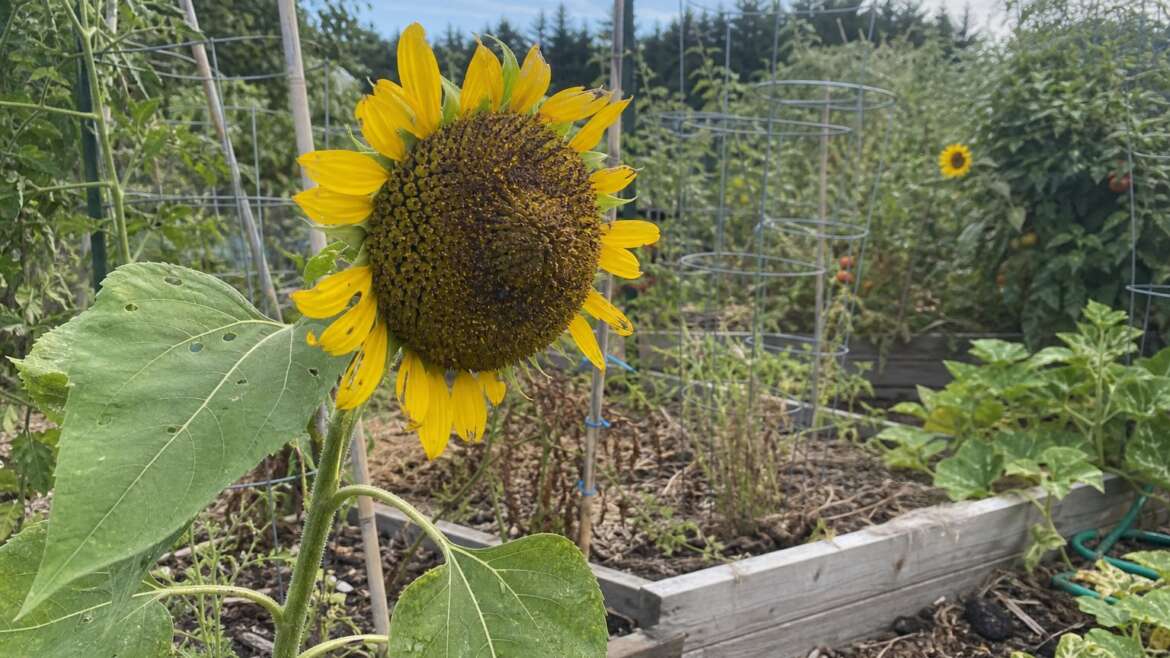
By late summer or autumn, depending on sowing date and climate, a sunflower can look as if it has made a firm decision. The unopened bud and upper shoot that leaned east at breakfast and west by evening now hold the open capitulum toward morning. The stem is rough, the leaves are broad and weathered, and the seed disk is beginning to darken. If you pass it at sunset, it may still be looking east, faithful to sunrise rather than to the sun overhead.
That surprises people because the sunflower’s public reputation is simple: it follows the sun. That is true, but only for a particular part of its life. Before flowering, the growing shoot and unopened bud track from east at dawn toward west by dusk, then reorient east during the night. As flowering approaches, the westward excursion becomes smaller; mature capitula generally stop tracking and remain east-facing.1 The famous movement is not a permanent habit. It is a growing plant’s timed behavior, and it ends when the plant has different work to do.
In a garden this can feel like personality. In the plant, it is physics, growth, temperature, and pollination braided together. The sunflower is not admiring the sunrise. It is using it.
The flower is really a crowded room
What we casually call a sunflower flower is actually a flower head, or capitulum, made from many smaller flowers. The central disk holds hundreds of tiny disk florets; the showy yellow “petals” around it are ray florets.37 The big face is not one bloom in the way a tulip is one bloom. It is more like a small village of blooms arranged so neatly that our eyes read it as a single sun.
This matters because the plant’s final direction is not just about display. The disk florets in the center are where pollen is presented, where visits from bees and other insects matter, and where the fruits we call sunflower seeds will develop after successful pollination. A mature sunflower head has become a reproductive platform. Its angle changes the temperature, light, and timing experienced by all those little florets.
How a stem turns without muscles
A young sunflower does not swivel on a hinge. It turns because one side of the growing stem lengthens more than the other. UC Berkeley’s summary of the 2016 sunflower study explains that during the day the eastern side of the stem grows more than the western side, turning the plant westward as the sun moves. At night, the western side grows faster, bringing the head back east before dawn.2
The timing is not only a direct response to light. The plant’s circadian clock helps gate the growth response so the stem is ready for predictable changes in the day. That is why the movement has an anticipatory quality. The plant is not merely being pushed around by the sun. It is keeping time, then growing unevenly in a way that makes the whole top of the plant lean through the sky.
This is also why the tracking fades instead of stopping like a hinge. As overall stem elongation slows near flowering, the unequal growth that bends the shoot becomes smaller, so its westward excursion shrinks even while it returns east at night.1 By the time the stem beneath the open head is stiff and woody, the capitulum is left facing east.4
Why the adult flower faces morning
East is not a random resting place. In the 2016 field experiments, east-facing capitula warmed faster after sunrise and received about five times as many insect visits as west-facing heads during the early-morning interval when the east-facing heads were warmer. Artificially heating west-facing heads increased visits but did not fully match east-facing heads, showing that temperature contributed without explaining the whole difference.12
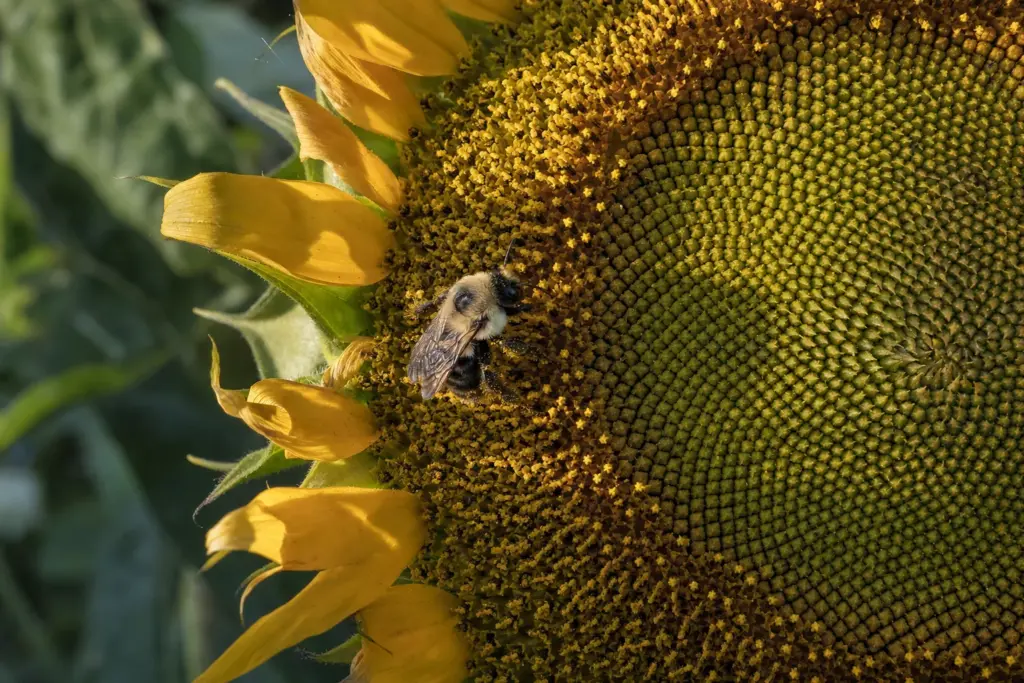
Morning warmth is not just comfort. A warmer flower can reduce the energy a bee needs to begin foraging, so a head that catches first light offers an advantage at the start of the day. UC Davis also notes that direct sunlight makes ultraviolet markings on the head more visible to bees than to human eyes.4 The experiments did not isolate those markings as the cause of the extra visits, so they are a plausible light cue rather than a complete explanation. From our side of the garden, the head looks yellow. From a bee’s side of the morning, it may be a warmer, brighter invitation.
A later study in New Phytologist pushed the question further by manipulating flower orientation and temperature. Compared with heads turned west, east-facing heads showed earlier style elongation and pollen presentation, drew pollinators earlier, and sired more offspring. Under some conditions they also produced heavier, better-filled seeds, although orientation did not change seed number.5 That makes the sunflower’s final pose feel less like a habit and more like a bargain with dawn.
What gardeners are actually seeing
Not every sunflower in a home garden will line up with the neatness of a research plot. A plant squeezed against a fence may reach sideways for light. A tall stem bent by wind may keep an awkward lean. Branching cultivars carry many smaller heads, each with its own angle, so the whole plant can look less like a compass and more like a conversation. Container-grown sunflowers can become top-heavy; a large, freely draining container and a dwarf cultivar reduce the risk of tipping.6
The clearest way to see the movement is to watch a young, single-stem sunflower before the head fully opens. Look early, look at midday, then look again in the evening. The shift is slow enough to miss if you expect drama, but obvious if you compare the plant to a fixed post or wall. Later, after the flower opens and the seed disk begins to fill, the performance becomes quieter. The plant has stopped traveling across the day and has chosen the hour that matters most.
If you grow a sunflower in a pot specifically to watch the behavior, resist rotating it every evening to make it look tidy. Mark the pot and leave its orientation unchanged while you observe it: in the 2016 experiments, turning potted plants 180 degrees at sunset disrupted normal tracking, so moving the pot confounds the pattern you are trying to watch.1
Helping the clock do its work
Sunflowers are forgiving, but the classic tracking plant needs open light. Oregon State University Extension describes common sunflower as an annual that thrives in full sun and well-drained soil.6 In a confined or shaded site, neighboring plants and structures can obscure the movement. If you want to watch the head turn, give the plant a clear view of the sky.
For direct sowing, wait until local frost risk has passed and the soil has reached at least 50°F (10°C), plant about one inch deep, and keep the seedbed moist until germination. Space plants for their cultivar and purpose: Oregon State suggests 18 to 24 inches for larger branching types, while single-stem cut-flower plants can be grown closer.6 Georgia Extension likewise notes that sunflowers are easy to establish by direct seeding and are best located in full sun.3
Keep the seedbed moist through germination, then water according to rainfall, soil, drainage, and the plant’s stage rather than a rigid calendar. Established sunflowers tolerate some drought, but regular water supports flowering and seed production.6 Containers and hot, windy sites dry faster. Space also matters: use the seed packet’s mature dimensions, since a dwarf container cultivar and a many-branched garden sunflower do not need the same room.
Choose flowers for bees, not only for vases
Some modern sunflower cultivars are bred to be pollen-free because florists appreciate clean stems and tablecloths without yellow dust. They can be beautiful garden plants, but a planting meant for pollinators should include pollen-producing varieties too. Oregon State Extension notes that pollen-free varieties are preferred for cut flowers, while pollen-producing varieties supply the resource needed by pollinators and for seed production.6 For bees, pollen is not a stain. It is food.
It also helps to think beyond the bloom. NC State Extension describes common sunflower as valuable for butterflies and other pollinators, notes that Helianthus supports several specialized bees, and recommends leaving dead flowers standing into winter as natural bird feeders.7 A late-season sunflower is therefore not finished when it stops looking fresh. The head that warmed bees in the morning can later feed seed-eating birds.
If neatness is important, compromise rather than clearing everything at once. Cut the most battered stems near the path, but leave a few sturdy heads standing in the back of the bed. Their angle may no longer matter to pollinators once seed has set, but their structure still matters to the winter garden.
The lesson in a turned face
A sunflower that stops following the sun has not become less alive. It has changed tasks. The young plant tracks light while it is building leaves, stem, and height. The mature plant holds its head toward morning while florets open, pollen appears, bees arrive, and seeds begin to fill. Movement gives way to orientation.
That is one of the pleasures of watching plants closely. A behavior that first looks like a simple trick turns out to be timed growth, solar heat, insect vision, and reproductive economy. The sunflower’s eastward face is not a cute misunderstanding of the sun’s path. It is plant timing made visible, standing at the back of the late-season bed.
References
- Atamian et al.: Circadian regulation of sunflower heliotropism, floral orientation, and pollinator visits
- UC Berkeley: How sunflowers follow the sun
- University of Georgia Extension: Growing Sunflowers in the Home Garden
- UC Davis: Why Sunflowers Face East
- Creux et al.: Flower orientation influences floral temperature, pollinator visits and plant fitness
- Oregon State University Extension: Grow your own sunflowers
- NC State Extension Gardener Plant Toolbox: Helianthus annuus