
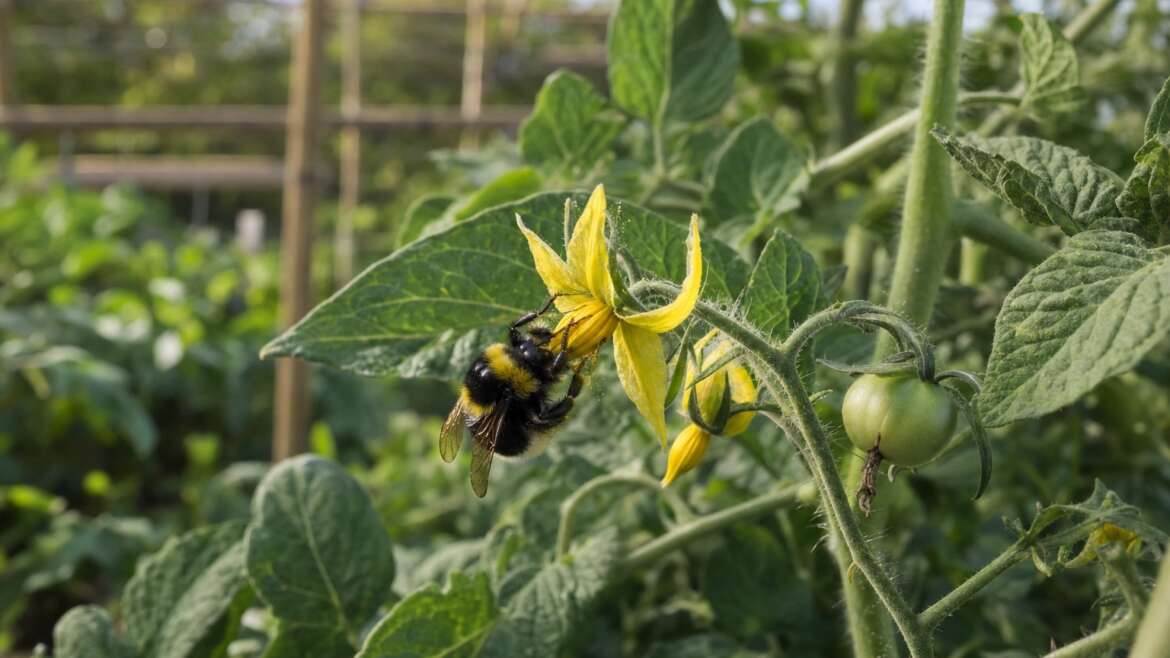
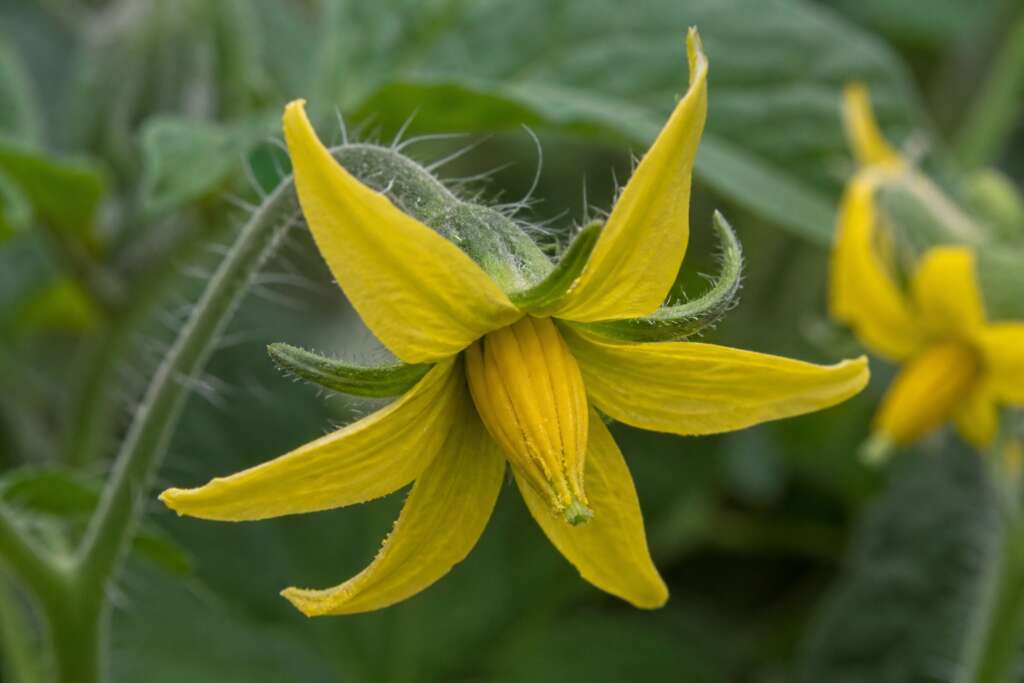
On a warm July morning, a tomato flower can look too small for the job ahead of it. Five yellow petals bend backward around a pointed center. The flower hangs from a hairy green stem, facing slightly down, while the plant puts most of its visual effort into leaves and swelling fruit. Then a bumblebee arrives, grips the yellow cone, and changes its sound.
The note is sharper than the bee’s flight hum. For a fraction of a second, the bee seems to become a tuning fork. Its wings stay folded while its body vibrates, the flower shakes, and a faint dust of pollen spills out. This is buzz pollination: a bee using its flight muscles as a pollen tool.2
Tomatoes can set fruit without a visiting bee. Their flowers are self-fertile, and an outdoor breeze may provide enough movement to transfer pollen. But self-fertile does not mean motionless. The pollen still has to leave the anthers and reach a receptive stigma. A bumblebee is exceptionally good at making that happen, and the reason is hidden in the architecture of the flower.
The yellow center is a pollen vault
At the center of a tomato flower, five anthers stand close together around the style, the slender structure that ends in the stigma. Fine interlocking hairs help hold the anthers in a tight cone. Instead of displaying loose pollen on exposed surfaces, the flower keeps most of it inside that yellow structure.4
You will often see tomato flowers described as having poricidal anthers, meaning anthers that release pollen through small pores like a pepper shaker. That is a useful shorthand, but cultivated tomatoes are a slightly untidy example. The tomato group has elongated inward-facing cracks rather than only neat terminal pores. Functionally, however, the result is similar: pollen access is restricted, and vibration is an efficient way to make the cone dispense it.1
The flower also carries both sexual roles in one small package. Pollen is produced in the anthers, while the stigma waits inside or near the tip of the cone, depending on the variety and growing conditions. This arrangement is very different from a squash blossom, where pollen usually has to travel from a separate male flower to a separate female one. A tomato can use its own pollen. What it often needs is a good shake.
A bumblebee turns its flight motor into a tool
Flight muscles normally deform a bee’s thorax to power the wings. During a floral buzz, a capable bee uncouples that muscular work from wing movement. It grabs or bites the anther cone, folds its wings, and contracts the indirect flight muscles rapidly. The vibration passes through the bee’s head and body into the flower by direct contact.2
The sound is the part we notice, but it is mostly a by-product. The flower is not being persuaded by a note in the air. It is being physically shaken. Research on buzz pollination shows that the airborne sound contributes very little to pollen extraction; the important energy travels through the bee-flower connection.2
That is why there is no useful “tomato tone” for a gardener to play from a phone. Pitch is only one property of a floral vibration. Strength, duration, direction, where the bee grips, and how the flower itself bends all help determine what the anthers experience. The bee is not singing a password. It is operating a tiny mechanical dispenser.
When pollen is released, some lands on the bee’s hairy body. She grooms much of it into the pollen baskets on her hind legs to carry home as food. Some grains also reach the stigma of the flower she is holding or travel with her to another blossom. Tomato flowers offer pollen but no nectar, so this dusty meal is the reward.13
Honeybees do not have the same trick
Bumblebees are the most familiar floral buzzers, but they are not alone. Many solitary bees, including some carpenter, sweat, and mining bees, can use vibrations to harvest concealed pollen. A major review estimates that roughly half of bee species are capable of this behavior.4
Honeybees are the famous exception. They do not buzz-pollinate flowers.3 A honeybee may still visit a tomato flower or pick up pollen that has already been loosened, and it would be too absolute to say that it can never contribute anything. But it cannot clamp onto the anther cone and vibrate it in the specialized way a bumblebee can. For tomatoes, one bee is not automatically interchangeable with another.
This also explains why tomato flowers can seem oddly unpopular when other plants are blooming nearby. They have no nectar to offer. A honeybee looking for sugar has little reason to stay. A pollen-collecting bumblebee, equipped to open the dispenser, sees a better bargain.
Self-pollinating does not mean self-shaking
A single tomato plant can make tomatoes. You do not need a second cultivar as a pollen partner, and pollen from one flower can fertilize ovules in that same flower. That is what gardeners usually mean when they call tomatoes self-pollinating or self-fertile.
But pollination is still a physical transfer. Outdoors, wind bends the flower and shakes the cone. A gardener tying stems, brushing past foliage, or moving a container may add more vibration. University of Minnesota Extension therefore places tomatoes among crops that can produce without bee help while noting that bumblebee buzz pollination is also effective.5
Bee visits can improve the result even when some fruit would have formed anyway. A review of 71 tomato experiments from 24 studies found that treatments with buzz-pollinating bees, and open pollination by mixed bee communities that included buzzers, significantly increased fruit weight compared with no-pollination controls. The response varied with cultivar, bee species, visitation, and method, so this is not a promise that every backyard flower visited by a bumblebee will make a larger tomato. It is good evidence that the quality of vibration can matter.4
Greenhouses made the partnership obvious
In an open garden, the wind does quiet pollination work without sending an invoice. In a large greenhouse, still air exposes what the plant was relying on. Flowers open, pollen waits, and thousands of vines cannot be shaken efficiently by accident.
Growers once walked rows with electric vibrators, tapped support systems, or used moving air to shake flower clusters. Commercially reared bumblebee colonies changed that work in the late 1980s. The bees visited flowers continuously and delivered vibration directly where it was needed, turning a curious natural behavior into an important part of protected tomato production.4
That history comes with a caution. A commercial bumblebee colony is not a casual accessory for a home greenhouse. Small structures can be over-pollinated, and moving managed bees outside their native ranges can create ecological and disease risks.48 For a few sheltered plants, a finger and a moment of attention are usually enough. For the wider garden, supporting local wild bees is a better goal than ordering a box of them.
How to help a tomato in still air
If your tomatoes grow outdoors where wind and insects reach them, routine hand pollination is usually unnecessary. Watch before adding another garden chore. Plants inside a greenhouse, sunroom, screened porch, or very sheltered balcony are more likely to benefit.
For a handful of plants, tap the flower-cluster stem gently when several blossoms are fully open and dry. Do not pinch the flower or strike the developing fruit. In protected-crop guidance, a small vibrating tool can be touched to the cluster stem for a few seconds; repeating every other day while new flowers open is a common schedule.78 A finger tap will not copy every detail of a bee’s vibration, but it can provide the movement a still plant is missing.
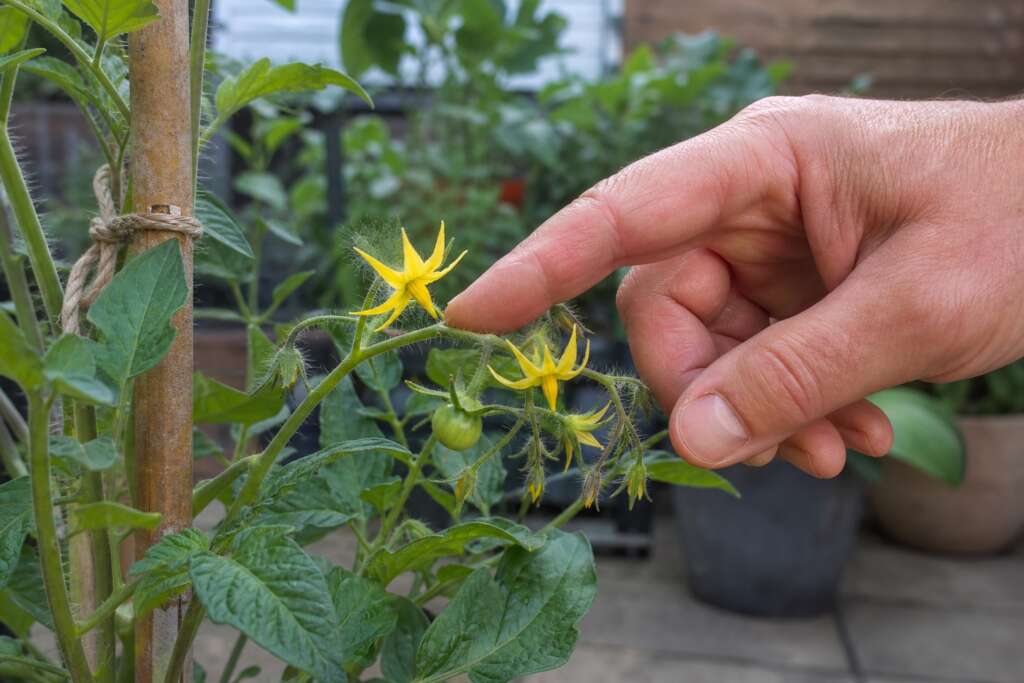
Late morning is often practical because dew has dried and humidity inside a structure has begun to fall, but avoid turning the task into a rigid clock ritual. The useful moment is when open flowers are dry, pollen can move, and the greenhouse is not dangerously hot. If you see a faint yellow dust when the cluster vibrates, conditions are favorable for pollen release.
You can also help the actual buzzers. Bumblebee colonies need flowers across the whole season, including nectar sources that tomato blossoms do not provide. A mixed planting, some undisturbed nesting cover, and careful pesticide decisions do more than a row of tomatoes alone.6
A buzz cannot rescue damaged pollen
When tomato blossoms yellow at the joint and fall, gardeners often blame a lack of pollination. Sometimes the flowers were not shaken enough. Often the problem began earlier.
Temperature, humidity, light, water stress, and nutrition all affect pollen production, stigma receptivity, fertilization, and fruit set. University of Alaska Fairbanks Extension recommends keeping greenhouse temperatures roughly between 60°F (16°C) at night and 85°F (29°C) during the day for pollination, while South Dakota State notes that nights below 55°F (13°C), days around 90°F (32°C) and above, or relative humidity above 80 percent can interfere with pollen development or release.78 These are useful warning zones, not universal on-off switches; cultivars and the duration of stress matter.
During sustained heat, a whole round of flowers may abort even if you tap every cluster. University of Minnesota Extension notes particular trouble when days remain above 85°F (29°C) and nights above 70°F (21°C).9 Very humid pollen can clump. Poor light can reduce pollen development. Excess nitrogen can produce luxurious leaves while flowering and fruit set suffer. A vibration can move viable pollen; it cannot make damaged pollen viable.
The sequence matters. First the flower must develop under workable conditions. Then pollen must be released and transferred. Then pollen tubes must grow and fertilize ovules. After that, steady growth brings its own problems, including why tomatoes split after rain. Tapping a flower solves only one small mechanical step in a much longer process.
The smallest green tomato is the receipt
A successfully fertilized tomato flower does not put on an immediate show. The petals fade. The yellow cone dries. Behind it, the ovary begins to swell while the green calyx remains like a little crown. In a close relative, that transition is eventually wrapped inside a tomatillo’s lantern. On a tomato, the fruit stays in plain sight.
If you want to see buzz pollination itself, watch an open tomato flower on a warm, calm morning. A bumblebee usually lands beneath or around the downward-facing cone. Listen for the pitch to jump. Look for folded wings, a tight grip, and perhaps a dusting of pollen on black hairs. The visit may last only a second or two, but it is one of the garden’s clearest demonstrations that pollination is not simply an insect touching a flower.
It is mechanics, anatomy, weather, and behavior meeting in something smaller than a thumbnail. The tomato has already placed male and female parts together. The bee supplies motion. A few weeks later, the evidence hangs heavy enough to need a stake.
References
- Solanaceae Source: Morphology of Solanum
- Vallejo-Marín, M. Buzz pollination: studying bee vibrations on flowers. New Phytologist 224, 1068–1074 (2019)
- USDA Forest Service and Pollinator Partnership: Bee Basics: An Introduction to Our Native Bees
- Cooley, H. & Vallejo-Marín, M. Buzz-Pollinated Crops: A Global Review and Meta-analysis of the Effects of Supplemental Bee Pollination in Tomato. Journal of Economic Entomology 114, 505–519 (2021)
- University of Minnesota Extension: Fruits and vegetables that require pollination
- University of Missouri Extension: Native Insect Pollinators and Their Habitats
- University of Alaska Fairbanks Cooperative Extension: Pollination & Fruit Development in Tomatoes
- South Dakota State University Extension: Pollinating Tomatoes in High Tunnels
- University of Minnesota Extension: How vegetables respond to heat