
Sci-fi garden art can go wrong in a hurry. One polished sphere can make a border feel deliberate. Ten shiny objects can make it feel like storage. The trick is not to decorate the garden until it becomes strange. The trick is to use structure, material, shadow, and planting so ordinary botany feels newly seen.
Good landscape design already has the tools a speculative garden needs. University of Florida IFAS describes line, form, color, texture, and visual weight as core design elements, with proportion, order, repetition, and unity helping those features hold together.1 A sci-fi mood is not a separate rulebook. It is a sharper edit of the same principles.
Start with the site, not the object
The easiest mistake is to buy the weirdest thing first. A ring sculpture, mirrored panel, black obelisk, or rusted steel fin can be beautiful, but none of it rescues a plant in the wrong soil or exposure. UF IFAS’s right plant, right place guidance emphasizes matching plants to real site conditions such as soil, moisture, light, function, and aesthetics.2 That matters even more in a themed garden, where the mood can tempt you to ignore the horticulture.
Begin with the stubborn facts: sun hours, winter low temperatures, drainage, wind, irrigation, foot traffic, and what the garden must do for you. Then decide where a visitor’s eye should travel. A sci-fi garden can be as simple as a narrow path that bends toward one circular opening, or a dry gravel court where grasses catch light against a dark stone plane. The site should still make sense in July heat, winter rain, and the dull week after flowers have finished.
Use art as a signal, not a substitute
A strong object should have a job. It can mark a turn, frame a view, hold a climber, catch late sun, give winter structure, or make a small path feel intentional. If it only says “look at me,” it will age badly once the novelty wears off.
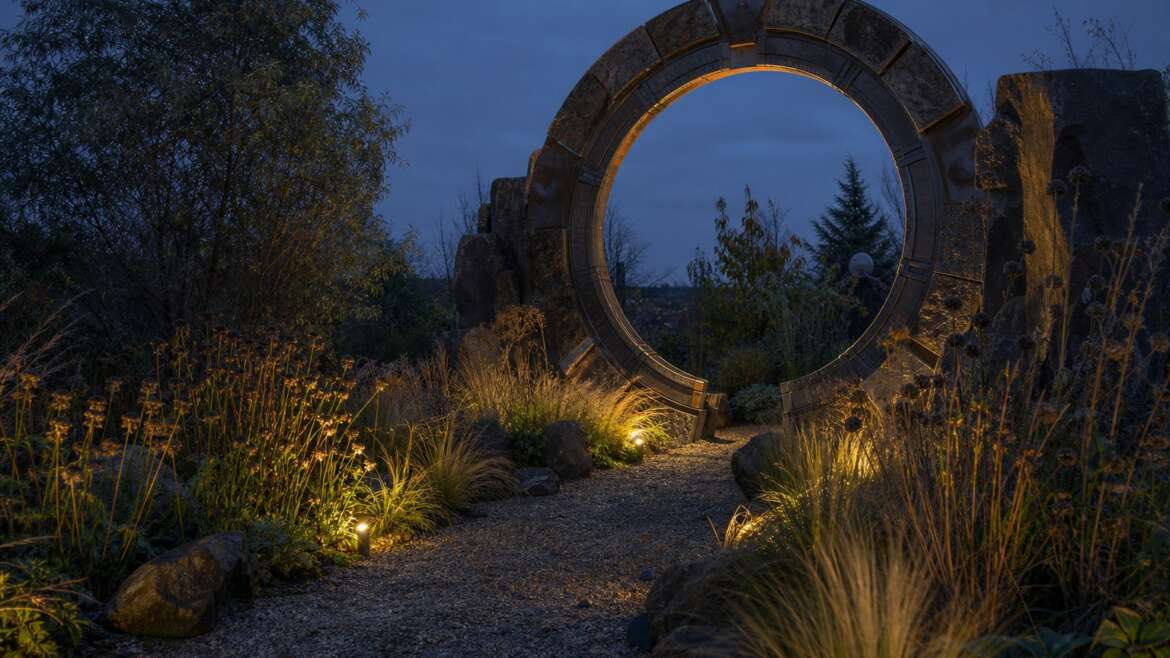
Think in signals rather than props. A steel hoop at the end of a path suggests a portal without becoming a theme-park gate. A rectangular slab with a round aperture can feel observatory-like while still acting as a screen. Three low posts through a grass bed can read as landing markers, but they also create rhythm and depth. The most convincing futuristic gardens usually stop one object before they become obvious.
Choose materials that can stay outside
Glossy plastic is rarely the future for long. Weathering steel, dark basalt, granite setts, matte ceramic, charred timber, gravel, and pale concrete tend to look more convincing because they age with the garden instead of fighting it. They also give leaves, seed heads, bark, and shadows something calm to play against.
Be honest about weathering. Weathering steel can stain adjacent paving while its patina develops. Concrete needs good drainage and a scale that does not overwhelm the planting. Timber needs detailing that keeps it from sitting wet. Painted props should be exterior-rated and stable; anything that flakes into the soil or becomes brittle after one winter is not garden art. It is future cleanup.
Plant for strange silhouettes
The plants are where the magic usually happens. Many species already look slightly extraterrestrial when they are well placed. If you want a deeper plant list, the same principle runs through our guide to alien-looking plants that still belong in real soil: oddness is more convincing when the plant is healthy and repeated with intention. Alliums hover as spheres, rattlesnake master and sea holly read like metallic umbels, yucca and agave work where climate allows, sedum seed heads carry winter structure, ferns unfurl like small mechanisms, and ornamental grasses turn into fine signal lines when backlit.
Use those forms in drifts, not as a collector’s shelf. A mass of one grass can make a rusted ring feel intentional; seven unrelated oddities can make the same ring look stranded. If you use aggressive architectural plants such as horsetail, keep them contained and know your local invasive guidance. The point is not to assemble the strangest species list. It is to give familiar plants enough space, contrast, and repetition that their geometry becomes visible.
Light without glare
A sci-fi mood often wants night lighting, but the garden does not need to glow like a parking lot. DarkSky International and the Illuminating Engineering Society summarize responsible outdoor lighting as useful, targeted, low level, controlled, and warm-colored.3 That is a good design brief for a garden: light what must be used, aim it downward, keep it dim, put it on a timer or motion control, and avoid cool blue-white glare.
Ecology is part of the design, not an afterthought. Artificial light at night can disrupt wildlife and plants, and insects drawn to lights can alter food webs and pollination relationships.4 The U.S. Fish & Wildlife Service also recommends minimizing unnecessary night lighting, avoiding upward skyglow, keeping fixtures low, and choosing warmer LEDs below 2700 K where lights cannot be turned off.5
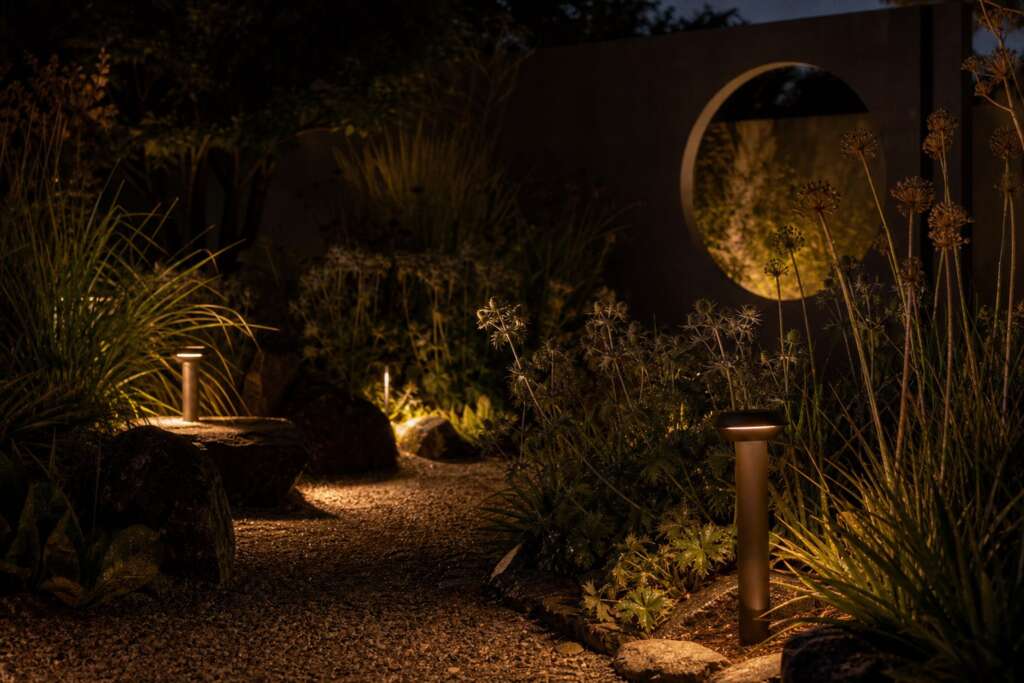
For a garden, this usually means low shielded bollards, step lights tucked under edges, or small downlights aimed at gravel, bark, or a single trunk. Leave some areas dark. Darkness gives night gardens depth, makes modest pools of light feel intentional, and keeps the plants from flattening into stage scenery. That restraint is close to the logic of a moon garden: pale flowers, silver leaves, scent, and movement do more work after dusk than another bright fixture.
Colored light is best treated like spice. A temporary blue wash on silver grass can be fun for an evening, but permanent saturated color often makes living plants look artificial. Warm white or amber light usually preserves foliage, bark, stone, and soil texture better than purple or icy blue.
Mind scale, paths, and maintenance
Speculative forms need ordinary construction discipline. A tall panel needs a proper footing and wind resistance. A ring or aperture should not pinch a path below comfortable walking width. Reflective surfaces should not bounce harsh sun into seating areas or neighboring windows. Low art near a path should be visible enough that nobody trips over it in winter dusk.
Maintenance is also aesthetic. A sculpture that looks excellent only when the bed is weed-free may be too demanding for a real garden. Gravel migrates. Grasses collapse. Leaves collect in apertures. Lights drift out of aim. Choose details that can tolerate a little mess, because living gardens always edit the design back.
Let the plants win
The goal is not to make visitors say, “That is a spaceship.” It is to make them pause over a seed head, a shadow, a blade of grass, or a cactus rib as if the familiar world had tilted a little. The art is there to frame that attention. When it starts demanding more attention than the garden, remove one object. The future, in a real garden, needs editing.
References
- University of Florida IFAS: Basic Principles of Landscape Design
- University of Florida IFAS: Right Plant, Right Place
- DarkSky International: Five Principles for Responsible Outdoor Lighting
- DarkSky International: Light pollution harms wildlife and ecosystems
- U.S. Fish & Wildlife Service: Threats to Birds – Nighttime Lighting