

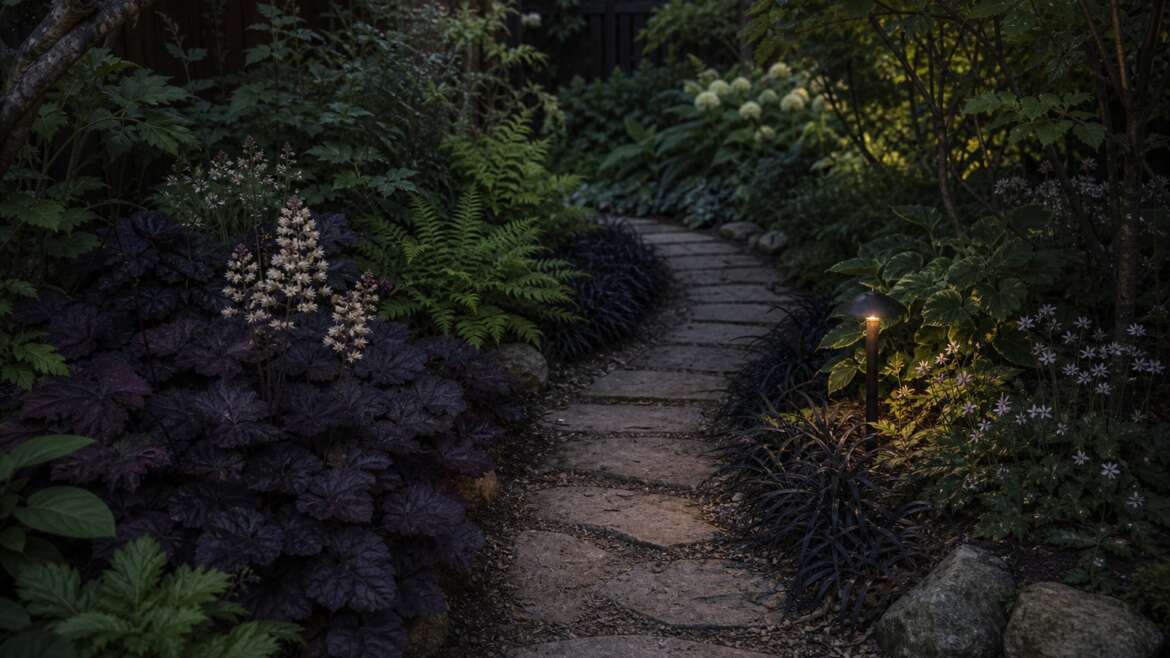
A shadow garden should invite a person forward, not trap them in a theme. Mystery works when the eye cannot see everything at once: a bending path, a pale flower beyond dark leaves, a bench partly hidden by fern, a sound of water before the basin appears. The mistake is to buy only dark plants and expect atmosphere to arrive.
Dark foliage needs contrast. The RHS highlights dark-leaved plants as tools for depth and year-round drama, especially when paired with lighter blooms or foliage.1 In a shadow garden, that contrast has to be designed deliberately because shade already lowers visual detail.
Shape the walk first
Before choosing plants, decide how the garden is entered, crossed, and left. A shadow garden with an awkward path feels unsettling in the wrong way. Make the walking surface firm enough for wet weather, wide enough for real use, and clear enough that a visitor can read the route. Curves are welcome; confusion is not.
Use a bend, gate, shrub, or tree trunk to delay the view. Place a pale pot, fern, stone, or white flower where the eye needs a destination. If there is a bench, let it feel discovered but not hidden. The best mystery gives orientation in fragments.
Use darkness as contrast, not mass
A whole bed of dark foliage can vanish in shade. Mix leaf sizes and finishes: glossy hellebores, matte heucheras, fern fronds, strappy black mondo grass, silver lamb’s ear in brighter edges, pale sedges, and white or green-flowered perennials. Dark plants should create pockets of depth, not a visual hole.
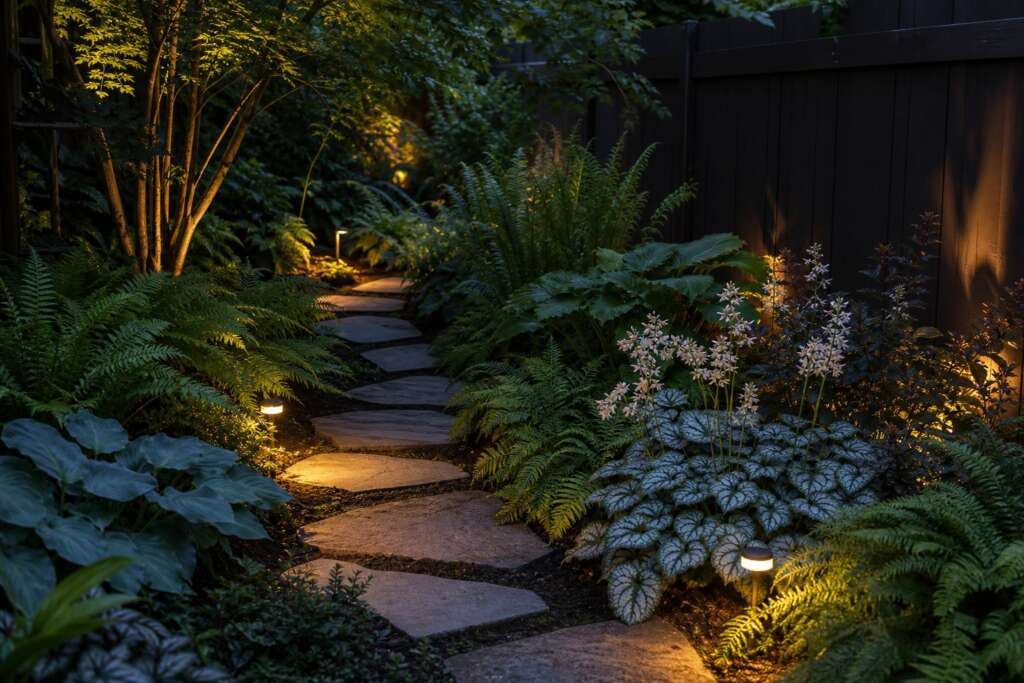
Black mondo grass can be useful at the front of a border or along a path, but NC State Extension notes that it prefers fertile, moist, slightly acidic, well-drained soil in part sun to part shade and spreads slowly.3 That slow habit is good for control, but it also means you should not expect instant carpet.
Light the path, not the sky
Low lighting can make a shadow garden usable, but too much lighting turns it into a display case. RHS guidance on garden lighting and wildlife recommends retaining dark areas, asking whether lighting is truly needed, aiming lights downward, and using timers or motion sensors for necessary lights.2 That advice fits the design goal as well as the ecological one.
Place light only where it solves a problem: a step, a turn, a threshold, a water edge. Warm, shielded, low fixtures usually work better than bright uplights. Let pale flowers, variegated leaves, bark, gravel, and water catch small amounts of light. A shadow garden should still have shadows.
Choose plants for the actual shade
Shade is not one condition. Dry shade under maples, damp shade near a wall, bright open shade, and deep evergreen shade are different gardens. Match plants to the specific version you have. Ferns, epimediums, carex, hostas, hellebores, Solomon’s seal, woodland phlox, foamflower, and native sedges can all be useful in the right region and soil. Dark heucheras may color better with morning light than in deep shade.
If roots from trees dominate the soil, plant small and water through establishment. Do not pile deep soil over tree roots to force a lush woodland scene. Work with leaf litter, mulch, and plants that tolerate competition. A believable shadow garden often grows from restraint.
Add mystery through sequence
Sequence is more durable than novelty. A narrow entrance opening into a wider pocket, a pale bloom glimpsed around a curve, a textured wall behind fern shadows, or a quiet seat at the end of a path will keep working after the first season. Objects can help, but they should weather well and earn their place.
Avoid making every feature announce itself. One water bowl, one sculptural branch, one stone basin, or one lantern may be enough. The garden should feel as if it has depth, not as if it has been filled with props.
Make it work in daylight
The most common failure of a shadow garden is that it only looks good in a photograph taken at dusk. In ordinary daylight, the path still needs to drain, the bench still needs to be comfortable, and the plants still need healthy foliage. If the garden is dull at noon, add leaf texture and pale structure. If it is unsafe after rain, fix the path before adding atmosphere.
Mystery is strongest when the practical details are handled. The visitor relaxes because the garden is readable, and then the shadows can do their quieter work.