
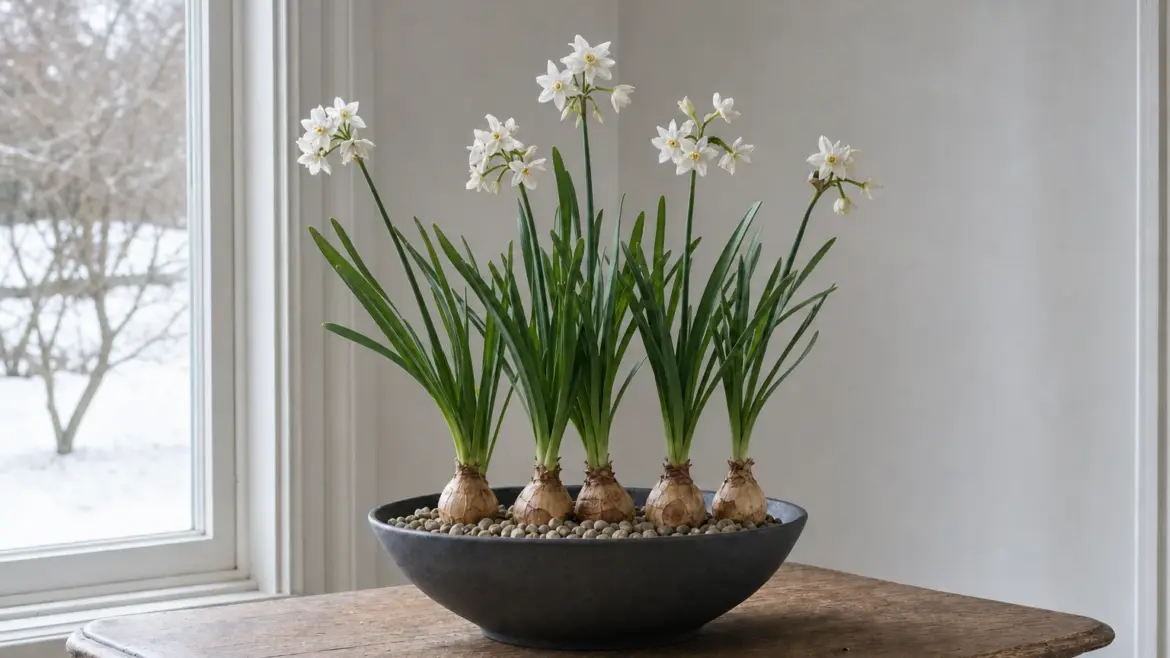
On Christmas morning, a bowl of paperwhites can look as if someone has smuggled April onto the windowsill. Outside, the garden may be resting under frost, mulch, or a thin layer of snow. Inside, bare tan bulbs sit in white pebbles and throw up green blades, then clusters of starry flowers so bright they almost make the room feel newly washed.
The trick is common enough to be sold as holiday decor, but it is stranger than decor. A paperwhite bowl is a living calendar compressed into a few weeks. It asks almost nothing that looks like ordinary gardening: no bed preparation, no compost forked into soil, no season of waiting. Give the bulbs moisture, support, and a little cool light, and they spend the reserves they have been carrying all along.
Paperwhites are narcissus, close kin to daffodils and jonquils. NC State’s Extension Gardener Plant Toolbox lists paper white and paperwhites among the common names used for Narcissus, a genus of bulbs in the amaryllis family.1 The tender bulbs sold for indoor forcing are commonly labeled Narcissus papyraceus or placed in the N. tazetta group; horticultural references do not always use the same treatment.4 They are not houseplants in the long, leafy sense. They are spring bulbs persuaded to spend their stored reserves indoors.
A flower already packed for travel
A bulb is not a seed, and it is not a dead object waiting to be revived. It is a compact plant with a pantry. A true bulb contains a basal plate from which roots grow, fleshy storage scales, a protective tunic, and developing leaf and flower buds.2 Those reserves can support the first indoor display, which is why Wisconsin Horticulture says fertilizer is unnecessary when forcing bulbs.3
That explains the bowl of stones. The pebbles are not feeding the plant. They are scaffolding. They hold the bulbs upright, give the new roots something to grip, and keep the display from becoming a small swamp. The force behind the first bloom is already in the bulb. Water supports renewed growth, roots emerge from the basal plate and anchor, and the flower stalk rises from structures formed before the bowl appeared on a December table.
This is also why the best paperwhite bowls begin with good bulbs. Choose top-quality bulbs that feel firm, with no soft spots, obvious damage, mold, or decayed areas. A bulb that yields under your thumb is a poor candidate for a clean winter display.3
Why paperwhites skip the cold treatment
Many spring bulbs need winter before they will bloom well indoors. Tulips, hyacinths, crocus, and many hardy daffodils are usually potted, chilled for weeks, then moved into light and warmth so the plant experiences a shortened version of autumn, winter, and spring. Paperwhites are easier because they do not ask for that cold chapter. Wisconsin Horticulture notes that paperwhite narcissus are among the easiest bulbs to force, bloom in about 3 to 5 weeks, and do not require the longer conditioning period needed by many other spring-flowering bulbs.3
Clemson Cooperative Extension gives the same practical distinction: paperwhite narcissus can be forced without pre-cooling, while many hardy bulbs need cool temperatures before leaves and flowers develop properly.4 That is what makes paperwhites feel almost miraculous in December. They are not reading the calendar on the wall. Their growth cycle simply allows them to respond when a gardener adds water and brings them into a livable room.
If a bowl is blooming on Christmas Day, it was started earlier. If you start one on Christmas Day, the gift is different: a January promise. That delay is part of the charm. In a season full of finished things, paperwhites are one of the few decorations that keep changing after they are placed.
Setting the bowl without drowning the bulbs
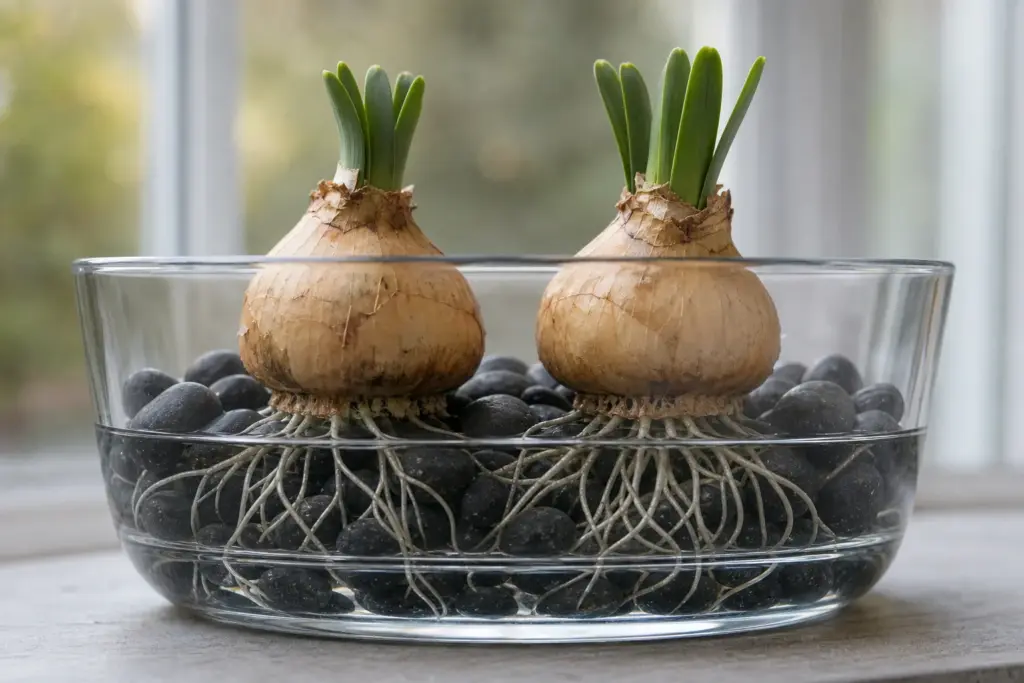
A watertight bowl, clean pebbles, and several bulbs are enough. Set the bulbs pointed end up, close together but not touching. Add pebbles around them so the lower quarter of each bulb is held steady. Then add water carefully. The water should stop just below the flat base of each bulb. New roots can grow down into it, but the bulb body should not sit in water.
This is the small detail that separates a clean bowl from a rotting one. Wisconsin Horticulture recommends keeping the water just below the bottom of paperwhite bulbs grown in pebbles and warns that bulbs will rot if water touches them.3 Clemson’s paperwhite instructions are similar: maintain the water level carefully because too much water causes bulb rot.4
One reliable way to start the bowl is to give it a cool, dark rooting period. Mississippi State University Extension suggests about two weeks in those conditions, followed by a move to a sunny area, with bloom expected around six weeks after planting.5 Timing varies with temperature and the bulbs themselves: warmer conditions can hurry the display, while a cooler room usually slows it and helps the flowers last longer.3
Light, cool air, and the leaning problem
The classic paperwhite problem is not failure to bloom. It is enthusiasm. The stems rise fast and can become tall and top-heavy, while growth toward a window pulls the display to one side. Clemson notes that paperwhites may need support as they grow.4
The low-tech answer is usually enough. Keep the bulbs cool and in low light while they root, then introduce brighter light gradually once the shoots appear. Rotate the bowl every day or two so the stems do not all lean in one direction. Keep it away from radiators, fireplaces, and the warmest shelf in the room. When buds begin to open, a cooler spot out of direct sun will slow the show; forced flowers also last longer when moved to a cool room at night.4
There is also a stranger horticultural trick, and this one has research behind it. Cornell’s Flower Bulb Research Program tested the old advice that alcohol could keep paperwhites shorter. Start the bulbs in plain water. Once roots have formed and the green shoots are 1 to 2 inches tall, replace the water with a solution whose final alcohol concentration is 4 to 6 percent. For a 5 percent solution made from 40 percent spirits, that means one part spirits to seven parts water. Cornell’s treated plants finished roughly a third shorter without smaller or shorter-lived flowers.6
The treatment is optional, and it deserves precision. Cornell warns that concentrations much above the recommended range cause growth problems, while beer and wine are poor choices because their sugars damage plants.6 If measuring is awkward, or children or pets can reach the bowl, use plain water instead. Cool bright conditions and a simple twig support are less fussy. A few red-twig dogwood stems, willow stems, or slender prunings can make a natural cage before the plants begin to fall sideways.
The scent in the room
Paperwhites are famous for fragrance, and fragrance is not always polite. Some people love the scent because it makes a winter room feel damp, green, and alive. Others find it too sweet or too musky, especially near a dining table. This is not a flaw so much as a reminder that a strongly scented flower may need a little distance from the place where people eat or sleep.
If you are sensitive to the smell, place the bowl in an entry, a cool hallway, or a bright bathroom rather than a small warm room. If you love it, plant several bulbs together. Mississippi State recommends grouping multiple bulbs for a fuller display, and that is usually the difference between a lonely stem and a proper winter clump.5
What to do after the flowers fade
A forced paperwhite is generous, but it is not endlessly generous. Outdoor daffodils rebuild after flowering by keeping their foliage in the sun for weeks, the reason spring bulb leaves have to linger. A paperwhite forced in stones and water indoors does not get the same recovery. Clemson recommends discarding paperwhites after forcing, and Wisconsin notes that bulbs grown without potting mix are difficult to transplant and often fail to bloom again.34
Gardeners in very mild climates can check the bulb package and local guidance if they want to experiment outdoors, because hardiness varies among tazetta-type bulbs. Paperwhites are not reliably hardy in cold-winter gardens.7 Composting or discarding a spent indoor bulb is therefore a practical choice, not a gardening failure.
There is one more practical caution: narcissus bulbs are not edible bulbs. They are not onions, not garlic, and not a clever garnish. NC State describes Narcissus as having medium-severity poison characteristics, identifies the bulbs as the most poisonous part, and notes risks to cats, dogs, and horses; ingestion can cause nausea, vomiting, and diarrhea, while handling can irritate some people’s skin.1 Keep the bowl and spent bulbs away from pets and curious children, and wear gloves if bulb handling irritates your skin.
A small winter lesson
Paperwhites suit Christmas not because they are red or glittering, but because they make stored work visible. A bulb is last season made dense. It is sunlight, leaf growth, and time folded into a quiet body, then carried through darkness until water arrives.
That makes the bowl more interesting than a holiday centerpiece. The stones do not feed it, and the room has not made spring arrive. The gardener simply gives a prepared bulb the conditions to resume growth, and for a few white weeks in the middle of winter, the windowsill becomes a borrowed garden.
References
- NC State Extension Gardener Plant Toolbox: Narcissus
- Illinois Extension: Bulbs
- Wisconsin Horticulture: Forcing bulbs
- Clemson Cooperative Extension HGIC: Forcing bulbs indoors
- Mississippi State University Extension: How to grow paperwhite narcissus
- Cornell Flower Bulb Research Program: Pickling your paperwhites
- Virginia Cooperative Extension: Fooling Mother Nature—forcing flower bulbs for indoor bloom