
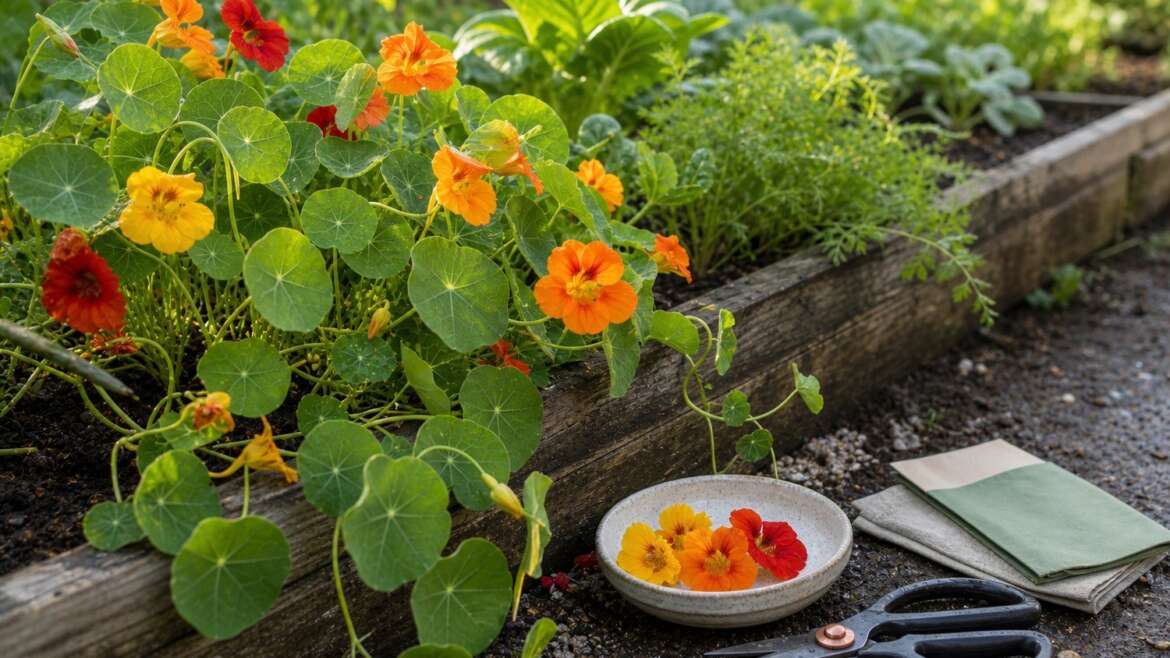
A nasturtium does not behave like a polite border annual. It sprawls, loops, leans over timber, climbs if you help it, and drops bright flowers into the vegetable garden as if the lettuces and beans were waiting for punctuation. That informality is part of its usefulness. The plant softens hard edges, feeds the eye, feeds the table, and quietly makes a vegetable bed feel more alive.
Nasturtiums are often sold as edible flowers, but that phrase can make them sound like garnish and little else. North Carolina Extension describes the leaves, buds, flowers, and green fruits of Tropaeolum majus as edible, with a spicy, peppery taste; flowers add color to salads, while immature fruits are commonly used like capers.1 In practice, nasturtiums are usually grown as warm-season annuals, though they can persist longer in mild, frost-free climates.2 A plant that can be border, bloom, herb, salad green, container spiller, and forage for visiting pollinators deserves more respect than a decorative sprinkle.
The trick is to place it where its looseness becomes structure. Nasturtiums are not tidy by nature. They are useful because they are generous.
Why the edge is the best place
The best place for a nasturtium is often not the middle of a bed but the seam between bed and path, pot and air, wall and soil. Wisconsin Horticulture describes compact forms as useful for edging, while trailing types can spill from hanging baskets, window boxes, walls, or act as groundcover.2 That habit makes them especially valuable in small gardens, where every edge is an opportunity.
Let a mounding variety mark the front of a herb bed. Let a trailing one slide down the outside of a raised bed, where it will not smother young carrots. Train a longer type loosely up a low bamboo support near beans or tomatoes. In containers, allow nasturtium to spill beneath an upright edible companion only when their mature size and needs for moisture and fertility suit the same pot. Check the variety’s mature spread before planting so a vigorous trailer does not crowd a path or a slower neighboring crop.
This is garden design at a practical scale. The round leaves cover bare soil, the flowers pull warm color through a planting, and the soft stems hide the awkward geometry of boxes and pots. A vegetable bed can look productive and still have rhythm.
Grow them a little hungry
Nasturtiums are one of those plants that can become less charming when treated too richly. The Royal Horticultural Society recommends poor, well-drained soil in full sun, noting that rich soil encourages foliage at the expense of flowers.3 North Carolina Extension gives similar guidance, warning that fertilization can lead to more leaves and fewer blooms.1 Here, poor means lean and free-draining, not compacted, waterlogged, or neglected.
That does not mean they want abuse. They still need water while establishing, and container plants dry quickly in warm or windy weather. But they do not need the richest compost in the garden or a regular feed. If your nasturtiums are lush, dark, and flowerless, the soil may simply be too generous. Move the next sowing to a leaner place, or stop feeding the container and let the plant remember why it makes flowers.
Sow after the danger of frost has passed, or start them in plantable pots if your season is short. Their large seeds are easy to handle, and Wisconsin Horticulture notes that soaking them for a few hours or overnight can improve germination.2 They resent root disturbance, so if you start them indoors, transplant gently and early.
Eating the leaves, flowers, and pods
The flavor is easiest to understand if you think of watercress or arugula: green, peppery, and slightly sharp. Wisconsin Horticulture describes both leaves and flowers as edible and notes that the flowers are less intensely flavored than the leaves.2 Young leaves can be torn into salads, tucked into sandwiches, or chopped into soft cheese. Flowers can be scattered over potatoes, eggs, pasta, cold soups, and anything that benefits from color and bite.
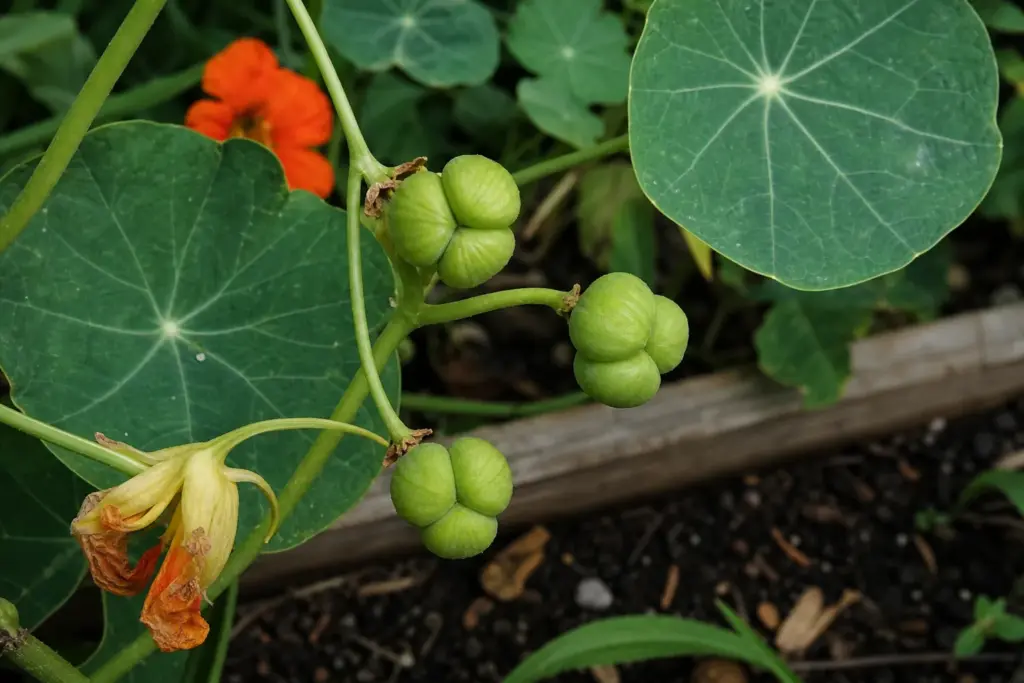
The young green fruits, commonly called seed pods, are a different pleasure. Botanically, each is a three-segmented fruit with one seed in each section.2 Picked while green and tender, they can be brined or pickled into a caper-like condiment. True capers are unopened flower buds of Capparis spinosa, so this is an analogy rather than the same plant part.4
The usual edible-flower cautions matter here. Colorado State University Extension advises confirming a flower’s identity, avoiding flowers treated with pesticides not labeled for edible crops, and introducing edible flowers gradually because some people experience allergic reactions or digestive upset.5 Grow your own from seed when you can, and see our guide to serving edible flowers safely for a fuller checklist. Do not eat flowers from roadsides, florist buckets, nurseries, or garden centers unless you know they were produced for food and treated accordingly. The RHS also flags T. majus as a potential skin allergen, so wear gloves if handling the plant irritates your skin.3
What they can do for pests
Nasturtiums have a reputation as companion plants, and this is where it is worth being precise. They are not a force field. They will not make aphids, cabbageworms, or whiteflies vanish from a garden. North Carolina Extension lists aphids, mealybugs, and whiteflies among possible problems on Tropaeolum majus.1 Wisconsin Horticulture also notes aphids and imported cabbageworm caterpillars as common pests.2
Aphids on a nasturtium do not prove that nearby vegetables are protected. Inspect both the nasturtium and its neighbors, then pinch off badly infested growth, rinse small colonies with water, or use another crop-appropriate control if numbers keep rising. The Royal Horticultural Society describes companion planting as a set of possible interactions whose results depend on context: flowers including nasturtiums may be grown near vegetables to attract beneficial insects, while mixed planting can sometimes reduce the chance of a pest finding every suitable host.6
Plant nasturtiums for diversity, observation, nectar, cover, and beauty. Watch what happens in your own garden, and treat any pest effect as an observation to test rather than a service the plant is certain to provide. Do not let the folklore outrun your eyes.
A few varieties, many habits
The word nasturtium covers plants that can behave quite differently. Some are compact and mound neatly around a pot. Some trail several feet. Some are sold as climbing types, though Wisconsin Horticulture points out that trailing nasturtiums lack tendrils and do not climb well without help.2 That small detail matters. A nasturtium can be guided, tied, or leaned through a support, but it is not a pea.
For containers and crisp edges, choose bush or dwarf types. For walls, window boxes, and raised beds, choose trailing forms. Variegated varieties add interest even before bloom, especially in mixed edible containers. Deep red varieties look handsome near purple basil and bronze fennel. Yellow and orange flowers wake up blue-green cabbages and silver-leaved herbs.
If you want the plant for the kitchen, grow more than one. Harvesting flowers encourages more bloom, but a single plant can look sparse if every bright blossom becomes lunch. A small group lets you eat and still leave enough color for the garden.
Keeping them generous
Nasturtiums are not demanding, but they respond to attention. Pick flowers often. Remove yellowing leaves. Trim back stems that begin to bury neighboring seedlings. Water containers before they wilt hard. In hot climates, afternoon shade can help the plant carry on through summer, though flowering is usually strongest with good light.1
Let a few fruits mature if you want volunteers or seed to save, but remember that self-sowing can become messy in mild climates. Wisconsin Horticulture notes that nasturtiums may become invasive where winters are mild.2 Check local invasive-plant guidance, and prevent seed set where the plant escapes cultivation. In colder gardens, the occasional volunteer is often welcome. In warmer areas, treat seed drop as a choice rather than an accident.
Useful nasturtium supplies
- Seed Needs Jewel Mix nasturtium seeds: a compact Jewel-type mix for beds, containers, and border edges. If you intend to eat the crop, confirm the current packet is untreated or marketed for edible growing, and use only crop products labeled for edible plants.
- Fiskars Softouch micro-tip pruning snips: useful for harvesting flowers, trimming soft stems, and removing aphid-covered leaves without tearing the plant apart. Clean the blades before moving from infested or diseased growth to healthy plants.
- Avalution 16-inch bamboo trellises: a small 10-pack of ladder- and fan-shaped supports for guiding young container nasturtiums. Trailing forms lack tendrils, so attach stems loosely and do not expect a short support to carry a heavy mature plant.
Final thoughts
Nasturtiums are easy to underestimate because they are easy to grow. Their seeds are large, their flowers are cheerful, and their habit is relaxed. But that ease hides a clever garden role. They turn unused edges into edible color. They make containers feel abundant. They invite closer looking at leaves, flowers, pests, and pollinators.
Grow them where they can spill. Feed them less than you think. Pick them often. Let a few flowers remain for insects and for the simple pleasure of seeing orange, yellow, and red stitched through the green work of the vegetable bed. Nasturtium earns its place as both border and ingredient.
References
- North Carolina Extension Gardener Plant Toolbox: Tropaeolum majus
- Wisconsin Horticulture: Nasturtium, Tropaeolum species
- Royal Horticultural Society: Tropaeolum majus
- Wisconsin Horticulture: Capers, Capparis spinosa
- Colorado State University Extension: Edible Flowers
- Royal Horticultural Society: Three ways to use companion planting