
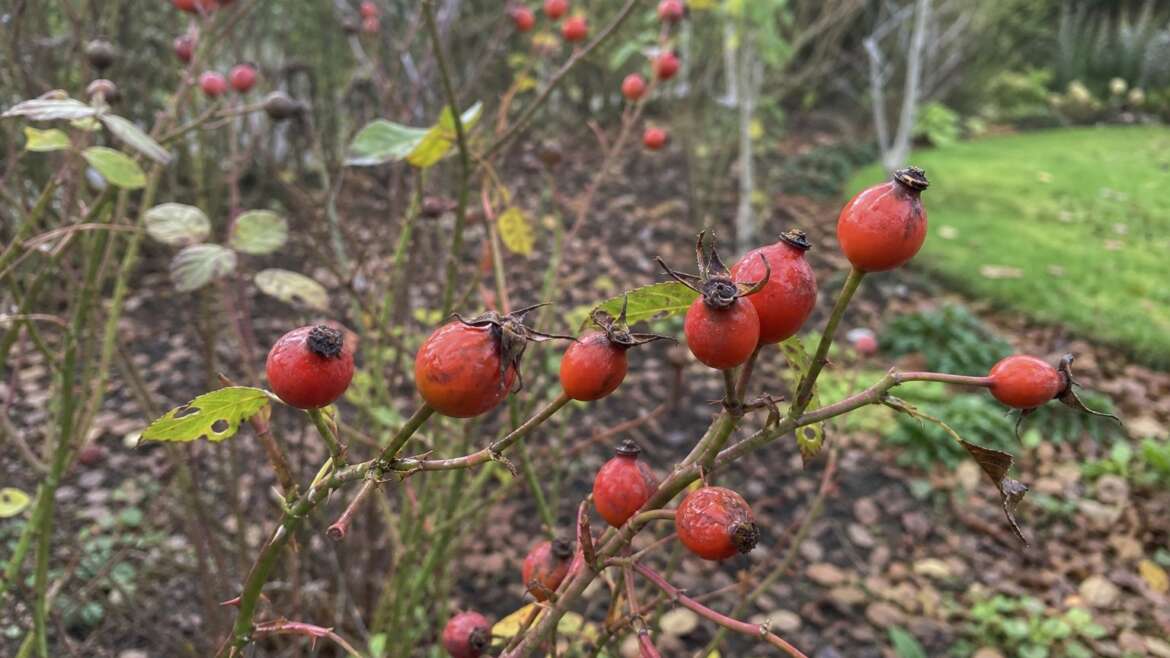
By late November, roses have mostly lost their usual language. The petals are gone. The leaves are tired or already fallen. Canes that looked romantic in June have become thorny lines against a quieter garden. Then, where a flower once opened, a small red or orange fruit remains.
Rose hips are easy to miss if you think of roses only as flowers. They sit after the show, round or oval, glossy or wrinkled, sometimes bright as sealing wax against bare stems. In a season when many borders are settling into brown, the hips can look almost too cheerful. They are not decoration added after the plant has finished. They are what the flower was working toward.
A rose hip is a record of a flower that was allowed to complete its sentence. Pollination happened. Petals fell. The floral cup remained and matured around the developing fruits. The gardener who leaves a few hips is not neglecting the rose. They are letting the plant reveal the fruit half of its life.
The flower’s hidden ending
Botanically, a rose hip is not a simple fruit in the everyday plum-or-cherry sense. Its fleshy wall is an enlarged floral cup called the hypanthium. Inside it are many achenes: the hard, one-seeded structures that are the true fruits. A peer-reviewed study of rose-hip anatomy describes this exact arrangement,1 and North Carolina Extension classifies the hip as an accessory fruit filled with achenes.2
That detail changes how the spent flower looks. The hip is not a berry pasted onto the stem after bloom. It develops from tissue that was already part of the flower. The dark tuft at the end is the remains of the blossom end. Sepals that once backed the petals may dry into a star. What looked like romance in summer becomes architecture in autumn.
This is also why deadheading changes the story. When you remove a spent rose flower, you usually remove the place where the hip would have developed. That can be useful during the main blooming season, especially on repeat-flowering roses, because it can encourage more flowers. Brooklyn Botanic Garden notes that when a pollinated flower is spared from deadheading, the hip swells as the achenes mature.3 Late in the year, the same tidy habit can erase winter color before it has a chance to form.
Why some roses make better hips
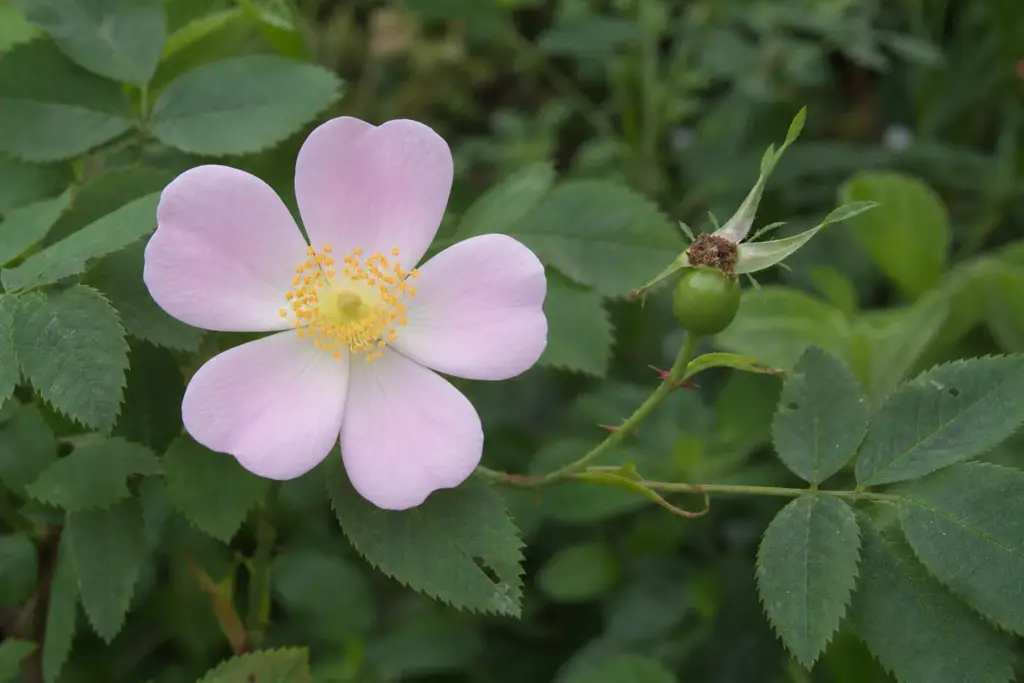
Many roses can set hips when pollination succeeds and the spent flower is left in place, but the amount and appearance vary by species and cultivar. Flower form matters too. The Royal Horticultural Society notes that open-flowered roses attract pollinators and describes a semi-double rose that exposes its stamens as it opens.4 Visible, accessible reproductive parts are a useful clue when choosing a rose for insects as well as hips, though the surest test is to observe how a particular cultivar fruits where you grow it.
Species roses and older shrub roses often make the clearest display. Rugosa roses are famous for large, tomato-like hips, but Rosa rugosa is native to eastern Asia and is invasive in parts of North America, especially in some coastal regions; check its local status before planting it.5 Where it belongs to the local flora, Carolina rose can be a better fit. North Carolina Extension describes Rosa carolina as a plant whose hips are eaten by songbirds, quail, wild turkey, and small mammals, while its flowers are visited by bees, syrphid flies, and beetles.6
That is a useful reminder: the hip begins with the flower, and the flower belongs to more than the gardener. A rose with open, accessible flowers can offer pollen to visiting insects. If some of those flowers are left alone, the same plant can carry fruit into the quieter months. The value is not only beauty. It is continuity.
Deadheading as a seasonal decision
Deadheading roses is often taught as a rule, but it works better as a seasonal decision. In June, removing spent flowers can keep a repeat-blooming rose tidy and productive. Near the end of the growing season, the question changes. The plant is no longer being asked to hurry into another flush of bloom, and the gardener can decide whether the hips are worth keeping.
For repeat-flowering roses in Iowa, Iowa State University Extension recommends stopping deadheading in late August or September so hips can form; it explains that developing hips slow vegetative growth and help the plant prepare for winter.7 The calendar date shifts with climate and cultivar. The practical aim is simply to leave selected late flowers in place long enough to fruit. You do not have to keep every spent bloom. A few hips on strong canes may be enough for a second, quieter display.
There is also a practical reason not to fuss too much late in the year. In its cold-winter guidance, Iowa State advises against fall pruning because pruning stimulates growth that may not harden before winter; it recommends early spring pruning for Iowa.8 That timing is regional, not universal. Use local extension guidance to find the right pruning window where you garden rather than treating every mild autumn afternoon as an invitation to reach for the secateurs.
Winter color that feeds something
Rose hips are one reason a winter garden can feel inhabited even after flowering has ended. They hold color at bird height. They catch frost. They make old canes easier to read against snow or leaf litter. In a designed border, hips can echo crabapples, hawthorn fruit, winterberry holly, red-twig dogwood stems, and the dry seed heads of perennials.
Some hips also persist after easier foods have disappeared. Brooklyn Botanic Garden notes that rose hips can remain into winter and feed birds and squirrels,3 while North Carolina Extension records Carolina rose hips as food for several birds and small mammals.6 Which animals use them, and when, depends on the rose, the weather, and the foods available nearby. A garden with several kinds of fruit, seed, shelter, and water is more useful than one shrub asked to do everything.
A wildlife label does not make every rose appropriate everywhere. Rugosa rose can offer fruit and flowers, yet North Carolina Extension also warns that it forms dense thickets and is invasive in several regions.5 A locally native rose is not interchangeable with a merely hardy or drought-tolerant one. Check regional invasive-plant lists and choose a species whose mature size, spread, and ecological behavior suit the site.
Eating rose hips, carefully
Rose hips also belong to the edible-garden tradition, but this is a place for care rather than romance. Iowa State describes hips as edible and notes their use in tea.7 Illinois Extension describes rose hips as a source of vitamin C and discusses teas and jellies, while warning against using roses treated with pesticides or combination fertilizer-pesticide products.9
That warning is not a formality. University of Alaska Fairbanks Cooperative Extension advises collecting where plants have not been sprayed and avoiding hips exposed to car exhaust or excessive dust.10 Florist roses, roadside roses, and roses in public landscapes may have an unknown treatment history. A rose hip is only a food if you can identify the plant and know the site and its treatments. If you cannot, let it feed the eye or wildlife instead.
Preparation matters too. North Carolina Extension notes that the achenes inside a hip are surrounded by irritating hairs.2 University of Alaska Fairbanks advises removing the stem, blossom end, and seeds before eating rose hips, and notes that ripe hips can be gathered from late summer into winter, often after frost.10 Follow a tested preservation recipe rather than improvising canning times or acidity.
How to invite more hips
If you want rose hips, begin in summer by choosing which flowers to leave. On a repeat-blooming rose, deadhead through the main display, then stop on selected canes later in the season. On species and shrub roses, a lighter hand often gives the best autumn effect. Avoid cutting every faded flower simply because it looks untidy for a week. Fruit needs that awkward middle stage.
Choose roses that suit the space rather than forcing a rose into a role it cannot hold. A large shrub rose that makes beautiful hips may be a poor fit beside a narrow walkway. A smaller rose native to your region may suit the edge of a wildlife planting. A prickly rose can provide structure and cover, but it is less charming where children, sleeves, or hoses must pass every day.
Keep food safety separate from ornament. If a hip is meant for the kitchen, do not use it unless every treatment applied to the plant is appropriate for an edible crop and any harvest interval on the label has passed; Illinois Extension specifically warns against harvesting treated roses.9 If the plant shows disease, identify the problem and use local extension guidance instead of spraying by habit simply because fruit is forming.
Leaving the ending in place
A rose hip changes the emotional temperature of a rose. The summer flower asks to be admired now. The November hip asks to be remembered. It carries the evidence of pollination, seed, weather, restraint, and time. It proves that the plant’s beauty was not finished when the petals fell.
That is why rose hips are worth making room for in a garden that wants more than peak bloom. Stop deadheading a few flowers late in the season. Let the hips color and persist. Harvest only from plants you know are safe. Leave the rest for winter structure and whatever finds them useful.
The rose does not become less of a rose after flowering. It becomes more complete. In the small red fruit at the end of the cane, the garden gets one last version of the bloom: quieter, tougher, and built to carry the season forward.
References
- Popović-Djordjević et al.: Rapid characterization of hypanthium and seed in wild and cultivated rosehip
- North Carolina Extension Gardener Plant Toolbox: Rosa
- Brooklyn Botanic Garden: Rose Hips: Behold the Fruit of the Rose Plant
- Royal Horticultural Society: Roses at the RHS Gardens
- North Carolina Extension Gardener Plant Toolbox: Rosa rugosa
- North Carolina Extension Gardener Plant Toolbox: Rosa carolina
- Iowa State University Extension: Growing Roses in Iowa
- Iowa State University Extension: Should I prune my rose back in the fall?
- Illinois Extension: The Incredible, Edible Rose
- University of Alaska Fairbanks Cooperative Extension: Wild Roses