
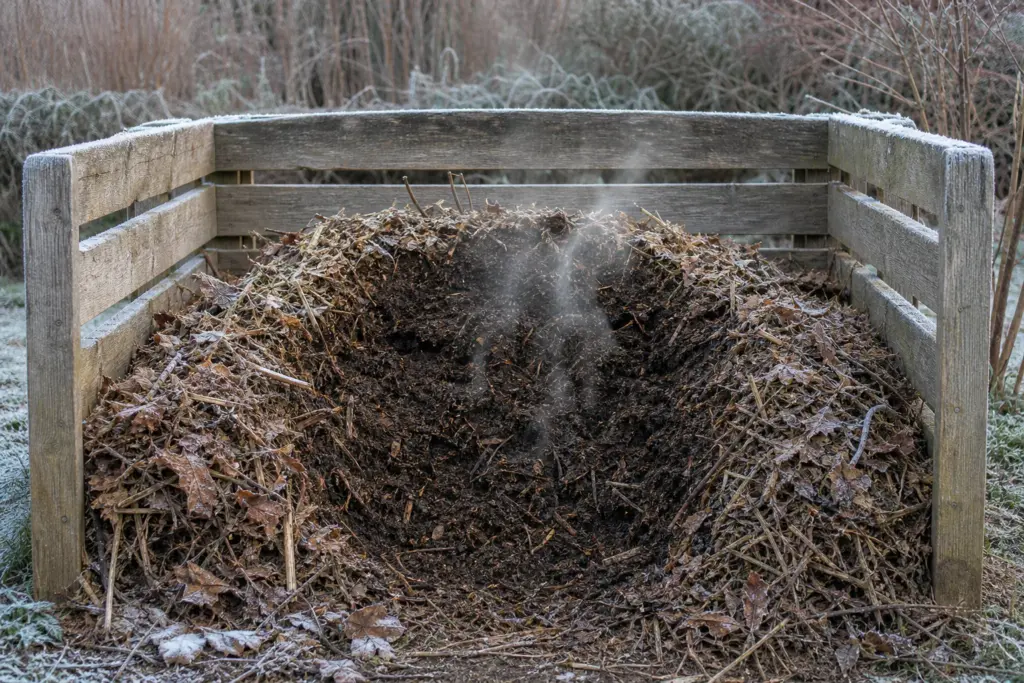
On a cold November morning, a compost pile can look strangely alive. The lawn is stiff. The beds are mostly bare. The shed roof may be silvered with frost. Then, from a heap of leaves, stems, peelings, and coffee grounds, a pale veil lifts into the air.
It is easy to read that steam as something dramatic: smoke, rot, danger, or a garden pile misbehaving. Most of the time, it is the opposite. Steam rising from compost is usually a sign that the pile is biologically active. The heap is warm inside because microorganisms are eating, breathing, reproducing, and turning stored plant energy into carbon dioxide, water vapor, new microbial bodies, and heat.
A steaming compost pile is not magic, but it does feel like one of the better small winter mysteries. The garden appears to be shutting down, yet inside the pile another season is happening at microbial scale.
Steam is not smoke
The first thing to know is simple: steam from a compost pile is usually water vapor, not smoke. Warm, moist air rises from the pile. When it meets colder outside air, the water vapor condenses into visible mist. It is much like seeing your breath on a cold day, except the breath belongs to a whole community of microbes.
Cornell’s composting materials describe heat as a by-product of microbial breakdown of organic material, with heat production affected by pile size, moisture, aeration, carbon-to-nitrogen ratio, and outdoor temperature.1 When that heat evaporates moisture from the pile, a cold morning makes the vapor visible.
Cornell’s composting guide describes the visible plume from a hot pile as steamy water vapor.1 That ordinary mist is not the same thing as smoke. If the pile smells like damp leaves, soil, or mushrooms, it is probably composting. If it smells burned or chemical, or produces persistent gray smoke, ash, or flame, treat it as something other than ordinary compost vapor.
The heat comes from aerobic life
Composting is not simply matter falling apart. It is largely aerobic decomposition, meaning oxygen-using organisms are doing much of the work. Bacteria and fungi use carbon-rich materials as food. In the process, they release energy. Some of that energy is stored in new cells, but much of it escapes as heat.
This is why a pile can be warm even when the air is cold. The pile is a small ecosystem with insulation. The outer few inches may be chilled by weather, but the center can remain warm enough for active microbial metabolism if the ingredients, moisture, oxygen, and size are right.
Cornell notes that composting happens fastest during the thermophilic stage, roughly 40 to 60°C (104 to 140°F), and that this hot phase can last for weeks or months depending on pile size and ingredients.1 Measure the center with a long compost thermometer rather than reaching into a hot pile. Those temperatures are also warm enough to send visible vapor into cold air.
A pile has weather inside it
A good compost pile has its own tiny weather system. Warm air rises through channels in the heap. Cooler air is drawn in from the sides. Moisture evaporates from hot surfaces and condenses where temperatures fall. The surface may crust or dry while the center stays damp. The bottom may be wetter than the top. The outer layer may host worms and other invertebrates while the hot center belongs mostly to microbes.
Cornell describes the heat balance in compost as a contest between heat produced by microorganisms and heat lost through conduction, convection, and radiation.1 That is a compact way of explaining why two piles made from similar materials can behave differently. A small loose pile loses heat faster than a larger one. A pile exposed to wind cools faster than one tucked behind a shed. A wet pile may hold heat differently from a dry one.
Steam appears when that internal weather is strong enough to show itself. It is the visible edge of an invisible balance: microbial heat, water, cold air, and moving vapor.
Size matters more than romance
Gardeners often want composting to feel forgiving, and it is forgiving in the long view. Given enough time, most plant material will soften, darken, and return to soil life. Hot composting is less casual. It asks for enough mass to hold heat.
Oregon State University Extension uses an initial volume of about one cubic yard—roughly 3 feet by 3 feet by 3 feet—as a practical starting point for fast hot composting, together with enough nitrogen-rich material, water, and air.5 That does not mean a smaller bin is useless, or that every cubic-yard pile will become hot. It means a small bin may behave more like a slow decomposition box than a winter heater.
The reason is geometry. A larger pile has more interior volume compared with its cooling surface. The middle is protected by the material around it. A small heap has too much edge. It loses heat almost as fast as microbes make it, especially in windy or freezing weather. That is why a three-gallon bucket of scraps does not steam like a farm windrow, even if both contain organic matter.
Carbon and nitrogen set the table
The microbes need food, but not all food is the same. Carbon-rich materials, often called browns, include dry leaves, straw, wood chips, sawdust, shredded paper, and dry stems. Nitrogen-rich materials, often called greens, include grass clippings, vegetable scraps, coffee grounds, fresh plant trimmings, and some manures.
Cornell’s compost chemistry guide explains why carbon and nitrogen are central: carbon provides energy and structural material for microbial cells, while nitrogen is needed for proteins, nucleic acids, enzymes, and growth.3 The classic target is a carbon-to-nitrogen ratio around 30:1. It is not a spell. It is a useful average that gives microbes enough energy and enough nitrogen to build themselves.
If the starting mix has too little available carbon for its nitrogen, nitrogen may be lost as sharp-smelling ammonia.3 Rotten-egg odors point more directly to oxygen-poor pockets, often made worse by excess water or compaction.3 At the other extreme, a carbon-heavy mix may sit cool for a long time, especially if most of that carbon is woody, dry, or in large pieces. A steaming pile usually has a workable mix, but vapor alone cannot confirm the balance everywhere inside it.
Leaves alone are often a different project
Autumn leaves are wonderful material, but a pile made mostly of whole dry leaves may not heat much. Leaves can mat together, shed water at first, and then form wet plates that block oxygen. They are also often more carbon-heavy than a hot pile wants. The result is not failure. It is a different kind of decomposition.
Leaf mold is its own slower, mostly leaf-based project. The finished material is dark and crumbly, and is useful as mulch or a soil-conditioning organic layer. It simply does not usually produce the same dramatic steam as a balanced hot pile unless the leaves are mixed with more nitrogen-rich material and managed for heat.
If you want a leaf-heavy pile to warm, shred the leaves, mix rather than layer them with modest amounts of greens such as grass clippings or kitchen vegetable scraps, and avoid packing the pile into a wet, airless brick. Smaller pieces expose more surface to decomposers, but material chopped too finely can compact and restrict air.1
Water is both invitation and problem
Microbes need water. They live and work in thin films of moisture around organic particles. Too little moisture and the pile becomes a dry pantry, full of food no one can eat. Too much moisture and air spaces fill with water, oxygen drops, and anaerobic organisms begin producing sour, swampy odors.
Cornell gives 50 to 60 percent moisture as a generally optimal range for composting, and describes the practical squeeze test: the mixture should feel about as damp as a wrung-out sponge.1 That old phrase is still useful because it translates invisible percentages into a hand test. Damp is good. Dripping is not. Dusty is not.
Cold, wet weather makes moisture tricky. Rain can soak an uncovered pile. Snow can insulate it, then melt into it. Dry leaves can hide saturated layers underneath. Steam and an earthy smell show that at least part of the pile is warm and active; they do not prove that every layer has enough air. Check several spots. Rotten-egg odors, dripping material, or a slick compacted texture point toward excess water and too little oxygen.
Oxygen keeps the smell honest
A hot pile needs oxygen because the organisms doing the fast, clean work are mostly aerobic. Cornell notes that oxygen is essential for aerobic microorganisms, and that if oxygen in the pile falls too low, anaerobic regions develop and odors can result.1 This is why a pile can be both wet and hot, yet unpleasant. Heat alone does not prove the pile is balanced.
Turning a pile adds oxygen and exposes undecomposed material to active zones. Cornell also notes that turning a cooling pile can produce a new temperature peak by replenishing oxygen and exposing organic matter that has not yet decomposed thoroughly.1 That is the reason a pile may steam again a day or two after being forked apart and rebuilt.
There is a winter tradeoff here. Turning can replenish oxygen and expose fresh surfaces, but it also increases convective and surface heat loss when a warm core is opened to cold air.1 A steaming, earthy-smelling pile may not need immediate intervention. A waterlogged or foul-smelling pile may still benefit from turning and dry, coarse browns even though its temperature drops temporarily.
The pile changes crews as it changes temperature
A compost pile does not have one permanent workforce. Temperature changes which organisms are most active. Cornell describes thermophilic microbes doing the fastest work during the hot phase, then mesophilic microbes taking over much of the long curing phase as the pile cools.1 These are overlapping communities, not two crews changing shifts at an exact thermometer mark.
That matters because a non-steaming pile is not necessarily dead. It may simply be in a cooler phase. Freshly mixed material may heat quickly. An older pile may settle into curing. A winter heap may work slowly under snow. The visible steam is one chapter, not the whole book.
This is why patience belongs in composting as much as technique. You can manage the pile toward heat, but you cannot demand that it stay dramatic forever. Microbes use the easiest food first. As the pile matures, the remaining material becomes more resistant, temperatures fall, and the work becomes quieter.
When steam is useful information
Steam tells you that the pile has an active warm zone. It does not tell you everything. It does not guarantee that every weed seed was killed.5 When unevenly heated compost is spread, surviving seeds can join the garden’s buried weed seed bank. It does not prove the pile is finished or ready for the vegetable bed. It only says that warm, moist decomposition is happening strongly enough to show itself.
Illinois Extension suggests looking for steam or finished compost in the middle or bottom of a winter pile as evidence that the pile is still cooking.4 That is a helpful diagnostic. Steam means at least one zone has not simply frozen or gone dormant. The whole pile may still be uneven, and any feeding, covering, or turning should answer a condition you can observe.
Use your nose and hand as well as your eyes. A well-aerated active pile usually smells earthy and vegetal, not like sewage, ammonia, or rotten eggs. It should be damp rather than dripping, with visible coarse pieces or pore spaces instead of the slick compression of a saturated mat. Sample more than the surface: a dry crust can cover a wet center.
What to do as cold weather settles in
In a climate where late autumn brings sustained cold, this is not the time to fuss a pile into perfection every day. Help the heap keep a workable core. Add chopped, disease-free garden debris, noninvasive spent annuals without mature seed, vegetable scraps, coffee grounds, and enough dry browns to preserve structure. Bury food scraps in the active middle rather than leaving them on top. Keep meat, grease, dairy, pet waste, and diseased plants out of a simple backyard pile; different systems and local rules handle those materials differently.5
If the pile is too wet, mix in dry leaves, straw, shredded cardboard, or woodier material and open it enough for air. If it is dry, add water gradually while turning when the weather allows, or mix in wetter greens. Oregon State University’s home composting guide gives the same basic correction: add dry browns and turn if the pile is too wet, or add water when turning if it is too dry.5 If the pile is steaming and smells good, resist the urge to overmanage it. Let the warm core do its work.
University of New Hampshire Extension suggests buffering a winter bin with bags of leaves or straw bales, or lining the inside with a thick layer of leaves, sawdust, or woodchips.2 Insulate for a reason, not out of habit. An insulating layer can help the pile keep a warmer core, but it will not fix a bad mix, a saturated base, or a heap that is too small to hold heat.
Steam does not mean finished
A steaming pile is active, not finished. Finished compost is usually dark, crumbly, earthy-smelling, and close to ambient temperature. Cornell’s compost temperature fact sheet notes that when the pile drops below 70°F, composting is nearly complete, though poor oxygen or moisture can also cool a pile before it is finished.6 Temperature is therefore a clue, not a maturity test by itself. A hot pile is still decomposing rapidly and may contain recognizable material that needs more time.
After the hot phase, curing matters. Cornell describes a later maturation phase in which temperature drops near ambient while the remaining organic matter becomes more stable and suitable for plants.1 Oregon State recommends additional curing after a hot pile no longer reheats when turned, especially before use with tender seedlings or in a vegetable garden.5 This quiet phase is easy to undervalue because it lacks steam.
If you need compost for seed starting, potting mixes, or delicate seedlings, use fully finished material or a tested product. If your pile is still hot enough to steam, admire it, turn it when appropriate, and give it time.
The small satisfaction of a working heap
There is something deeply satisfying about a steaming compost pile in a late-season garden. It is not picturesque in the usual way. It is a heap. It may contain coffee filters, squash vines, leaf stems, old marigolds, and the last collapsed bean plants. But it is also a lesson in energy moving through life.
Sunlight became leaves. Leaves became food, stems, peels, and roots. Microbes took those leftovers apart and released heat into the cold. The steam is a sign of that passage, visible for a few moments before it disappears into the air.
A garden does not stop when the beds go brown. Some of its most important work simply moves into darker places. On a cold morning, the compost pile lets you see it breathe.
References
- Cornell Composting: Compost Physics
- University of New Hampshire Extension: Can you compost in the winter?
- Cornell Composting: Compost Chemistry
- University of Illinois Extension: Spring into composting by reviving a compost pile after winter
- Oregon State University Extension: Do the rot thing, choosing and using a composting system
- Cornell Composting: Temperature