
By the last morning of the year, a deciduous tree has usually stopped pretending. The leaves are gone. The soft green noise of summer has fallen away. Every fork, scar, old pruning cut, and awkward branch angle is suddenly visible against the winter sky.
That is when the green clump looks most suspicious.
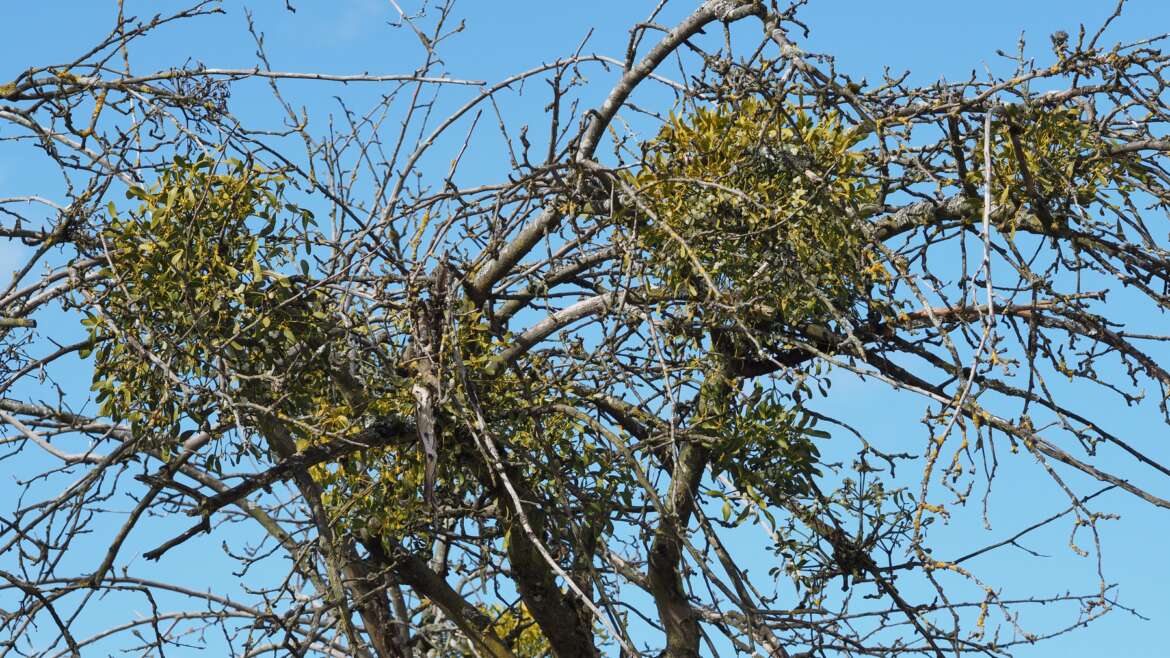
High in an apple, poplar, maple, hawthorn, oak, or old orchard pear, there may be a rounded tuft of leaves that has no business being there. It stays green after the host tree has gone bare. It may hold pale berries. From the ground it can look like a nest, a squirrel’s winter pantry, or a piece of wind-thrown evergreen caught in the branches. But if it is attached and growing, you may be looking at mistletoe.
Mistletoe is one of those plants that culture has made too cute. We hang it in doorways, turn it into holiday shorthand, and forget that in the tree it is not decoration. It is a flowering plant living partly inside another plant, green enough to make some of its own food, but dependent enough to tap the host’s plumbing.
A winter plant with one foot in someone else’s body
The word mistletoe does not name one tidy species. It is a loose common name for several groups of parasitic plants. The familiar leafy holiday mistletoes include plants such as European mistletoe, Viscum album, and American mistletoes in the genus Phoradendron. Conifer forests also have dwarf mistletoes in the genus Arceuthobium, which look less like a leafy ball and more like small jointed shoots or distorted brooms in the crown.
What links them is the habit. Wisconsin Horticulture describes mistletoes as perennial flowering plants parasitic on the aboveground parts of woody trees and shrubs. Many of the leafy kinds are hemiparasites: they contain chlorophyll and can photosynthesize, but they still draw water and nutrients from a host tree through specialized penetrating tissue.1
That distinction matters. Mistletoe is not a fungus. It is not a moss. It is not a bird nest that has sprouted. It has stems, leaves, flowers, fruits, seeds, and a botanical agenda. Its strangeness comes from where it puts its roots. Instead of entering soil, the young plant enters living wood.
How a seed chooses a branch
The beginning is almost comic because it is so sticky. Birds eat mistletoe berries, or peck them apart, then carry the seeds in droppings or wipe them from their bills onto branches. USGS notes that many North American mistletoes are distributed by birds, helped by the stickiness of the berries and seeds; in some mistletoes, seeds can also be forcibly ejected from the fruit.2
A seed that lands on soil has chosen badly. A mistletoe seed needs bark, not a seed tray. If it stays moist enough and rests on a suitable host, it germinates on the branch surface. The young plant produces a holdfast, then sends a sinker inward. This is the start of the haustorium, the organ that makes the whole arrangement possible.
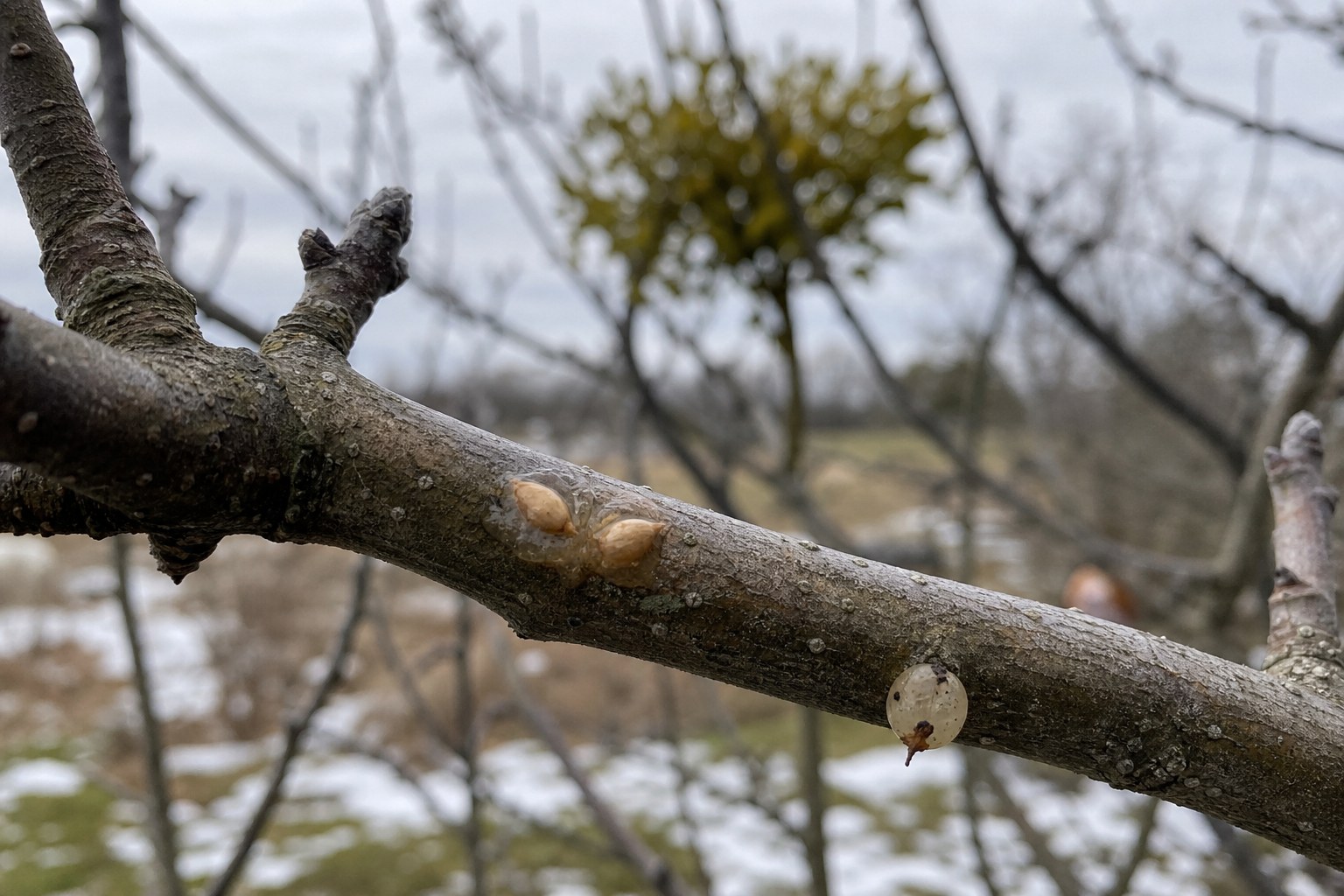
The branch does not open a polite door. The young mistletoe has to grow into it. Once established, the parasite can persist for years, expanding outside as a green clump while maintaining a hidden connection inside the wood.
The hidden organ in the wood
The haustorium is the part gardeners rarely see, and the part that explains why simply clipping off the visible leafy mass is usually not enough. UC IPM describes mistletoes as parasitic plants that absorb water and nutrients from a host tree.3 The green tuft above the bark is only the public part of the plant. The more consequential part is the embedded system that connects with the host’s conducting tissue.
This does not make mistletoe a vampire in the melodramatic sense. A leafy mistletoe still uses sunlight. Its leaves contain chlorophyll. It builds sugars of its own. But because it lacks an ordinary root system in soil, it relies on the host for water and mineral nutrients, which is why drought stress can make the relationship much harder on the tree.
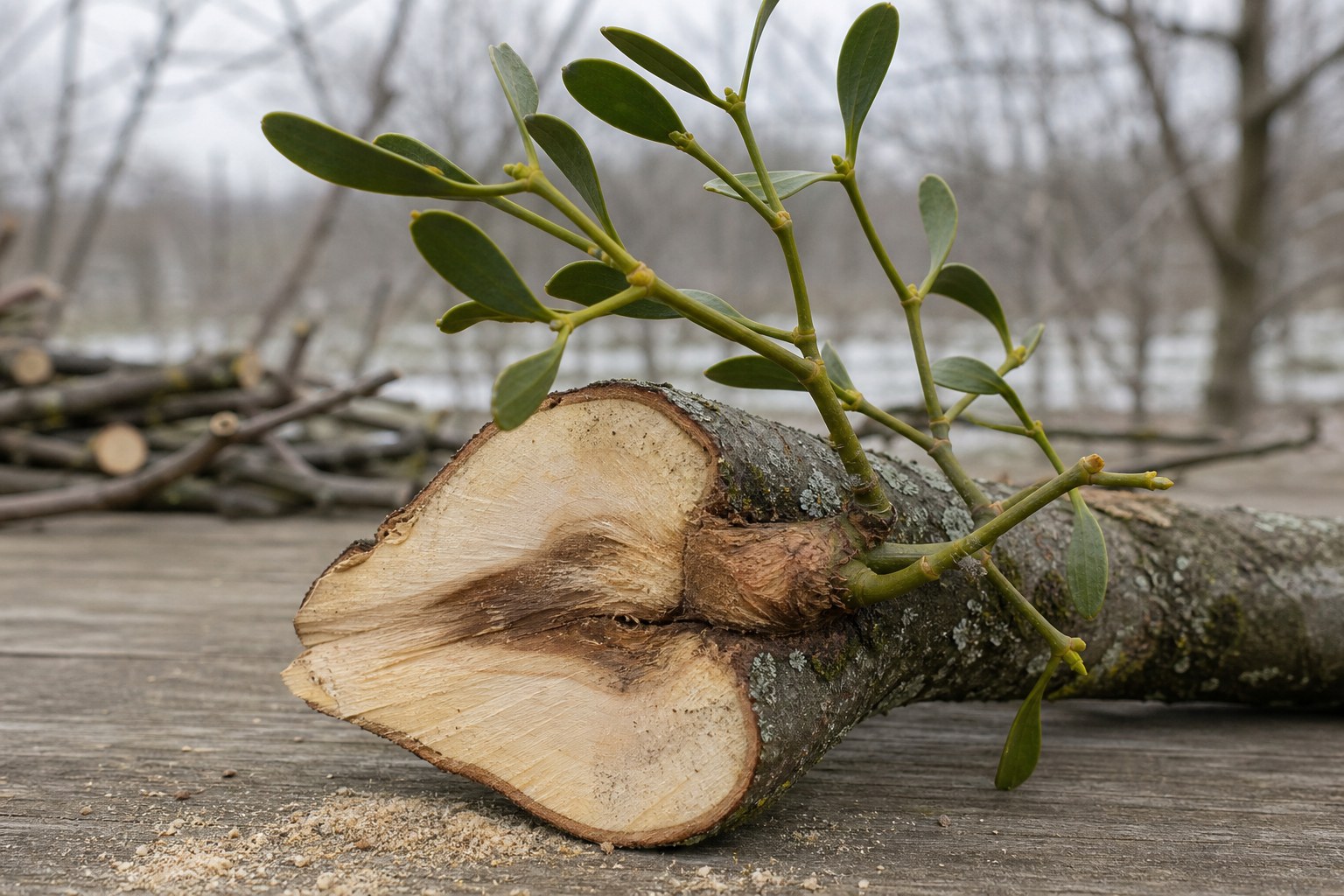
If you have ever cut a mistletoe-infested branch, you may notice swelling, distortion, or oddly dense growth around the attachment. That is the tree and the parasite negotiating space in the least romantic way possible: through living tissue, resource flow, and time.
The damage is slow, not magical
A single clump of leafy mistletoe on a vigorous mature tree is often more interesting than alarming. UC IPM notes that healthy trees can tolerate a few infected branches, while severe infestations can weaken trees, stunt growth, kill branches, or in extreme cases contribute to death, especially when trees are already stressed by drought or disease.3
That is the correct level of concern. Mistletoe is not an emergency siren every time it appears, but it is not harmless folklore either. It is a chronic drain, and chronic drains matter most when a tree is already short of water, old, structurally weak, recently transplanted, poorly pruned, root-damaged, or fighting other pests and diseases.
Dwarf mistletoes in conifers deserve separate respect. Colorado State Forest Service describes them as small parasitic flowering plants that can cause swelling at infection sites and, in some species, witches’ brooms, the dense distorted branch growth that slowly disrupts the tree’s normal structure.4 Colorado State University Extension notes that dwarf mistletoe brooms draw nutrients and water from uninfected parts of the tree and can gradually reduce host vigor.5
For a home gardener, the useful question is not simply, “Is there mistletoe?” It is, “How much, where, and on what kind of tree?” One clump on a disposable limb is different from many clumps through the crown of a drought-stressed orchard tree. A small infection low in a branch that can be pruned cleanly is different from mistletoe established on a main scaffold or trunk.
Why wildlife complicates the verdict
It would be easier if mistletoe were only a pest. Gardens are simpler when a thing can be placed in one box. Mistletoe refuses. In wild systems, it can feed birds, move through bird behavior, shelter insects, and add structure to tree crowns. USGS describes the relationship with birds directly: birds eat the berries, rely on them as food in some places, and help distribute the seeds.2
That does not mean you should cultivate mistletoe in a small garden tree because it is ecologically interesting. Poison ivy is ecologically interesting. So are mosquitoes. The better lesson is restraint in both directions. In a natural woodland edge, a mistletoe clump may be part of the local pattern. In a young apple tree you are trying to keep productive, it may be a problem worth removing before it becomes several problems.
This is often the most adult answer in gardening: context decides. A plant can be native, useful to wildlife, and unwelcome in a particular branch over a particular path.
What to do if it is in your tree
Winter is the best time to map leafy mistletoe because deciduous hosts have stopped hiding it. Stand back and look through the crown. Mark which branches carry clumps, whether the infection is on small removable wood or major structure, and whether the tree looks otherwise vigorous. If you need binoculars to decide, you probably should not be the person climbing after it with a pruning saw.
For accessible infections on deciduous trees, pruning out the infected branch is the cleanest practical control. UC IPM recommends removing infected branches at least a foot below the mistletoe attachment before the plant produces seeds that can infest other limbs and trees.3 That extra distance matters because the hidden infection is not confined to the leaves you can see.
Do not respond by topping the tree, stripping half the crown, or leaving ragged cuts because the green clump annoyed you. Bad pruning can damage the host faster than a small mistletoe infection would have. If the clump is high, near power lines, on a large limb, or widespread through the canopy, call a certified arborist. The problem is not just plant biology at that point. It is gravity, branch weight, tree structure, and safety.
If mistletoe is attached to a main trunk or a large scaffold that cannot be removed without ruining the tree, control becomes less tidy. Removing the visible growth may reduce seed production temporarily, but regrowth is possible from the embedded tissue. On valuable trees, an arborist can help decide whether repeated suppression, selective pruning, improved irrigation during drought, or eventual removal is the more honest plan.
A note on safety
Mistletoe berries are for the birds, not for the kitchen. NC State Extension lists American mistletoe, Phoradendron leucarpum, as poisonous to humans if large quantities are eaten, with the fruits among the poisonous parts.6 The practical advice is simple: do not eat it, do not let children or pets treat fallen berries as snacks, and do not use home-harvested mistletoe where berries can drop onto a table or floor unnoticed.
If you bring purchased mistletoe indoors as decoration, treat it like a plant with toxic parts rather than a harmless ornament. Hang it out of reach, sweep up shed berries, and compost or discard it responsibly when the season is over. If you cut mistletoe from your own trees, bag berry-laden material instead of leaving it under susceptible hosts where birds may continue the delivery work.
Learning to read the clump
The interesting thing about mistletoe is that winter does not make it happen. Winter makes it visible. The plant was there in July, camouflaged by the host’s leaves. It was there in October, while the tree was withdrawing sugars and sealing off the season. On December 31, the year simply removes the curtain.
That is a useful way to look at a garden at the turn of the year. Bare branches are not empty. They are records. They show old pruning decisions, storm damage, lichens, buds, galls, bark patterns, and sometimes a green parasite quietly doing its work. A gardener who learns to read those winter silhouettes gets a longer season without planting a thing.
So if a tree holds an impossible green ball above the path, do not rush straight to myth or panic. Look at the host. Look at the number of clumps. Look at where they attach. Think about birds, water stress, pruning cuts, and the hidden organ in the wood. Mistletoe is a thief, yes, but a precise one. It steals through botany, and winter is when the evidence is easiest to see.
Featured image: Mistletoe on an apple tree by Kreuzschnabel, Wikimedia Commons, licensed under CC BY-SA 3.0. Cropped for display.