
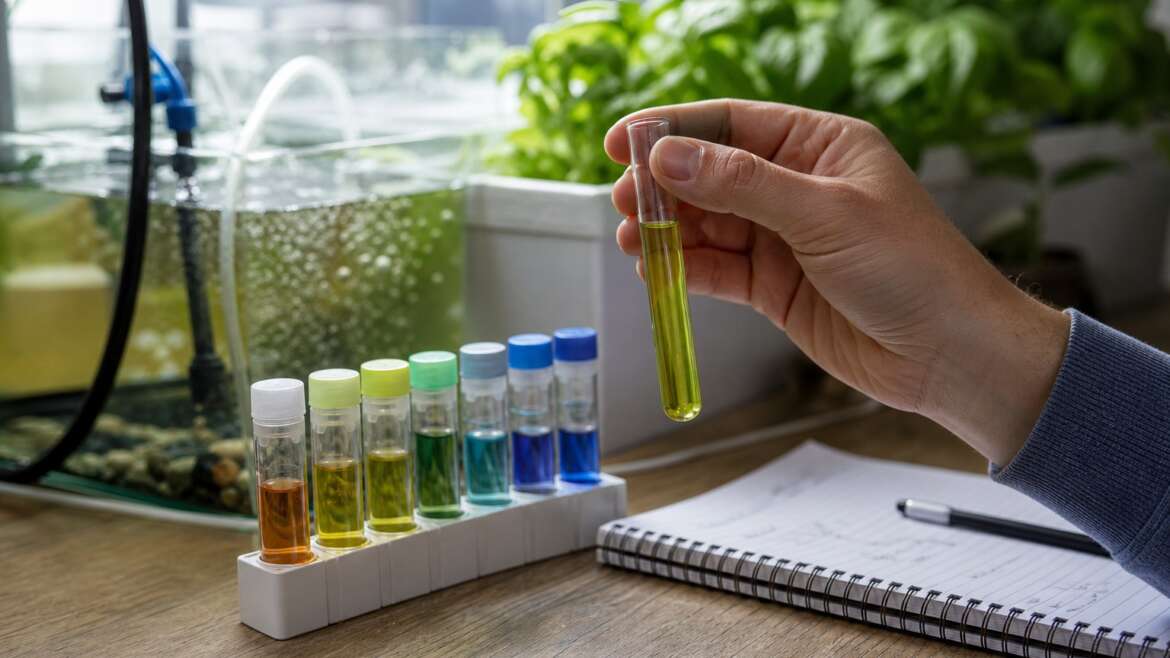
The easiest aquaponic problems to solve are the ones that still look boring. A pump hums a little differently. Fish come up for food more slowly. Lettuce that was bright yesterday looks slightly tired. A test tube shifts from pale yellow toward green. Those are not emergencies yet. They are the system giving you time.
Aquaponics is often described as a loop: fish feed plants, plants clean the water, and the water returns to the fish. That is true, but it leaves out the part that makes or breaks the system. The loop depends on bacteria, oxygen, flow, and a gardener who notices drift before it becomes a crash. USDA’s National Agricultural Library defines aquaponics as aquaculture and hydroponics combined in one system, while FAO’s small-scale aquaponics guide treats fish, plants, and bacteria as the three living groups that have to be kept in balance.12
If you are still choosing a tank, bed, fish species, or growing method, the design decisions belong in choosing an apartment aquaponics system without overbuilding it. This article starts after the water is already moving, when the real work is keeping a small ecosystem steady.
Test before the story gets dramatic
Cloudy water, yellow leaves, stressed fish, weak growth, and algae can all come from more than one cause. Guessing is how small problems become tangled. Testing gives you the order of operations.
New Mexico State University Extension lists ammonia, nitrite, nitrate, dissolved oxygen, pH, temperature, alkalinity, and hardness among the water-quality variables that matter in aquaponics.3 In a new system, daily testing is reasonable because the biofilter is still maturing. Once the system is cycled and predictable, weekly testing is often enough for routine care, with extra checks after fish additions, heavy feeding, heat waves, equipment changes, or unexplained plant symptoms.
Write the numbers down. A single pH reading is a snapshot; a week of pH readings is a trend. The same is true for ammonia and nitrite. A log also keeps you from making the same correction twice because you forgot what you changed yesterday.
Know which number is urgent
Ammonia and nitrite are the fast alarms because they can harm fish. Most hobby test kits measure total ammonia nitrogen, which includes both ionized ammonium and the more toxic un-ionized ammonia. The dangerous fraction rises as pH and temperature rise, so a warm tank at a higher pH can be riskier than the same ammonia reading in cooler, slightly more acidic water.
Dissolved oxygen is just as practical. Fish need it, and the bacteria that convert ammonia to nitrate need it too. NMSU recommends maintaining dissolved oxygen at 5 mg/L or higher in aquaponic systems, and it notes that warm water holds less oxygen than cool water.3 That is why a system can look fine on a cool morning and become strained during a hot afternoon.
pH matters because it affects fish stress, nutrient availability, and bacterial activity. The goal is not to chase a perfect number every time the meter twitches. NMSU describes the best compromise for fish, plants, and nitrifying bacteria as near neutral, and notes that roughly 6.4 to 7.4 is generally tolerable for all three parts of the system.3 Sudden pH corrections are often more dangerous than a slightly imperfect pH.
Feed the biofilter, not the problem
Fish food becomes fish waste. Fish waste becomes plant nutrition only after nitrifying bacteria have turned ammonia into nitrite and then nitrate. That is why the earlier introduction to apartment aquaponics, with the fish and bacteria included, is not just setup background. The bacteria are not decoration. They are the bridge between the tank and the salad leaves.
Overfeeding is the simplest way to overload that bridge. Feed what the fish will eat promptly, remove leftovers, and resist adding more fish just because the plants look hungry. A young biofilter needs time and surface area. Media beds, tank walls, filter sponges, and dedicated biofilters all become bacterial habitat, which is why aggressive cleaning can set a system backward.
Clean the parts that trap excess solids, but do not sterilize every surface. Rinse reusable filter media in dechlorinated system water or conditioned water when you are trying to preserve the bacterial colony. Municipal water may contain chlorine or chloramine, and NMSU specifically notes that these must be removed before that water is used in an aquaponic system.3
Fix problems in the order that protects fish
When fish are gasping near the surface, hanging by the return flow, flashing, or refusing food, start with oxygen and circulation. Check the air pump, air stones, water pump, inlet screens, tubing, and drains. Add aeration if you can. Stop or reduce feeding while you investigate. Fish can usually miss a meal; they cannot wait long for oxygen.
If ammonia or nitrite is elevated, reduce feeding, remove uneaten food and settled waste, increase aeration, and check whether a pump or filter has slowed. If the reading is high enough to threaten fish, use a partial water change with dechlorinated water that is close in temperature and pH to the tank. Oklahoma State University’s aquaponics troubleshooting guidance puts the first response to nitrite problems in much the same order: reduce feeding, exchange water when needed, and look for solids buildup, dead fish, inadequate biofilter area, or overstocking.4
Change one thing at a time when the fish are not in immediate danger. Five corrections at once can hide the real cause and create a second problem. A small system can be knocked off balance by sudden pH shifts, temperature swings, hard cleaning, a new school of fish, or a big feeding increase.
Keep circulation boring
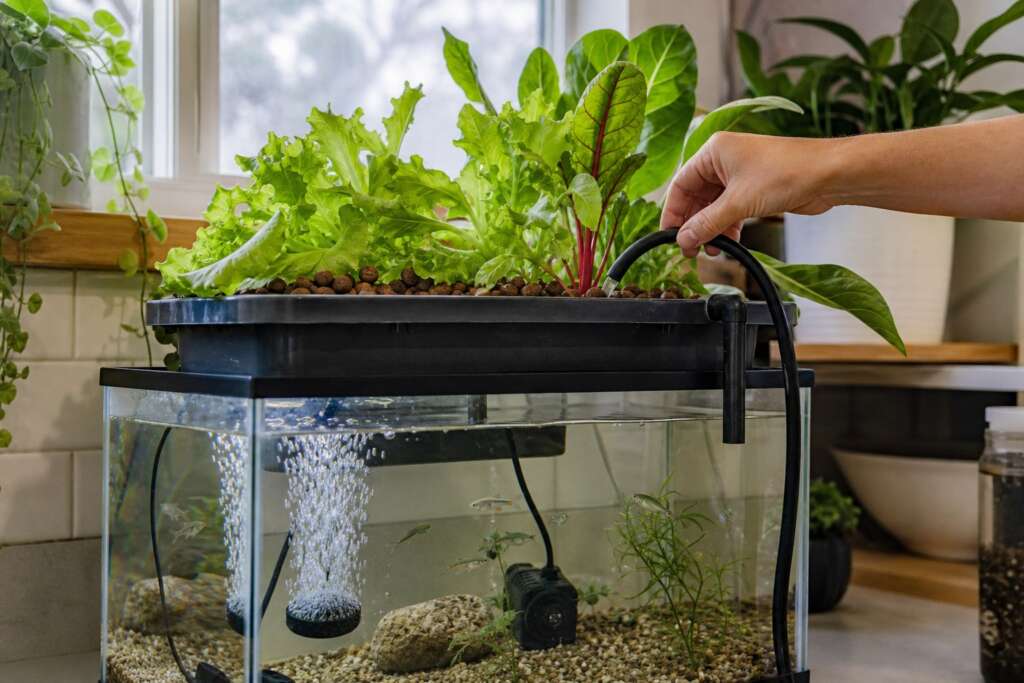
Aquaponics failures often begin in ordinary hardware. A pump intake clogs with roots. An air stone weakens. A drain line develops a slow mat of biofilm. A grow bed floods more slowly than usual. None of this looks as interesting as a nutrient deficiency, but it matters more.
Make a habit of watching the water return to the tank. Listen to the pump. Look for bubbles. Lift the lid or media guard and check for roots where water needs to move. Keep a spare air stone, short length of tubing, and backup pump if the fish matter to you. A cheap spare can be the difference between a nuisance and a tank loss.
Read plant symptoms more slowly
Plants are excellent witnesses, but they are not always urgent witnesses. Yellowing leaves can mean too little nitrate, but they can also point to poor light, old leaves, transplant stress, pH-related nutrient lockout, or shortages of iron, potassium, or calcium. NMSU notes that many plant nutrients are supplied through fish feed and fish byproducts, but calcium, potassium, and iron may need supplementation in aquaponic systems.3
Algae is similar. A little algae is not a system failure. A lot of algae usually means light is reaching nutrient-rich water, solids are accumulating, or feeding is too generous for the plant mass. Shade exposed tank water, remove settled waste, improve plant cover, and avoid dumping algaecides into a system that also contains fish, bacteria, and edible plants.
A simple maintenance rhythm
- Daily: Watch fish behavior, check water movement and bubbles, feed lightly, and remove uneaten food.
- Weekly: Test pH, ammonia, nitrite, and nitrate; top up with dechlorinated water; clean obvious solids from mechanical filters.
- Monthly: Inspect pump intakes, tubing, drains, grow-bed roots, mineral buildup, and any backup equipment.
- After every change: Record what changed, then test again before making a second correction.
The point is not to make the system sterile or fuss over it every hour. A stable aquaponic system still has algae on a surface, a yellowing old leaf, and the occasional odd reading. Stability means the trend is visible, the cause is narrow enough to act on, and the gardener responds before the fish have to announce the problem at the surface.