
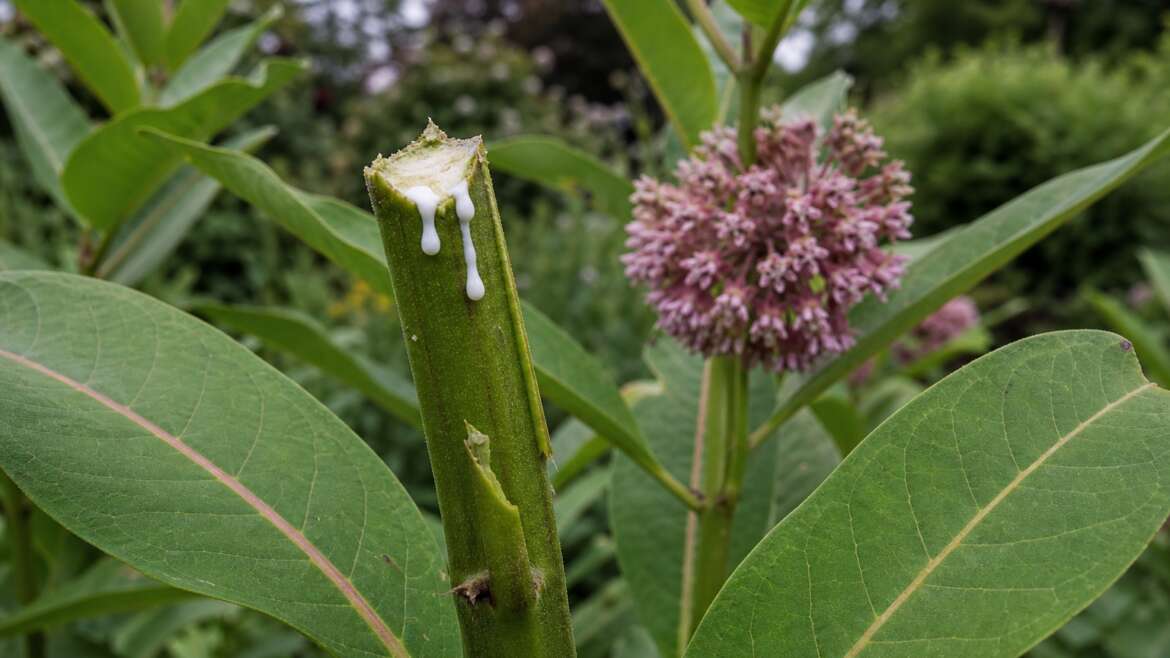
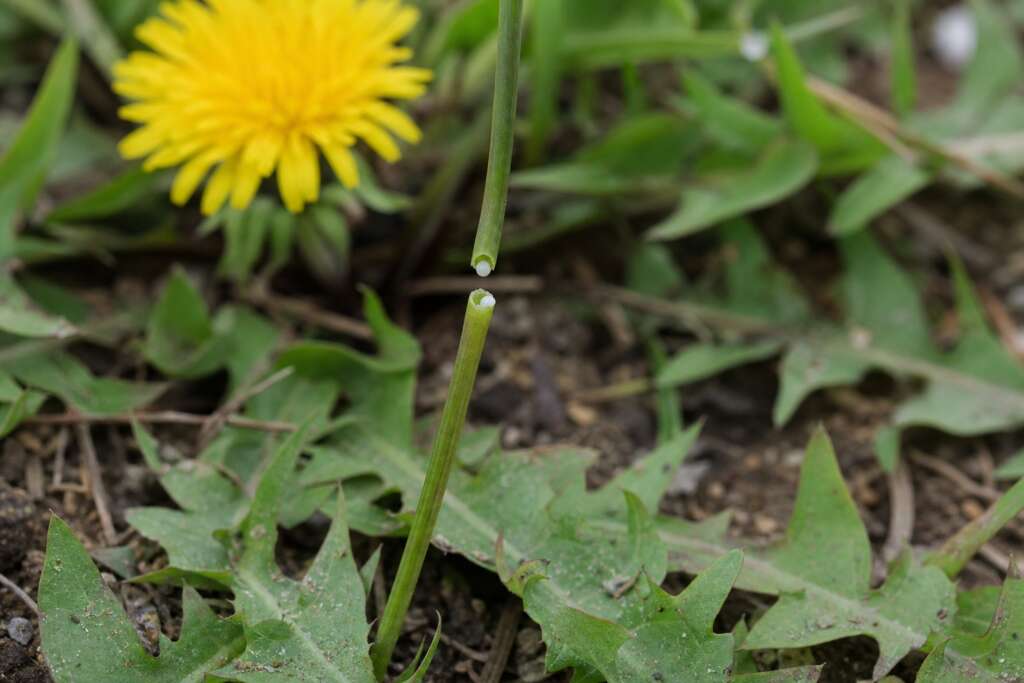
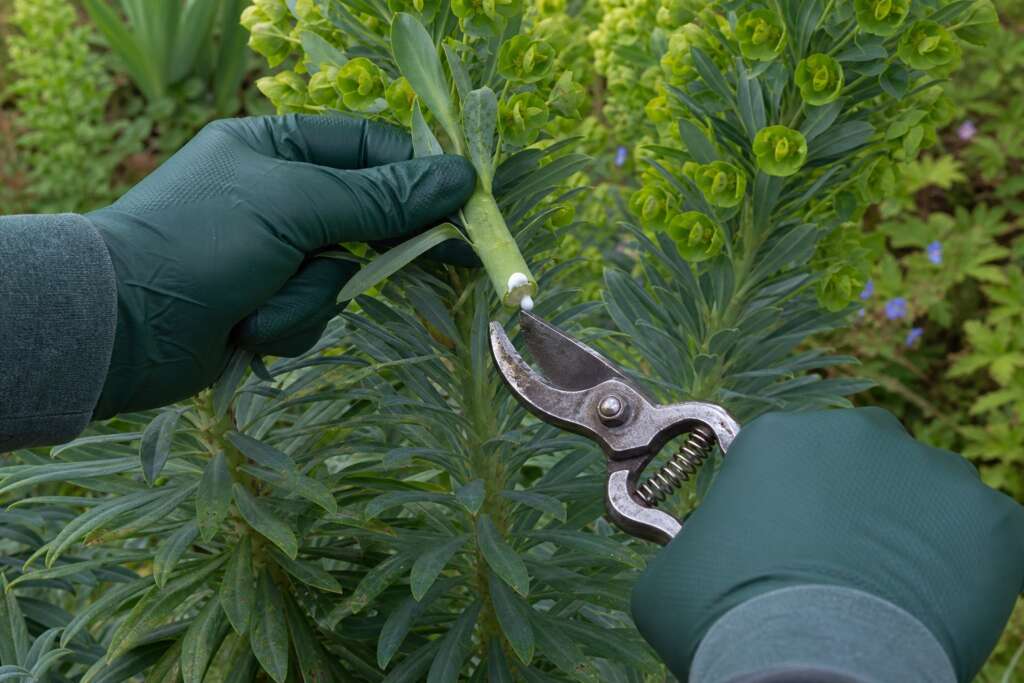
On a warm June evening, deadheading a garden spurge can reveal a hidden part of the plant. The cut end wells white almost at once. A broken lettuce stalk or dandelion stem does something similar, forming a pale bead that turns tacky while you watch. It is easy to call the liquid sap and leave the explanation there.
Sap is not exactly wrong; the word is often used loosely. But this is not the watery xylem stream lifting minerals from the roots, nor the sugar-rich phloem flow distributing the products of photosynthesis. It is latex, held in a separate system of specialized cells called laticifers. A major review estimates that about ten percent of flowering plant species release latex when damaged. The droplet was prepared before the cut ever happened.1
The distinction matters because latex is not one harmless white fluid shared by all plants. Depending on the species, it can be sticky, bitter, irritating, poisonous, rich in rubbery particles, or loaded with compounds useful to medicine. Its familiar color tells you very little about what is in it.
A second network runs through the plant
Xylem and phloem are transport tissues. Their contents move water, minerals, sugars, hormones, and other materials between organs. The clear flow seen when pruning cuts start to bleed is a vascular event. Laticifers are different: they are living secretory cells, or rows of joined cells, that make and hold latex.
Their construction can be astonishing. In an articulated laticifer, a line of cells joins into a tube, sometimes losing the end walls between them and branching into a connected network. A nonarticulated laticifer begins as one cell and grows with the plant, extending and branching between other cells. What looks like a vein full of milk may therefore be part of one extraordinarily long, many-nucleated cell.2
Laticifers often run near vascular bundles and through the outer regions of stems and leaves, where a bite or cut is likely to reach them. Latex is commonly held under positive pressure. Sever the laticifer and the pressure falls at the opening, driving its contents outward. The plant is not deciding, after the scissors close, to send rescue fluid to the cut. The reservoir was already beside the tissues most likely to be injured.
Architecture changes how much of that reservoir an injury can reach. A bite into a widely connected network may drain a larger area, while a more compartmentalized arrangement can restrict the flow. Pressure and volume can also change with the organ, its age, and the plant’s water status. The same stem will not necessarily bleed the same amount on every occasion.
White is an appearance, not a recipe
Latex is usually an emulsion or suspension: water carrying tiny particles and dissolved substances. Those dispersed particles give many latices their cloudy appearance, but latex can also be yellow, orange, red, or nearly clear. Some contains abundant rubber particles. Other latex contains little rubber and more proteins, oils, sugars, tannins, alkaloids, terpenes, or defensive glycosides.
The variation is the important fact. Rubber-tree latex is valued for its polyisoprene. Milkweed latex may combine stickiness with cardenolides and other defenses. Opium poppy stores morphine, codeine, and related alkaloids in its laticifer system. None of those recipes can be inferred safely from whiteness alone.2
This also explains why “milky sap” is a description, not a botanical identification. A dandelion, a fig, a poinsettia, a poppy, and a lettuce can all bleed something that looks related while belonging to distant plant families and carrying very different chemistry. It is also distinct from the mobile, seasonally changing xylem fluid that explains why maple sap runs before the leaves.
A cut turns stored liquid into a seal
The first benefit of pressure is speed. Latex can flood a small injury before a slower wound response has time to begin. Once outside the laticifer, it loses water, particles crowd together, proteins interact, or other chemical changes make it thicken. The result plugs the severed tube and can coat the exposed surface.
There is no single clotting mechanism for plants. A comparative microscopy study of natural latex from weeping fig, clustered bellflower, and three Euphorbia species found markedly different particle structures. The researchers proposed a chemically assisted process for the fig and a process driven more by densely packed particles and water loss for the spurges. They also noted that some latices take many minutes to set while clustered bellflower latex can coagulate in seconds.3
It is useful to keep the scale of that repair honest. Coagulated latex can stop the laticifer from draining, reduce water loss from the damaged spot, and form an immediate barrier. It does not rebuild a severed stem. The longer work of closing and reinforcing a wound still depends on living cells around the injury. Latex is closer to a fast plug than a complete cure.
The plug can also make a miserable mouthful
A caterpillar biting a latex-bearing leaf does not meet a passive reservoir. It opens one under pressure. Sticky latex can gum mouthparts, trap a very small insect, or force a feeder to abandon the cut. At the same time, the fluid delivers concentrated chemicals and proteins directly to the place where tissue is being eaten.
Those contents work in different ways. Cardenolides interfere with an animal’s sodium pump. Alkaloids may poison or deter. Proteases and other proteins can disrupt digestion or act against microbes. A latex that is only moderately defended chemically may still work because its adhesive properties make feeding difficult. A fluid that is not especially sticky may deliver potent chemistry.1
Packaging is part of the defense. The laticifer keeps concentrated, biologically active material apart from most of the plant’s other cells until injury opens the system. The attacker therefore receives a mixture that the intact plant had kept safely contained. Evidence is strongest for defense against herbivorous insects, while wound sealing and possible protection against some microbes add other layers to the story.1
Unrelated plants arrived at a similar answer
Latex occurs in plant lineages too distant for every example to be one inherited family trait. The two major laticifer designs also have different developmental origins. Together, those patterns point to repeated evolution: unrelated plants arrived at variants of the same strategy, storing reactive or sticky material in an internal network and releasing it when the network is cut.2
A bolting lettuce makes this easy to see without leaving the vegetable bed. Cut its stem and the genus name Lactuca suddenly feels apt. Researchers analyzing cultivated lettuce latex found derivatives of lactucin, deoxylactucin, and lactucopicrin among its major components. The mixture varied among lettuce varieties and stages of development and may contribute to bitterness.4
Milkweeds use another mixture. Poppies use another. Spurges use another. The repeated solution is the laticifer and the sudden exudate, not a universal substance called white sap. That is why a familiar lettuce cut should never be used to judge the safety of an unfamiliar garden plant.
Monarch caterpillars answer the defense twice
Milkweed and monarchs show what happens when an effective plant defense meets a specialist over evolutionary time. Long before the silk inside a milkweed pod carries seeds away, the leaves can feed monarch larvae. Larger caterpillars may notch a vein, cut a leaf stalk, or make a trench before feeding beyond the cut. Damaging the supply lines reduces latex flow into the chosen patch.1
Behavior solves only part of the problem. Milkweed cardenolides inhibit Na+/K+-ATPase, an enzyme essential to animal cells. Monarchs carry amino-acid substitutions that make this molecular target less sensitive. In a 2019 experiment, researchers recreated the monarch lineage’s sequence of substitutions in fruit flies with genome editing. The edited flies gained increasing resistance to cardiac glycosides, unusually direct evidence for how the adaptation works.5
The familiar “sabotage” story has a twist. A 2024 study found that older monarch caterpillars sometimes actively drank latex released while cutting a milkweed leaf stalk, acquiring cardenolides they can retain for their own defense. Young larvae and other milkweed butterflies do not handle the fluid in exactly the same way.6 Milkweed latex did not simply fail; the specialist evolved several ways to manage and even exploit it.
Treat an unknown white exudate as unknown
The practical rule is simple: do not taste a plant because its latex resembles lettuce milk. Wear gloves when pruning an unfamiliar latex-bearing plant, keep the cut end pointed away from your face, and avoid using a contaminated blade for food. Keep fresh cuttings where children and animals cannot handle or chew them.
Euphorbia deserves particular care. The genus includes garden spurges, poinsettia, and many cactus-like houseplants. Its latex can irritate skin and eyes, and ingestion can cause serious discomfort. Poison Control advises covering skin and wearing eye protection when working closely with these plants.7 If exposure occurs, wash it off promptly and seek advice from an appropriate local poison or medical service when symptoms are significant.
Poppy latex is a different reason not to experiment. In opium poppy, the laticifer system accumulates pharmacologically active alkaloids. Deliberately scoring capsules or sampling the exudate is not a harmless garden demonstration, and rules governing the plant and its latex vary by jurisdiction.2
Color is not a toxicity scale. Some white latex comes from an edible crop; some can injure an eye. The plant’s identity has to come first.
The droplet is a clue, not a diagnosis
Latex at a fresh break is usually a normal feature of that species, not evidence of disease, overwatering, or a plant “detoxing.” The volume can vary with the organ, its age, water status, and the size of the injury. A small amount does not prove weakness, and a dramatic flow does not prove vigor.
Other exudates can complicate the picture. Clear watery liquid may come from xylem. Sticky droplets scattered over intact leaves may be insect honeydew. Trees can release resins and gums from wounds. The safest identification uses the whole plant—its leaves, flowers, growth habit, and known family—not one drop at the end of a stem.
There is no need to injure a healthy plant merely to test for latex. Use a naturally broken leaf or an existing pruning cut when one is available. The presence or absence of one reluctant droplet is weaker evidence than the plant’s complete structure.
Still, the drop rewards attention. For a few minutes after the cut, a hidden network becomes visible. Pressure turns into flow, an emulsion becomes a clot, and chemistry that waited quietly inside the plant arrives exactly where teeth or shears broke through. It looks like ordinary white sap. It is a small defensive system coming into the open.
References
- Agrawal and Konno: Latex as a model for plant defense against herbivory
- Castelblanque et al.: Multiple facets of laticifer cells
- Bauer et al.: Comparative study on plant latex particles and coagulation
- Sessa et al.: Metabolite profiling of sesquiterpene lactones from Lactuca species
- Karageorgi et al.: Genome editing retraces toxin resistance in the monarch butterfly
- Betz et al.: Late-instar monarch caterpillars sabotage milkweed to acquire toxins
- Poison Control: Keep away from spurge sap