
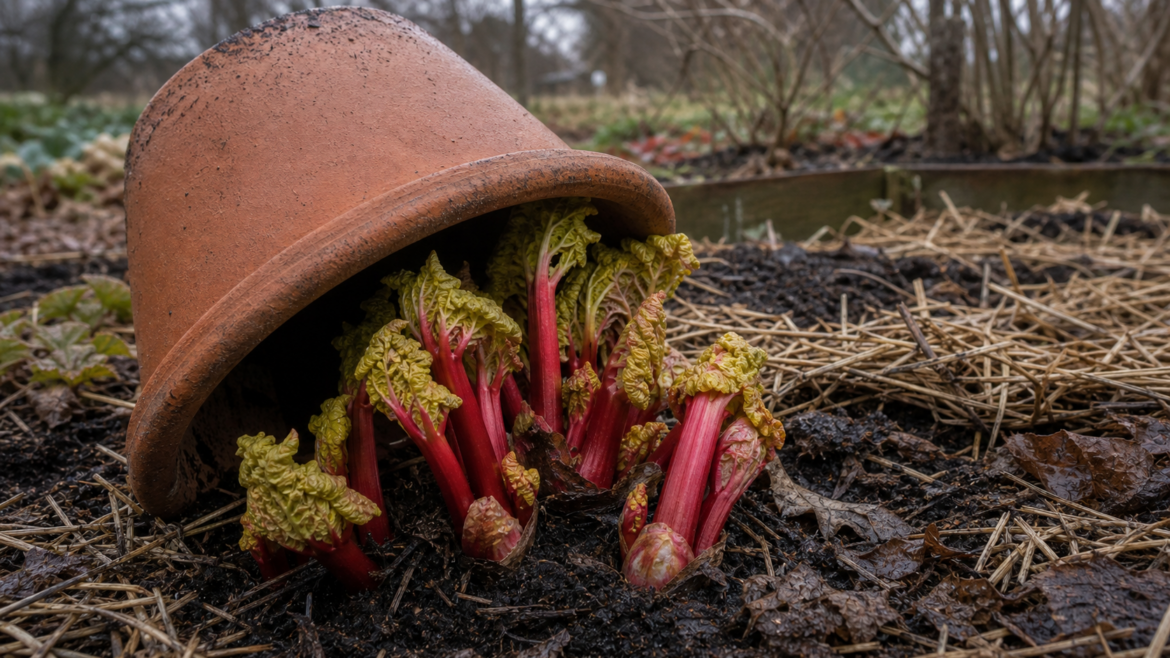
In February, a rhubarb crown can look like nothing at all. The leaves are gone, the bed is flat, and the plant seems to have retreated into a knot of roots below cold soil. Then a gardener puts a dark pot over it, waits, and finds red stems rising in the absence of light, tender and bright as if spring had been persuaded to speak in a whisper.
This is forced rhubarb. It sounds theatrical, but the method is simple: cover an established crown before or just as new growth begins so the stalks develop in darkness. The Royal Horticultural Society describes forcing as excluding light to produce an earlier crop of tender stalks with less green coloring.1 The plant is not being tricked from nothing. It is spending stored energy.
That is what makes the practice so interesting. Forced rhubarb is a conversation with reserves. The crown gathered energy the previous season, rested through cold, then used that stored strength to push new stems upward before the garden around it had properly begun.
A perennial with a pantry underground
Rhubarb is a hardy perennial vegetable grown for its thick leaf stalks, not for its leaves. Iowa State University Extension describes it as a cool-season perennial that can remain productive for many years when planted in a suitable site.2 The foliage may vanish in winter, but the crown at or just below soil level and the roots remain alive, carrying buds and stored carbohydrates into the next growing season.4 The same reserve-and-recovery bargain helps explain why asparagus spears seem to appear overnight: an early edible shoot is brief, while rebuilding the perennial crown is the long work.
Forcing works because those buds are already prepared to grow. Darkness changes the character of that growth. Without light, the leaf blades stay small and yellowish while the stalks elongate and remain tender. Forced stalks usually have less green coloring and often look pinker than ordinary spring rhubarb, although the exact color still depends on cultivar.14
The crown pays for that early performance. A forced plant has used energy before it has had leaves in the sun to replace it. That is why forcing belongs on mature, vigorous crowns, not young plants still trying to establish themselves.
Choose the crown carefully
Use only a healthy, vigorous crown that has grown in place for at least three years. Both the Royal Horticultural Society and Iowa State University Extension advise waiting until a crown is at least three years old before forcing it.12 A crown needs reserves before you ask it for an early, shaded crop.
Do not force a weak plant, a newly divided crown, or a rhubarb that struggled through drought, disease, or heavy harvest the previous year. It may still produce a few stems under cover, but you will be borrowing from a small account. Better to let that plant grow normally, water it in dry weather, base any fertilizer or compost on the site’s needs, and consider forcing another year.
Never force the same crown in consecutive years. Iowa State recommends rotating among two or three plants; where space allows, a longer rest is prudent, and the RHS adviser featured in its forcing guide rests each crown for at least three years.12 The best forced rhubarb comes from restraint as much as from darkness.
The dark cover
A traditional rhubarb forcer is a tall terracotta cover with a removable lid, but the plant does not require ceremony. An upturned large pot, a clean black nursery container, a bucket, or a lidded bin can work if it blocks light and leaves room for stems to rise. Choose a cover tall enough for about 12 inches (30 cm) of growth, block drainage holes that admit light, and secure a lightweight pot or bin against wind.12
Time forcing to local conditions. RHS guidance for the UK covers crowns before strong growth in December or January, while Iowa State begins as shoots emerge in early spring.12 In a cold garden, loose straw around the outside of the cover can moderate temperature. The aim is not to cook the crown. It is to create a dark, sheltered room where growth can begin.
Before covering, clear away soggy debris and check that the crown is not sitting in a wet hollow. A little compost around the plant can be useful, but do not bury the crown deeply. Rhubarb likes fertile, well-drained soil, and the University of Maine Cooperative Extension notes that it does best in a well-drained site with good organic matter.3
What happens under the pot
For several weeks, very little seems to happen from the outside. Inside, buds swell. Stalks lengthen toward the top of the dark chamber. Leaf blades begin to unfold but remain small, puckered, and pale because they are not receiving light. Depending on cultivar, the stalks may range from pink to deep red.
Check every week or two, since growth speeds up in milder weather. Forced stalks are often ready after four to eight weeks. When they are long enough to harvest, twist and pull them from the crown rather than slicing through the base.12
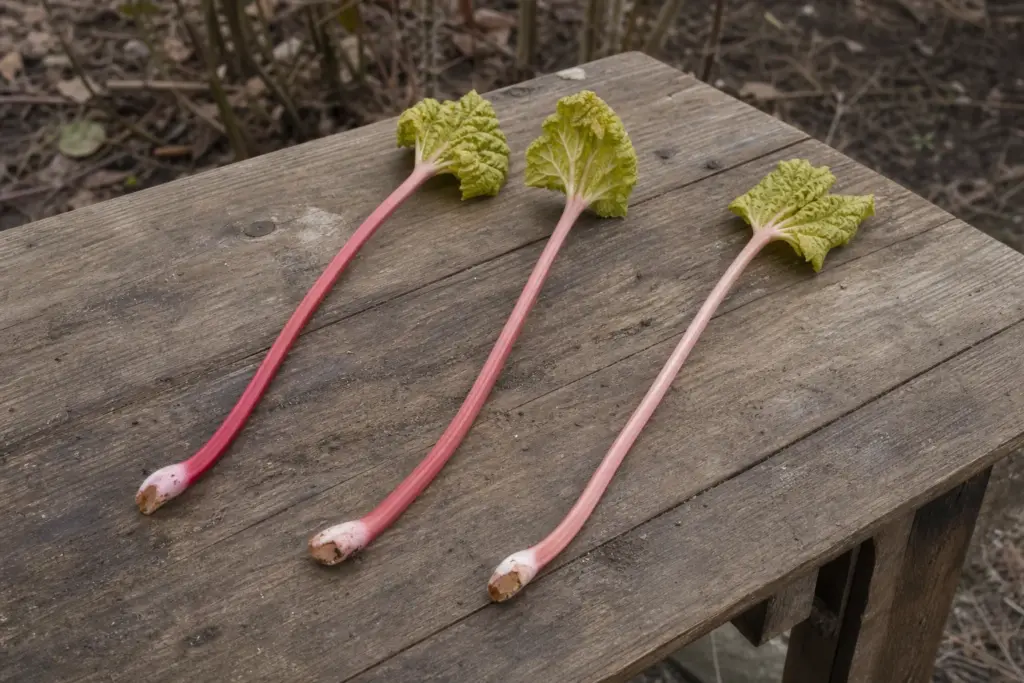
Eat only the stalks, which are leaf petioles; rhubarb leaf blades are toxic and should not be consumed. Remove the blades at harvest. Disease-free leaves may go into an ordinary compost pile: Iowa State and the RHS state that oxalic acid and soluble oxalates break down during decomposition, and finished compost containing rhubarb leaves is safe to use in a vegetable garden.24 After a freeze, discard stalks that have become soft or mushy; firm, undamaged stalks and new growth that follows remain safe to harvest.2
Outdoor forcing or indoor forcing?
Most home gardeners will do best with outdoor forcing in place. The crown remains in the bed, the soil buffers temperature, and the plant can return to ordinary growth once the cover is removed. This is also less disruptive to the root system.
Indoor forcing is possible with lifted dormant crowns, but it is harder on the plant. The RHS method exposes lifted roots to additional cold if needed, then pots them and keeps them dark at 45 to 60 degrees F (7 to 16 degrees C), damp but not wet. Stalks may be ready in about five weeks, but crowns forced this way are usually badly weakened and discarded after harvest.4 It is usually more than a home gardener needs.
In a small garden, the gentler method is enough: choose a mature crown, cover it before or just as growth begins according to local conditions, harvest modestly, then let it grow in daylight again.
After the early harvest
Once you have taken the forced crop, remove the cover and do not harvest that crown again in the same season. Leave all later foliage to photosynthesize and rebuild the reserves you asked the plant to spend early.14
Keep weeds down, water during dry spells, and topdress with compost if the soil needs organic matter. Iowa State notes that healthy foliage stores food in the roots for the following year’s growth, while the RHS forcing guide recommends a mulch of well-rotted organic matter after the cover comes off.12
If the crown seems tired, listen. Thin stalks and weak growth can indicate lost vigor; skip forcing and check soil, drainage, crowding, and care before asking for another early crop.4 Rhubarb is long-lived when treated as a perennial partner rather than a machine.
Why the practice is worth trying
Forced rhubarb is not necessary. Outdoor rhubarb will arrive in its own time, and there is nothing wrong with waiting. But forcing teaches something useful about the plant. It shows how much spring is prepared before spring is visible. It shows how a crown stores last year’s sunlight and spends it as this year’s first growth. It shows that darkness does not stop a plant from moving, but it changes the kind of growth it makes.
There is also the pleasure of the harvest itself. In a season of stored onions, seed catalogs, and wet boots by the door, lifting a cover to find red stalks in the dark feels like opening a letter from the coming garden. It is not a large crop. It is a signal.
Useful rhubarb-forcing supplies
- Pro Cal 10-gallon nursery pots (5-pack): black plastic pots that can serve as light-blocking covers when inverted over mature crowns; cover drainage holes if they admit light.
- Clean straw mulch: useful for insulating around the outside of a forcing cover in cold, exposed beds.
- AcuRite soil thermometer: optional for comparing late-winter soil conditions in exposed and sheltered beds; it is not required for forcing.
Final thoughts
Forcing rhubarb is a small, old-fashioned winter experiment with a serious plant lesson inside it. You are not making growth from darkness. You are revealing growth that the crown has already saved for, then shaping it with shade, shelter, and timing.
Use a strong crown. Cover it before or just as growth begins, following local conditions. Harvest modestly, then remove the cover and let the rest of the season belong to recovery. If you treat the plant generously, the reward is more than a handful of red stems. It is a clearer sense of how perennials remember the previous year underground.
February often feels like the garden’s pause. Forced rhubarb proves that it is also a held breath.