
The dream is easy to understand: a garden that glows after dark with luminous mushrooms, sparkling water, and living plants. The useful version is quieter, but more interesting. Bioluminescence is not a substitute for path lights, and most living light is faint enough that a porch lamp, phone screen, or nearby window can erase it from human perception.
That does not make the idea useless. It changes the design brief. The best bioluminescent garden is less a lighting scheme than a small night observatory: you are arranging darkness, moisture, sightlines, containers, and expectations so that living light has a chance to be noticed.
NOAA defines bioluminescence as light produced and emitted by a living organism, with the light coming from chemical reactions inside or released by that organism.1 It is different from glow-in-the-dark paint or plastic stars, which store energy and release it later. It is also different from fluorescence, which needs an external light source. A real bioluminescent garden should respect that distinction.
Start With Darkness, Not Glow
Most gardens are too bright for subtle biological light. Security lamps, unshielded porch lights, cool-white LEDs, reflective paving, and neighboring windows all reduce dark adaptation. If your eyes never adjust, faint fungal glow or a soft bioluminescent petunia will seem disappointing even when the organism is doing exactly what it can do.
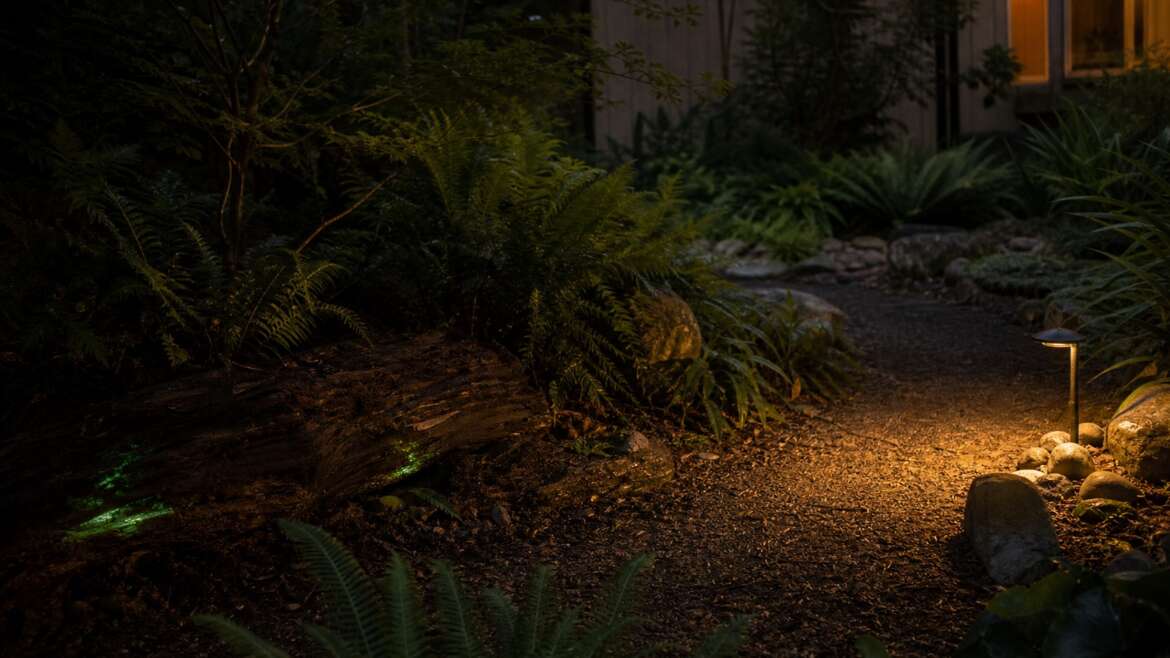
DarkSky International recommends that outdoor lighting be useful, targeted, low-level, controlled, and warm-colored.8 The National Park Service gives similar practical advice: use light only where needed, use fully shielded fixtures, choose warm LEDs, and keep light levels as low as the task allows.9 For a home garden, that means low, shielded path lights for safety, not decorative uplighting sprayed across the whole planting bed.
Place the living-light feature away from the light source. Put a bench or viewing spot in the darker part of the garden. Use a timer or motion sensor so lights are not on all evening. If you need to walk safely, use the path light. If you want to see bioluminescence, step away from it, wait a few minutes, and let your eyes adjust.
If you want the garden to read after dusk even when nothing is glowing, borrow from moon-garden design: pale flowers, silver foliage, fragrant night bloomers, and strong silhouettes can carry the space while the biological light remains a small reward.
Use Fungi as a Damp-Wood Feature
Fungi are the most garden-like source of natural glow because many bioluminescent species are associated with decaying wood. The old name for this light is foxfire. Cornell’s Mushroom Blog notes that most fungi do not glow, and that North American glowing species often require dark-adjusted eyes before their light can be seen.2 That is the key design lesson: make the fungal element intimate and shaded, not theatrical.
A good setting is a contained nurse-log feature in a cool, moist, shaded corner: a partially buried hardwood log, leaf litter, ferns, mosses that are already suited to the site, and a nearby seat or stepping stone. The log is the stage. The surrounding plants make the space feel intentional during the day, while the darker background helps any faint glow register at night.
There are important cautions. Do not inoculate living trees or prized shrubs with random glowing fungi. Some wood-decay fungi are plant pathogens, with Armillaria root rot a familiar garden example,10 and some luminous mushrooms, such as jack-o’-lantern mushrooms, are poisonous.11 Do not use this as a foraging cue, and do not move wild fungi across regions. If you experiment, keep it small, contained, and locally appropriate, and treat any mushroom as an ornamental organism unless an expert has identified it for another purpose.
Keep Glowing Water Contained
The glowing “algae” people imagine in water gardens are usually marine dinoflagellates: single-celled plankton that can flash blue-green when disturbed. Smithsonian Ocean describes surface blooms of bioluminescent dinoflagellates that sparkle as waves move them at night.4 That natural spectacle does not translate cleanly to a freshwater pond. For more background on the organisms before the design choices, Soil Sages has a separate look at bioluminescent fungi and algae.
For a garden, the responsible version is a contained saltwater culture in a clear vessel, not an outdoor pond, stream, or rain barrel. The Latz Laboratory at UC San Diego describes dinoflagellates as readily grown in home, school, or laboratory cultures, but the care is closer to a small culture system than ordinary gardening: marine medium, nutrients, room temperatures around 20-25 degrees C, a regular light-dark cycle, and clean handling.3
Design with their behavior in mind. Dinoflagellates usually flash when gently swirled or agitated; they are not a steady underwater lamp. A sealed or covered tabletop vessel near a seating area can be delightful for evening guests. An open pond full of imported marine plankton is not a responsible garden feature. Do not pour cultures into drains, ponds, streams, or coastal water.
Consider Bioluminescent Petunias, With Context
Bioluminescent plants are no longer only science fiction. In 2020, researchers reported tobacco plants engineered with a fungal bioluminescence pathway that uses caffeic acid, a compound found in plants, to support self-sustained visible luminescence.5 That line of work led to commercial bioluminescent petunias.
In 2023, USDA APHIS reviewed Light Bio’s genetically engineered autoluminescent petunia and determined that it was not subject to regulation under 7 CFR part 340 because APHIS did not identify a plausible pathway for increased plant pest risk compared with conventional petunias.6 That is a plant-pest regulatory finding, not a blanket rule for every country or every future glowing plant. Gardeners should still check local rules, especially outside the United States.
As of July 5, 2026, Light Bio says its 2026 season has closed and that its plants are expected to return in spring 2027.7 The company also says the plants are sold as live plants, not seeds. If you use them in a design, treat them like specimen petunias in pots or hanging baskets: sunny by day, viewed in real darkness by night, with regular water and feeding. The youngest flowers and new growth are typically the brightest, but the glow is still soft.
A Practical Layout
Begin with a dark pocket of the garden rather than the most visible patio edge. A shaded side yard, woodland border, or quiet corner under shrubs works better than a bright entertainment area. Give the space a clear path, but light the path from below with shielded warm fixtures rather than overhead lamps.
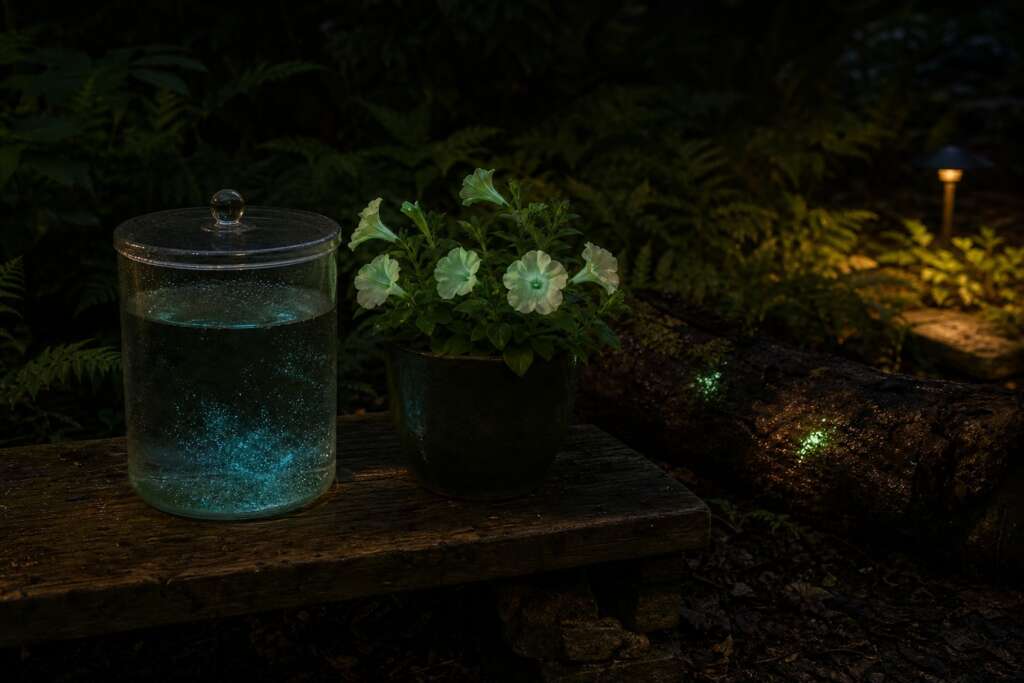
- The fungal focus: a damp-log bed with ferns, leaf litter, and locally suitable shade plants. Keep it close enough to view, but far enough from the path light to remain dark.
- The contained water accent: a small, removable vessel of marine dinoflagellates on a bench, shelf, or table for occasional viewing. Think of it as a living display, not a pond treatment.
- The plant accent: bioluminescent petunias, if legally and practically available, in pots that receive strong daytime light and can be moved or viewed in a dark spot after sunset.
- The supporting night garden: white flowers, pale bark, silver foliage, fragrant night bloomers, and textured foliage that reads in low light without needing glare.
This layout gives you multiple kinds of nighttime interest without pretending that any one organism will light the whole garden. It also keeps the higher-risk elements contained: fungi in dead wood, marine plankton in vessels, and engineered petunias in managed plantings.
What to Skip
Skip claims of glowing moss unless the source is very clear about what is glowing. Most moss does not bioluminesce. Skip open-water releases of dinoflagellates. Skip mushroom projects near vulnerable trees or shrubs. Skip blue-white floodlights, blacklights, and decorative lighting that overpowers the very darkness the garden needs. And be skeptical of photos: long exposures can make faint glow look much brighter than it appears to the eye.
The most accurate version of a bioluminescent garden is not a fantasy landscape blazing with neon life. It is a dark, carefully edited garden where a damp log, a small vessel of living plankton, or a pot of glowing petunias can reward patience. Design the night well, and the glow can stay small without feeling like a failure.
References
- NOAA National Ocean Service: What is bioluminescence?
- Cornell Mushroom Blog: This Bark Glows in the Dark! Bioluminescence in Mushrooms
- Latz Laboratory, UC San Diego: Dinoflagellate Culturing
- Smithsonian Ocean: Bioluminescence
- Mitiouchkina et al., Nature Biotechnology: Plants with Genetically Encoded Autoluminescence
- USDA APHIS Regulatory Status Review Response: Light Bio Petunia
- Light Bio: Firefly Petunia Availability and Care Information
- DarkSky International: Support Responsible Outdoor Lighting
- National Park Service: Outdoor Lighting Principles
- UC IPM: Armillaria Root Rot
- NC State Extension: Omphalotus illudens (Jack-O-Lantern)