
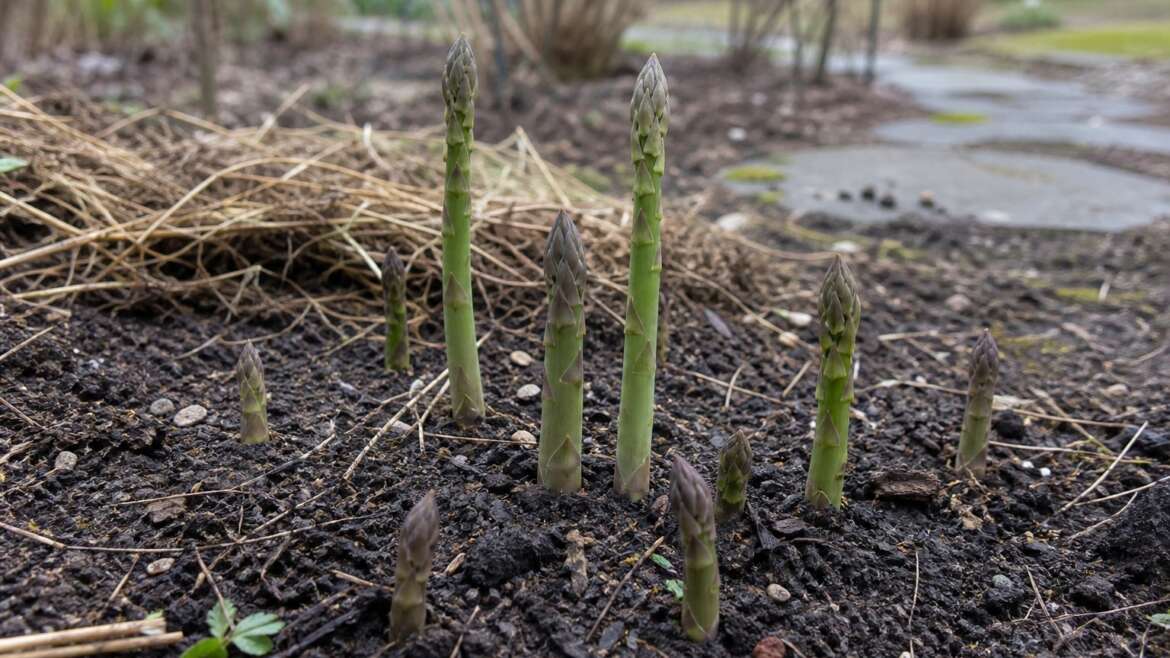
An asparagus bed can look empty in a way that tests a gardener’s memory. In late winter it is just a strip of soil, a little straw, perhaps a few cut stalks from last year if cleanup was delayed. Then a mild spell passes through. You walk by in the morning and see nothing. By evening, a green point has broken the surface. The next day there are three. A week later the bed seems to be sending up edible pencils from underground.
This is why asparagus feels different from almost every other vegetable in the garden. Lettuce arrives leaf by leaf. Peas climb into view. Tomatoes spend a long time looking like plants before they become harvest. Asparagus begins as a surprise. The part we eat is not a fruit, a leaf, or a root. It is a young shoot moving fast on stored energy, soil warmth, and the plant’s long memory.
University of Maryland Extension describes asparagus as a perennial that commonly lives for 12 to 15 years or longer, with spears developing daily from underground crowns during harvest.1 That one fact changes how the whole crop should be read. A spear is brief. The plant beneath it is not.
The spear is only the first sentence
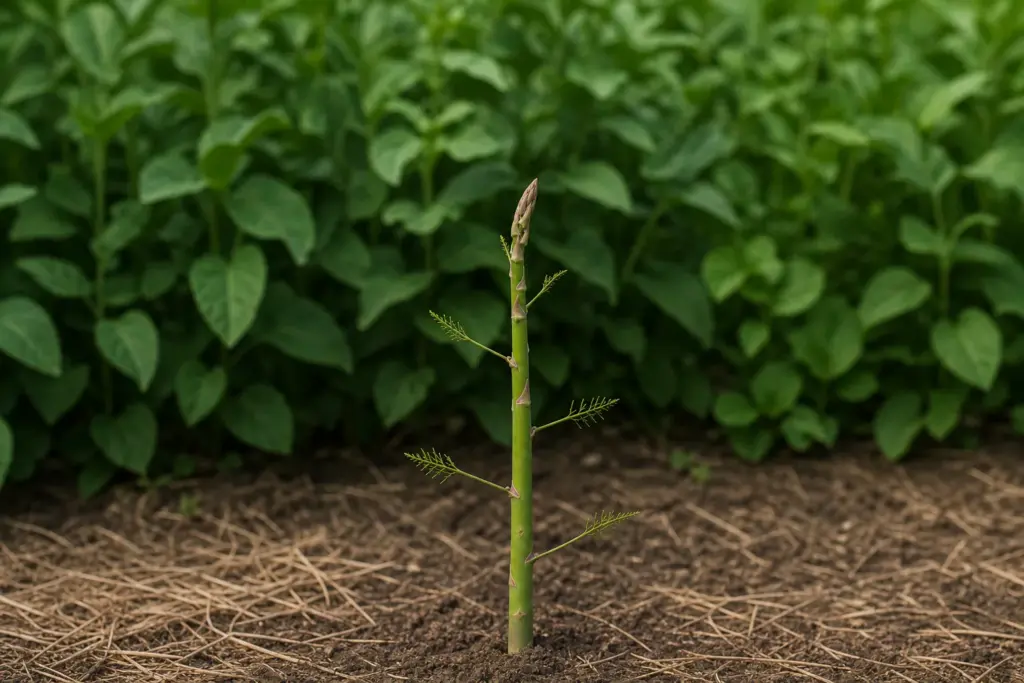
Asparagus grows from a crown, the underground root-and-bud system that sends up new shoots year after year. Those shoots are the spears. If a spear is left uncut, it does not stay a spear for long. It lengthens, branches, and opens into the airy green growth gardeners call fern. Maryland Extension makes the practical distinction clear: spears develop from the crown during harvest, then the later shoots must be allowed to grow once harvest ends.1
That fern stage is not an afterthought. It is the plant’s income. The fern catches light and rebuilds the reserves below ground. A study of asparagus spear sugars notes that sucrose and fructans accumulate in the roots, then are broken down to supply energy for spear development.2 When you harvest asparagus, you are taking shoots before they can become the solar panels that would pay the plant back.
This is the central bargain of asparagus growing. The plant offers tender spears early, before most vegetables are ready. The gardener takes some of them, but not all, and not forever. The bed survives because harvest ends while the season is still young enough for the ferns to rebuild.
Soil warmth is the quiet alarm clock
Calendar dates are a poor way to understand asparagus. March 3 may be bare soil in one garden, frozen mulch in another, and the beginning of harvest in a warmer region. The crown is paying closer attention to temperature below the surface than to the month name above it. That mismatch is a small example of using phenology instead of the wall calendar to read a particular garden.
Michigan State University Extension has described asparagus emergence as a two-step temperature story: deeper soil temperatures help predict when crowns wake from winter, while shallower soil temperatures help predict when shoots grow enough to break the surface.3 That explains the odd pause gardeners sometimes notice. A warm week may start the process underground, then a cold spell slows the visible result. The bed has not forgotten. It is waiting for the upper soil to cooperate.
Oregon State University’s vegetable production guide gives the simple version of that threshold: spear growth begins slowly around 50 degrees Fahrenheit, then becomes fastest in warmer soil, especially with good moisture.4 Once the soil is warm enough, asparagus has little reason to move politely. The bud is already formed. The stored food is already there. The spear’s job is to elongate quickly before it opens into fern.
That is why mulch can be both useful and slightly inconvenient. Straw or leaves suppress weeds and protect soil, but they can also keep the asparagus row cooler in early spring. Maryland Extension describes a simple season-extension comparison: exposed soil warms sooner and its crowns sprout before those under retained mulch.1 Pulling mulch from the row can bring emergence forward; leaving it temporarily in place delays the first spears, a potential advantage when the forecast still carries frost risk.3
Why the growth feels sudden
Part of the overnight illusion is that the plant begins out of sight. The crown wakes, buds push, and the spear travels upward before the gardener sees the first tip. By the time the spear is visible, it is already committed. A few warm days can turn a small purple-green point into something worth cutting.
At peak season, a bed can change between breakfast and dinner. Iowa State says harvest frequency depends on temperature and moisture: picking may be necessary every day in warm weather, while every two or three days can be enough in cooler periods.5 That is not garden folklore. It is the visible result of a perennial plant spending reserves at the moment conditions finally suit it.
The speed also explains why asparagus can change quality so quickly. In warmth, a tight spear elongates and its bracts loosen sooner. But tenderness is not as simple as warm equals fibrous or thin equals tender: Oregon State notes that fiber is concentrated toward the base, and that cool-grown spears can contain more fiber proportionally because elongation is slower.4 For a home harvest, the useful rule is simpler: take firm spears with compact tips at about 6 to 8 inches, then cool them promptly.18
Harvesting without weakening the bed
The hardest asparagus rule is the one that asks a new gardener to wait. A newly planted crown is not ready to pay rent immediately. Exact schedules vary with how the bed was started and how strongly it grew. Iowa State advises no harvest during the first two years after planting, then an Iowa harvest ending in early to mid-June from the third year onward.5 Utah State likewise delays harvest until year 3, limits it to four weeks that year, and lengthens the season as the bed matures.6
That restraint can feel absurd when the first spears look perfect. But asparagus is not a one-season crop. A bed stripped too early, too young, or for too long may still survive, but it often answers with thinner spears and lower vigor later. The plant spends stored carbohydrates to make each shoot; if every shoot is removed before fern growth can rebuild the reserve, the account runs down.2
For established beds, the daily decision is simpler. Harvest spears while they are firm and tight. Treat a sustained shift toward thin spears as a signal to end the season, not as a reason to leave a few isolated shoots among an otherwise active harvest. Utah State says to stop when most spears are thinner than a pencil.6 Iowa State recommends removing all spears during the active harvest because scattered fern growth can inhibit new spears; once the season ends, allow the later shoots to fern together.5
The fern is not a weed
After harvest ends, asparagus changes character. The tight edible points become tall, fine-textured ferns that can make the bed look almost ornamental. This is where some gardeners get impatient. The ferns flop, shade nearby paths, catch beetles, and make the tidy spring row look looser by midsummer.
Resist the urge to tidy too soon. The fern is the repair season. Illinois Extension explains that vigorous fern growth produces and stores nutrients in the roots for the next production season.8 Utah State likewise ties healthy fern and stored food to good spear growth.6 Even in an established bed, the fern is what turns this year’s sunlight into next year’s sudden spears.
The usual cleanup can wait until frost and natural yellowing show that the foliage has finished for the season.1 Removing old tops then also makes the bed easier to inspect in spring. Until that point, those soft green plumes are not the asparagus getting messy. They are the asparagus saving.
What the bed asks for in return
Because asparagus is perennial, the site matters more than it does for many vegetables. You can move lettuce next month. You do not want to move an asparagus bed next month. It wants full sun, steady moisture, good drainage, and room for tall summer ferns. Iowa State warns that wet sites can invite Phytophthora crown rot and recommends raised beds where drainage is poor.7
Weed control matters because the crown is investing for years, not weeks. Pull weeds while they are small. Maryland Extension favors pulling rather than hoeing during production, and Utah State warns that tilling can injure crowns.16 Illinois limits cultivation to light, shallow work early in spring; once spears are emerging, hand pulling and mulch avoid probing around hidden shoots.8
Both cutting and snapping are acceptable. Iowa State advises cutting at the soil surface or snapping slightly above it, because cutting below ground can damage spears that have not emerged.5 Illinois Extension notes that a snapped spear usually breaks at the lowest point free of fiber.8 However you harvest, attentiveness matters. In asparagus season, the bed changes faster than a gardener’s routine. Check often, especially after warm rain.
A perennial with a spring pulse
Asparagus seems to appear overnight because much of its work happens before the gardener is invited to notice. The crown has stored last year’s light. The buds are waiting below the soil. The warming ground opens the gate. Then the spear rises quickly, tender for a short window, already on its way to becoming fern.
That speed is part of the pleasure. An asparagus bed makes spring feel physical. It turns soil temperature, stored carbohydrates, and restraint into dinner. The first spear is not simply an early vegetable. It is a message from a plant that has been keeping time underground, and it asks the gardener to keep time too: harvest, watch, stop, and let the fern make the next miracle possible.
References
- University of Maryland Extension: Growing asparagus in a home garden
- Takahashi et al.: Sugar composition in asparagus spears and its relationship to soil chemical properties
- Michigan State University Extension: Predicting asparagus emergence
- Oregon State University: Asparagus
- Iowa State University Extension: Harvesting asparagus
- Utah State University Extension: How to grow asparagus in your garden
- Iowa State University Extension: Planting asparagus in the home garden
- Illinois Extension: Asparagus