
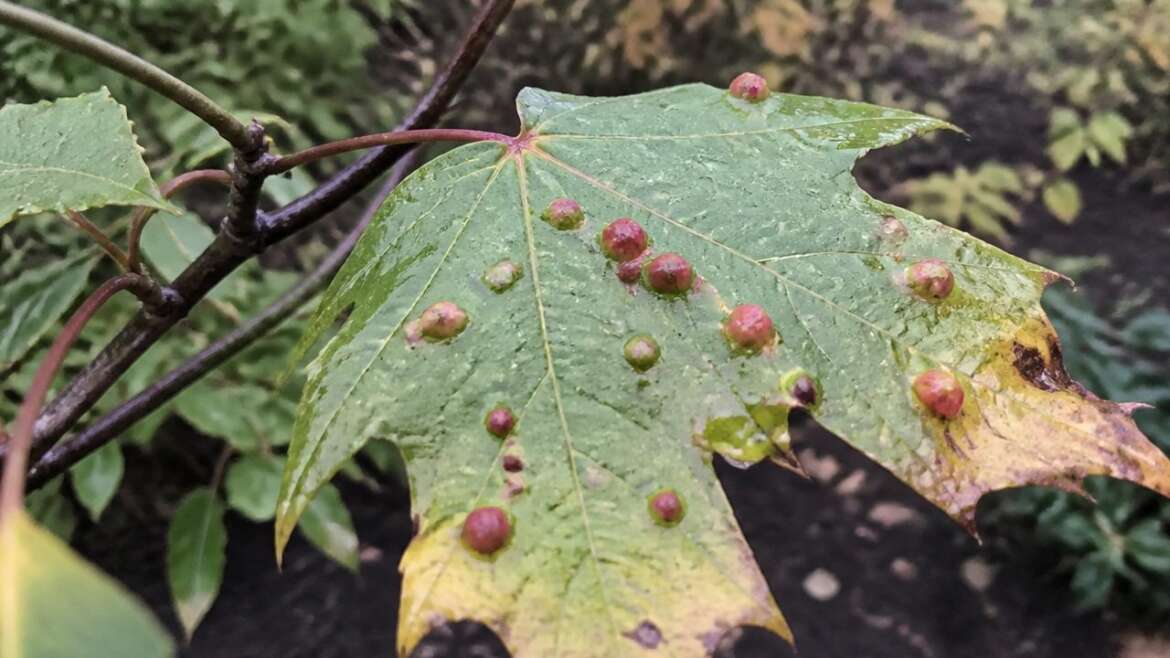
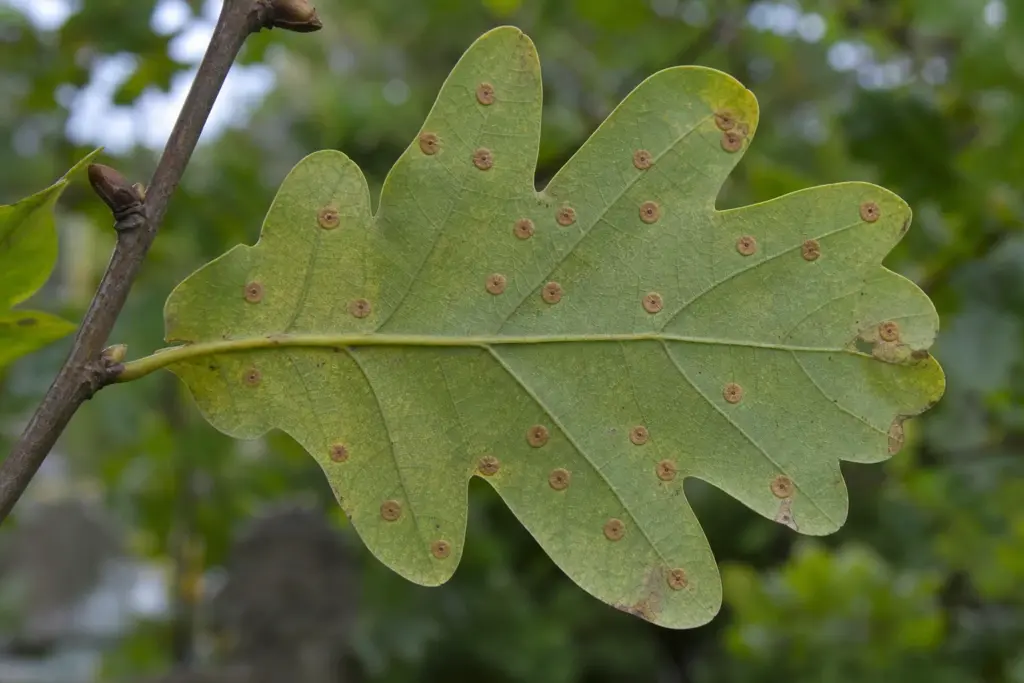
By September, leaves begin to collect evidence. A maple leaf that looked ordinary in June may now be dotted with red beads. An oak leaf may carry small brown discs, pale blisters, or fuzzy patches that look halfway between velvet and rust. Turn the leaf in your hand and the pattern can feel too deliberate to be simple damage.
These odd swellings are often galls. They are not eggs glued to the leaf, and they are not usually a disease spreading across the tree. In many cases, they are plant tissue itself, redirected into a strange little structure by an insect or mite that began its work months earlier.
That is what makes galls so satisfying to notice. They are botanical architecture built under animal influence. A gall looks like a thing growing on a leaf, but it is more intimate than that. The leaf has been persuaded to build it.
What a gall really is
The University of Minnesota Extension describes galls as abnormal plant growths caused by organisms such as insects, mites, nematodes, fungi, bacteria, and viruses. Insect and mite galls can begin when feeding or egg-laying triggers changes in plant growth hormones, causing plant cells to enlarge or multiply in unusual ways.1
In garden terms, that means the bump is not simply a blister from injury. It is organized growth. The plant supplies the walls, the color, the texture, and often some of the food. The insect or mite supplies the irritation, chemistry, or feeding pattern that starts the building process.
Iowa State University Extension notes that plant galls can take many forms: bumps, warts, spheres, spines, fuzzy patches, smooth swellings, and other shapes on leaves, stems, and flowers.2 This variety is one reason they can be so confusing. A gall on a hackberry leaf may look like a wart. A maple bladder gall may look like a scattering of tiny red beads. An erineum gall may look more like felt than swelling.
The form is often a clue. Gall-makers tend to be particular about their hosts and about the kind of structure they induce. A certain mite may make a certain blister on a certain maple. A tiny wasp may make a particular oak gall. Once you begin to see them, the garden becomes less like a flat green surface and more like a set of signatures.
Why they show up late
Leaf galls are often noticed in autumn, but many begin much earlier. The University of Minnesota explains that galls usually form during the fast growth period of new leaves, shoots, and flowers in late spring, when plant tissue is still flexible enough to be redirected.1 Mature tissue is harder to persuade.
That timing explains the September surprise. By the time a gardener sees a leaf dotted with bumps, the important moment may be long past. The mite or insect may be protected inside the gall, already gone, or too far along for any ordinary spray to matter. The gall is a record of spring activity that becomes obvious only after summer has made it large, colored, or dry.
Maple bladder galls are a good example. Iowa State University Extension describes them as being caused by very small mites that overwinter under bark and move to unfolding leaves in early spring. The leaf responds by producing extra cells at the feeding site, and the gall encloses the mite while it feeds and lays eggs.3
To the gardener, the dots appear later as a cosmetic mystery. To the mite, the important window was the moment the leaf was opening. By September, the visible gall is less a current attack than a small finished room.
A room, a pantry, and a shield
Galls are sometimes described as shelters, but that undersells them. Many are shelters, food sources, and protective walls at the same time. Missouri Botanical Garden explains that galls may form when insects or mites feed, lay eggs, or otherwise irritate actively growing tissue; the enclosed organism receives shelter or food inside the gall, while the plant receives little benefit.4
This arrangement can sound almost sinister, but most leaf galls are not dramatic enemies of the garden. They are better understood as tiny ecological negotiations. A small organism uses a plant’s growth system for its own purposes. The plant spends some energy making the gall. The leaf keeps doing much of its ordinary work around it.
There are exceptions. Galls on stems and twigs can matter more than leaf galls, especially when they are numerous or repeated year after year. Young trees under stress deserve closer attention than large established trees. But the strange beads and felted patches on autumn leaves are usually less alarming than they look.
What to do when you find them
The first useful response is to slow down before treating anything. Missouri Botanical Garden notes that galls affecting leaves are seldom, if ever, a serious problem.5 The University of Minnesota also states that insect galls rarely affect plant health and that control is generally not suggested.1
That advice runs against a common gardener’s instinct. We see a deformity and want to correct it. But leaf galls are often already sealed structures by the time we notice them. Spraying after they appear is usually too late, and it risks harming the predators and parasitoids that make a garden more balanced. The gall protects its maker better than a late spray can reach it.
If the tree or shrub is otherwise healthy, the best treatment is ordinary good care. Water during real drought, mulch lightly out to the drip line without piling mulch against the trunk, avoid unnecessary root damage, and let the plant keep its leaves until they fall naturally. A tree that is well supported can afford a few odd structures on leaves it was going to shed anyway.
If a young tree has heavy twig galls, dieback, or repeated branch swelling, that is a different question and worth identifying more carefully. But for the bright red beads on maple leaves, the little pouches on hackberry, or the fuzzy patches that appear under leaves, the most useful tool is often a hand lens rather than a pesticide.
A pattern worth keeping
Leaf galls are one of the garden’s better reminders that not every strange mark is a crisis. Some are signs of a complicated living neighborhood. A tree is not a solitary object. It is a host, a shelter, a feeding ground, and a weather station. Insects, mites, fungi, birds, and people all read it differently.
That does not mean a gardener should ignore every symptom. It means the first question should be better than “What do I spray?” A better question is “What is this, and is the plant actually suffering?” With leaf galls, the answer is often more interesting than dangerous.
In autumn, when the leaves are already beginning to give themselves back to the soil, those little bumps become part of the season’s texture. They are not flaws in the leaf so much as evidence of another life written into it.