
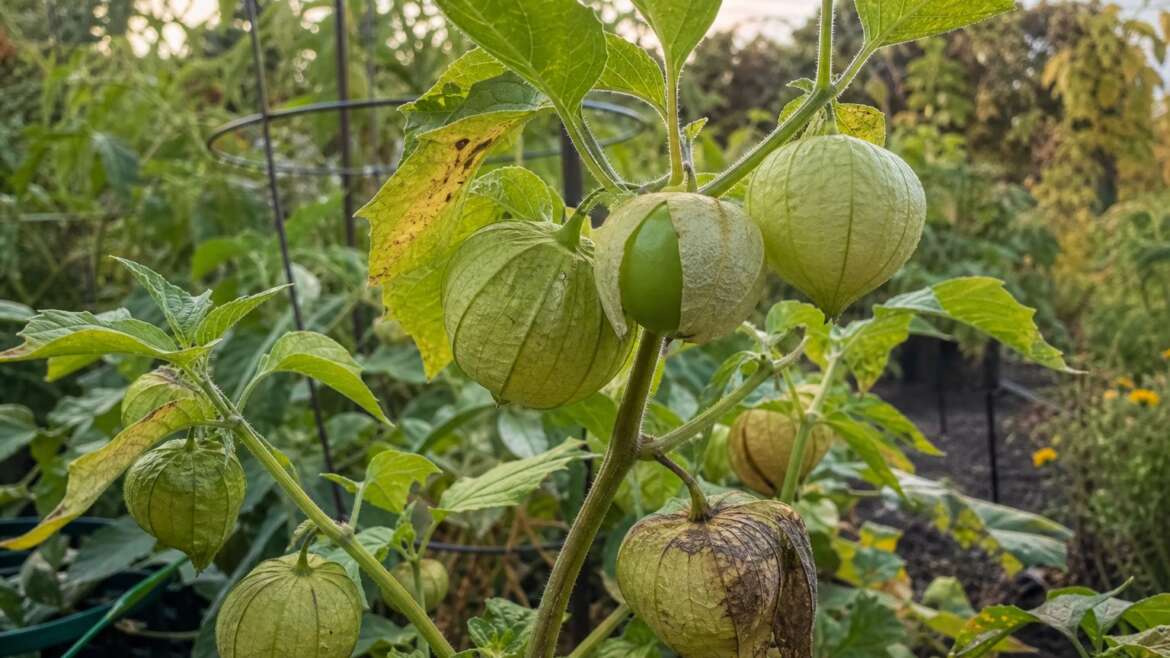
By the end of September, a tomatillo plant can look as if it has been quietly making decorations while the tomatoes were taking all the attention. The plant sprawls through its cage, lifts yellow flowers in the leaf forks, and hangs little green lanterns from the stems. Some are tight and empty-feeling. Some are papery and swollen. Some have split just enough to show the firm green fruit pressing from inside.
Those lanterns are the part of the plant that make gardeners stop and look twice. A tomatillo is not simply a green tomato in wrapping paper. It is a different kind of fruiting trick, one that belongs to the genus Physalis, a group known for berries enclosed in husks. UF/IFAS describes tomatillos and husk tomatoes as members of the nightshade family, with fruits surrounded by husks that resemble paper lanterns.1
The wrapper is not packaging added at the end. It is an old flower part that keeps growing after the flower has done its first job. Once you understand that, the plant becomes easier to read. The husk tells you about pollination, fruit growth, harvest timing, and why one lonely tomatillo plant can make a hundred hopeful lanterns with very little salsa to show for it.
The husk is a flower that kept going
Before there is a tomatillo, there is a small yellow flower. Like tomato flowers, tomatillo flowers have sepals at the base. In many plants, sepals protect the flower bud and then become visually unimportant once the petals open. In tomatillos and their relatives, the sepals do something stranger. After successful fertilization, the five persistent sepals resume growth, expand around the developing berry, and become the papery calyx we call a husk.
Botanists call this an inflated fruiting calyx or inflated calyx syndrome. A 2022 Frontiers in Plant Science study examined these structures in Physalis and related genera, including Physalis ixocarpa, the name used for tomatillo in that paper. It describes a calyx that enlarges after fertilization and encloses the developing fruit.2 In plain garden language, the tomatillo’s lantern is made from the flower’s own outer cup.
This is why the husk often appears before the fruit seems substantial. The calyx can inflate and hang like a little balloon while the berry inside is still small. When fertilization leads to fruit set, the berry gradually catches up. When fruit set fails, the husk may remain mostly empty, a green promise with nothing much inside it.
The effect is especially clear when you peel back a fresh husk. The veins of the calyx are still visible, like the veins in a leaf. It dries from living green to straw as the fruit matures, but it never stops looking botanical. It is not a shell. It is a piece of the flower that became architecture.
What the lantern does
A tomatillo husk looks delicate, yet its surface is a real barrier rather than decoration. The Frontiers study measured the calyx’s cuticular barrier and water permeability and concluded that it helps limit water loss while forming a protective microclimate around the fruit.2 The chamber is not sealed or pest-proof, and a torn husk offers less protection.
Experiments in the related species Physalis floridana, rather than in garden tomatillos, found that the green calyx photosynthesized, contributed to fruit and seed growth, and buffered low-temperature conditions.3 That study shows how active an inflated calyx can be, although its exact contribution should not be assumed to be identical in every Physalis species.
In the garden, the easiest physical consequence to see is separation: an intact husk stands between much of the berry’s surface and cage wires, damp mulch, or loose soil. That does not make dropped fruit clean, and it does not guarantee freedom from scuffs or insects. Think of the lantern as a buffer, not a sealed package.
There is also an elegant bit of timing. Early in development, the husk is green and alive. Later, as the fruit fills it, the husk becomes paler, drier, and more brittle. The plant makes the lantern useful first and readable later. A hollow husk says the fruit has not filled it; a full, tight husk tells you to check the variety’s other ripeness cues.
Empty husks often point to poor fruit set
One of the most confusing tomatillo moments is finding a plant loaded with husks that never fill. At first glance it looks productive. Every flower has become a lantern. Then you squeeze a few and realize they are mostly air.
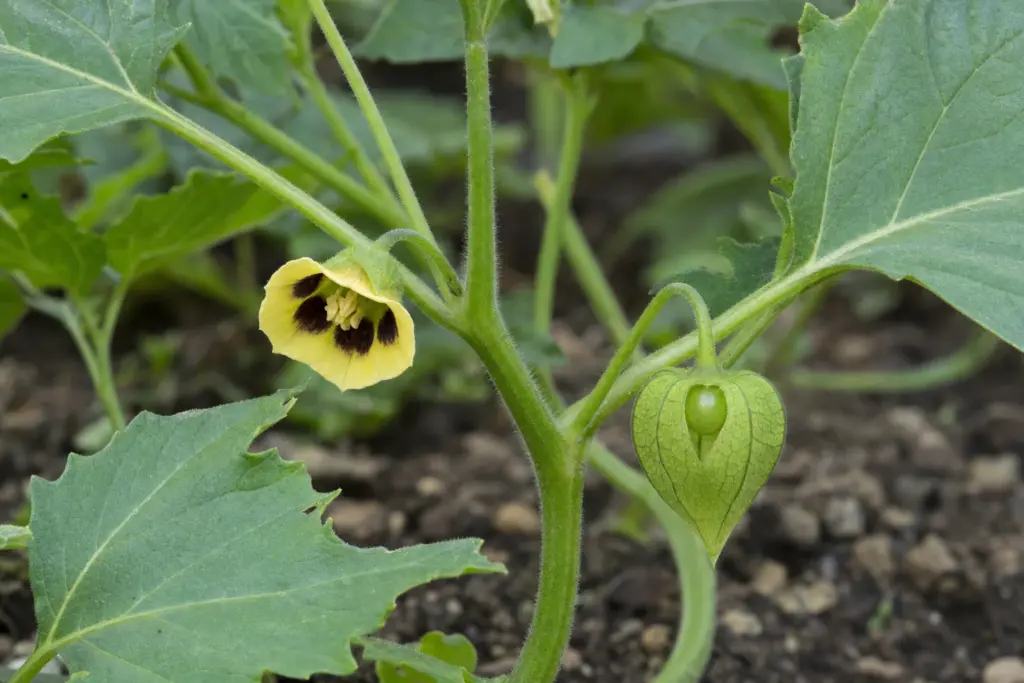
Often, the plant is not sick. Fruit set has failed. Utah State University Extension describes tomatillos as not self-fruitful and recommends at least two plants; they may be the same or different varieties. Bees and other insects move the pollen, while extreme temperatures and dry conditions can interfere with fertilization.4
This is different from the way many gardeners think about tomatoes. A single tomato plant can often set a crop because its flower structure allows self-pollination. A lone tomatillo may bloom generously and still behave as if no one has answered the door. The flower can age, the calyx can inflate, and the fruit inside can remain small or absent.
For a reliable crop, plant at least two tomatillos close enough that bees can work both, but leave room for their mature spread. The variety labels do not have to differ. Give them full sun, warm soil, and steady moisture. If the garden is extremely hot, dry, stormy, or short of visiting insects, fruit set may still wobble, but the plants at least have a chance to exchange pollen.
How to read a ripe tomatillo
Tomatillos can make ripeness feel backward because the fruit is often best while it is still green. With many green varieties, yellowing is not the goal. It can mean the fruit is moving past the bright, tangy stage that makes salsa verde taste awake.
South Dakota State University Extension says tomatillos are generally ready 75 to 100 days after transplanting, when the fruit completely fills the husk, the husk dries from green to tan and begins to split, and the fruit comes off the plant easily. It also notes that green varieties should be harvested before they turn yellow or purple because they soften and lose tangy flavor as they change color.5
The hand test is useful. A young husk feels hollow. A maturing one has resistance. A harvest-ready one feels as if the fruit has pressed the lantern into its final shape. Sometimes the husk splits at the seams, revealing the green globe inside. Sometimes the fruit drops before you notice. If fallen fruit is clean, firm, and undamaged, gather it and use it soon or let it finish in the husk.
Variety matters. Purple tomatillos have a different color cue from green ones, and small-fruited types may never fill the hand like a supermarket tomatillo. The pattern is more reliable than the size: the husk swells, the fruit fills it, the calyx dries, and the attachment loosens. Let the plant teach you its version.
Growing them without turning the bed into a thicket
Tomatillos grow with the confidence of plants that know summer is short. They can become broad, loose, and surprisingly heavy by September. Utah State University Extension notes that plants may spread three to four feet wide; its starting layout spaces transplants two feet apart in rows three feet apart and uses cages for support.4 Adjust that layout for the cultivar, climate, and way you intend to support the plants.
A tomato cage works if it is sturdy and put in early. A loose stake-and-string system also works, especially if you want to lift stems off the soil without forcing the plant into an upright tomato shape. The goal is not to make tomatillos formal. It is to keep leaves moving in air, fruits visible, and husks from resting in damp mulch for weeks.
They like warmth, sun, and steady moisture, but they are not asking for pampering. South Dakota State University Extension recommends full sun, warm soil after frost danger has passed, about three feet between plants, and roughly 1 to 1.5 inches of water per week, with mulch to help keep moisture even.6 Treat those figures as a starting point: soil texture, rain, temperature, and plant size change how often a bed needs water. Dry conditions and temperature extremes can also interfere with fertilization.4
Do not be surprised if volunteers appear next year. Tomatillos drop fruit. Seeds escape. A plant that felt exotic in its first season can become a cheerful weed in its second. Keep the strongest volunteers only if they are in useful places and if you still have at least two plants. A single volunteer can flower all summer and still produce mostly lanterns.
The sticky fruit under the husk
Peel a fresh tomatillo and you meet the other surprise: the fruit is sticky. The surface can feel tacky enough to make you wonder whether something is wrong. Usually, it is normal. A Food Chemistry study indexed by PubMed identified five sucrose esters in the natural sticky coating of Physalis philadelphica fruit.7 You do not need to think about that chemistry while making dinner, but it helps explain why the fruit feels unlike a tomato.
Remove the husk just before using the fruit when possible. The husk helps protect the tomatillo in storage, but it is not eaten. The fruit should be washed after husking, especially if it has fallen to the soil or the husk has split. For home produce, the FDA recommends washing fruits and vegetables under running water and says not to use soap, detergent, or commercial produce washes.8 Rub the surface gently with clean fingers under the running water, then dry it with a clean towel.
Green-fruited varieties can be mature while they are still green, but maturity still matters. NC State Extension identifies the mature fruit as the edible part and lists the leaves, stems, flowers, husk, and immature fruit as parts not to eat.9 Keep plant trimmings and unfilled fruits out of the kitchen.
Storage is simpler if the husks stay on. South Dakota State University Extension recommends keeping tomatillos in a paper bag in the refrigerator with husks on for one to two weeks, and notes that airtight bags can make them spoil faster.5 For longer keeping, remove husks, wash and dry the fruit, then freeze it. The texture will soften, but frozen tomatillos still work well in cooked sauces.
Using the harvest well
The classic use is salsa verde, but the garden gives you more than one path. Raw tomatillos are sharp, green, and citrusy. Roasted tomatillos become rounder and deeper, with a sweetness that arrives after the acidity. Simmered tomatillos soften into stews, bean pots, enchilada sauces, and braises. They are useful wherever you want brightness without lemon.
For a simple garden rhythm, sort the harvest as you bring it inside. Firm, full, green fruits go toward fresh salsa and roasting. Slightly smaller but sound fruits can wait in their husks. Split, bruised, or soil-marked fruits should be cleaned and used quickly. Any fruit that smells sour, has soft dark spots, or has obvious insect damage should go to the compost rather than the sauce pot.
Late September is also the moment to watch the forecast. Tomatillos are frost-sensitive. If cold is coming, pick what is full-sized, even if some husks are still green; harvested fruit can continue to ripen off the plant.5 A frosted plant can collapse quickly, and the lanterns that looked decorative yesterday can become wet little bags by morning.
A small lesson in plant invention
The tomatillo husk is one of those garden details that becomes more satisfying the more accurately you name it. It is pretty, but it is not merely pretty. It is a calyx, a persistent flower part, an inflated chamber, a harvest signal, and a clue about whether fruit set succeeded and how far the berry has grown.
That is the pleasure of growing tomatillos instead of only buying them. In the store, the husk is a wrapper to remove. In the garden, it is a sentence written slowly by the plant. First a yellow flower. Then a green balloon. Then a fruit pressing outward. Then a dry, papery shell in your hand, light enough to crumple, useful enough to have mattered.
Plant two. Leave them room. Let bees do the small work between flowers. By September, the lanterns will tell you the rest.
References
- UF/IFAS Gardening Solutions: Tomatillos
- Frontiers in Plant Science: Multifunctional contribution of the inflated fruiting calyx in Physalis, Alkekengi, and Nicandra
- Scientific Reports: Chinese lantern in Physalis is an advantageous morphological novelty and improves plant fitness
- Utah State University Extension: How to grow tomatillos in your garden
- South Dakota State University Extension: Tomatillos, harvest and storage
- South Dakota State University Extension: Tomatillo, how to grow it
- NCBI PubMed abstract: New antiinflammatory sucrose esters in the natural sticky coating of tomatillo
- U.S. Food and Drug Administration: Selecting and serving produce safely
- NC State Extension Plant Toolbox: Tomatillo