
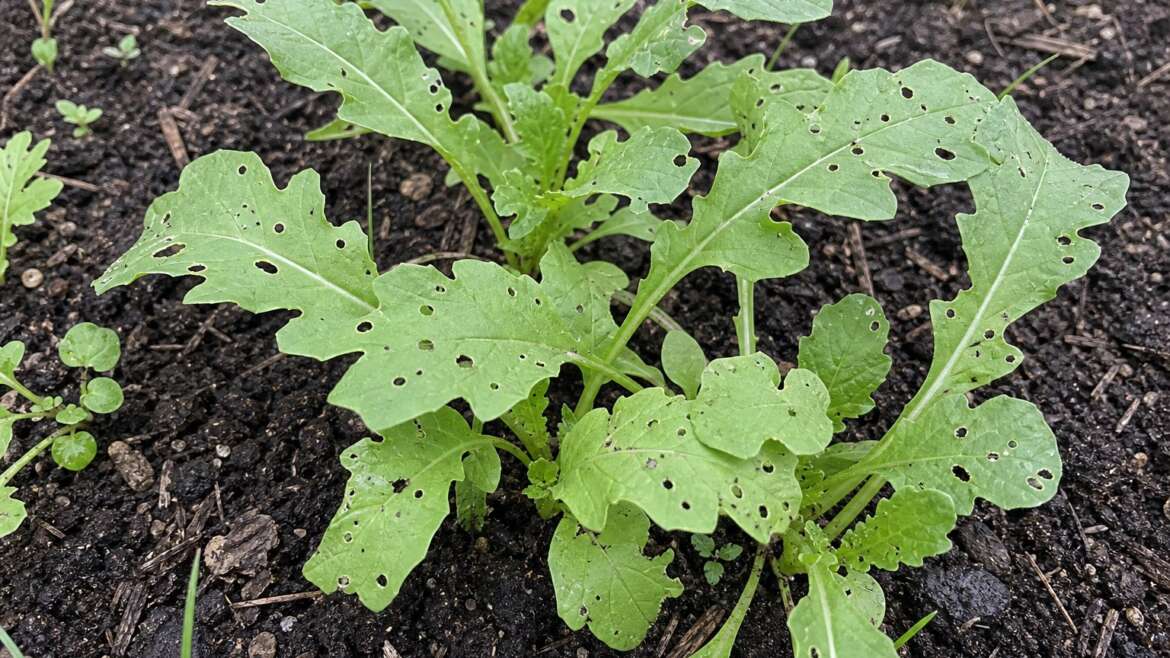
In late April, a bed of young greens can look perfect at breakfast and peppered by lunch. The arugula leaves are still bright and tender. The mustard seedlings are standing. The radish tops look cheerful. But every leaf has acquired tiny round holes, as if someone spent the morning tapping them with a miniature paper punch.
The damage is so small that it can feel almost decorative at first. Then the holes multiply. A seedling that should be making its first true leaves begins to look tired and lace-thin. The culprit may be hard to catch because it does not sit still for inspection. It jumps.
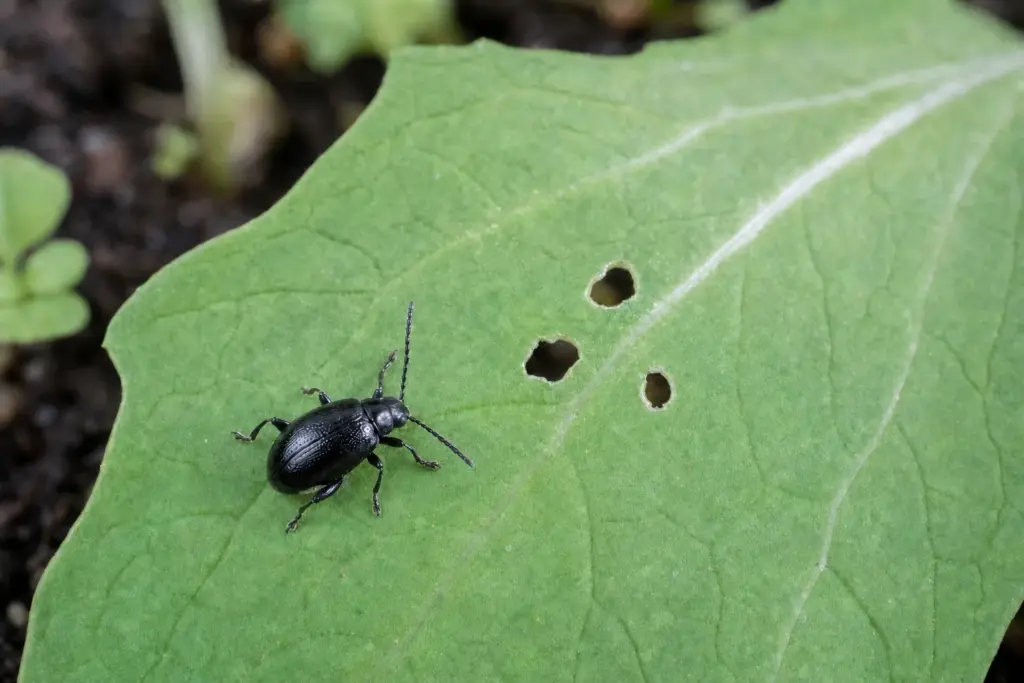
Flea beetles are among the first insects many vegetable gardeners notice on spring greens. They are small, dark, shiny beetles that chew little pits and holes in tender leaves. The University of Maryland Extension describes their damage as small round holes or pits, especially on young plants, and notes that the beetles jump when disturbed.1 When tiny jumping beetles are present, that combination is a strong clue: the marks are feeding injuries rather than a disease or hail damage. Holes alone are not a complete diagnosis, because slugs, caterpillars, and other insects can also chew leaves.
A beetle that behaves like a flea
The name flea beetle is descriptive rather than poetic. Adult flea beetles have enlarged hind legs that let them spring away when touched, much like fleas.3 Colorado State University Extension describes flea beetles as small beetles that jump powerfully and feed on leaves, producing small pits or holes.2 They are easy to underestimate because many are only a few millimeters long.
Their size is exactly what makes the damage confusing. A caterpillar announces itself by leaving obvious chewed edges and visible droppings. A slug leaves slime and ragged nighttime work. Flea beetles often leave only a constellation of pinholes and then vanish into the bed when you lean close.
Different flea beetle species prefer different plants, but vegetable gardeners often notice the brassica-feeding species on members of the mustard family. Arugula, radish, turnip, mustard greens, kale, cabbage, bok choy, broccoli, and related crops can all become spring targets. Eggplant, potato, tomato, corn, and other plants can have their own flea beetle problems too, depending on the species and region.2
Why the first leaves matter most
A mature kale plant can tolerate a surprising amount of cosmetic chewing. A two-leaf arugula seedling cannot. The same number of holes means very different things depending on the size and vigor of the plant. On a young seedling, each hole removes part of the small solar panel that is supposed to feed the next stage of growth.
Colorado State University Extension notes that flea beetle injury matters most while seedlings are becoming established and in crops grown for their leaves; established plants often tolerate and outgrow feeding.2 That is why flea beetles are so frustrating in spring. They arrive when the crop is smallest and the gardener has not yet built much leaf mass to spare.
There can also be a timing mismatch. Cool-season greens tolerate cool air, yet growth may pause during a chilly spell. Flea beetle adults, meanwhile, become active on warm days in early to mid-spring.2 The first bright day after a cold week can therefore find the seedlings still small while overwintered adults are ready to feed.
The garden bed is not empty in winter
Flea beetles do not appear from nowhere. Many spend winter as adults under leaves, dirt clods, or in other protected sites, then become active as temperatures rise. They can also fly well and travel in search of suitable host plants.23
That habit explains why the first brassica sowing can take the worst hit. After winter, the adults seek suitable leaves. If the nearest tender mustard-family leaves are your carefully sown arugula, the bed can become their first feeding site.
It also explains why garden history and edges are worth reading. Old crop debris and sheltered margins can provide overwintering sites, while volunteer mustards and winter annual mustard weeds can serve as early hosts.123 Damage may be worse along one side of a bed or beside last year’s brassica patch, but mobile adults can also arrive from farther away.
Why mustard defenses do not stop every beetle
Mustard-family greens are chemically defended. When their tissue is damaged, compounds called glucosinolates meet the plant enzyme myrosinase, producing breakdown products that can deter or harm many attackers. Specialist insects that evolved with brassicas, however, have counter-adaptations that let them feed where other herbivores may struggle.4
In experiments with the striped flea beetle, Phyllotreta striolata, researchers found that the beetles selectively accumulated glucosinolates from their food plants and produced their own myrosinase, building a defensive system from host compounds.4 This does not mean every flea beetle species handles mustard chemistry in the same way, or that peppery scent alone explains damage in a garden. It does show that a plant defense can favor specialist countermeasures instead of making the plant immune.
Grouping spring brassicas makes sowing, covering, and scouting simpler, but it also concentrates preferred hosts. Colorado State notes that most flea beetles attack only a few closely related kinds of plants.2 Interplanting may change the layout of a bed, but it is not a reliable substitute for timely exclusion and close monitoring.
Cover before they arrive
Once flea beetles are feeding heavily, control becomes harder. The simplest protection is often physical: keep adults off the seedlings from the beginning. University of Maryland Extension recommends covering vulnerable plants and securing the material to the ground, while Colorado State notes that floating row covers or screening can exclude beetles during seedling establishment.12
That last detail matters. A loose cover draped casually over hoops can become a greenhouse with beetles inside. The edges need soil, boards, stones, clips, or another practical seal. Utah State warns that adults can emerge under a cover placed where a susceptible crop grew the previous year, so it recommends pairing row cover with rotation after a non-susceptible crop.3 Rotation cannot stop adults flying in from elsewhere; if you lift the cover for thinning or weeding, reseal it promptly.
Row cover is not elegant, but it can be the difference between a spring salad bed and a collection of lacy regrets. It is especially useful for arugula, radishes, turnips grown for greens, bok choy, and young brassica transplants. Leafy crops can be uncovered once they are large enough to tolerate some feeding or if ventilation becomes a greater concern. Remove cover from eggplant at flowering so pollinators can reach the blossoms.1
Make seedlings grow through the danger
Healthy, fast-growing plants tolerate flea beetle feeding better than stalled seedlings. That does not mean forcing lush growth with excessive nitrogen. It means giving the crop the conditions it needs to move quickly through its most vulnerable stage: even moisture, suitable soil temperature, good seed spacing, and a bed that is not compacted or crusted.
Utah State recommends a well-prepared seedbed with adequate water and nutrients, noting that favorable growing conditions shorten the vulnerable early stage.3 In a home garden, this often translates into small habits. Thin crowded seedlings before they compete. Water young greens evenly. Do not let a seedling row sit in a dry crust for days and then expect it to shrug off chewing.
Trap crops can sometimes help, but they require attention and will not suit every flea beetle species or region. Colorado State describes radish or daikon used to attract brassica-feeding flea beetles away from other crucifer seedlings, then harvested or destroyed once the main crop is established.2 A trap crop is therefore a monitored part of the plan, not a decoy to plant and forget.
What not to panic about
Not every hole needs a response. Flea beetle damage on established plants is often minor, while seedlings and leafy vegetables are more likely to suffer meaningful injury.2 A mature radish top with a few holes may still grow a fine root. A kale plant with a sturdy center may outgrow early chewing. The useful question is whether the plant is losing more leaf than it can replace.
Look at the newest growth. If the center is still expanding, the plant may recover. If seedlings are stalled, heavily riddled, or disappearing, protection is overdue. If a whole bed is peppered within a day or two, cover the next sowing before emergence. Let crop stage and the rate of new feeding guide the response rather than treating one damaged leaf as an emergency.
Also avoid treating flea beetles as proof that the garden is dirty or badly kept. A diverse garden will host insects. The useful response is not shame or indiscriminate spraying. It is timing, exclusion, sensible debris and weed management, and close observation during the small-seedling stage.
Final thoughts
The tiny holes in spring greens are easy to read as damage and nothing more. But they are also a sign of timing. The beetles became active. The seedlings were small. A chemically defended host met an insect lineage equipped to feed on it. The bed became part of a spring interaction already unfolding in crop residue, weeds, and sheltered edges.
The practical lesson is simple: protect the first leaves before they are bitten, and help the crop grow quickly enough to withstand what gets through. A leaf with a few holes can still feed a plant. A seedling reduced to lace cannot. In April, the difference often comes down to a row cover put on before the jumping starts.
References
- University of Maryland Extension: Flea Beetles on Vegetables
- Colorado State University Extension: Flea Beetles
- Utah State University Extension: Flea Beetles on Vegetables
- Beran et al. (2014): Phyllotreta striolata flea beetles use host plant defense compounds to create their own glucosinolate-myrosinase system