
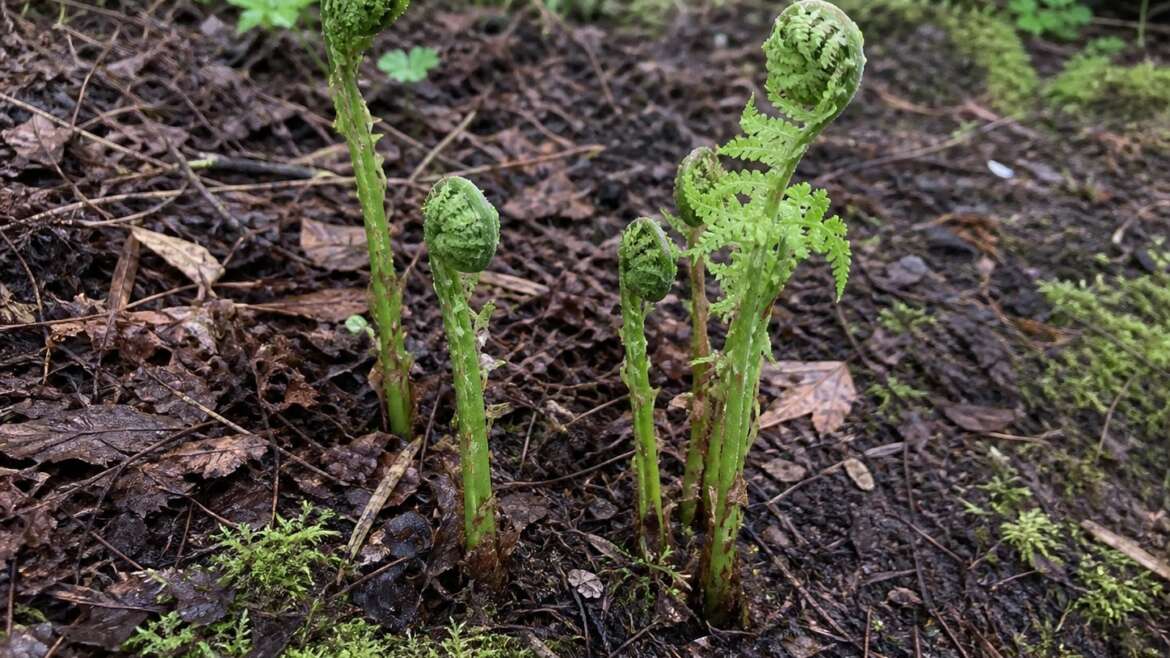
In the soft weather of May, ferns can make a shaded bed look as if it has invented a new kind of spring. One week there is only leaf litter, damp soil, and the brown remains of last year’s stems. Then little green scrolls rise from the crown, tucked inward like the heads of violins, each one holding a whole frond in miniature.
A fern fiddlehead is beautiful partly because it looks unfinished. It is not a leaf that has been folded flat and packed away, the way a beech leaf or a hosta leaf might be. It is a leaf that has been wound into itself. The botanical word for this is circinate vernation, and the American Fern Society describes it as the coiled new growth of many fern fronds, gradually unfurling as the leaf develops while protecting the meristem, the tender growing region at the tip.1
That coil is not just ornament. The soft apical and pinna meristems sit inside the crozier while older tissue below continues to grow. Botanists generally interpret this arrangement as protective, but it does not make an emerging frond frost-proof, slug-proof, or safe from a misplaced boot.8
The frond is already there
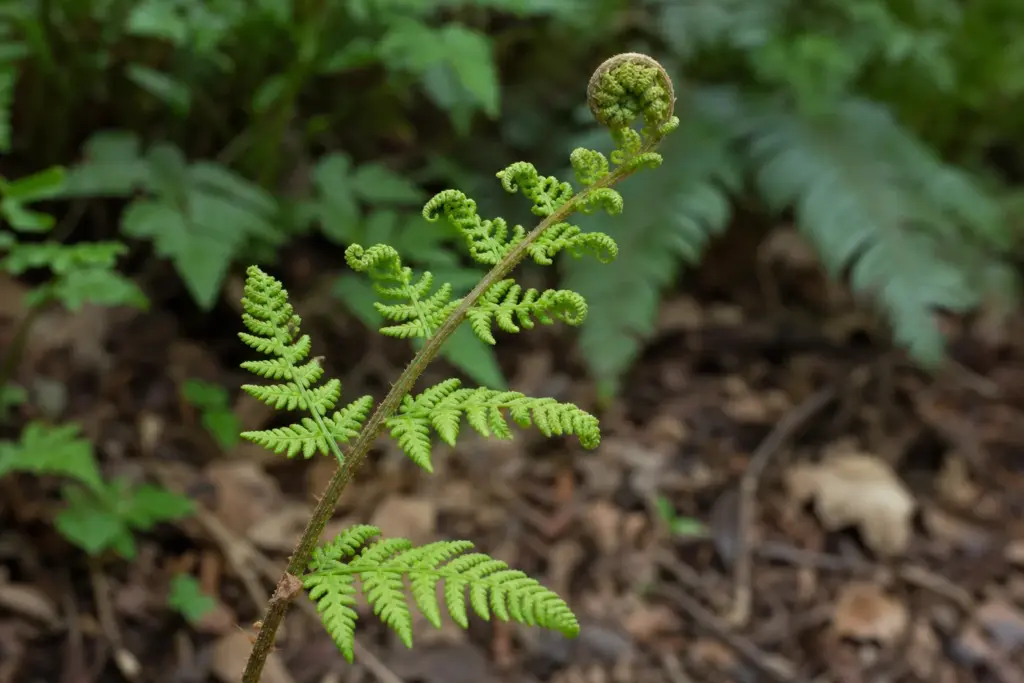
When a fiddlehead appears, much of the future frond’s architecture is already patterned into the coil: the rachis, future pinnae, and, in more divided species, pinnules. But it is not a finished miniature simply being unwrapped. A peer-reviewed review of fern leaf development describes continuing cell division in apical and marginal meristems, with maturation moving from the base toward the tip.8
Growth and revealing happen together. Sector analysis in Boston fern found fronds and pinnae developing iteratively from apical initial cells rather than expanding as finished parts.9 As proximal portions mature, the curve relaxes and the side divisions separate, even while the tip remains a growing meristem. A few days later the plant can look much larger than it did the morning before.
Not every fern lineage makes the familiar coiled fiddlehead in exactly the same way. A recent Current Biology paper notes that fiddleheads, or croziers, are one of the most recognizable features of ferns, but that this circinate development is not universal across the whole fern lineage.2 For a gardener, that is a useful reminder: “fern” is not one habit, one leaf shape, or one life history. It is a large and old way of being a plant.
Why the coil is useful
The coiling is nested: the whole leaf may be curled, and so may its pinnae and pinnules. That places several scales of soft, developing tissue inside the crozier rather than spreading them through the leaf litter. Fern morphologists describe protection of those concealed meristematic parts as the presumed function of the coil.8
The coil also presents a smaller profile than an expanded frond. It can rise through loose leaf litter without exposing a broad blade from the start. As the rachis lengthens and the lower portions mature, the pinnae separate into the shade-catching surface we recognize as a frond. That compact geometry is easy to observe; it should not be mistaken for proof that the coil prevents every kind of spring damage.
This is one reason ferns look so at home in layered spring gardens. While bulbs are finishing, trilliums are fading, and hostas are still gathering themselves, fern fiddleheads are rising through the gaps. They do not need a flower to announce the season. Their architecture does it for them.
A leaf that does not flower
Ferns are easy to place in the “foliage plant” drawer and leave there, but their leaves are doing more than making shade look graceful. Ferns do not make flowers or seeds. The USDA Forest Service explains that sori, the small dots or patches often seen on the underside of fern blades, are clusters of sporangia that contain spores.3 If those regular patches look suspicious, the brown dots under fern leaves are usually sori, not pests.
Those spores belong to a life cycle that is easy to miss because the familiar fern is only one stage of it. The plant we notice in the garden is the sporophyte. Spores can grow into a small, separate gametophyte stage if they land somewhere moist and protected. The details are wonderfully unlike tomatoes, beans, or zinnias, which is part of the pleasure of growing ferns: they keep a very old botanical grammar alive in an ordinary border.
Many garden ferns also spread by rhizomes. The USDA notes that creeping rhizomes can produce roots and leaves near their growing tips, allowing some ferns, including ostrich fern, to form colonies over time.4 That colony-making habit is why a fern that looks modest in a nursery pot may become a broad, repeating patch once it finds the right shade.
What fiddleheads tell you in the garden
Fiddleheads are a useful location marker. They show where dormant crowns are waking, where not to cultivate, and where excess mulch should be eased aside by hand. Do not treat the number or size of the coils as a simple moisture gauge: species, crown age, recent division, browsing, cold damage, and present soil conditions can all affect emergence. Iowa State University Extension recommends evenly moist but well-drained soil and warns that rakes can damage the tender new growth.10
Ostrich fern is the classic fiddlehead plant for many northern gardeners. Missouri Botanical Garden lists it as a rhizomatous, deciduous fern for part shade to full shade, happiest in rich soil with constant moisture, and capable of spreading into dense colonies where conditions suit it.5 In a real garden, that means it belongs where the soil stays evenly damp: near a rain garden edge, along a shaded swale, beside a woodland path, or in the cool part of a border that receives leaf mold instead of reflected heat.
It does not mean every fern wants bog conditions. Lady fern, Christmas fern, maidenhair fern, royal fern, sensitive fern, and Japanese painted fern all have their own tolerances. Even ostrich fern needs drainage as well as moisture: University of Maine Extension describes wild plants in well-drained, organic-rich sandy loams and cautions that they do not tolerate prolonged wet feet.7 A rain garden edge can suit it when that zone drains between storms, not when the crown remains submerged.
The edible question
Because the word fiddlehead often appears in markets and spring recipes, it is worth being precise. Many familiar garden ferns produce coiled young fronds, but some fern lineages do not, and a coil alone says nothing about edibility.2 University of Maine Extension identifies edible fiddleheads as the young coiled fronds of ostrich fern, Matteuccia struthiopteris, and notes a smooth stem, a deep U-shaped groove on its inner side, and a brown papery covering.6
Correct identification is only the first safety step. Do not eat fiddleheads raw or lightly cooked. University of Maine Extension advises boiling cleaned ostrich fern fiddleheads for 15 minutes or steaming them for 10 to 12 minutes before using them in a recipe; reported illnesses have followed raw or undercooked fiddleheads.6
Even then, a garden article is not a foraging license. If you are not certain of the fern, do not eat it. If you do grow ostrich fern for harvest, treat the fiddlehead as the plant’s future leaf, not as a free extra. UMaine garden guidance recommends letting planted ostrich ferns establish for three years before harvesting and then taking no more than half of the emerged fiddleheads from a crown, leaving later ones to feed the plant for next year.7
That last point matters even if you never cook a fiddlehead. The coil is not a garnish on the plant. It is the next solar panel, the next storehouse, the next contribution to the crown. Remove too many and you are borrowing from the fern’s future.
How to help the unrolling
The best care for spring fiddleheads is mostly restraint. Ease excess mulch away by hand, but leave a loose woodland layer around the plant. Keep the soil evenly moist and well drained while new fronds expand, and avoid raking or stepping between crowns. Division timing varies by species and climate; Iowa State lists late summer or early fall as optimal for most garden ferns in Iowa. Whatever the timing, replant each division at its original depth and water it like a transplant rather than an established clump.10
Ferns also reward patience in design. A young clump may look like punctuation in its first spring. In a few seasons it can become a sentence: repeated green arcs, a cool underlayer for shrubs, a soft landing for spring ephemerals, and a living measure of how damp and shaded a place really is.
That is the quiet charm of a fiddlehead. It is both a small spectacle and a practical report. It tells you the fern is alive, the crown has energy, the season has turned, and the garden is about to open a leaf that has been carrying its own spiral since before you noticed it.
References
- American Fern Society: About Ferns
- Current Biology: Identification of a tetrahedral apical cell preserved within a fossilized fern fiddlehead
- USDA Forest Service: Fern Structure
- USDA Forest Service: Fern Reproduction
- Missouri Botanical Garden Plant Finder: Matteuccia struthiopteris
- University of Maine Extension: Facts on Fiddleheads
- University of Maine Extension: Maine Home Garden News, growing ostrich ferns
- Frontiers in Plant Science: The evolution and development of fern leaves
- Development: Sector analysis and predictive modelling reveal iterative shoot-like development in fern fronds
- Iowa State University Extension: Growing ferns in Iowa