
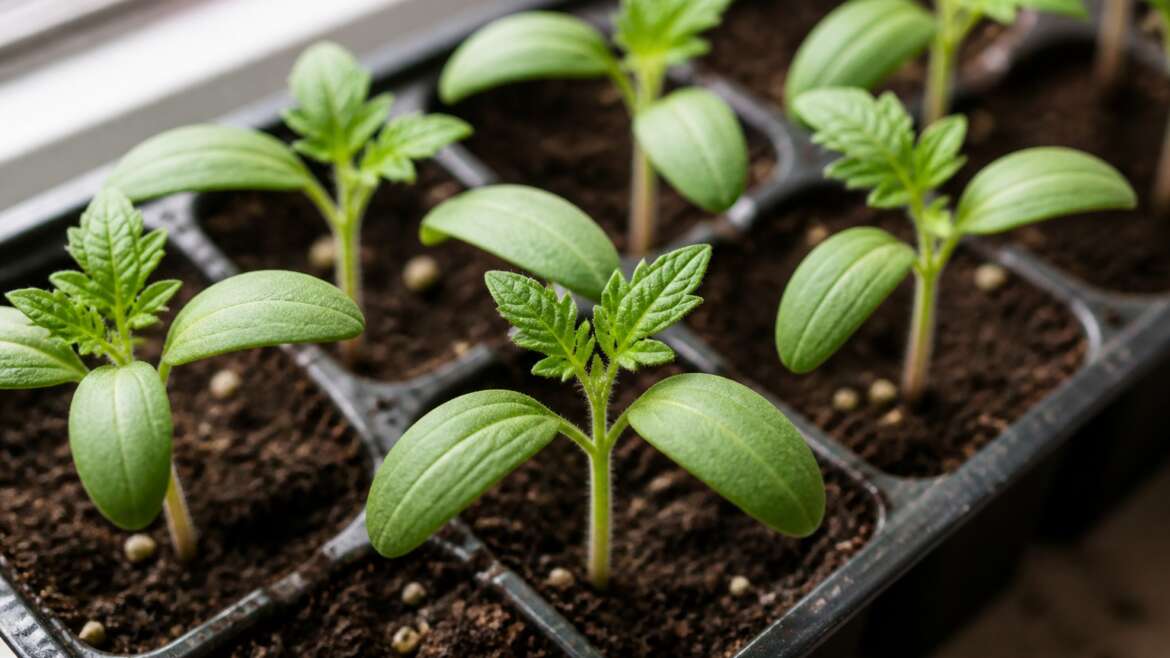
An indoor seed-starting tray can make the gardening year feel suddenly physical. One week the packets are still paper promises. The next, thin green stems are lifting paired little leaves above the mix. They are so small that it is easy to treat them as decoration. In fact, they are a working system.
The first leaves on many seedlings do not look like the leaves the plant will carry later. A tomato seedling opens with two smooth, oval leaves, then begins to make the toothed, divided leaves we recognize as tomato. A basil seedling starts with a simple pair before making true basil leaves. A cucumber seedling pushes up broad seed leaves like two green paddles, long before the rougher vine leaves arrive.
Those first structures are cotyledons, often called seed leaves. They are not a reliable preview of adult foliage. Depending on the species, they can store food, transfer reserves from other seed tissues, photosynthesize after emergence, or combine those jobs. They are the seedling’s opening equipment: a bridge between the protected life inside the seed and the exposed life of a young plant in air and light.
A seedling begins with borrowed food
A dry seed contains an embryo and resources that sustain early growth. Penn State Extension describes germination as depending on water, oxygen, suitable temperature, and sometimes light; the young root generally emerges before the shoot appears above the growing medium.1 That occasional light requirement concerns germination itself, not the bright light a seedling needs afterward.
That order matters. The first root, called the radicle, extends into the medium, helping to anchor the seedling and take up water. In many familiar epigeal garden seedlings, the young stem lifts the cotyledons into the light. Beans and tomatoes do this. In hypogeal germination, by contrast, the cotyledons remain below ground while the shoot emerges. Peas are a familiar example.1 “Seed leaf” therefore describes an embryonic structure, not one position or appearance.
For the gardener, emergence is the moment when patience changes into care. Warmth and moisture may still matter, but the exposed seedling now also needs strong light, oxygen around its roots, measured watering, and room to grow. It is not a miniature adult plant. It is a plant in transition, and the cotyledons make part of that transition visible.
What cotyledons are doing
Cotyledons are part of the plant embryo. OpenStax notes that flowering plants are often grouped by their number of cotyledons: monocots have one, while eudicots have two.2 Cotyledon number is one structural difference; species-specific development produces the varied beginnings of grass, corn, onion, tomato, bean, and lettuce seedlings.
Their contribution differs among species. Thick bean cotyledons hold reserves that fuel early growth, while a grass cotyledon helps move food from the endosperm to the embryo. Cotyledons raised above the soil may turn green and photosynthesize as well.2 These are overlapping strategies, not a universal switch from stored food to sunlight on one particular day.
In many annual vegetables and flowers, cotyledons are temporary but important. They support the opening stage while roots spread and true leaves expand, then may yellow and drop. Their plain shapes can make different seedlings look confusingly similar, so true leaves usually make a better identification clue. Even then, a label is safer than memory when several related cultivars share a tray.
True leaves change the conversation
True leaves are foliage produced by the seedling’s growing point rather than leaves already present in the embryo. They begin to reveal the plant’s characteristic pattern: the serrated, divided leaf of a tomato; the lobed leaf of cilantro; the pointed blade of a pepper; or the crop-dependent scallops and serrations of young brassicas. A plant may keep its cotyledons while several true leaves unfold, so the two stages overlap.
University of Maryland Extension recommends strong light, a moist but not saturated medium, and moving crowded vegetable seedlings after the first true leaf appears.3 True leaves are a useful sign of development, but not an automatic command to fertilize. Many commercial seed-starting mixes contain nutrients for the first several weeks. Whether more is needed depends on the crop, the mix, the container, and how long the seedling will remain in it.
Do not rush this stage. Two cotyledons and one tiny true leaf do not, by themselves, call for a large pot of wet mix. Look at the whole plant: expanding foliage, roots beginning to hold the cell together, and a medium that no longer stays waterlogged between waterings. A modest step up in container size is easier to manage than a large volume of damp, unused mix.
Light decides the shape
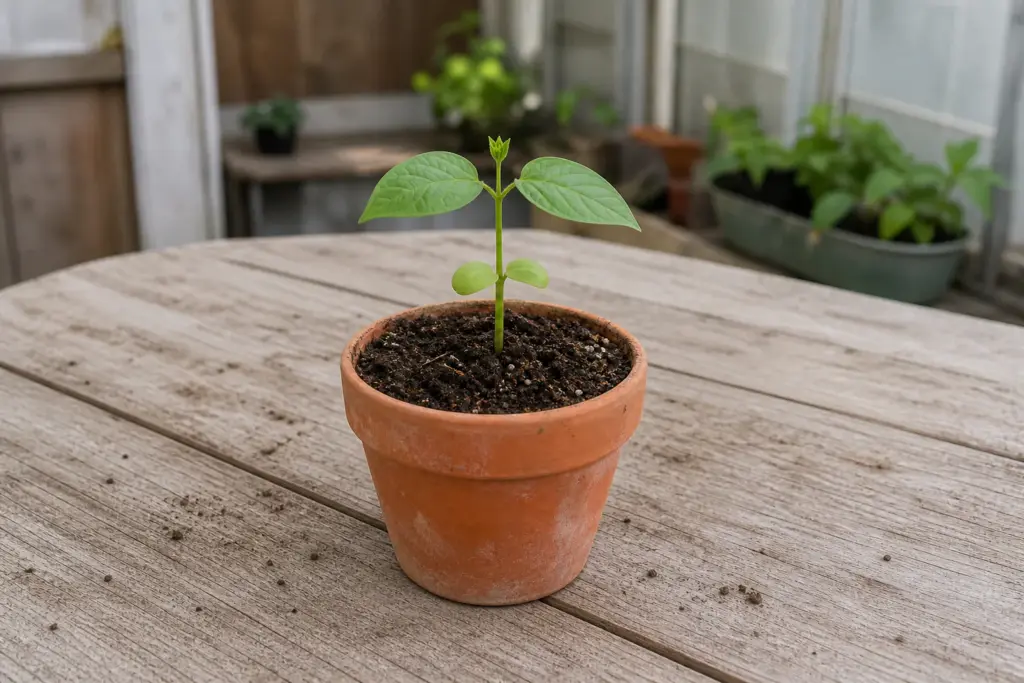
The most common indoor seedling problem is not lack of affection. It is lack of light. A windowsill that looks bright to a person can be dim to a seedling, especially during late winter at higher latitudes. When light is weak or too far away, stems elongate and lean toward the brightest direction. The result is a pale, soft seedling that is harder to handle.
University of Maryland Extension advises keeping seedlings close to a strong artificial light source and providing a dark period each day.3 Exact distance depends on the lamp’s heat and intensity, so follow its instructions and adjust as plants grow. In many homes, a basic shelf, height-adjustable light, and timer provide more consistent exposure than a windowsill alone.
Compact seedlings are easier to move and transplant than elongated ones, but “short” is not a universal target: normal height and leaf spacing differ by crop. If seedlings are stretching, improve the light before reaching for fertilizer. Added nutrients cannot replace missing light, and excess fertilizer can injure tender roots or create salt stress.
Water the root zone, not the idea of growth
Seedlings need even moisture, but they also need oxygen around their roots. University of Maryland Extension recommends keeping seed-starting medium moist without saturating it.3 How often that takes depends on cell size, plant size, temperature, airflow, and the medium itself, so a fixed watering calendar is less useful than checking the tray.
Watering from below can wet the mix without flattening delicate stems, and capillary mats or shallow water trays can make a large batch easier to manage.3 Bottom watering is not magic, however. Let the medium absorb moisture, then drain away standing water rather than leaving the cells submerged. The aim is a damp root zone with air-filled pores, not a permanently wet reservoir.
This balance matters while cotyledons and the first roots are small, but it is site-specific rather than fragile ceremony. A warm, brightly lit tray may dry much faster than a cool one. Lift the tray, feel the medium, and watch how quickly its surface changes color. If the surface develops a green film on the seed tray, it is usually algae rather than damping off, but it is a useful clue that the surface has remained wet. Small plants reward small adjustments.
The thin line called damping off
Damping off is not one diagnosis based on a fallen stem. It is a group of diseases, caused by several fungi and water molds, that can rot seeds or kill seedlings before or after emergence. Affected stems may become water-soaked and constricted at the soil line before the seedling collapses. Excess moisture, high humidity, and crowding favor the problem.4
Prevention is practical. Start with clean containers and fresh, soilless seed-starting mix; provide drainage; sow at sensible spacing; and avoid keeping the medium saturated.4 If you use a humidity cover for germination, remove or vent it as seedlings emerge and the particular crop allows. A closed dome can conserve moisture, but it should not become a permanently dripping roof over growing seedlings.
Remove and discard clearly affected seedlings rather than trying to prop them up. Then correct moisture, temperature, or crowding problems and clean and sanitize tools before moving between trays.4 Not every failed seed or bent stem is damping off, so look for a repeated pattern and symptoms at the stem base instead of treating every loss as the same disease.
When to thin, pot up, and move on
Thinning feels severe until you see what crowding costs. When several seedlings share a small cell, their roots, leaves, and light exposure begin to overlap. If you intend to keep only one, snipping extras at the surface avoids tugging through the keeper’s roots. Species that tolerate transplanting can instead be separated carefully into their own cells, but not every seedling handles that disturbance equally well.
Potting up makes sense when true leaves are present and roots are filling the cell, before growth stalls or the plant becomes badly rootbound. Handle a small seedling by a leaf rather than pinching its stem when possible, and choose a container with drainage.3 The next pot should fit the root system, not the gardener’s hopes for the mature plant.
Before indoor-grown seedlings go into the garden, harden them off gradually. University of Maryland Extension recommends starting in a shaded, protected place, increasing exposure over roughly one to two weeks, and protecting seedlings from wilting, strong wind, and unsuitable temperatures.5 Timing still depends on the crop and local weather: a cold-tolerant brassica and a tender pepper should not follow the same temperature threshold.
Useful seedling supplies
- VIVOSUN seedling heat mat: bottom heat can help crops whose germination range is warmer than the room. It is not needed for every seed; monitor the medium temperature and reduce or remove heat when the crop’s instructions call for it.
- Bootstrap Farmer 1020 seed trays: a sturdy outer tray can make a group of cell packs easier to carry and bottom-water. Drain excess water, and match solid or perforated trays to the way you intend to water.
- Burpee Organic Coconut Coir Concentrated Seed Starting Mix: this compressed, lightweight medium is unfertilized, so follow its directions for expansion and provide nutrition later when the crop and growth stage call for it.
Final thoughts
Cotyledons are easy to overlook because they are brief in many familiar annuals. They emerge, support the transition, and often yellow as true leaves and roots take over more of the work. Yet they are one of the most revealing stages in gardening: the seed’s stored past is giving way to the plant’s growing future.
When you look at a seed tray, do not see only future tomatoes, basil, zinnias, or kale. Notice the handoff. The embryo has drawn on stored reserves. The cotyledons are supplying, transferring, and sometimes making food. The true leaves are beginning to express the plant’s characteristic form. Your job is not to hurry that change. It is to make the conditions steady enough for the seedling to keep going.