
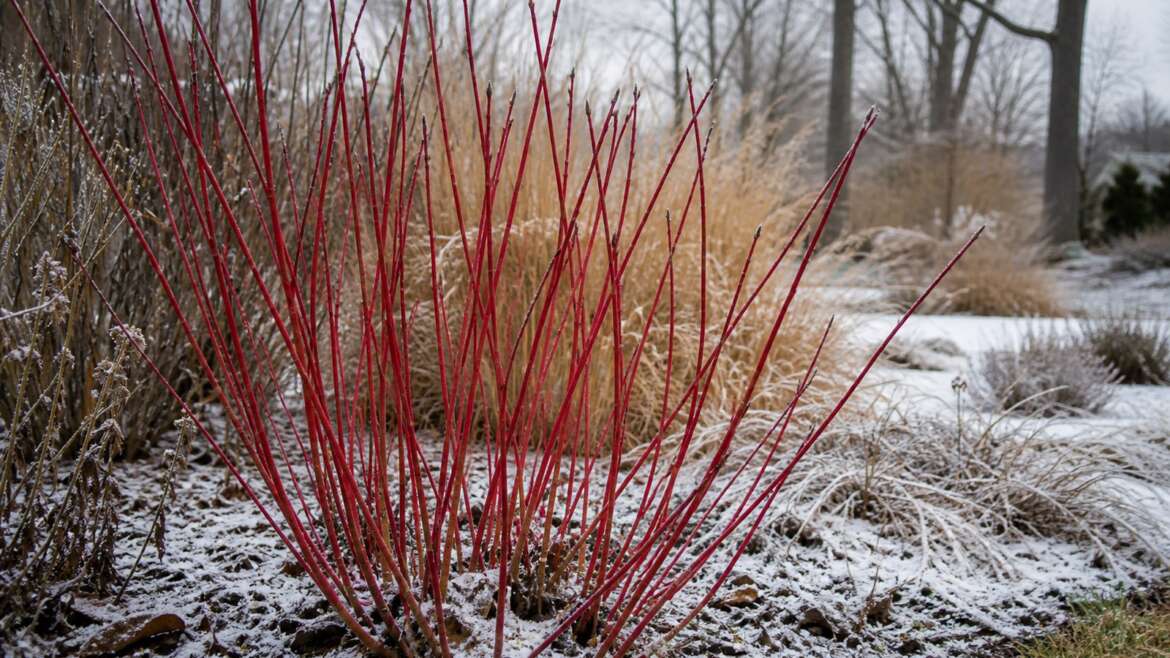
On the last day of the year, a garden can look as if it has been reduced to essentials. Soil, bark, seed heads, paths, the quiet architecture of shrubs. Then a stand of red-twig dogwood catches the low light and refuses to behave like background. The stems are leafless, but they are not dull. They burn red against snow, frost, wet leaves, tan grasses, and the gray patience of winter.
That color is not a flower, not a berry, and not a trick of holiday decoration. It is living stem tissue, especially young stem tissue, carrying pigment into the season when most of the garden has stopped trying to impress anyone. Red-twig dogwood is one of the best reminders that winter interest is not only evergreen. Sometimes it is the newest wood on a deciduous shrub.
The common names can overlap. Gardeners may say red-twig dogwood, red-osier dogwood, red-stem dogwood, or simply shrub dogwood. In North America, Cornus sericea is the native red-osier dogwood, a moisture-loving shrub with red stems, white spring flower clusters, and pale fruit. NC State Extension describes it as a fast-growing deciduous shrub with attractive red stems and value for erosion control, wildlife, and wet sites.1
Why the young stems are brightest
The winter show depends on age. The youngest stems usually carry the strongest color. Older stems become thicker, barkier, duller, and more gray-brown with time. This is why an unpruned red-twig dogwood can slowly lose the very quality it was planted for. The shrub may still be alive and healthy, but the color retreats into a few younger shoots at the outside of a woody thicket.
The red comes from anthocyanins in the outer stem tissues, not from the wood as a whole. In a study using the species’ former name, Cornus stolonifera, researchers found anthocyanins in the periderm and outer cortex of red stem portions. Under strong light, red portions maintained higher photosystem II efficiency than green portions, supporting a light-screening role for the pigment.6 That does not mean stem color is fixed: cultivar, stem age, exposure, and growing conditions all affect what a gardener sees.
For the gardener, the practical point is simpler: grow fresh wood if you want fresh color. The bright winter effect is renewed, not permanent.
A shrub for wet edges and winter structure
Red-osier dogwood belongs naturally in places where many showier shrubs sulk: stream edges, damp low spots, pond margins, rain garden shoulders, and moist woodland edges. The USDA Forest Service describes Cornus sericea as occurring across much of North America, often on moist sites such as streambanks, swamps, wet meadows, and riparian areas.2 That habitat preference matters when placing it in a garden.
It is not a tiny shrub for a polite foundation bed. In comfortable conditions, red-twig dogwood wants room to make a colony of stems. It can be beautiful at the back of a border, on a slope that needs holding, near a wet ditch, in the appropriately moist zone of a rain garden designed around its drainage zones, or massed where its winter color can be seen from a window. In cramped dry soil beside a hot wall, it is often the wrong plant being asked to do the wrong job.
The best companions are quiet winter textures: grasses or sedges suited to that exact moisture zone, dark conifers, pale stone, and seed heads left standing. Do not copy a visual pairing without checking that both plants want the same drainage; the dogwood’s damp root zone may be too wet for a dry-site grass. Red stems look sharper when the surrounding garden lets them breathe.
How pruning keeps the color honest
For a shrub grown for its loose cane habit and young-stem color, repeated surface shearing is a poor substitute for renewal. It shortens the outside tips but leaves the oldest, dullest canes in place. Remove selected old stems at ground level so new basal shoots can replace them.3
Virginia Cooperative Extension gives two species-specific routes for red-twig dogwoods: remove about one-third of the largest, oldest stems in early spring, or cut all stems to about 9 inches above the ground roughly every three years.3 Selective removal preserves more of the shrub’s established structure; the harder cut produces a more managed crop of young canes.
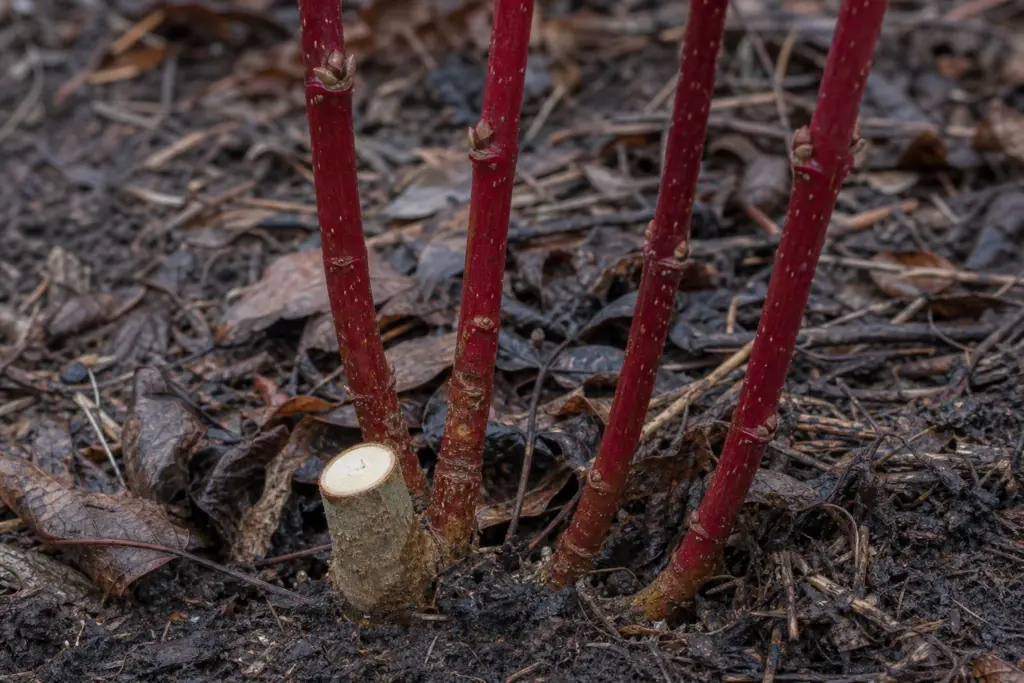
The Royal Horticultural Society places hard pruning from late winter to mid-spring and notes that many gardeners now wait until late March or mid-April to enjoy the colorful stems for as long as possible. It also advises letting young plants establish for a year or two before hard pruning begins.4 If you cut everything down in early winter, you remove the very stems you planted for the cold season. Enjoy the color first, then prune as growth resumes.
Selective renewal is often the most useful balance. Hard cutting can maximize young stems, but it removes existing flower-bearing wood; Iowa State University Extension cautions that spring-blooming shrubs lose that season’s flowers after renovation pruning.7 Decide whether you want maximum red stems, flowers and fruit, shrub mass, or a balance of all three.
Flowers, fruit, and the other half of the plant
It is easy to treat red-twig dogwood as a winter object, but the plant has a full-year life. Spring brings clusters of small flowers. Summer brings green leaves and, in many forms, pale berries. Birds use the shrub, and the dense branching can shelter small wildlife. The Morton Arboretum describes red-osier dogwood as useful in naturalized areas, rain gardens, and moist sites, with white flowers, white fruit, and red stems that are most colorful on young growth.5
This matters because aggressive annual cutting can simplify the plant. A shrub treated like a stem crop may give strong winter color but less flower-bearing wood, while a shrub never renewed may become a large thicket with weaker stem color. Neither approach is automatically superior. The right pruning pattern depends on what the plant is doing in that particular garden.
For a rain garden edge or wildlife planting, lean toward selective renewal. For a designed winter border seen from a kitchen window, prune more deliberately for young stems. If the shrub is already too large, compare its mature 7-to-10-foot habit with the available space; replacement with a properly scaled plant may be more durable than repeated severe pruning.5
Choosing red, yellow, or coral stems
Red is the classic winter color, but it is not the only one. Yellow-twig dogwoods and coral-stemmed selections can be beautiful, especially in front of dark evergreens or against blue-gray winter skies. The same principle holds: the newest stems are usually the most vivid, and the color needs thoughtful pruning to stay fresh.
Choose the plant for the site first, then the color. Within its native range across much of North America, red-osier dogwood can be a strong choice where habitat value and wet-site tolerance matter.2 Ornamental selections of Cornus alba, Cornus sanguinea, and related shrub dogwoods offer a wider palette,4 but mature size, hardiness, soil tolerance, and local ecological value vary. Check the botanical name and cultivar rather than assuming every plant sold as red-twig dogwood behaves like Cornus sericea.
Useful red-twig dogwood supplies
- Fiskars bypass pruning shears: useful for clean cuts on young stems and light renewal work.
- Fiskars 28-inch bypass loppers: helpful for older canes that are too thick for hand pruners.
- Corona RazorTOOTH pruning saw: practical for removing large, old, dull stems at the base when renovating an overgrown shrub.
Final thoughts
Red-twig dogwood is one of winter’s clearest arguments against thinking of the dormant garden as empty. The leaves are gone, the flowers are months away, and still the shrub is doing something visually generous. It has turned its newest wood into color.
The secret is not to plant it as a decoration and then forget the living shrub behind the display. Give it the moist, open space it prefers. Let it make strong young stems. Cut out enough old wood to keep the color honest, but not so much that the plant loses every other part of its character.
On December 31, that feels like a useful gardening lesson. Some beauty is not preserved by holding still. It is renewed by knowing what to let go of, and when.
References
- NC State Extension Gardener Plant Toolbox: Cornus sericea
- USDA Forest Service Fire Effects Information System: Redosier dogwood
- Virginia Cooperative Extension: Red twig dogwoods
- Royal Horticultural Society: Shrubs for colourful stems or large foliage
- The Morton Arboretum: Red-osier dogwood
- Journal of Experimental Botany: Why some stems are red
- Iowa State University Extension: Pruning large, overgrown shrubs