
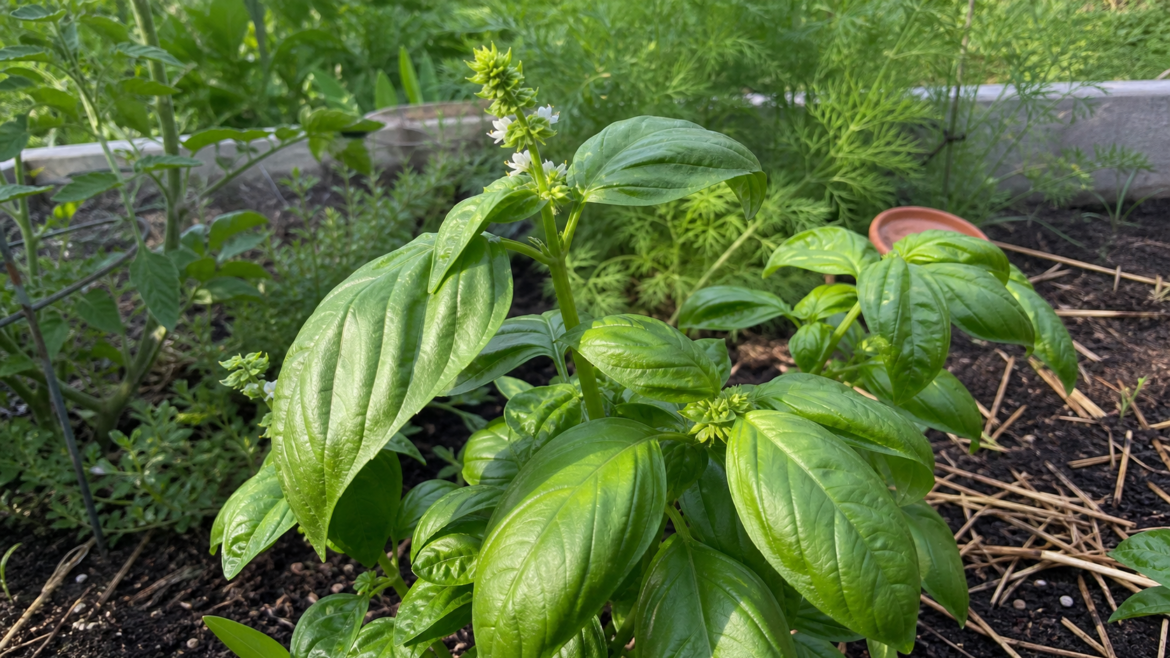
A basil plant in July can seem to break a small kitchen promise. For weeks it gives you soft green leaves, each one smelling like summer before it even reaches the cutting board. Then, almost overnight, the top of the plant changes shape. The leaves become smaller. The stem lengthens. A pale green spire of buds appears where a handful of pesto used to be.
Gardeners often call this bolting, though with basil it is better understood as the plant changing jobs. It has spent spring and early summer building leaves. Now it is preparing flowers, seeds, and the next generation. The kitchen wants basil to remain a leafy herb forever. The basil has other plans.
The good news is that flowering is not a disaster. The leaves do not suddenly become unsafe or useless. The flowers themselves can be edible and fragrant. But the plant’s priorities do shift, and if you want the long, leafy harvest that basil is famous for, you have to prune with the plant’s architecture in mind.
The stem tip changes its work
Sweet basil, Ocimum basilicum, is usually grown as a frost-tender annual herb in the mint family, the Lamiaceae. North Carolina Extension describes its fragrant simple leaves as opposite and its thin, hollow stems as square in cross-section. It recommends full sun and moist, well-drained soil.1
When the plant is young and regularly cut, each shoot tip behaves like a leaf-making point. It produces pairs of leaves and short sections of stem. As the season advances, that same tip can switch into a flowering shoot. Iowa State University Extension notes that in Iowa, basil flowers often appear from late July into August and range from white to shades of pink and purple.2
That timing is why the first flower buds can feel so personal. They appear just when the tomatoes are ripening, the grill is busy, and basil finally feels indispensable. But the plant is not reacting to your menu. Utah State University Extension notes that high summer temperatures and water stress can push basil toward flowers and seed.3 Cultivar, plant age, and other growing conditions also matter, so July is a familiar pattern rather than a universal deadline.
Why flowering changes the leaves
Most of what we call basil flavor is aroma. Cut a leaf and the scent reaches you before the taste does. Research summarized in the U.S. EPA’s HERO database identified major volatile aroma compounds in basil leaves, including linalool, estragole, methyl cinnamate, eugenol, and 1,8-cineole.4 A seven-variety sensory and chemical study found distinct Thai, lemon, cinnamon, and Italian sweet basil aroma profiles tied to different volatile patterns.5 Basil does not smell like one plant wearing different clothes.
Flowering does not erase those compounds, but it changes the harvest around them. The leaves close to a developing flower spike are smaller than the broad leaves cooks usually want, and an uncut shoot keeps extending into flowers and seed. Iowa State advises harvesting when buds have formed but before they open, and notes that much leaf flavor has dissipated once seed forms.2 Illinois Extension likewise says that leaving flower buds affects leaf flavor.6
There is a useful nuance here. A basil plant with one early bud is not ruined. A plant covered in open flower spikes has simply moved farther away from lush leaf production. The first stage calls for pruning. The second stage calls for either a hard reset, a big harvest, or acceptance that one plant is now doing something more floral than culinary.
Pinching works because basil has pairs of leaves
The most important part of a basil plant is not the leaf you are about to pick. It is the node, where a pair of opposite leaves emerges. An axillary bud sits in each angle between leaf and stem. Picking individual leaves reduces leaf area but leaves the central shoot tip intact. Cutting the stem just above the node removes that tip while preserving the buds below it; those buds can extend into branches. A review of shoot branching describes this release of axillary buds from apical dominance after the shoot apex is removed.7
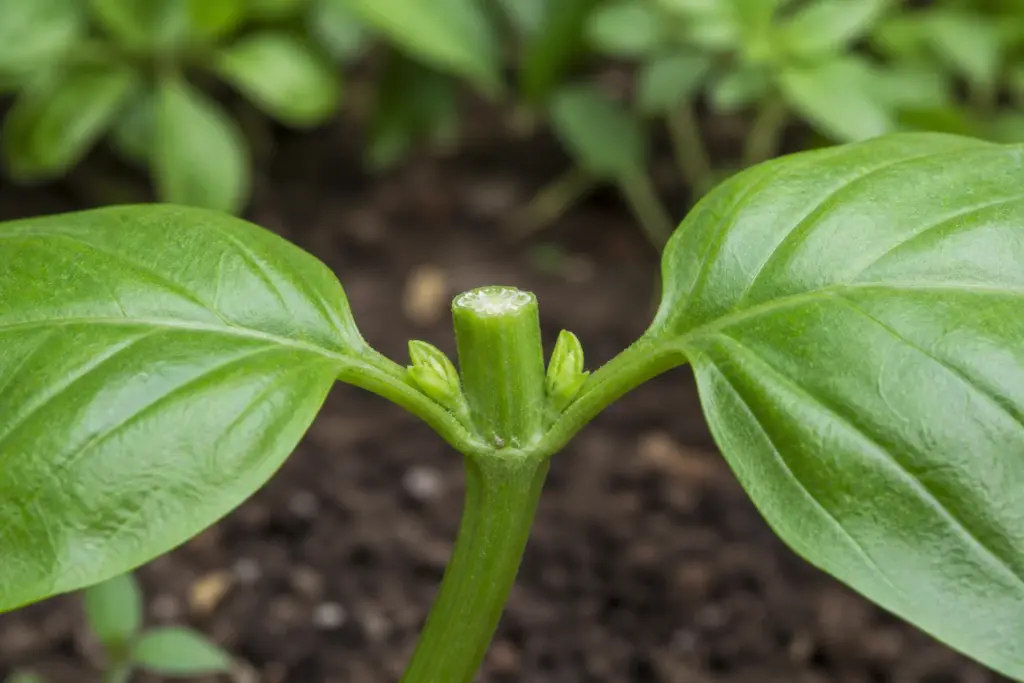
North Carolina Extension’s Plant Toolbox recommends pruning basil by pinching the tips of long stems and any flower buds, which encourages a branching, bushy form.1 Utah State University Extension gives the practical version: begin harvesting when plants have six to eight leaves, then cut stems just above a leaf node while leaving a few leaves behind so the plant can keep growing.3
Do not merely snap off the flower cluster and leave a bare stalk. Utah State notes that removing flowers alone can encourage more flowers in the leaf axils.3 Make the intervention a usable stem harvest above a leafy node instead.
That is the whole trick, but it is easy to forget in the moment. Many gardeners treat basil like lettuce and pluck the biggest individual leaves from the outside. That gives dinner a few leaves, but it leaves the plant’s central stem in charge. A better harvest is a small pruning cut: take a section of shoot, cut just above a paired set of leaves, leave useful leafy growth below, and let the buds beneath the cut respond.3
A July harvest rhythm
In July, basil often needs to be harvested more boldly than feels polite. A healthy plant can handle regular cuts if it is warm, watered, and actively growing. Waiting until every shoot is in flower leaves fewer tender stems to harvest, but repeated hard cuts on a drought-stressed or cold plant can also slow recovery.
Walk the basil every few days. Look not only for open flowers, but for the tight green clusters that come before them. When you see that pointed cluster forming at a tip, cut the stem back to a strong pair of leaves below it. If the whole plant is tall and narrow, cut several stems back while leaving leafy growth below every cut.3 The plant may look smaller for a few days, then fuller.
Water matters because pruning asks the plant to regrow. Utah State University Extension uses about one and a half inches per week as a starting point for vigorous basil.3 Adjust that figure for rainfall, heat, soil, drainage, and container size rather than watering by calendar alone. Containers dry faster than beds, while roots in poorly drained soil should not be kept soggy.
Do not overfeed it into softness. Iowa State notes that basil grows best in full sun with moist, well-drained soil and warns that too much nitrogen can affect flavor.2 Basil wants fertility, but it does not need to be pushed like a cabbage. The aim is steady, aromatic growth, not forcing soft growth at the expense of flavor.
What to do once flowers open
If the flower spikes are just opening, you can still cut the plant back and use the leaves. Taste first. If the leaves are still pleasant, make pesto, herb butter, vinegar, or a large batch of sauce. This is the moment to harvest heavily instead of letting the plant drift into seed production while you take a few leaves at a time.
If you have more than one basil plant, let one flower. The blossoms are small, usually white to pink or purple, and they belong nicely in an edible garden. North Carolina Extension lists basil leaves and flowers as edible, and many cultivars with purple stems or showy blooms are useful as ornamentals as well as herbs.1 A flowering basil is not failing. It is simply no longer your main leaf factory.
If you plan to eat the blossoms, use positively identified culinary basil grown for food and a treatment history you know. Our guide to serving edible flowers without losing the plot covers identification, handling, and allergy cautions.
Flowering can also tell you something about succession sowing. If all your basil is the same age, much of it may start to bloom around the same time. Illinois Extension suggests sowing at two-week intervals for a continuous supply.6 In a short or cool season, fewer rounds may make sense; the point is to have younger plants ready as the first planting moves into flower.
Preserving the leafy surplus
The problem with correct basil pruning is that it creates a lot of basil. That is not really a problem, but it does require a plan. Iowa State describes both drying and freezing: thoroughly dried leaves belong in airtight storage away from heat and light, while frozen leaves or basil cubes are convenient for sauces and soups.2
After cutting, wash the basil and pat it dry. Use the best leaves fresh. Freeze the rest whole in freezer bags, or chop it with a little water in an ice-cube tray and transfer the solid cubes to a labeled freezer bag.2 For stems you expect to use soon, Illinois Extension recommends a glass of water at room temperature and warns that refrigeration can discolor basil leaves.6
Useful basil harvest supplies
- Fiskars 6-inch pruning scissors: small, clean snips make it easier to cut just above leaf nodes without bruising the rest of the stem.
- Souper Cubes 2-tablespoon freezer trays: a tidy size for freezing pesto, chopped basil with oil, or small herb portions for winter sauces.
Final thoughts
Basil flowers are not a betrayal. They are the plant’s honest answer to summer. The stem tip that once made leaves is ready to make seed, and the gardener has to decide whether to interrupt that work or admire it.
For the kitchen, interruption is usually the right choice. Cut above nodes, remove buds early, water steadily, and harvest enough that the plant keeps branching. Let one plant bloom if you can spare it, especially if it is beautiful or buzzing with visitors. A good basil patch does not have to be frozen in leaf mode forever. It only has to give you enough leaves before it starts telling the rest of its story.
References
- North Carolina Extension Gardener Plant Toolbox: Ocimum basilicum
- Iowa State University Extension: Growing basil in the home garden
- Utah State University Extension: How to grow basil in your garden
- U.S. EPA HERO: Identification of volatile components in basil leaves
- Patel et al.: Descriptive aroma profiles of fresh sweet basil cultivars
- Illinois Extension: Basil
- Domagalska and Leyser: Auxin, cytokinin and the control of shoot branching