
Fantasy games are good at making a landscape feel larger than it is. A path bends and suggests a village beyond the trees. A bright clump of flowers feels like a clue. A dark gap between shrubs promises another zone. A real garden can borrow those feelings, but it has to do so with plants that root, paths that drain, and materials that improve as they weather.
The useful lesson is not imitation. It is composition. Games use contrast, pacing, repetition, thresholds, and focal points to guide attention. Landscape designers use the same tools. UF/IFAS describes line as a way to control movement of the eye and body, notes that curved lines can add mystery by creating hidden views, and treats repetition and focal points as core ways to organize a landscape.1 That is the bridge between screen world and soil.
Start With The Route
A game world rarely begins with a list of plants. It begins with movement: a gate, a path, a turn, a small reveal, a place to pause. A garden should start there too. Before choosing the dramatic fern or the blue grass, decide how someone enters the space, where the eye lands first, and what is deliberately hidden until the next few steps.
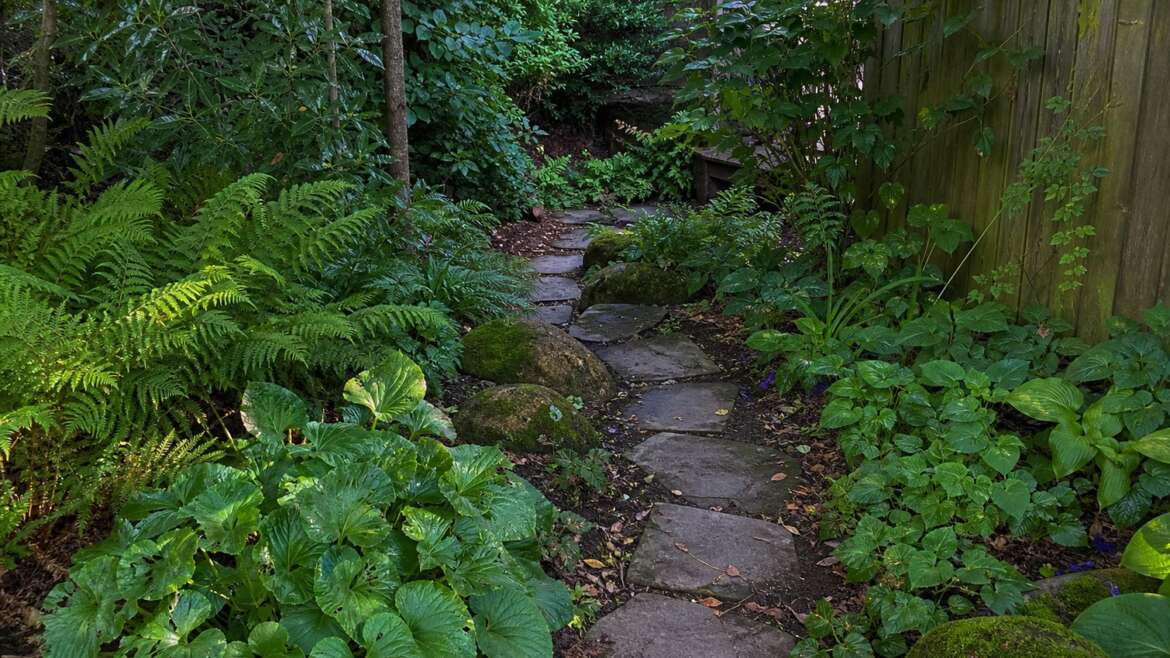
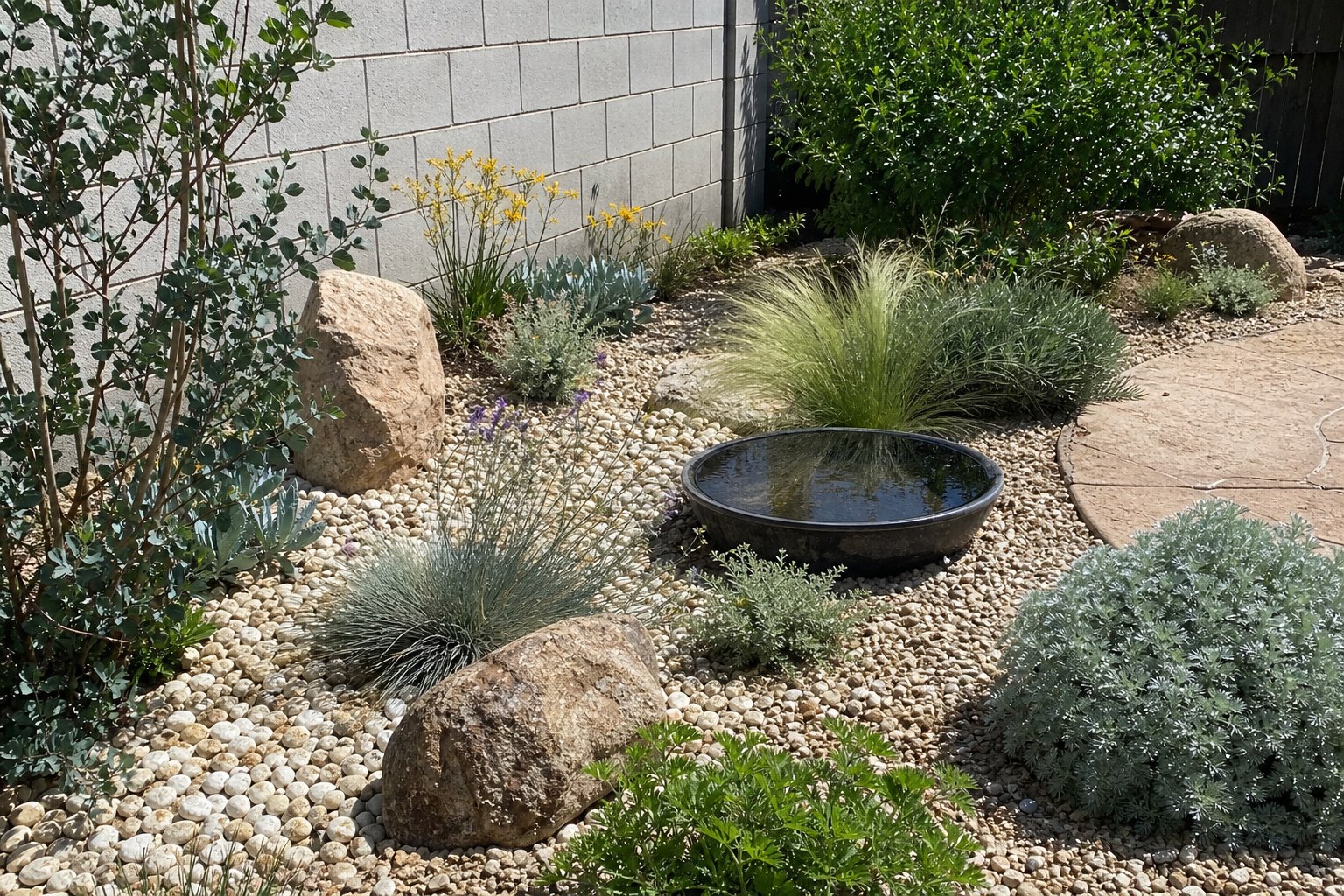
For a woodland mood, that route might be stepping stones that disappear slightly under foliage, with a darker evergreen mass at the far end. For a sun-baked ruin, it might be a gravel path that narrows between upright grasses and then opens around a bench. For an underwater or shoreline mood, it might be a dry stream of rounded stone, blue-gray leaves, and a low bowl of water that catches sky.
This is where the garden stops feeling like decoration and starts feeling like a small place with its own logic. The visitor does not need to know the inspiration. They only need to feel that the space is pulling them forward.
Translate, Do Not Copy
The fastest way to make a game-inspired garden age badly is to fill it with literal props. A plastic sword, a novelty sign, or a replica ruin may be funny for a season, but it asks the garden to carry someone else’s story. Plants are better at atmosphere. Stone, shade, water, scent, seed heads, and sound are better at memory.
Translate the mood instead. A forest game does not require a fake ruin. It may only require shade, layered greens, a curving path, leaf litter, and a stone partly softened by moss. If that is the direction your yard wants to go, the practical questions overlap with designing a moss garden that looks grown, not placed: surface, moisture, foot traffic, and patience matter more than a dramatic purchase.
An ocean world can become blue-gray foliage, rippling grasses, rounded gravel, and a shallow reflective bowl. A desert world can become gravel, heat-loving herbs, pale seed heads, and a seat placed like shelter. A haunted castle can become vertical yews, dark-leaved shrubs, white flowers that glow at dusk, and one weathered object used with restraint.
Choose three or four cues and repeat them. Too many references turn the garden into a costume box. A limited palette gives the place confidence.
Let The Site Choose The Genre
The site should decide what kind of fantasy is plausible. UF/IFAS describes the landscape design process as beginning with site inventory and analysis, including soil, drainage, climate, sunlight, existing vegetation, circulation, and user needs.2 Its “right plant, right place” guidance also emphasizes matching plants to environmental requirements, function, and aesthetics.3
That may sound like the least magical part of the project, but it is the part that keeps the magic alive. A dry, south-facing yard will not become a convincing fern ravine without constant irrigation and shade structures. It might become a strong sunlit threshold with gravel, aromatic herbs, silver foliage, and a single dark evergreen for contrast. A damp, shaded side yard might become a woodland passage with far less strain.
Work with the existing strengths. A narrow side path can become a corridor. A low corner can become a rain-catching planting. A slope can become a lookout. A plain fence can become a backdrop for shadow, vine, and repetition. If you want a second pass focused on durability, the companion article on designing a game-inspired garden that still works is useful because it treats maintenance as part of the design rather than a punishment after the fun is over.
Build Scenes At Garden Scale
Game landscapes often work because they are broken into scenes: entrance, passage, clearing, overlook, shelter, return path. A small garden can do the same without feeling theatrical. Use a tree canopy, arching shrub, or tall grass as a threshold. Place one focal point where a path turns, not in the exact center of every view. Let a bench, boulder, pot, or water bowl act as a waypoint.
Scale matters. A garden is entered by bodies, not cameras. Paths need enough room to walk. Plants need mature size, not only nursery size. Thorny, brittle, or wet plants should not lean into the place where ankles, sleeves, children, pets, and wheelbarrows need to pass. The fantasy should make the real space easier to love, not harder to use.
Light can do some of the storytelling, but restraint helps. One low fixture aimed at a trunk or a pale gravel bend can be more convincing than a row of bright path lights. Dusk is often when a theme becomes visible: white flowers lift, blue foliage cools, glossy leaves catch the last light, and dark shrubs become walls.
Plant For Repeat Visits
Games reward return visits with new details. Gardens can do this better because they actually change. Use spring bulbs as the first clue, summer foliage as the main scene, autumn seed heads as structure, and winter bark or evergreen forms as the final map. A garden that only looks good for one weekend is a set. A garden that changes is a world.
Repeat a few plants, but let them appear differently as the route changes. The same fern can be a foreground texture near the path, a soft mass under shrubs, and a shadow at the back of a border. The same grass can catch light, mark a corner, and soften the edge of stone. Repetition is not boring when the view keeps shifting.
Maintenance should be part of the story. Mulch the paths and beds. Leave room to weed without crushing the scene. Choose plants that mature to the right size. Refresh small water features often enough that they stay clean. Remove props that stop feeling integrated. The less the garden asks for emergency care, the more time there is to notice it.
Fantasy works best when it sharpens reality. A game-inspired garden is not an escape from botany. It is a way of arranging botany so the ordinary act of walking outside feels slightly more charged.