
By August, a garden begins to show its small machines. Bean pods dry and tighten. Poppy capsules rattle. Grass heads turn from green brushwork to brittle combs. And in the low, often overlooked places, a stork’s-bill or filaree may be preparing a trick so precise that it looks less like seed dispersal and more like a tiny hand tool.
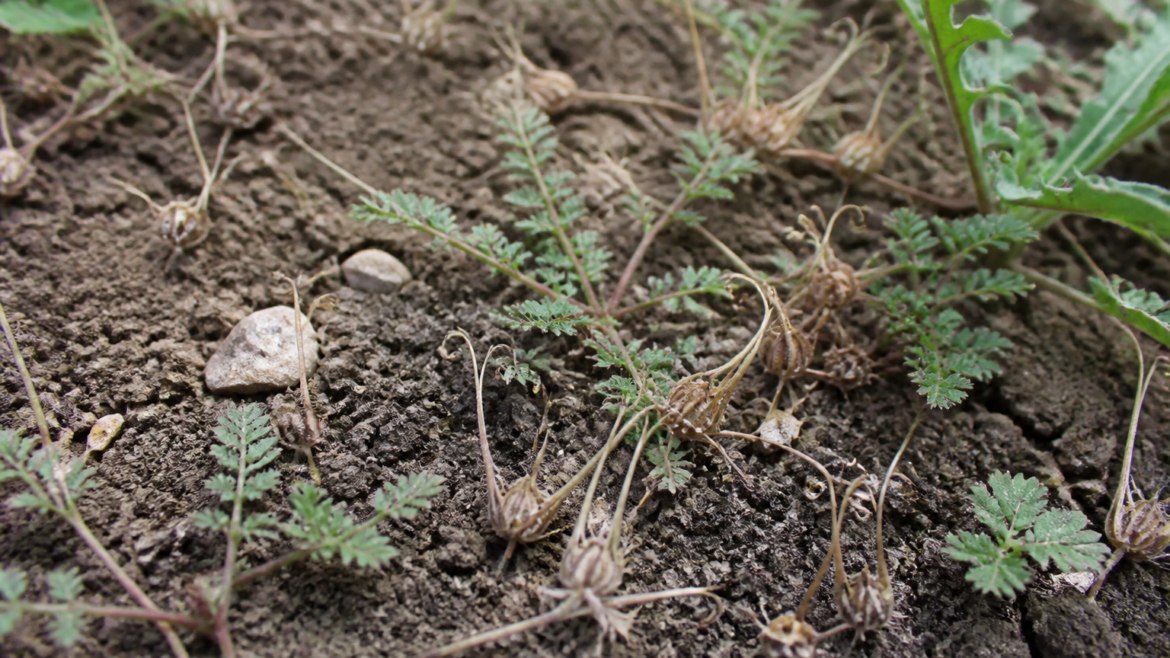
The plant itself is easy to miss until you learn its outline: a flat rosette of finely cut, ferny leaves, small pink to lavender flowers, and a long beaked fruit that gives stork’s-bill its common name. When the fruit matures, it separates into five narrow seed units. Each one carries a long tail that coils as it dries. UC IPM describes these filaree seeds as lance-shaped, hairy, and attached to a coiling style that tightens in dry air and loosens in humidity, acting to drill the seed into soil.1
That is the part worth kneeling for. The seed does not merely fall and hope. It lands with a spring, a point, a tail, and a preference for crevices.
A seed with a crank handle
In Erodium cicutarium, often called redstem filaree or common stork’s-bill, the dispersal unit is more than a seed in the everyday sense. It is a mericarp: a small fruit segment with a hard, pointed seed body at one end and a long awn at the other. While the fruit is held together on the plant, those awns are forced into a straighter arrangement. As the tissue dries, stored stress builds. Then the pieces separate.
Researchers studying filaree in the Journal of Experimental Biology found that the plant combines two forms of movement. First, the drying fruit can fling seeds away from the parent plant. After landing, the awn twists and untwists with changes in humidity, allowing the seed to move and eventually bury itself.2 It is not quick in the dramatic way described by plants that throw their seeds. It is slower, quieter, and in some ways stranger. The seed keeps working after it has left the plant.
The awn is dead tissue, but dead does not mean inert. Plant cell walls can remain beautifully responsive after the living protoplasts are gone. In hygroscopic movement, cell walls gain or lose water from the air. Different wall layers shrink, swell, bend, or twist at different rates. A 2014 review in Plant Science describes hygroscopic movement as a common seed-dispersal mechanism, capable of releasing seeds, catapulting them, or pushing them along the soil toward a place where germination is more likely.3
The weather does the winding
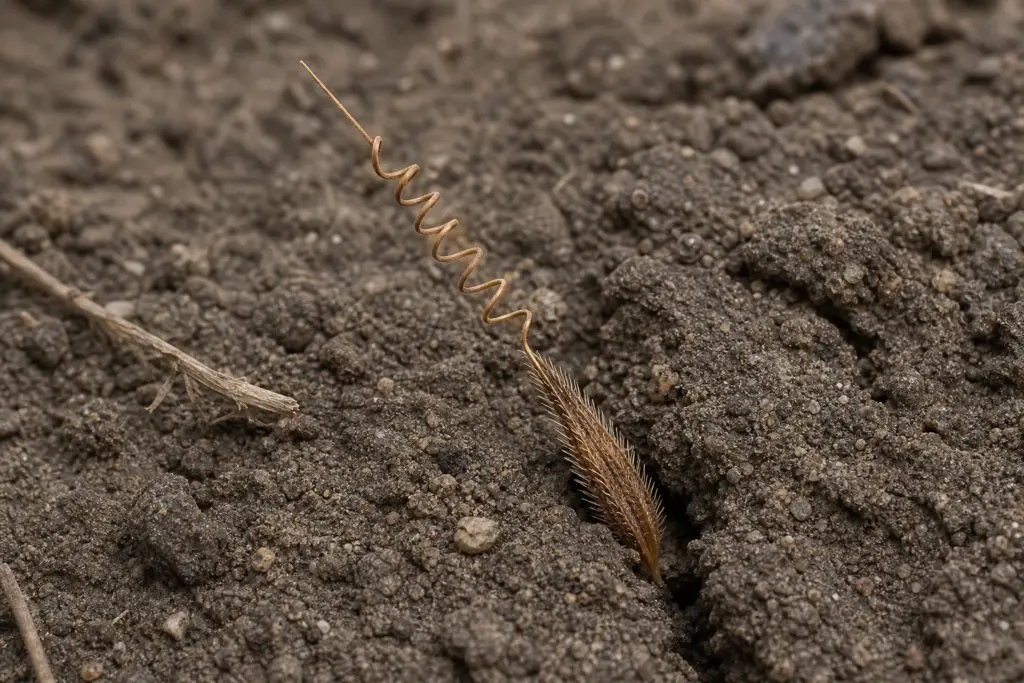
The power source is ordinary weather. A dry afternoon tightens the coil. Evening dampness or a mist of rain loosens it. Drying tightens it again. Each cycle is small, but it is directional because the seed is built like a one-way instrument. The pointed end catches in a pore, crack, or crumb of soil. Hairs and barbs on the seed body and awn help resist backward motion. The tail turns; the point advances.
Wild wheat awns use a related principle. In a study published in Science, researchers found that changes in humidity bend the awns, while tiny silicified hairs help the seed unit move in one direction, making the dead tissue behave like a motor.4 Once you notice that, the dry seed heads in a meadow stop looking passive. They are full of stored shapes, ratchets, springs, and latches.
For the seed, self-burial changes what happens after dispersal. The filaree study observed that humidity-driven twisting and untwisting can move the seed and bury it in the ground.2 The awn does not excavate like a root. Repeated wetting and drying moves the mericarp across the surface until it catches in a crevice and may work into the soil.
What gardeners can learn from it
Filaree is not a plant most gardeners set out to cultivate. UC IPM describes the California filarees it covers as low-growing winter annuals or sometimes biennials, common in agricultural land, roadsides, landscaped areas, and other open disturbed sites.1 But filaree is a useful teacher. It reminds us that the surface of the soil is not a flat stage. To a seed, it is a landscape of cracks, aggregates, pebbles, mulch fibers, and small shaded rooms.
This is one reason seedbed preparation matters. Most garden seeds cannot adjust their position after sowing, so depth and contact are our job. Requirements differ by species, and a self-burying awn is not a general instruction to leave a rough, loose surface.
If you are sowing a native-grass or prairie mix, do not infer the method from the presence of awns. Species and mixes differ in dormancy, timing, depth, and equipment. Penn State Extension notes that each seed type has its own germination requirements and that a fine-textured seedbed with good seed-to-soil contact usually supports germination.5 Follow the supplier’s or a local restoration specialist’s directions for the particular mix.
The same knowledge helps with weeding. If filaree is becoming a problem in a bed or path, remove it before the beaked fruits dry and split. Once the awns are mature, the plant has already packed its own planting tools. Mulch, denser groundcover, and less bare winter soil make it harder for these small winter annuals to find open landing places.
How to watch a seed drill
The demonstration is simple if filaree grows where you are allowed to collect it. Take a mature, dry seed unit, the kind that has already separated from the beak and has a corkscrew tail. Place it on a saucer, a tile, or a pinch of dry gritty soil. Look at the coil. Then breathe gently near it, or touch it with the lightest mist of water. The awn should begin to relax. Let it dry again and it will tighten.
On loose soil, the pointed seed may shift, pivot, and work toward a crack. The movement is easy to miss if you expect drama. It belongs to the pace of condensation on glass and seed coats swelling in a tray. A hand lens makes it better, but patience matters more. If you collect from your own garden, contain the experiment and dispose of the seeds afterward if the plant is weedy in your region.
A note about awns and pets
Not every awn in a garden is merely interesting. Dry, barbed grass seed heads, often called foxtails, can become foreign bodies in dogs and cats. A UC Davis retrospective study of 791 confirmed cases found them most often in dogs’ ear canals, skin or underlying tissue, and nasal canals. Most cases had good short-term outcomes, but a minority became life-threatening.6
That does not mean every awned plant is a crisis, but gardeners with dogs should pay attention to dry grass seed heads along paths, fence lines, and play areas. Mow or pull problematic grasses before the heads harden, and check the coat, paws, and ears after walks through dry weedy margins. If a dog develops new discomfort after exposure or you suspect an awn is embedded, contact a veterinarian promptly.6
The idea engineers borrowed
The stork’s-bill seed is so elegant that engineers have begun copying it. A 2023 paper in Nature described self-burying seed carriers inspired by Erodium. The prototypes turn wood veneer into moisture-responsive coiling structures that can carry seeds and other payloads. The work tests a possible approach to aerial seeding; it is not yet a finished restoration method.7
It is a satisfying reversal. Gardeners often think of technology as something brought into the garden from outside: timers, sensors, irrigation controllers, grow lights. Here the older technology is already underfoot. A dry seed tail, built from cell wall architecture and powered by humidity, has been solving a planting problem long before anyone named it biomimicry.
Useful seed-watching supplies
- Carson MicroBrite Plus pocket microscope: a small lighted microscope for looking at awns, seed hairs, leaf surfaces, and other details that are hard to appreciate with the naked eye.
- self-adhesive kraft seed envelopes: useful for labeling collected seed heads, keeping experiments contained, and separating different seed types while they dry.
- Burpee SuperSeed seed starting tray: a reusable tray for sowing small batches when you want to compare how different seeds respond to firming, surface grit, or shallow covering.
Final thoughts
A self-burying seed changes how a late-summer garden feels. The dry parts are not simply leftovers. They are instructions, tools, stored movements, and small negotiations with weather. A seed with a corkscrew awn does not know the future, but it has been shaped by countless futures in which a few millimeters of soil made the difference.
That is the pleasure of looking closely. The garden grows larger when the small things become legible. A stork’s-bill seed on a bare patch of soil is not just debris. It is a little auger, a weather-driven motor, and a reminder that plants often solve practical problems with a grace our tools are still trying to imitate.
References
- UC IPM: Filarees
- PubMed: The mechanics of explosive dispersal and self-burial in the seeds of the filaree, Erodium cicutarium
- PubMed: Insights into the microstructures of hygroscopic movement in plant seed dispersal
- The Hebrew University of Jerusalem: The role of wheat awns in the seed dispersal unit
- Penn State Extension: Seed and seedling biology
- PubMed: Clinical characteristics, treatment, and outcome for dogs and cats with confirmed foxtail lesions
- Nature: Autonomous self-burying seed carriers for aerial seeding