
Planting garlic in autumn feels a little like hiding dinner from yourself. You break a head apart, press the cloves into cooling soil, cover the bed, and then walk away just as the rest of the garden is slowing down. There is no instant green reward. No seed leaves. No tidy row of hopeful seedlings. Just papery cloves buried point-up in the dark.
That quietness is the point. Garlic is not asking for the same bargain as lettuce, beans, or radishes. In many temperate gardens, it begins best before winter because its calendar is split between two seasons. Autumn gives it time to root. Cold helps fulfill the needs of many cultivars. Spring gives it leaves, while lengthening days and rising temperatures help tell an established plant to build a bulb.
Once you understand that sequence, fall garlic planting stops looking like a superstition handed down from vegetable gardeners with muddy boots. It becomes a practical use of plant physiology.
A clove is not a seed
Garlic, Allium sativum, is a close relative of onions and chives, but the part we plant is not a true botanical seed. Wisconsin Horticulture explains that cultivated garlic is propagated from bulbs because most types do not produce fertile seed.1 A bulb separates into cloves, and each clove is a small storage organ with a compressed shoot inside, a basal plate at the bottom, and enough stored food to begin growth before the plant can make much of its own.
That makes garlic wonderfully practical. You plant one clove and, if the season goes well, harvest one new bulb made of many cloves. The plant is copying itself vegetatively. This is why planting-stock quality matters so much. A weak, diseased, undersized, or poorly adapted clove is more than a bad seed in the ordinary sense. It is the actual starting body of next year’s plant.
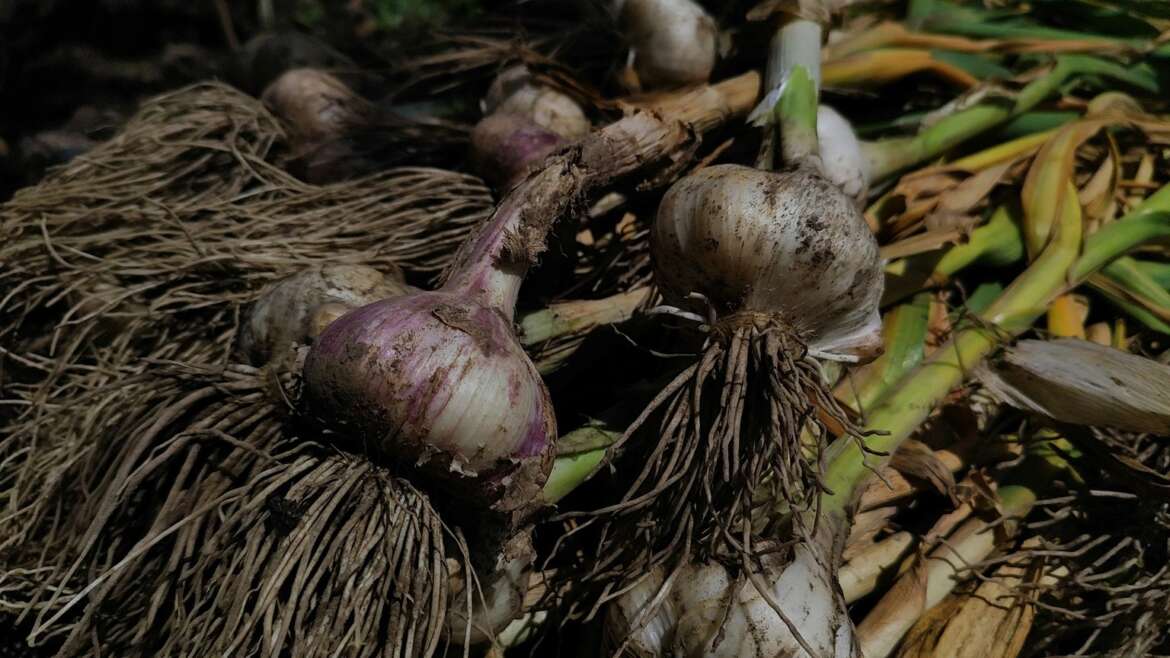
The largest cloves usually make the strongest plants and bulbs, which is why gardeners save the best healthy bulbs for replanting instead of eating them all.1 That small act of restraint is part of growing garlic well: the harvest contains next autumn’s beginning.
Why autumn is the useful window
Garlic can sometimes be planted in spring, especially in mild regions or when cloves have been chilled first, but fall planting gives the crop a better start in many temperate gardens. Cornell Cooperative Extension puts the reason plainly: garlic roots develop in fall and winter, and by early spring those roots can support the rapid leaf growth needed to form large bulbs.2
The timing is a local balance. Plant very early into warm conditions and shoots may emerge; that is not automatically a crop failure, although severe cold can damage exposed foliage. Plant after the soil is nearly frozen and the cloves may have little time to root. For its Wisconsin audience, Wisconsin Horticulture recommends planting within a week or two after the first killing frost so roots and shoots begin developing while the shoots remain below the soil by the first hard freeze.1 Use local extension guidance rather than exporting that frost cue to a very different climate.
That is the sweet spot. The clove wakes enough to anchor itself, but not so much that it behaves like a spring crop in autumn. Under the surface, the plant is making an investment. Above the surface, the bed may look empty.
Cold is part of the instruction
For many garlic cultivars, time alone does not guarantee a well-divided bulb; temperature and day length interact with cultivar. In a two-year controlled study of three naturally vernalized cultivars, warmer day-and-night treatments and a 14-hour photoperiod enhanced bolting, bulbing, clove formation, and bulb weight compared with cooler or 8-hour treatments.3
In garden language, winter helps set the plant up, and lengthening spring days help tell it what to do next. This is why garlic can behave strangely when planted at the wrong time or grown in a climate poorly matched to the variety. It may make lush leaves but small bulbs. It may form a single round instead of a divided bulb. It may mature unevenly or bolt differently than expected.
The details vary by cultivar. A hardneck garlic from a cold-climate seed grower is not the same as softneck garlic from a supermarket shelf. For fall-grown garlic adapted to a cold-winter climate, the practical pattern is useful: allow a cool rooting period, let the plant experience winter, then let it meet lengthening days with an established root system.
The roots grow before the leaves impress you
Autumn garlic is easy to underestimate because most of its early work is hidden. Roots grow from the basal plate at the bottom of the clove.1 They enter the loose soil, explore for moisture and minerals, and hold the clove steady through freeze and thaw. If you could lift the bed like glass, you would see that the crop has not been idle.
That root system changes spring. When the soil begins to warm, garlic does not have to start from nothing. It can send up leaves quickly because the underground support is already there. Those leaves are not merely garnish. They are the factory that will fill the bulb. Cornell’s growing guide ties large bulbs to rapid leaf growth in spring, supported by roots made earlier in the season.2
This also explains why weak fall establishment can echo all the way to harvest. If cloves sit in compacted soil, rot in a wet pocket, or freeze before rooting well, spring growth may be late and thin. Garlic does not have endless time to catch up. Once day length and temperature push it toward bulbing, the plant works with the leaf area and roots it has.
Hardneck, softneck, and local fit
Garlic choice matters because the crop carries climate memory in its habits. Hardneck garlics are often favored in colder regions. They typically make a stiff central stalk and produce a curling flower stalk, or scape, in late spring or early summer. Wisconsin Horticulture lists Rocambole, Purple Stripe, and Porcelain among hardneck groups and notes that hardneck types produce scapes, while softneck types such as Artichoke and Silverskin generally do not.1
Softneck garlics are the familiar braidable types often seen in grocery stores. They generally store longer and are better suited to milder climates, though climate can blur neat labels. Wisconsin Horticulture notes that flower-stalk formation and other varietal traits can change with location.1 Garlic is responsive enough to make gardeners humble.
This is why locally grown seed garlic is often worth seeking out. It has already passed through a version of your winter, spring, and summer. For cold-winter gardens, Wisconsin Horticulture cautions that common commercial California types may not adapt well, while University of Maine recommends clean planting stock from reliable sources.1, 4 The caution is not a universal ban on grocery garlic; it is a reason to choose firm, healthy cloves suited to the site and free of visible damage or disease.
The soil has to be ready before the cloves are
Garlic is often described as easy, which is true in the sense that it does not need daily fussing. It is not true if easy means indifferent to soil. Garlic wants a loose, well-drained bed with enough organic matter to hold moisture without staying soggy. University of Maine’s guidance for hardneck garlic recommends well-drained soil around pH 6.5 with good organic matter, while Iowa State advises improving heavy clay with compost or well-rotted manure.4, 6 A soil test and local guidance are better than treating one pH number as a guarantee.
The drainage piece is not optional. A garlic clove is alive, full of stored food, and wrapped in a protective skin, but it is not built to sit in cold mud. If water lingers around the basal plate, rot has an invitation. Raised beds can help where native soil drains slowly. So can suitable organic matter, avoiding low spots where winter water collects, and waiting until soil is friable before working it.
Nitrogen matters too, but timing matters with it. Garlic needs enough fertility for strong spring leaves, yet late nitrogen may work against bulb quality or storage. University of Maine suggests side-dressing at emergence and again two to three weeks later, and notes that later applications are not helpful and may reduce storage life.4 Start with a soil test or local recommendation rather than copying a fertilizer rate from a different soil. Feeding garlic is about the right support at the right phase, not simply more.
Planting is simple, but orientation matters
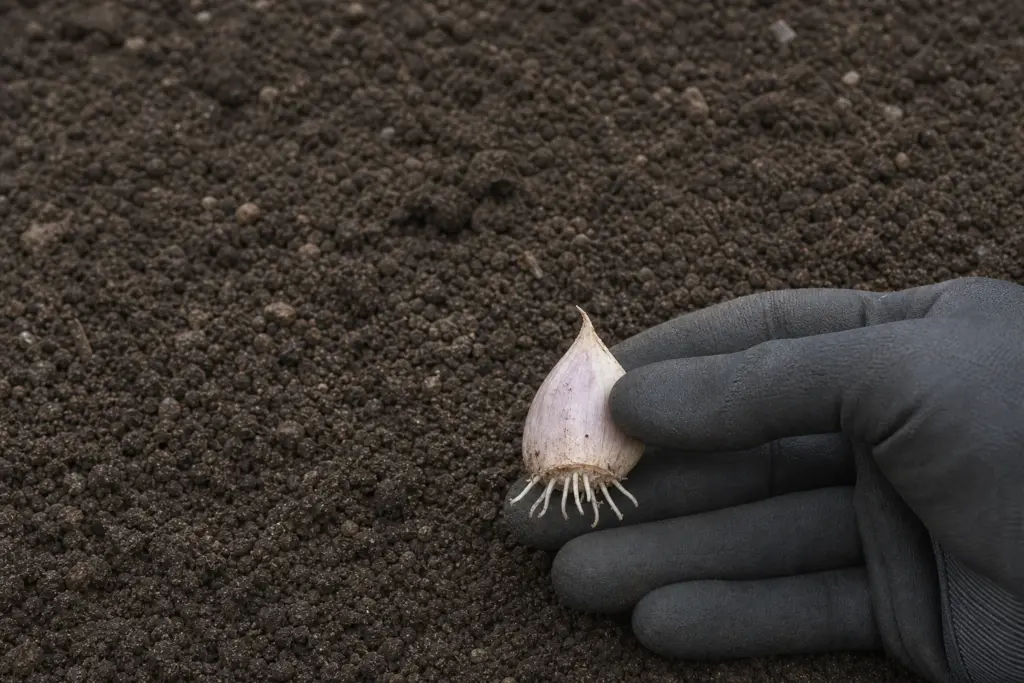
The actual planting is pleasantly plain. Break the heads into individual cloves shortly before planting, keeping the papery skins intact. Choose the largest healthy cloves for the main crop. Set each clove with the pointed end up and the basal plate down. Depth and spacing vary with climate, soil, and local practice: Wisconsin suggests planting cloves two to three inches deep and about six inches apart, while Maine places the clove point two to four inches below the surface and uses four- to six-inch spacing.1, 4
Point-up planting is not fussy perfectionism. The shoot emerges from the pointed side and roots emerge from the basal plate, so this is the orientation recommended by Wisconsin and Iowa guidance.1, 6 A sideways clove may still grow, but there is no advantage in making its path less direct. Garlic has a long season, but the best bulbs often come from small efficiencies stacked together: good cloves, suitable depth, loose soil, clean spacing, and a bed ready before the weather forces your hand.
After planting, water enough to settle the soil if it is dry. Do not leave the bed soupy. The goal is contact between clove and soil, not a winter aquarium.
Mulch is temperature management
A good garlic mulch is not decoration. It is insulation, weed control, and moisture moderation. Wisconsin Horticulture recommends three to four inches of clean straw after planting to limit damaging soil-temperature fluctuations, while Maine recommends about three inches of dried grass, leaves, or straw in its context.1, 4 Use clean material and adjust the layer to local winter conditions and drainage.
That temperature moderation is especially useful in climates where winter cannot make up its mind. Bare soil freezes, thaws, heaves, crusts, and warms unevenly. Mulch softens those swings. Our closer look at how repeated freeze-thaw can lift plants explains why a root zone can rise even when nothing pulled from above. A suitable mulch can help keep cloves from being lifted toward the surface and can slow early spring warming.
In spring, the mulch decision becomes local. Wisconsin recommends pulling mulch back after hard-freeze danger has passed, then replacing it after shoots are established for weed control; Iowa similarly moves straw between rows as garlic emerges.1, 6 The key is to watch the bed, not obey a ritual. If shoots are trapped under a matted layer or wet soil needs air and warmth, loosen it. If weeds are racing and drainage is sound, a lighter layer can remain useful.
Spring leaves make summer bulbs
By spring, garlic begins to look gratifying. Green blades push through mulch, often earlier than many vegetables are even sown. Those leaves matter because each one is connected to the layers that will become bulb wrappers and clove structure. When leaves are damaged, shaded, starved, or crowded by weeds, the bulb loses some of its future.
This is why early weed control is so important. Wisconsin Horticulture notes that garlic competes poorly with weeds and recommends early control.1 Garlic leaves are upright and narrow. They do not shade the soil the way squash or potatoes can. A bed that looked clean in autumn can become a spring weed nursery if mulch is thin or full of seed.
Water matters most while the plant is actively expanding leaves and bulbs, but the amount depends on rainfall, soil texture, temperature, and rooting depth. Iowa State uses about one inch per week as its home-garden baseline, while Wisconsin advises stopping irrigation when foliage begins to wither to reduce staining and disease risk.6, 1 Follow soil moisture and plant stage rather than a fixed calendar date.
Scapes are a useful interruption
Hardneck garlic offers a bonus crop before the bulbs are ready. The scape rises from the center of the plant, curls, and would eventually carry bulbils if left alone. Wisconsin Horticulture notes that immature scapes can be harvested while still curled and eaten.1 Cornell adds the practical reason many gardeners cut them: flower shoots may decrease bulb size, and removing them lets the plant put more energy into bulb formation.2 The bulb-size response can vary with plant nutrition and growing conditions, so scape removal is useful management rather than a universal promise.
Scape harvest is one of those moments when garden and kitchen agree. Cut the scape while it is still tender, before it becomes woody. Use it like a milder garlic in eggs, beans, soups, pestos, pickles, or anything that wants a green allium note. The plant gives you a sign that the bulb is entering its serious swelling period, and it gives you something good to cook while you wait.
Harvest begins before everything is brown
Garlic harvest is another place where waiting for obvious signals can go wrong. A fully dead plant may mean the bulb wrappers have already deteriorated. Wisconsin Horticulture uses a general cue of about half the leaves brown and recommends digging a test plant, because varieties mature at different times; too-late harvest can let cloves break through their skins and become more vulnerable to disease.1
Do not yank the plants by the tops if the soil is firm. Loosen them with a garden fork, lift carefully, and keep bruising to a minimum. Garlic can look tough, but fresh bulbs mark easily, and damaged bulbs do not store as well. Cornell is blunt on this point: dig, do not pull, because careless harvesting can ruin a fine crop.2
Curing finishes the crop. University of Maine Cooperative Extension describes curing as drying bulbs for storage and recommends a single layer in a warm, dry place with good air movement, avoiding very hot places such as attics, closed greenhouses, or direct sun.4 Curing does more than dry surface dirt: it tightens the wrappers, dries the neck, and turns a fresh summer bulb into a storage crop.
Do not save problems for next year
Because garlic is replanted from cloves, disease management has a memory. If you save planting stock from weak, moldy, damaged, or suspicious bulbs, you may be saving the problem too. Wisconsin and University of Maine guidance both emphasize clean, healthy planting stock because decay organisms and other problems can travel on cloves.1, 4
University of Maine’s blue mold guidance makes the same principle practical after harvest: properly cure and dry bulbs, cull diseased bulbs before cracking and planting, and remember that diseased bulbs can be a primary source of inoculum.5 The best seed garlic is not simply the largest. It is large, clean, well cured, and from a healthy plant.
Rotation helps too. Garlic should not return again and again to the same narrow strip where onions, leeks, shallots, or garlic have grown. The bed may look empty after harvest, but soil organisms, crop debris, and pest cycles can persist. University of Maine includes rotation in its blue-mold management guidance.5 Moving alliums through the garden gives the next crop a cleaner start.
Final thoughts
Garlic is one of the garden’s best arguments for thinking in seasons rather than tasks. The autumn act is small: break, place, cover. The plant’s response is stretched across months. It roots in autumn, rests under winter, rises in spring, reads lengthening days, curls a scape, swells a bulb, then dries into food and planting stock for the next cycle.
That is why planting garlic before winter feels so satisfying. It is practical, but it is also an act of timing. You are not forcing the plant out of season. You are giving it the season it understands.
References
- Wisconsin Horticulture: Garlic, Allium sativum
- Cornell Cooperative Extension: Guide for Growing Garlic
- Wu et al. Response of garlic (Allium sativum L.) bolting and bulbing to temperature and photoperiod treatments. Biology Open, 2016.
- University of Maine Cooperative Extension: Growing Garlic in Maine
- University of Maine Cooperative Extension: Blue Mold of Garlic
- Iowa State University Extension: Growing Garlic in the Home Garden