
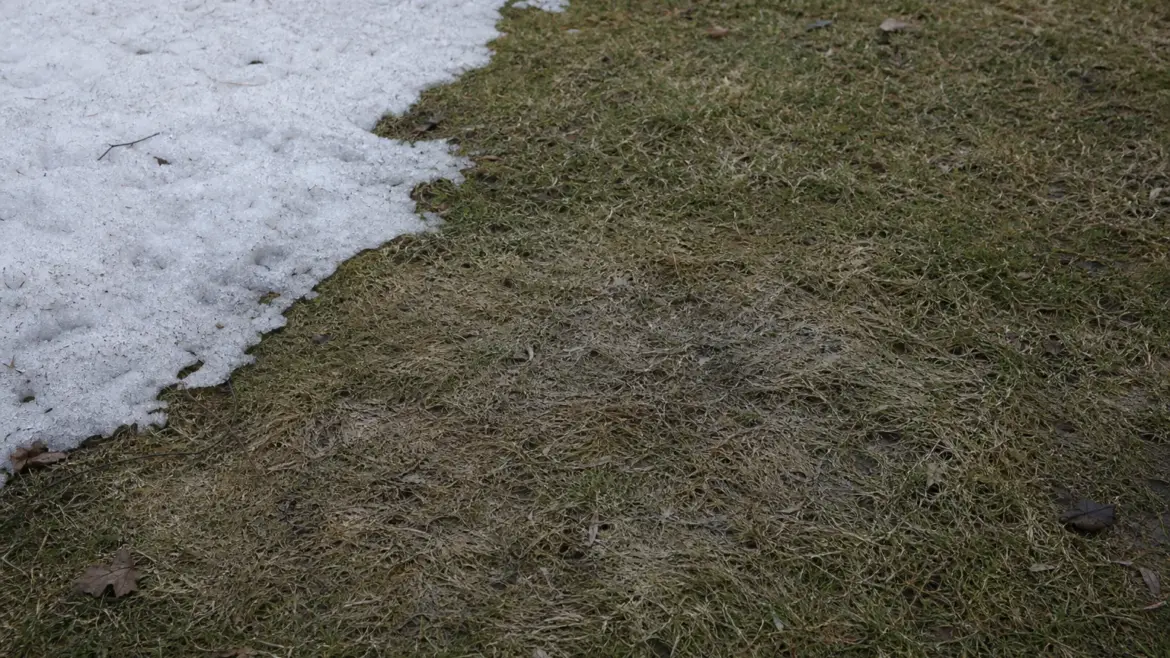
In early March, the edge of a snowbank can reveal a lawn that looks as if it has been badly stored. The grass is flattened into pale circles. Some blades are glued together in a papery crust. In the dampest places, fine gray-white threads stretch across the surface like cobwebs laid down overnight.
Spiders are not the only explanation. Those threads are often fungal mycelium, and the larger pattern is commonly called snow mold. It is one of those garden problems whose evidence appears after the interesting part is over. By the time the snow retreats and the patches become visible, the fungi may have been growing quietly at ground level for weeks.
The name makes snow mold sound like one disease with one answer. It is not. The two common diseases grouped under that name in cool-season lawns are gray snow mold, also called Typhula blight, and pink snow mold, more accurately called Microdochium patch. They overlap in appearance, but they do not have exactly the same weather requirements or the same capacity for damage.
The good news is that an alarming lawn at snowmelt is not automatically a dead lawn. Mature turf often grows through the injury once it dries and spring growth resumes. The useful first response is usually observation and patience, followed by a very light rake when the soil is ready—not an emergency dose of everything in the shed.
The disease begins before the evidence
Snow changes the weather beneath it. As snow protects a sleeping garden from sharp swings in air temperature, it also makes a dark, humid room at the surface of the lawn. When snow settles over wet, unfrozen turf and stays there, the grass can remain close to freezing instead of becoming deeply frozen and dry.
For gray snow mold, that sheltered interval is the opportunity. University of Wisconsin Extension describes Typhula blight as a disease of cool-season grasses under prolonged snow cover, especially when snow lies over unfrozen ground and the temperature at the turf remains just above freezing.1 The fungus does not need a warm lawn. It needs a cold lawn that is wet, dark, and protected from harder cold.
That is why the worst patches often follow the map of winter rather than the map of summer lawn care. They gather beside a driveway where shoveled snow was piled, behind a hedge where a drift lingered, or below a roof where sliding snow made a deep bank. The snowline pulls back in spring and reveals a record of where winter stayed longest.
The familiar claim that snow mold begins after a precise number of snowy days is too tidy. A long cover increases risk, but there is no magic morning when the lawn crosses from safe to diseased. Snow depth, soil temperature, drainage, grass species, autumn growth, and whether the ground froze before the first lasting snow all change the result.
Snow mold is two different stories
Gray snow mold is caused mainly by two related fungi, Typhula incarnata and Typhula ishikariensis. At snowmelt, affected grass may be bleached, straw-colored, gray, water-soaked, or matted into roughly circular patches. Gray-white mycelium can be visible while the area is still wet, then become much less obvious as sun and moving air dry the blades.1
Pink snow mold is caused by Microdochium nivale. Its better name, Microdochium patch, preserves an important correction: it does not require snow. It can develop during prolonged cool, wet weather in autumn or spring as well as beneath winter cover. Patches may be pale, tan, reddish-brown, or faintly pink at the edge, with white or pinkish fungal threads when conditions are moist.2
Neither disease should be confused with the white dust on summer leaves. Powdery mildew grows as a pale coating on standing leaves during the growing season. Snow molds reveal themselves as flattened, damaged turf in cold, saturated weather. Both are fungi showing up as pale growth, but they occupy different seasons, tissues, and garden stories.
The colors in the common names are less helpful than they sound. Gray snow mold can dry tan or silver. Pink snow mold may show very little pink. Several patches can merge until their original shapes disappear, and more than one winter problem can occur in the same lawn. A photograph may suggest a diagnosis; it cannot always settle one.
The small hard dots tell more than color
If you want a better clue, look closely at the grass blades rather than standing back and judging the shade of the patch. Typhula fungi make sclerotia: small, hard survival structures that remain after the showy threads dry away. Wisconsin Extension describes the sclerotia of T. incarnata as reddish-brown and relatively large, while those of T. ishikariensis are smaller, black, and pepper-like.1
A sclerotium is a compact packet of fungal tissue built to survive between periods of active growth. Sclerotia can remain dormant in infected leaves, thatch, and soil through the warmer months, then germinate when cool, wet conditions return.4 The lawn appears to recover and the visible webbing vanishes, but the fungus has not been erased from the property. It has changed form.
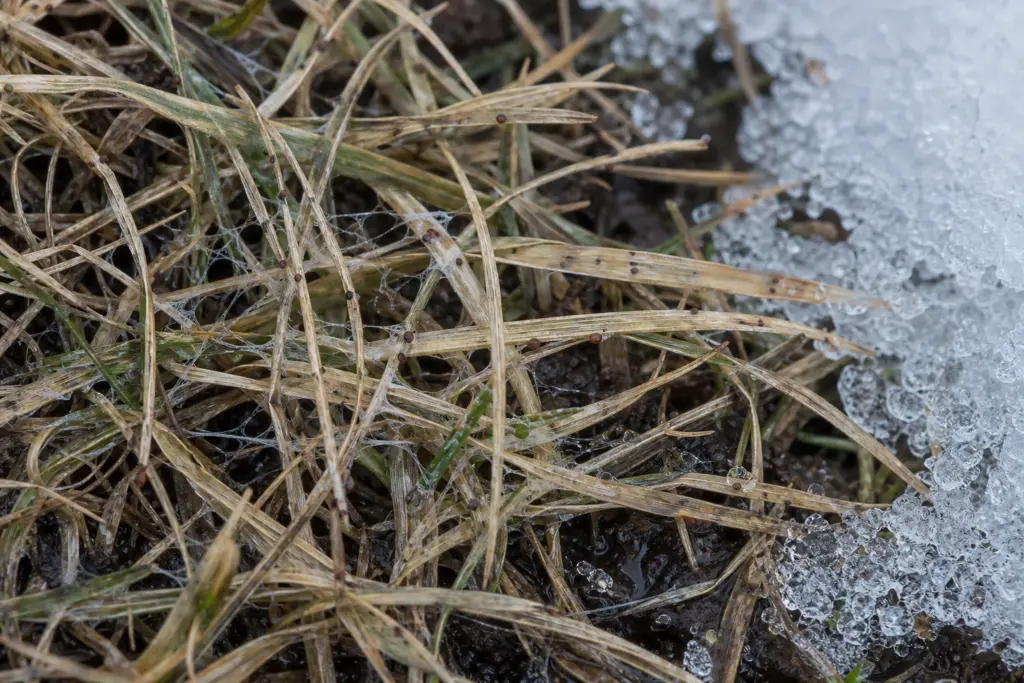
Microdochium patch does not make those sclerotia.2 That absence helps separate it from Typhula blight, although finding no dots with the naked eye is not proof that none are present. Tiny structures are easy to miss among soil grains, seed husks, old clippings, and ordinary dark flecks.
For a home lawn, exact species identification is not always necessary before taking gentle first steps. If the turf is especially valuable, the damage repeats every year, or the crowns remain dead after normal growth begins, a local university plant-disease clinic can examine a sample. That is more reliable than choosing a fungicide from patch color alone.
A ruined-looking lawn may still be alive
Grass can lose leaves without losing the plant. The growing crown of a turfgrass sits near the soil surface, where it can produce new blades if it remains alive. Typhula incarnata usually damages foliage while leaving crowns and roots capable of recovery. T. ishikariensis can injure crowns more seriously, which is why some gray snow mold patches return and others stay bare.1
Microdochium patch often grows out as the weather becomes warmer and drier, but severe cases can also require reseeding.2 Newly established grass, very closely cut turf, and lush, soft growth entering winter tend to have less margin for damage than a mature home lawn maintained at a sensible height.2, 4
This is why the first brown view after snowmelt is a poor time to declare the lawn dead. The blades you see are last season’s leaves. The more useful question is whether the crowns below them can restart. Give the surrounding turf time to green and make the contrast honest. A patch that looks hopeless beside dormant grass may become much smaller once the whole lawn is growing.
Let the grass dry before you rescue it
The traditional advice to rake snow mold is sound only if the adverb is included: rake lightly. Once the surface has drained and feels firm, a flexible leaf rake can lift matted blades, break the papery crust, and let air move through the patch. University of Minnesota Extension describes cobweb-like growth on wet gray snow mold patches and notes that the matted grass becomes silvery-gray and brittle as it dries.3
Do not attack a saturated lawn because the first sunny afternoon feels like permission. The same reason wet spring soil should be left alone applies here: pressure and aggressive tools can compact soft ground, smear soil, and tear living crowns loose. A cure that leaves rake scars and boot depressions has added a second problem.
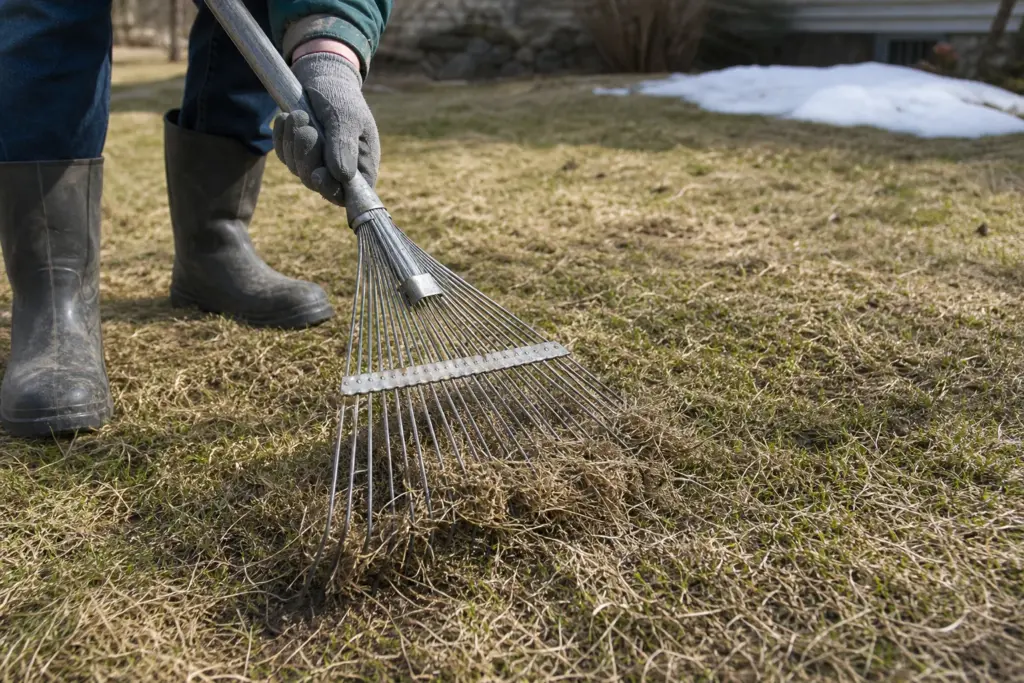
After the blades are lifted, wait for normal growth. Mow when the grass is actually growing and the surface can carry the mower without rutting. If a patch remains bare after the rest of the lawn has returned, loosen only the dead surface material and reseed with a grass suited to your region, light, and existing lawn. A local extension lawn calendar is more useful for timing than the date of the first thaw.
Do not use a heavy spring fertilizer dose as a reflex. Before feeding, follow a local extension lawn calendar for your turf species and climate. Snow mold does not turn excess nitrogen into medicine.
Prevention is an autumn job
The useful preventive work happens before the lawn disappears. Continue mowing at the locally recommended height until growth stops, and avoid fast-release nitrogen late in autumn that leaves grass lush as it enters winter.1, 2, 6 Remove thick accumulations of leaves from turf and correct drainage problems where water sits.5, 6
This does not require turning the whole garden into a vacuumed carpet. Leaves can be valuable in beds, under shrubs, and in habitat areas. The distinction is physical: a loose layer protecting soil in a border is not the same as a wet mat pressed over living turf. Move useful organic material to a place where it can do useful work.
Snow management should be equally restrained. There is no reason to strip ordinary protective snow from a lawn. Instead, notice where human-made piles remain long after the surrounding cover melts. If every storm is shoveled onto the same narrow strip, avoid creating a long-lasting bank on valuable turf when practical.4 Keep snow containing deicing salts away from planting areas.7
All cool-season turfgrasses can develop Typhula blight, while susceptibility to Microdochium patch varies among species and cultivars. Use local recommendations because regional performance differs.1, 6 If the same area is badly affected year after year, treat the pattern as information: drainage, shade, snow storage, thatch, fertility, or grass selection may be asking for a larger change.
A spray at snowmelt is mostly too late
Fungicides cannot rebuild a dead blade. For gray snow mold, products that work are used preventively before lasting snow cover, not sprayed onto the evidence in spring. Penn State Extension states plainly that applying fungicides after gray snow mold symptoms appear has no value.4
Microdochium deserves a little more nuance because it can remain active in cool, wet weather without snow. Even so, preventive fungicide programs are usually difficult to justify on an ordinary home lawn. Wisconsin Extension notes that treatments for Microdochium patch are often not cost-effective, while cultural management and recovery are usually the sensible first approach.2
Repeated severe disease on newly seeded, intensively managed, or unusually valuable turf is a different situation. Diagnose it first, then consult a local extension specialist or licensed turf professional about a preventive plan for the next season. The Connecticut Agricultural Experiment Station similarly limits preventive treatment to cases such as high-value turf or recently seeded lawns and notes that spring application is ineffective for gray snow mold.5 Pesticide registrations and permitted uses change, so an old list of active ingredients is not a safe shopping list. The current label and local rules are the authority.
Read the retreating snowline
The edge of melting snow makes hidden winter processes briefly visible. It shows where cold stayed damp rather than dry, where grass was pressed flat, where a snow pile lingered, and where fungi used the same insulating cover that protected the crowns below them.
Look while the evidence is fresh. Notice the fine threads before they dry. Search for the hard rust-colored or black dots that point toward Typhula. Photograph the pattern if it repeats. Then let the surface firm, lift the matted blades gently, and wait for the crowns to answer with new green.
For many mature home lawns, that is enough. The lawn is not a ruined carpet in need of instant replacement. It is a community of small perennial plants emerging from a cold, wet season, some leaves damaged and many crowns still alive. The cobweb-like threads may be fungal rather than spider silk, but they are not a reason to panic. They are winter’s last handwriting on the grass.
References
- University of Wisconsin–Madison Division of Extension: Typhula Blight
- University of Wisconsin–Madison Division of Extension: Microdochium Patch
- University of Minnesota Extension: Turf with Distinct Circular Patches, Rings, or Arcs
- Penn State Extension: Turfgrass Diseases—Gray Snow Mold
- Connecticut Agricultural Experiment Station: Gray Snow Mold of Turfgrass in Home Lawns
- Oregon State University Extension Service: Managing Microdochium Patch in Pacific Northwest Turfgrass
- Iowa State University Extension and Outreach: Using Deicing Salts in the Home Landscape