
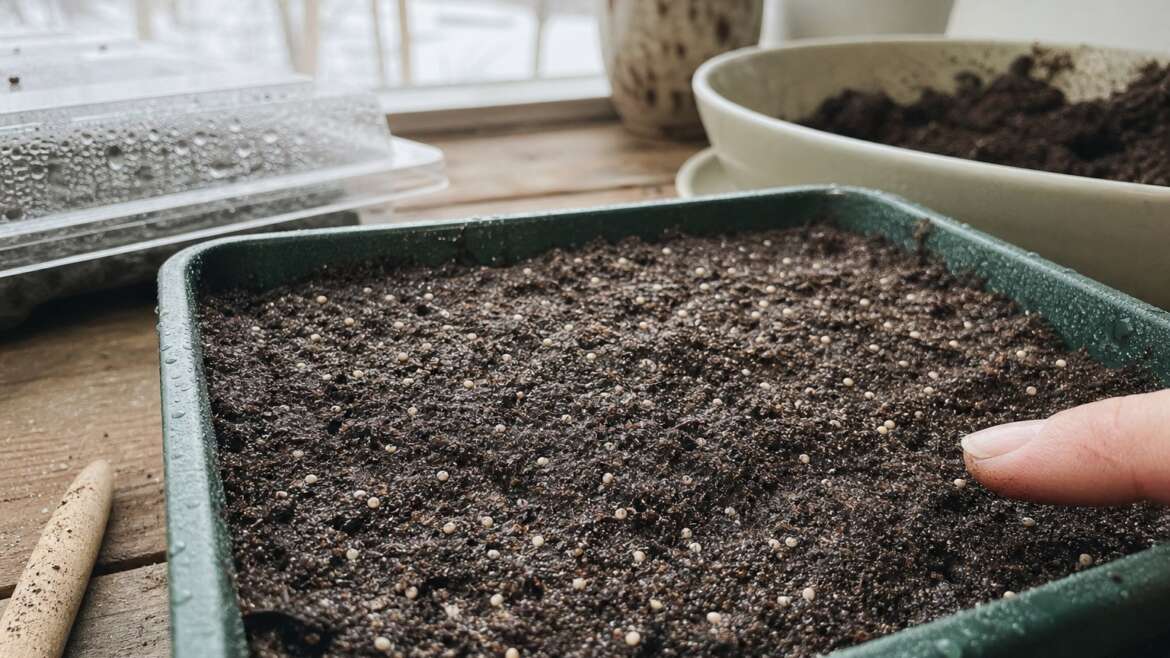
On a January afternoon, the smallest seeds on the bench can feel like the most uncertain ones. Lettuce seed looks almost weightless. Petunia and begonia seeds are closer to dust than to anything a gardener can confidently place. Then the packet gives an instruction that seems to go against every planting instinct: press into the surface, do not cover.
Gardeners like to tuck things in. We make a furrow, cover the seed, pat the soil, and feel that we have given it a safe beginning. For many seeds, that works. For others, a blanket of mix is not protection. It is a signal that the seed is in the wrong place.
Light-requiring seeds are not rare curiosities. Iowa State University Extension lists several familiar annuals and vegetables whose seeds require light for germination, including ageratum, snapdragon, wax begonia, lisianthus, petunia, impatiens, flowering tobacco, dill, and lettuce.1 The detail is small enough to miss on a seed packet, but it can decide whether a tray comes up like a green haze or sits blank for two weeks.
The smallest instruction on the packet
Seed depth is one of those gardening rules that sounds simpler than it is. A common guide is to plant a seed about twice as deep as its diameter, and University of New Hampshire Extension gives that rule of thumb for most indoor seed sowing.2 A pea can be covered. A bean can shoulder its way through soil. A tomato seed usually accepts a shallow burial without complaint.
But a very fine seed has almost no margin for error. If it is covered too deeply, it may germinate and then spend its finite reserve trying to reach the surface. If that reserve runs out before the shoot reaches light, the seedling fails underground before the gardener ever sees it. That is one practical reason surface sowing exists. It is not fussiness. It is matching the seed’s body to the depth of the world above it.
The rule is also biological. Some seeds are tuned to begin only when they receive light. UNH Extension advises leaving light-requiring seeds uncovered, or using only a very light layer of fine peat or vermiculite that still allows light to reach them.2 In other words, light is not just illumination. It can be part of the germination instruction itself.
Light as a surface signal
A seed does not need light because it is already trying to photosynthesize. At the moment of germination, the embryo is still living on stored food inside the seed. The first root and shoot are built from that reserve. Light matters because it tells the seed something about where it is.
For many small, light-responsive seeds, illumination is evidence of the surface. It suggests that the seed is close enough to open air for its first leaves to reach daylight before the stored food runs out. Darkness may indicate burial beneath soil or leaf litter, where an emerging shoot would have farther to travel.
This relationship between seed size and light has been measured beyond the seed tray. In a study of 131 taxa in the bellflower family, germination was higher in light at every temperature tested, and the light requirement became weaker as seed mass increased. The authors proposed that smaller-seeded taxa may germinate only at the soil surface or at shallow depths.3 That makes sense in a garden. A dust-like seed cannot afford to wake in the basement.
This is also why surface-sown seed should be pressed, not simply sprinkled. Good contact with moist mix lets the seed take up water. Exposure to light lets it read its position. Both matter. A seed lying on a dry crust in bright light is not better off than a seed buried in perfect darkness.
The red and far-red switch
The plant world reads light with more subtlety than our eyes do. One important photoreceptor family is phytochrome. Its proteins change state in response to red and far-red wavelengths, allowing light quality to become part of a seed’s germination decision. The response is not one universal meter for open sky or shade: species and individual phytochromes differ.4
Research on Arabidopsis, the small mustard-family plant used so often in plant science, found that phytochromes B and E participate directly in red/far-red-reversible germination, while phytochrome E also has a distinct role under continuous far-red light.4 A seed packet will not say any of that. It will simply say needs light, surface sow, or do not cover. Behind that short instruction is a photoreceptor system that lets a dry seed respond to its surroundings before spending its stored food.
This is one reason the advice can feel inconsistent from plant to plant. Seeds are not following one universal light rule. Some are encouraged by light. Some germinate best in darkness. Some will germinate either way if moisture and temperature are suitable, and dormancy can modify the response. The packet is not decorative paper. It is the most local instruction you have.
Darkness is not a failure
It is tempting, once you learn about light-requiring seeds, to start treating the surface as safer for everything. That creates a different set of problems. A seed that belongs under cover may dry out, fail to anchor well, or sit exposed to temperature swings and disturbance. Iowa State’s germination table lists many common vegetables and herbs as requiring darkness for germination, including tomatoes, peppers, basil, kale, cabbage, broccoli, cucumbers, squash, pumpkins, carrots, peas, beans, and radishes.1
Those seeds are not less sophisticated. They are working with a different body plan and a different ecological bet. A squash seed is large enough to push through a reasonable cover of warm soil. A bean carries a substantial food reserve. A pea is normally sown cool and covered. A tomato seed can germinate in darkness, then needs strong light as soon as green growth appears.
So the question is not whether seeds need light. The useful question is when light matters. For some seeds it is a germination trigger. For seedlings, it becomes the energy source for photosynthesis as green tissue unfolds; the first leaves a seedling wears mark that change of stage. Mixing up those two phases is a common cause of weak seed starting.
How to sow without burying the signal
Surface sowing works best when the tray is prepared before the seed appears. Moisten the seed-starting mix first, then let it settle. Level the surface gently with your fingers, a small board, or the bottom of another tray. A smooth surface is not about neatness. It prevents tiny seeds from rolling into cracks where they are effectively buried.
Sow thinly, then press the seeds into contact with the damp mix. A fingertip works for larger fine seeds. For dust-like seed, a folded piece of paper, a dry toothpick, or a small pinch mixed with dry sand can give better control. Do not chase perfection. A slightly uneven sowing is easier to fix later than a thick green carpet of seedlings competing from the first day.
If the packet says not to cover, do not cover with mix. If it suggests a light covering, use the thinnest possible veil of fine vermiculite or fine peat. Purdue Extension gives the same practical warning for very fine seeds such as petunia and begonia: they should not be covered, while most other seeds are generally covered to about twice their diameter.5
The hard part is moisture. A buried seed is buffered by the surrounding mix. A surface seed lives at the boundary between damp material and drying air. A clear humidity dome or plastic cover can slow moisture loss, but keep a covered tray out of direct sun and remove the cover when the first seedling leaves appear.2 Water from below when possible, or mist very gently. A careless stream from a watering can can move a week’s worth of careful sowing into one corner of the tray.
The seed only asks for a whisper of light
Light-requiring seeds do not need the force of midsummer sun to receive the message. UNH Extension notes that light-sensitive germination can occur at very low intensity, sometimes with enough light from a windowsill or low-intensity lamp for part of the day.6 That does not make direct sun safest: its seed-starting fact sheet warns that a covered tray in sunlight can overheat enough to kill seed.2
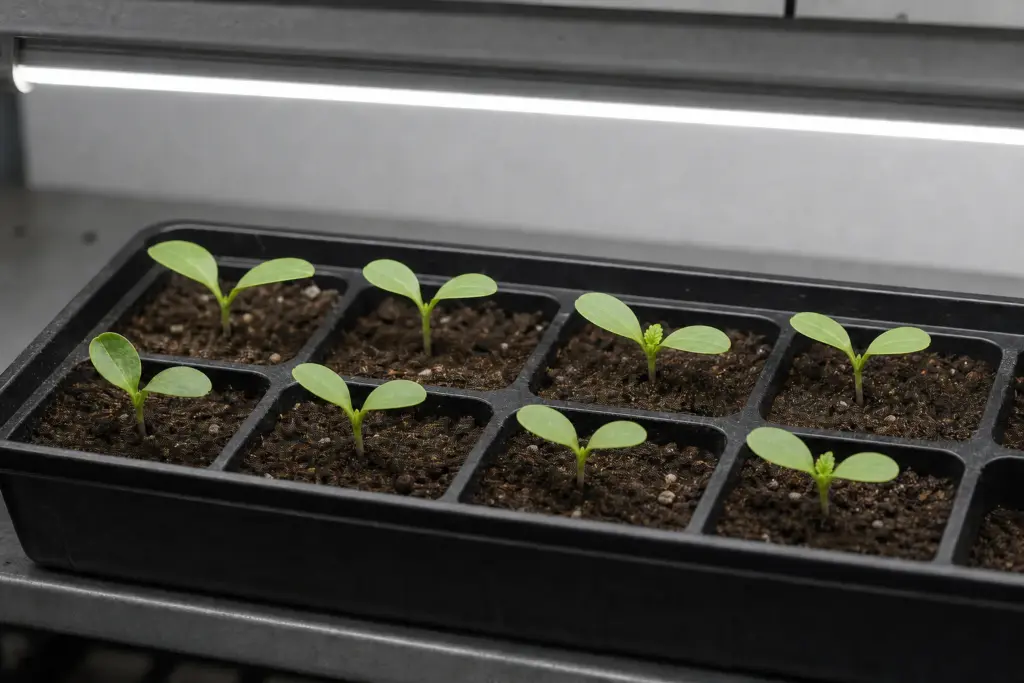
The moment the seedling emerges, the standard changes. Light that was sufficient to help trigger germination may not be sufficient to grow a sturdy transplant; UNH Extension makes that distinction explicitly.6 Its seed-starting fact sheet notes that seedlings stretch under insufficient light and recommends bright light after germination; the fluorescent-light example places seedlings about six inches below the tubes for roughly 16 hours a day.2 Modern fixtures differ in output and heat, so adjust their height according to the manufacturer’s guidance and the seedlings’ response.
This is the trap of a bright-looking winter window. It can be enough to wake a seed and not enough to raise it well. The seedling emerges, bends toward the glass, elongates, and becomes a pale thread. The gardener sees germination success and growth failure in the same tray. The cure is usually more useful light near the leaves for a steady daily period, while still giving seedlings a dark period at night.
What the garden learns from this
The same logic matters outdoors. Fine seed sown directly into a bed needs a firm, moist, shallow surface. Lettuce scattered onto rough soil may disappear into pockets too deep for reliable emergence. Dill can vanish under an enthusiastic rake. A pressed seedbed, gentle watering, and a very light covering when the packet allows it can make the difference between a row and a rumor.
Light-sensitive germination also explains part of the weed flush that follows disturbance. Iowa State Extension notes that deep cultivation can bring buried weed seeds to the surface, where they are more likely to germinate, and that many annual weed seeds require light. Mulch interrupts that signal by preventing light from reaching the soil surface.7
That does not mean every weed seed is waiting for light, and it does not mean every garden seed should sit uncovered. It means the soil surface is an information-rich place. Light, temperature, moisture, oxygen, and texture all tell a seed whether the odds are good enough to begin. A gardener’s job is often just to stop sending the wrong message.
Final thoughts
There is something satisfying about learning that a tiny seed is not passive. It is not simply waiting for us to water it. It is sampling the world with the tools evolution gave it: a coat that lets water in or keeps it out, stored food measured against depth, sensors that notice light, and dormancy systems that keep bad timing from becoming fatal.
So when a packet says press into surface, do not cover, take it literally. Give the seed contact, moisture, and a little light. Give the seedling much stronger light once it appears. The instruction may look delicate, but the plant is not being precious. It is reading the room before it wakes.
References
- Iowa State University Extension: Germination Requirements for Annuals and Vegetables
- University of New Hampshire Extension: Starting Plants From Seed
- Koutsovoulou, Daws, and Thanos: Campanulaceae: a family with small seeds that require light for germination
- Hennig et al.: Phytochrome E controls light-induced germination of Arabidopsis
- Purdue Extension: Starting Seeds Indoors
- UNH Extension: Optimizing Plant Growth with Indoor Lighting Q&A
- Iowa State University Extension: How to Manage Annual Weeds