
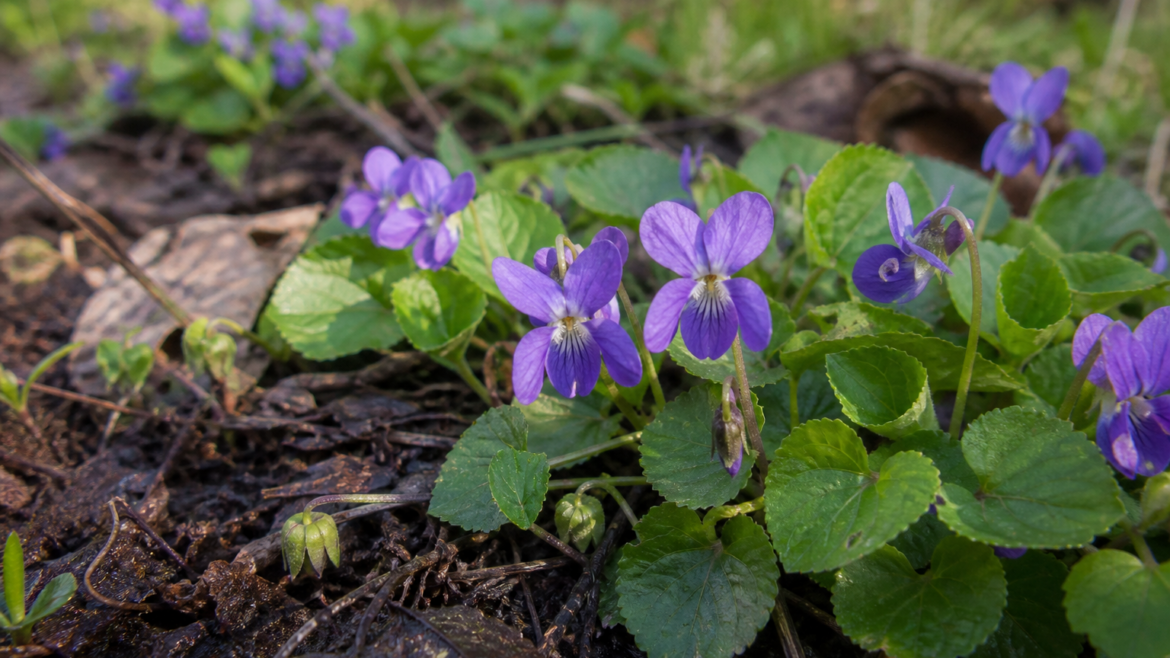
April violets have a way of appearing in the parts of a garden where management loosens its grip. They collect under hedges, soften the edge of a path, settle into damp lawn, and rise between last year’s leaves before the taller perennials have fully remembered themselves. From a distance they read as color: small purple flags in the green. Up close, they are stranger and more deliberate.
The familiar violet flower is only the public part of the plant. Later in the season, many violets make a second kind of flower, low and often hidden, that never opens at all. It does not need to be beautiful. It does not need to lure a bee. It fertilizes itself in private, sets seed, and gives the plant a way to reproduce without depending on a pollinator visit.
That is why a patch of common blue violet can feel almost mischievous. It is not simply spreading because nobody has weeded carefully enough. It is using a layered survival strategy: open flowers for chance and exchange, closed flowers for insurance, rhizomes for local persistence, and seeds that may end up carried away by ants.
A spring flower with a second plan
Common blue violet, Viola sororia, is a rhizomatous herbaceous perennial native to eastern and central North America. North Carolina Extension describes it as a plant of woods, thickets, streambanks, and shadier garden conditions, though it is also remarkably tolerant of different light levels, wet soil, clay soil, and even black walnut exudates.1 That tolerance helps explain why violets can be both beloved wildflowers and stubborn lawn residents.
In spring, the plant produces the flowers we notice: blue, violet, or sometimes white, held on slender stalks just above the leaves. These are chasmogamous flowers, which means they open and can be visited by insects. Their petals offer color, guide marks, and a shaped landing place. In a cool April garden, they can be among the early small invitations to bees and other pollinators.1
Then the plant changes tactics. During the warmer months, common blue violet can produce cleistogamous flowers, closed flowers that never open yet still develop fertile seed.1 Research on the related native violet Viola pubescens describes this mixed breeding system clearly: open, largely cross-pollinated spring flowers are followed by closed, self-pollinating flowers through summer and early fall, with environmental conditions helping shape which flower type appears and when.2
To a gardener, that can sound like a botanical loophole. To the violet, it is a sensible hedge. Open flowers make cross-pollination possible and can mix genes among plants. Closed flowers self-pollinate and provide a lower-cost route to seed when an insect visit does not happen. The balance is not governed by one universal switch: studies of different cleistogamous species have found different responses to light, moisture, temperature, and other conditions, so results from one violet should not be treated as a rule for every other one.2
Why make a flower no one can see?
A showy flower costs resources to build. Petals, nectar, full stamens, and a prominent position all support pollinator attraction. A cleistogamous flower reduces that investment: research describes vestigial or absent petals, no nectar, fewer reduced stamens, and a shortened or coiled style arranged for self-pollination.2 It is small, usually tucked low, and does not invest in display because display is no longer the point.
This is not an oddity confined to one weed in the lawn. Most species in the genus Viola use some form of mixed open- and closed-flower breeding.2 Violets make the pattern visible to anyone willing to kneel down later in the season. The plant has not stopped making flowers just because the purple show is over. It has moved part of the work under the leaf canopy.
The tradeoff is important. Self-pollinated seed does not gain the same genetic mixing as seed produced after cross-pollination. But a plant that can do both has options: open flowers offer opportunities for outcrossing, while closed flowers provide reproductive assurance at a lower construction cost.2 That is a flexible strategy, not a guarantee against every future stress.
This is one reason violets are worth treating as more than lawn weeds. Their behavior is a small lesson in plant risk management. Spring says, “try the open world.” Summer says, “keep something in reserve.”
The capsule that throws its seed
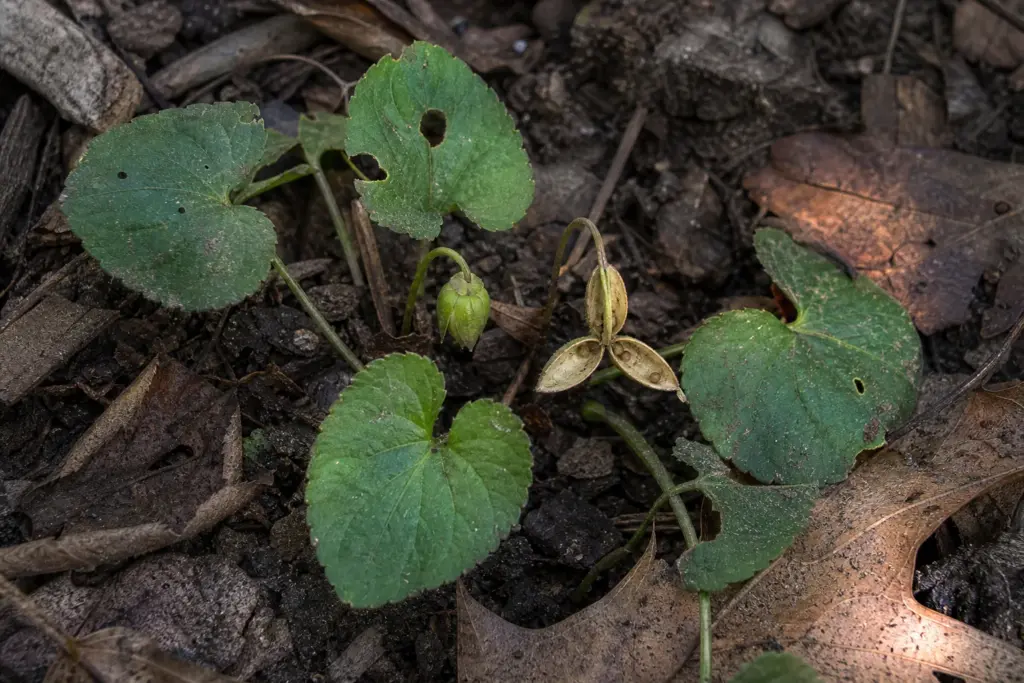
Violets are not passive once seed forms. Their three-parted capsules can split and eject ripe seeds away from the parent plant.3 It is one example of the broader ways plants use spring-loaded capsules to throw their seeds. Brooklyn Botanic Garden adds a second dispersal method: violet seeds carry nutrient-rich attachments called elaiosomes that attract ants.3
The ants are not gardening out of kindness. They collect the seeds for the elaiosome and carry them to their nests. Penn State Extension describes the ant eating the nutritious attachment and burying the seed, a dispersal partnership known as myrmecochory.4 The result is a small distribution network running at soil level, below the scale at which most gardeners are paying attention.
This explains the way violets appear in small surprises. A new plant at the base of a fence. A few heart-shaped leaves beside the compost path. A purple flower in the lawn several feet from the parent clump. Some of that is rhizome spread. Some of it may be seed thrown, carried, dropped, and given a damp little beginning.
Where violets belong in a garden
The best place for violets is where their habits become assets rather than arguments. They are excellent under deciduous shrubs, along woodland paths, near rain garden edges, around trees where turf is already failing, and in informal beds where a living ground layer is welcome. NCSU notes their use as a wildflower in lawns, rock gardens, edging, borders, and open woodland gardens where they can spread naturally.1
They are less ideal in a tiny bed reserved for slow, delicate alpines, or in a highly edited border where every inch is assigned. A violet patch has opinions. It will seed, creep, and test the softness of boundaries. That does not make it a villain. It means the gardener has to decide where a self-willed groundcover is useful and where it needs editing.
Under trees, violets can make more sense than struggling grass where the species is native and site conditions suit it. Penn State Extension recommends considering native violets as vigorous groundcovers for challenging Pennsylvania landscapes, while also warning that they can crowd other plants.4 In those places, the choice is not always between violets and a perfect lawn. It may be between a managed violet patch and bare, compacted soil.
If you want to keep them without surrendering the garden, think in patches rather than permission everywhere. Let a colony thicken under a shrub. Cut or mow a clean boundary where a path or vegetable bed needs discipline; NCSU notes that mowing can limit spread.1 If you want the patch to make seed, remember that the hidden flowers and capsules continue after the spring display. Lift unwanted clumps when the soil is moist, taking the short rhizomes with them, and move only correctly identified plants to another suitable part of your own garden.
The pollinator and butterfly side of the story
Violets are small, but they sit at a useful intersection in spring ecology. Their flowers provide nectar for bees and butterflies, and members of the genus support specialized Andrena bees.1 The leaves do a different job: common blue violet supports fritillary butterfly larvae, and Penn State Extension lists great-spangled, meadow, Aphrodite, and variegated fritillaries among the caterpillars that use violets.4 Clemson Extension likewise describes violets as an early nectar and pollen source and as fritillary host plants.5
That host-plant role matters because caterpillars cannot simply eat any leaf that looks green. Many butterflies are selective in their larval food plants. Adult butterflies may visit a wide range of flowers for nectar, but their young often require a narrower set of leaves. In a tidy garden, removing every volunteer violet may quietly remove part of the nursery layer for fritillaries.
The goal is not to turn every bed into a violet monoculture. Diversity still matters. But a garden with violets at the margins, spring bulbs above them, later perennials rising through them, and leaf litter allowed to rest in selected places is a garden with more layers. It gives small lives more ways to fit.
Eating violets carefully
Violets also belong to the edible-flower tradition, but this is where enthusiasm should slow down and become precise. Illinois Extension notes that both the flowers and leaves of common blue violet are edible, while the roots are not. It also cautions that plants must be correctly identified, that harvested plants should not come from areas treated with unsuitable pesticides, and that African violets are unrelated and not safe to eat.6
NCSU likewise lists young common blue violet leaves and flowers as edible.1 That does not make every violet-like plant or every part of a violet suitable food. A few correctly identified, clean flowers on a spring salad can be charming. A large harvest from an unknown or treated lawn is not wise, and anyone trying a new edible flower should begin with a small amount because individual food sensitivities are possible.
If you harvest, do it like a gardener rather than a collector. Take from unsprayed plants you know well. Leave plenty for pollinators and seed. Avoid roadsides and public land unless harvesting is clearly permitted. Do not pull roots for the kitchen. And if identification is uncertain, admire the plant and leave the eating for another day.
How to invite violets without being overrun
Most gardeners do not need to plant violets so much as recognize where they are already volunteering. If a few appear in a useful place, give them a season before deciding. Watch whether they knit bare soil, whether they clash with neighboring plants, and whether the summer foliage fades politely or becomes too dense.
In a more intentional native or naturalized planting, use violets as a low spring layer beneath plants that rise later: ferns, sedges, asters, goldenrods, spring ephemerals, deciduous shrubs, and small trees. Common blue violet prefers moist, rich soil and dappled light, but it tolerates a broad range of light and soil conditions.1 Observe how it behaves on your site, because a native plant can still seed beyond the place you intended for it.
If you buy plants or seed, choose species native to your region when possible, and buy from reputable nurseries rather than digging from wild colonies. Wild violet patches may look abundant, but they are habitat, not a free supply bin. The more interesting challenge is usually not how to obtain violets, but how to notice the ones already threading through the garden.
Useful violet-watching supplies
- Carson MicroBrite Plus pocket microscope: useful for looking closely at flower parts, seed capsules, and leaf hairs after identification has been checked with a reliable regional key; magnification alone does not identify an unknown plant.
- Nisaku hori hori garden knife: helpful for lifting unwanted violet clumps, moving volunteers within your own garden, and cutting a tidy edge around a patch you want to keep.
- Gorilla Grip garden kneeling pad: violets do their best work close to the ground, and a kneeling pad makes it easier to inspect flowers, capsules, seedlings, and ants without rushing.
Final thoughts
A violet patch asks for a different kind of attention than a tulip or a tomato. Its drama is small, seasonal, and partly hidden. The spring flowers are the easy beauty. The closed flowers, thrown seeds, ant partners, edible petals, rhizomes, and butterfly connections are the deeper story.
That does not mean every violet must be spared. Gardening is still the art of choosing. But before you pull the whole colony, kneel down in April and look at what is actually there. A plant that can bloom for bees, hide flowers for certainty, feed caterpillars, garnish a salad, and use ants as seed carriers is doing more than decorating a damp corner. It is practicing a quiet, complicated form of resilience.
References
- North Carolina Extension Gardener Plant Toolbox: Viola sororia
- Sternberger et al., PLOS ONE: Environmental impact on the temporal production of chasmogamous and cleistogamous flowers in Viola pubescens
- Brooklyn Botanic Garden: Weed of the Month: Common Blue Violet
- Penn State Extension: Native Violets
- Clemson Cooperative Extension HGIC: Common Violets, a Beautiful Treasure
- Illinois Extension: Embracing the common blue violet