
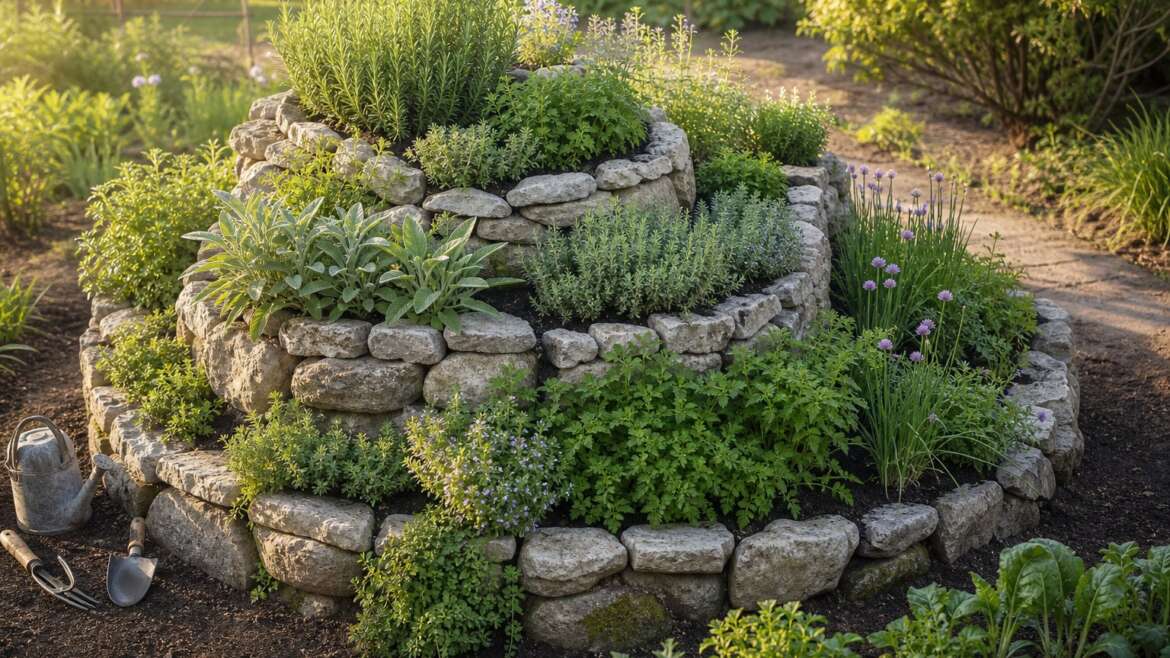
An herb spiral is a garden bed that has learned to coil. Instead of spreading a kitchen herb garden across a flat rectangle, it stacks the planting area into a small rising spiral, usually held in place with stone, brick, or reclaimed pavers. The result looks charming, but the charm is not the point. The shape makes the bed behave differently from one side to another.
At the top, soil tends to be warmer, sharper draining, and more exposed. At the lower edge, it stays a little cooler and moister. The sunny face bakes. The shaded face rests. UF/IFAS Extension describes herb spirals as a way to create varied microclimates within one compact bed, with different moisture and light conditions for different herbs.1 In other words, an herb spiral is not only a pretty pattern. It is a tiny climate machine for flavor.
The Shape Is the Tool
Most garden beds ask you to make one set of conditions and then choose plants that will tolerate it. An herb spiral does something more interesting. It creates gradients. Water moves downward after rain or irrigation. The upper soil drains first. The lower pockets hold moisture longer. The wall itself catches light and casts shade. If the spiral is built from stone, brick, or pavers, the hard material also becomes part of the climate, gathering warmth in sun and releasing it slowly as the air cools.2
That is why the spiral belongs so comfortably in a kitchen garden. Culinary herbs are not one tribe with one preference. Rosemary, thyme, sage, oregano, and lavender lean toward sunny, freely draining conditions, while parsley and mint accept partial shade and chervil favors moisture-retentive soil in part shade.34 A flat bed can grow a mixed collection, but it often forces compromise. A spiral lets you place each plant where its temperament makes sense.
The design can help with reach, but diameter matters. UF/IFAS gives six feet as a typical spiral width, while Oregon State recommends no more than four feet for a framed bed that adults must reach from the edges.15 A four-foot footprint is easier to tend entirely from the perimeter. If you build wider, plan safe access from every side and do not assume the center will remain at arm’s length.
Building the Spiral
Choose a level place with good sun, preferably near the kitchen door, patio, or main garden path. Herbs are used when they are easy to use. A spiral hidden behind the shed may look picturesque in May, but it will not season many dinners in August.
Mark a broad spiral on the ground with flour, sand, a hose, or garden twine. Tiny spirals can become cramped, hot, and difficult to water, but a wide spiral can put the center beyond an easy reach. About four feet across is manageable from the perimeter; six feet may suit a low build with access from all sides. Raise the center gently, not dramatically. The bed should be stable enough to weed with one hand and harvest with the other.
Lay plain cardboard over the site if you are building on lawn or weedy ground, then set the first course of stone or brick along the marked spiral. Add soil as the wall rises so the bed supports itself from within. UF/IFAS suggests making the spiral tallest in the middle and progressively lower toward the outside edge.1 Think of it as a low hill with a path wrapped around it, not as a tower.
For an edible bed, use clean, structurally sound materials whose history you know. Oregon State advises framing that will not leach unwanted chemicals and specifically warns against railroad ties and older pressure-treated wood; rocks and concrete blocks are among its suggested options.5 Reclaimed brick or pavers can be useful, but skip pieces contaminated by paint, fuel, industrial residue, or unknown treatments.
Raised beds can improve drainage and encourage earlier spring warming, although they also heat and cool faster than in-ground beds.5 The spiral adds aspect and elevation. The south or west side may become the warmest exposure. The north or east side may suit plants that dislike afternoon heat. In very hot climates, reverse the romance: a little shade may be the most valuable feature the spiral provides.
Soil for Fragrance, Not Just Growth
Herbs are often described as easy, which is true only if easy does not mean careless. Many common herbs grow best in full sun and well-drained soil. Clemson Cooperative Extension notes that Mediterranean herbs can struggle in heavy, humid soils and that raised beds, improved drainage, and stone or gravel mulch can help.3 That advice fits the top and sunny shoulder of an herb spiral beautifully.
Fill the spiral with a loamy raised-bed mix that drains freely but still holds water and nutrients; there is no universal recipe for unknown bulk topsoil. Clemson recommends improving heavy soil with coarse organic material or cracked pea gravel and improving sandy soil with compost, bark, or leaf mold, while Oregon State stresses both drainage and water-holding capacity.35 Keep the crown relatively lean and free-draining for thyme, oregano, sage, lavender, and savory, then increase moisture-holding organic matter modestly toward the base.
Most herbs prefer well-drained loamy to sandy soil, and the University of Georgia Extension gives a broad pH range of about 6 to 7.5 for many herbs, with rosemary and lavender favoring the slightly alkaline side.6 A soil test is still the cleanest answer if you are unsure, especially if you are building with salvaged materials or filling a large bed from bulk soil.
Do not make the entire spiral too rich. WVU Extension warns that too much nitrogen can push leafy growth at the expense of the oils that give many herbs their scent and flavor.7 A herb spiral is not a cornfield. It should grow steadily, aromatically, and a little lean where the plants call for it.
Planting by Temperament
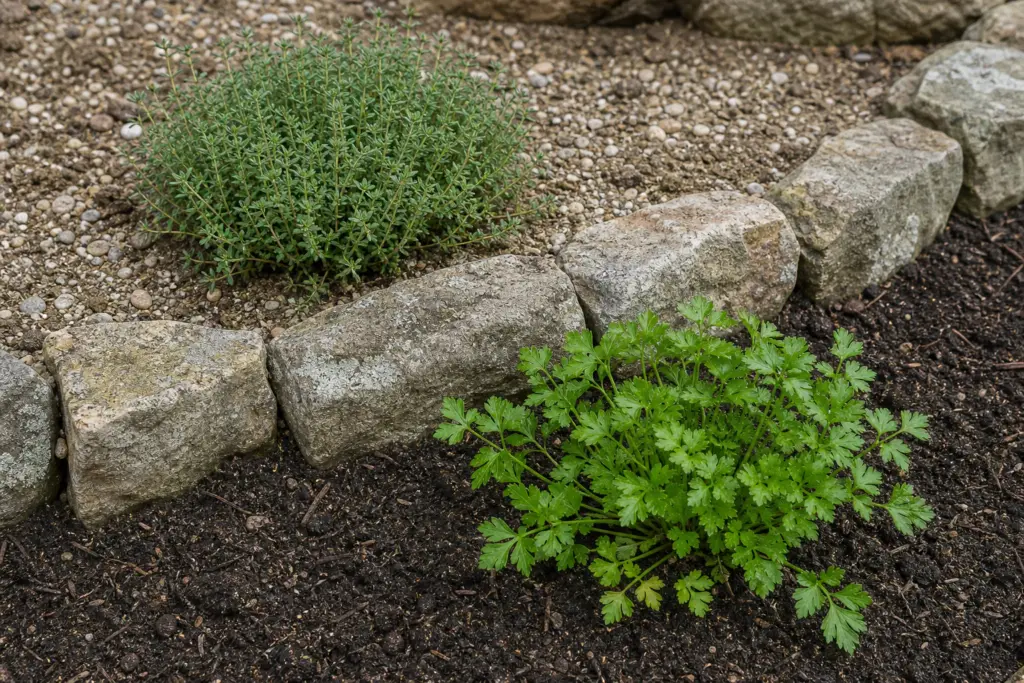
The crown of the spiral belongs to herbs that enjoy sun, drainage, and restraint. Thyme is especially good here because it tolerates stony, relatively poor soil and can spill over warm masonry. Oregano and marjoram suit an upper shoulder where they can spread without remaining wet. Sage likes sun and well-drained to dry soil, and its gray leaves give the spiral a quiet, silvery weight. Lavender can be beautiful if your climate and winter drainage suit it.4
Rosemary deserves a little caution. It belongs to the dry, sunny family of herbs, but many plants become woody shrubs rather than polite edging. UF/IFAS specifically cautions that rosemary can overwhelm the top row because of its size.1 Choose a genuinely compact cultivar or place a larger rosemary at the outer edge—or outside the spiral—rather than relying on repeated pruning to make it fit.
The middle turns can hold the herbs you reach for constantly: chives, parsley, basil, cilantro, dill, calendula, and edible violas. Some of these are annuals, some perennial, and some are best treated as seasonal guests. The Royal Horticultural Society groups basil, coriander, and dill as annual herbs, parsley as a biennial, and chives, oregano, sage, tarragon, and thyme as perennials, a useful reminder that not every plant in the spiral is meant to age there in the same way.4
If any edible flowers are intended for the kitchen, identify the species and edible part positively, and use only flowers grown for food without pesticide treatment. Colorado State Extension advises against eating florist or nursery flowers because they may have been treated, and recommends introducing unfamiliar flowers in small amounts in case of sensitivity.8
The lower edge is the place for thirstier herbs, quick salad leaves, and edible flowers that appreciate a little more root moisture. Parsley often performs better there than on the dry crown. Chervil and cilantro may last longer if protected from harsh afternoon sun. Nasturtiums can trail over the lower stones, though they will sprawl if happy. Mint should not be planted loose in the spiral unless you are prepared for a long argument. Sink it in a pot, keep the rim slightly above soil level, divide it regularly, and still watch it.4
Watering the Spiral
The first season is about establishment. Even drought-tolerant herbs need regular water while roots begin exploring the bed. Wet the root zone rather than sprinkling the surface, then let the upper Mediterranean zone approach dry before watering again. WVU Extension recommends deep watering instead of frequent shallow drinks.7 The lower parsley, chervil, or mint pocket may still need water sooner, so probe the soil in more than one place.
A spiral will not dry evenly, and that is the point. Use a watering can with a rose or a short soaker hose so you can water the lower curve more generously without soaking the thyme at the top. Mulch should follow the same logic. Gravel, small stone, or coarse grit suits the dry upper herbs. Finer organic mulch works better around parsley, chives, and annual herbs near the base, as long as it does not sit against crowns and stems.
Pay attention after rain. If water rushes through one side and leaves the other dusty, adjust the hose position, soil surface, or slope. If the center stays wet for days, check for dense fill, blocked drainage, or excessive irrigation rather than assuming height alone is the cause. The bed should teach you where it wants help.
What Makes It Beautiful
The best herb spirals are not overfilled on day one. Leave breathing room. Young herbs become larger, and the spiral’s structure should remain visible after midsummer growth. A little exposed stone is not failure. It is part of the design, part of the heat store, and part of the pattern that makes the bed readable.
Plant for texture as much as flavor. Fine thyme against broad sage. Hollow chive leaves beside flat parsley. Blue rosemary flowers, purple chive blossoms, orange calendula, and the occasional nasturtium bloom give pollinators and cooks a reason to visit. Clemson notes that herbs can be important nectar and pollen sources when they are allowed to flower.3 A herb spiral can be a kitchen tool and a small pollinator station at the same time.
The spiral also rewards repetition. Repeat one plant, such as thyme, in several small pockets rather than collecting one of everything. Repeat a stone size. Repeat a flower color. A spiral is already a strong shape; it does not need chaos to feel abundant.
Common Mistakes
The most common mistake is building too steeply. A dramatic cone sheds water quickly, dries at the top, bulges at the sides, and becomes awkward to maintain. Another mistake is using plants that are too large for the scale: full-sized rosemary, aggressive mint, sprawling fennel, or an enthusiastic lemon balm can turn a tidy spiral into a thicket.
The third mistake is treating all herbs as drought lovers. Basil, parsley, cilantro, chives, and many edible flowers need steadier moisture than thyme and lavender. If the whole spiral is built like a gravelly Mediterranean hill, the soft-leaved herbs will sulk. If the whole spiral is compost-rich and damp, the woody herbs will lose the crisp drainage they need. The genius of the spiral is difference. Use it.
Useful Herb Spiral Supplies
- Fiskars Ergo garden trowel: one compact option for planting small herb starts into tight soil pockets; do not use a hand trowel to pry against loose masonry.
- STYDDI 25-foot soaker hose: one way to loop low-pressure irrigation through selected turns; test moisture at the top, middle, and base because elevation and hose layout can make delivery uneven.
Final Thoughts
An herb spiral is a small act of botanical listening. It asks what each plant wants, then bends the bed to create several answers at once. Dry, warm, and stony at the top. Moist, leafy, and sheltered below. Bright on one side. Gentle on the other.
Build it slowly, plant it lightly, and let the first season reveal where the heat gathers and where the water lingers. By the second year, the spiral begins to feel less like a project and more like a living map: a coil of scent, stone, sun, shade, and supper.
References
- UF/IFAS Gardening Solutions: Spiral Herb Garden Tutorial
- UC Marin Master Gardeners: How to Assess Your Microclimates
- Clemson Cooperative Extension: Herbs
- Royal Horticultural Society: Herbs, Growing and Harvesting
- Oregon State University Extension: Raised Bed Gardening
- University of Georgia Extension: Herbs in Southern Gardens
- West Virginia University Extension: Herb Gardening for Beginners
- Colorado State University Extension: Edible Flowers