
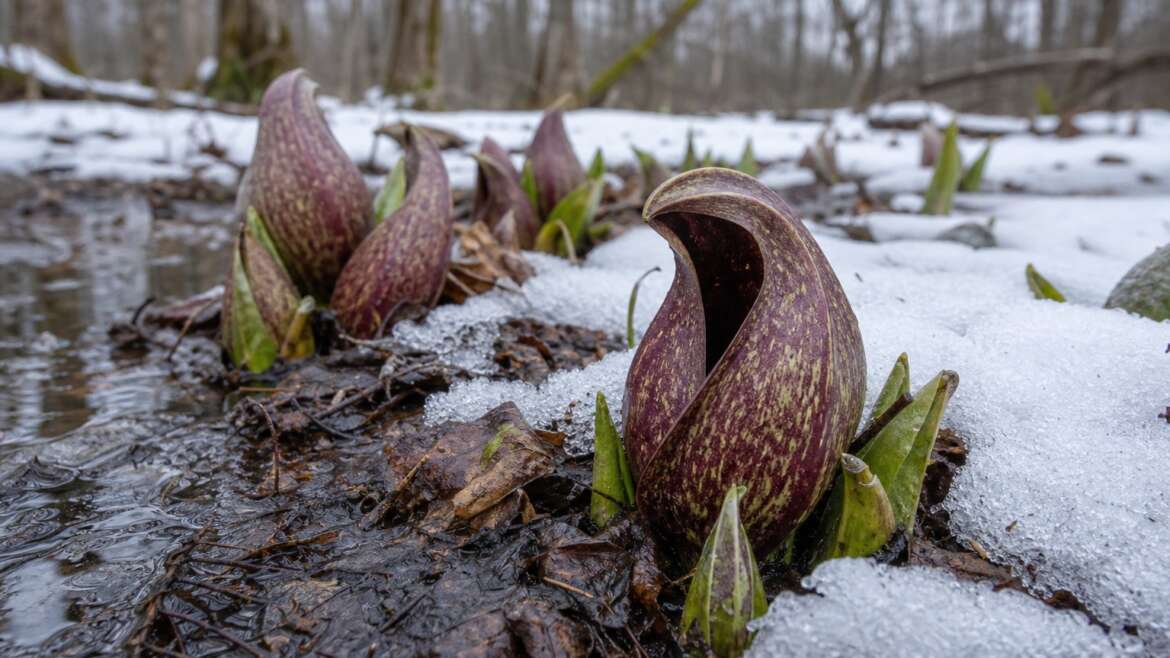
Before the woodland has much color to offer, eastern skunk cabbage is already making weather of its own. It rises from wet leaf litter while snow still lingers in the shaded hollows, often with a clean melted ring around each maroon hood. Look closely and it does not resemble cabbage at all. It looks more like a small, mottled lantern set into the mud.
That lantern is not just a shape. Skunk cabbage is one of the few plants gardeners in eastern North America can meet in the wild that actively warms its flowering structure. It spends stored energy to heat the chamber where its tiny flowers are packed, which helps it push into the cold season before most other plants have decided to move. A March walk through a wet woods can feel half asleep until one of these strange flowers appears, doing chemistry under its hood.
A flower before the leaves
Eastern skunk cabbage, Symplocarpus foetidus, is a native wetland perennial in the arum family, the same family that gives us jack-in-the-pulpit, peace lily, calla lily, and a great many plants with flowers arranged on a central spike. The USDA Forest Service describes it as an early-flowering wildflower of wetlands and stream edges across much of eastern North America.1
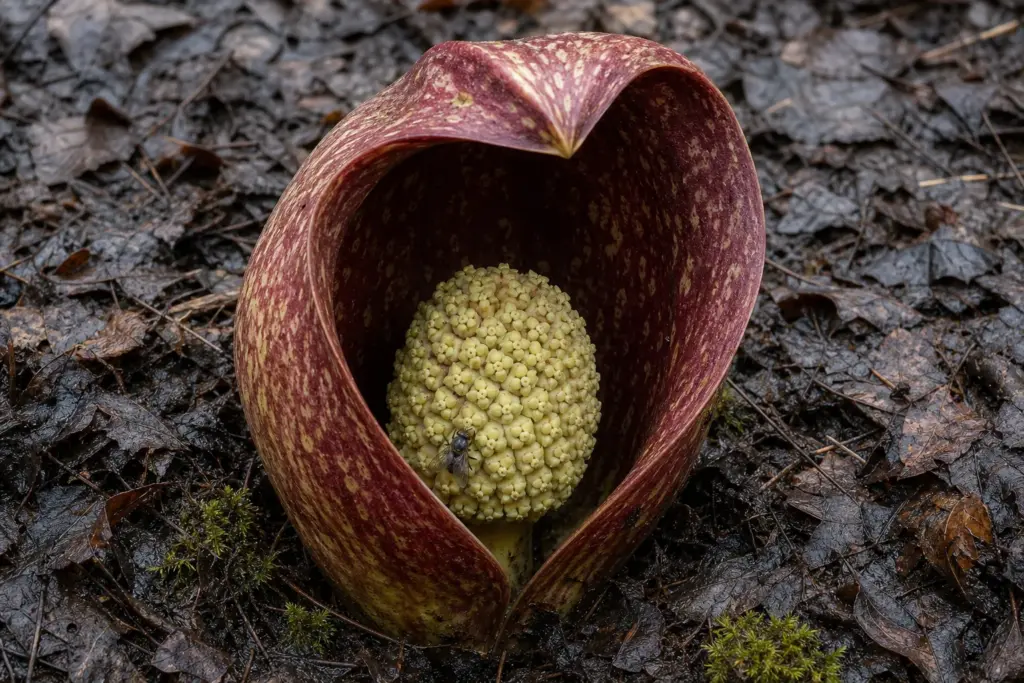
The first thing you notice is the spathe, a thick hood mottled in burgundy, purple-brown, olive, and cream. Inside sits the spadix, a squat knob covered in small flowers. The leaves come later, unfurling into large, ribbed, bright green blades that can make a wet woodland floor look tropical by May. By late summer the plant often collapses back into the mud, leaving little hint of the cold-season performance that started the year.
This timing is part of the fascination. Skunk cabbage does not wait until the canopy opens and the soil warms evenly. It uses a rhizome packed with stored carbohydrates, then spends that reserve early. The result is not a showy floral display in the usual garden sense. It is a small, well-insulated room for reproduction, built when the rest of the swamp still looks reluctant.
The warm room inside the hood
The classic measurement of this warmth is still startling. In a 1974 paper in Science, R. M. Knutson reported that the spadix of eastern skunk cabbage could hold an internal temperature 15 to 35 degrees C above ambient air temperatures, even when surrounding air ranged from -15 to 15 degrees C.2 This is plant respiration used like a tiny furnace.
Plants respire all the time. They break down sugars and use oxygen to release usable energy, just as they also photosynthesize when conditions allow. What makes skunk cabbage unusual is the scale and placement of that heat. The warmth is concentrated in the spadix and held by the spathe, which cups the flowering body and reduces how quickly heat is lost to cold air.
For a gardener, the lesson is not that every early bloom needs heat. Snowdrops, crocus, hellebores, witch hazel, and maples all have their own cold-season strategies. Skunk cabbage is simply a more literal example of a principle gardeners use all the time: a microclimate can change the calendar. A south-facing stone wall, a cold frame, a mulch layer, a raised bed, or a sheltered wetland hollow can shift plant behavior by a few valuable degrees. Skunk cabbage happens to carry part of that microclimate inside its flower.
Why the smell matters
The plant earns its common name honestly. Bruised leaves smell sharp and unpleasant, and the flower itself can give off an odor that suggests decay more than perfume. The species name foetidus points in the same direction. This is not a flaw in the plant. It is part of the message.
Early in the year, the pollinator world is thinner and slower. The National Park Service notes that the dark color and odor of the spathe fit a strategy of drawing flies and other early insects attracted to carrion- or dung-like smells.3 The role of heat is less certain. The USDA Forest Service notes that it can help vaporize scent, while the warming plainly changes conditions for the flower tissue.1 A 2023 comparative study of Symplocarpus notes that it remains largely unknown whether floral thermogenesis improves survival or reproductive success in cold environments, so warmth should not be reduced to a proven insect shelter.5
This is one of those places where a garden idea becomes more interesting if we stop asking only whether a flower is pretty. Skunk cabbage is not trying to please a human walking trail in March. Its job is to be findable to the right small visitors in a cold, wet place. The maroon hood and carrion-like odor are clear signals; heat gives the flowering tissue a different physical environment. Each trait can matter without requiring a tidy single-purpose story.
What it tells you about a place
A patch of skunk cabbage is a good field note. It usually points to consistently wet soil, seepage, swampy woods, bog edges, or streamside muck. NC State Extension lists its typical habitats as bogs, swamps, wet meadows, and very wet woods, and notes that once established its roots hold strongly enough to make transplanting difficult.4
That matters because gardeners often misread wet ground as a problem to be corrected everywhere. Sometimes it is a drainage issue near a foundation or path, and it needs attention. But in the right corner of a larger property, persistent wetness can be habitat. A seep, seasonal trickle, or low shaded swale may support a different garden logic from a dry border. It asks for plants that enjoy water at their feet and a design that respects the way water already wants to move.
Skunk cabbage also reminds us that early spring is not one season. It is a patchwork. Snow can remain under conifers while a nearby south-facing slope is already awake. A damp hollow can be cold to our hands but chemically active below the leaves. If you garden by calendar alone, you miss these small local timings. If you use phenology to garden by observation, the ground becomes more legible.
Should you grow it?
For most home gardeners, skunk cabbage is better admired than acquired. It is a native plant with a specific wetland life, not a novelty to dig from a swamp and tuck beside a patio. Wild wetland plants should be left where they are unless you are working through a reputable native nursery, a restoration project, or a permitted conservation context. Digging from the wild damages the plant and the place around it.
Even nursery-grown skunk cabbage is not a casual choice. It wants wet, organic soil, partial shade to shade, and room for large summer leaves. It is also listed by NC State Extension as having medium severity poison characteristics because of calcium oxalate crystals and other toxic principles, so it should not be treated as an edible curiosity despite the word cabbage in its name.4
The better garden use may be as a teacher. If you have a wet shady area and want the same ecological feeling without forcing this particular species, look toward locally appropriate wetland natives from reputable growers: marsh marigold where it is native, cardinal flower, blue flag iris, sedges, sensitive fern, or cinnamon fern, depending on your region and soil. The goal is not to copy a swamp plant as decoration. It is to let a wet place become a planted place on its own terms.
How to watch without disturbing it
The best skunk cabbage outing is slow and respectful. Look in wet deciduous woods, seepage slopes, stream margins, and swamp edges from late winter into early spring. Step on durable ground, not into the saturated patch itself. The plant’s roots, emerging spathes, and surrounding wetland soil are all easy to damage.
If you find a patch, kneel near the edge and watch before touching anything. Notice where snow has melted first. Look for the difference between the hood and the later leaves. If you carry a thermometer, compare open air, nearby water, and the sheltered ground around the plant without poking into the flower. If you carry a hand lens, look into the spathe only when you can do so without bending or tearing it.
There is a quiet discipline in this. A plant that can warm itself still depends on a very particular landscape: stored carbohydrates from past seasons, saturated soil, early insects, leaf litter, and the long patience of a rhizome anchored in muck. The warm hood is the memorable part, but the whole wet woodland is the machine.
Useful skunk cabbage watching supplies
- Luster Leaf digital soil thermometer, useful for comparing air, soil, and shallow water temperatures during early spring walks.
- Carson MicroBrite Plus pocket microscope, a small field tool for looking closely at leaf texture, buds, moss, and the spadix when viewing will not disturb the plant.
- Rite in the Rain weatherproof notebook, helpful for damp trails, phenology notes, and sketching where the first spring plants appear.
- Newcomb’s Wildflower Guide, a practical eastern North American field guide for learning the plant families and leaf patterns around wet woods.
References
- USDA Forest Service: Eastern Skunk Cabbage (Symplocarpus foetidus)
- PubMed: Heat production and temperature regulation in eastern skunk cabbage
- National Park Service: Skunk Cabbage (Symplocarpus foetidus)
- NC State Extension Gardener Plant Toolbox: Symplocarpus foetidus
- Ecology and Evolution: Potential contribution of floral thermogenesis to cold adaptation, distribution pattern, and population structure of Symplocarpus species