


Bob Ross enters Hell with a fan brush, two-inch calm, and the dangerous belief that every infernal ridge line deserves a happy little tree. Gandalf arrives with a staff, a cloak full of weather, and the firm opinion that a garden path should reveal itself only after the visitor has earned it.
The duel is not over who has the better beard. That question would divide households and solve nothing. The useful question is what happens when painterly softness collides with wizardly structure. One side wants atmosphere: loosened edges, cloudlike planting, flowers drifting through the border as if they wandered in by invitation. The other side wants bones: stone, shadow, threshold, evergreen mass, and a path that knows exactly where it is going even when it refuses to tell you.
A strong garden does not choose a champion. It lets the soft side and the severe side keep each other honest. Without Bob, Gandalf builds a courtyard where every fern feels like it is awaiting sentencing. Without Gandalf, Bob paints a meadow so agreeable that the whole thing collapses into a scented nap.
First, Interrogate The Site
Hell’s enchanted gardens may tolerate lava cracks, singing thistles, and roses with poor social boundaries, but they still have site conditions. Light is light. Drainage is drainage. A root zone does not become hospitable because someone waves a staff at it.
University of Florida IFAS describes landscape design as a process that starts with site inventory and analysis: soil, drainage, climate, existing vegetation, and user needs all come before the final design.1 This is where the fantasy becomes more useful, not less. A damp, shady corner can become a ferny threshold. A hot gravel strip can become a silver-leaved, drought-tolerant border. A dry slope can be dramatic without being punished into pretending it is a bog.
Themed gardens often fail because they begin with props and then demand that plants perform under unsuitable conditions. The better method is more ruthless: read the place first, then decide what kind of enchantment it can support without lying.
If the site already has shade, moisture, and leaf litter, use that gift. The umbrella-like leaves in our mayapple piece are a reminder that architecture does not have to be carved from stone. Sometimes it rises from a rhizome, opens in spring, hides a flower underneath, and refuses to explain itself.

The Bob Ross Side: Soften The Edges
The Ross method is not “throw seeds and whisper encouragement.” Painterly softness is built from repetition, value, texture, and restraint. Airy grasses, umbels, daisies, salvias, asters, fennel, yarrow, and self-sown annuals can make a border feel loose, but looseness still needs editing. A meadow can be generous. A catalogue dropped from a ladder is merely evidence.
Use color the way a painter uses temperature. Pale flowers catch evening light. Blues, violets, and silvers make a small border feel cooler and deeper. Warm yellows and oranges pull forward. Dark foliage creates pauses. Fine leaves act like brushwork when they are repeated often enough for the eye to understand the rhythm.
Texture does a great deal of the quiet work. A fern frond, a grass blade, a broad hosta leaf, and a clipped evergreen mound do not speak the same visual language. Put them together carefully and the garden gains depth without shouting for more flowers. The slow unrolling in our fern fiddlehead article is exactly the kind of small seasonal theatre that makes shade feel alive.
The Gandalf Side: Give The Garden A Spine
Gandalf’s contribution is not gloom. It is consequence. A path that bends out of sight, a clipped hedge, a stone urn, a bench under a dark tree, a gate, a single conifer, or a weathered arch can turn a pretty planting into a place with direction. The garden stops being a view and becomes a sequence.
Structure is especially important when the planting is soft. Flowers and grasses can look glorious in June and undecided in February. Evergreen mass, trunks, stone, walls, paths, and repeated shrubs hold the composition when the soft material changes. They also make the softness softer. Ferns look more delicate beside rock. Pale flowers glow harder beside shade. A path feels brighter when it has just escaped darkness.
Think of thresholds as invitations with standards. A change from lawn to gravel, sun to shade, low planting to archway, or open bed to enclosed path tells the body that it has entered another room. You do not need a wizard to do this. You need a believable reason for the eye, and the feet, to continue.
Rhythm Keeps The Spell From Becoming A Yard Sale
NC State Extension lists scale, balance, unity, perspective, rhythm, and accent among the fundamental design concepts, with repetition, line, variety, simplicity, and harmony as organizing principles.2 These words sound as if they should be carved above a lecture hall. In a garden, they mostly keep the chaos from winning.
Rhythm is the repeated grass clump that stops a path from looking accidental. Balance is a dark evergreen answered by a drift of pale flowers. Scale is the difference between a charming stone ornament and a lonely object waiting for rescue. Accent is where the eye stops: a bench, an urn, a red stem in winter, a pool of light, a doorway in a hedge.
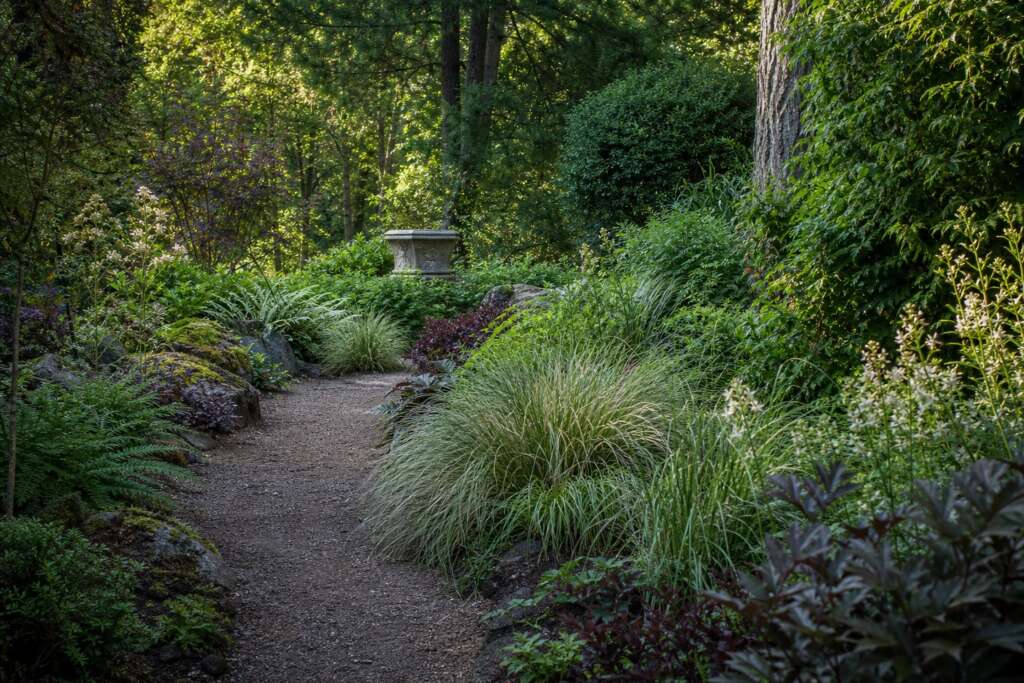
This is where the duel becomes useful. Repetition softens structure because it makes the garden feel grown rather than staged. Structure sharpens softness because it gives flowers and foliage a frame. The most convincing enchanted gardens are not full of novelty. They are full of decisions that repeat just often enough to seem inevitable.
A Practical Treaty Between Brush And Staff
- Choose the site honestly. Note sun, shade, soil moisture, drainage, wind, existing roots, views from the house, and how people actually move through the space.
- Pick one structural move. Use a path, arch, hedge, small tree, bench, urn, boulder, wall, or repeated shrub mass. Do not scatter focal points like loose change.
- Choose a restrained plant palette. A few repeated forms and textures will do more than a collector’s bed of unrelated curiosities.
- Build contrast deliberately. Pair fine with broad, dark with pale, loose with clipped, vertical with mounded, glossy with matte.
- Plan for time. Plants grow, flop, seed, go dormant, and leave winter gaps. Good structure makes those changes read as seasonality instead of defeat.
- Keep the theme subordinate to plant health. If a plant wants full sun, do not cast it as a shade-garden extra. If it wants drainage, do not imprison it in wet clay for narrative reasons.
A small garden can use the treaty as well as a large one. In a container, the arch becomes a trellis. The path becomes the line of sight across a balcony. The meadow becomes repeated texture: thyme, sedge, parsley, violas, or trailing nasturtium. The principle is the same: one clear structure, a limited cast of plants, and enough softness to make the scene breathe.
Declare A Winner, Cowardly But Correctly
If forced to judge the duel, the garden refuses. Bob wins every time a hard corner needs grace. Gandalf wins every time a border needs bones. The gardener wins only by stealing from both and pretending it was the plan all along.
Use the painter as a reminder to notice atmosphere, color harmony, edges, and light. Use the wizard as a reminder to add threshold, shadow, structure, and a little suspense. Then let the plants overrule everyone. The right plant in the right place will always beat the cleverest theme imposed on the wrong site, even if the wrong site has excellent lava.