

A garden is full of shapes that look as if they were drawn with a compass: sunflower seed heads, pinecones, aloe rosettes, unfurling fern tips, the pointed towers of Romanesco. Once you begin noticing them, the garden becomes less like a collection of separate plants and more like a living sketchbook of repeated decisions.
The tempting story is that plants are doing mathematics. That is not quite right. A sunflower is not counting Fibonacci numbers, and a succulent is not consulting a golden-ratio chart before making its next leaf. The better story is more interesting. Plants grow from small active tissues, respond to space, hormones, light, and inherited form, and those local rules can produce patterns that look astonishingly ordered from a human distance.
For gardeners, this is not just a curiosity. The same patterns that delight the eye can help with plant identification, pest scouting, seed saving, and design. Geometry in the garden is not a separate subject from horticulture. It is one of the ways plants make their lives visible.
What phyllotaxis means
Phyllotaxis is the arrangement of leaves or other plant organs around a stem. In a simple field sense, it is one of the first things a botanist or careful gardener checks: are the leaves alternate, opposite, or whorled? North Carolina Extension’s Plant Toolbox uses those same categories among its plant-identification characters.1 Arrangement is a useful clue alongside buds, stems, flowers, and other features, not an identification by itself.
Alternate leaves appear one at a time along a stem. Opposite leaves come in pairs. Whorled leaves gather three or more at a node. Spiral phyllotaxis is what many people notice in rosettes, cones, and seed heads, where the organs seem to march around the center in two directions at once.
This matters because arrangement is architecture. A plant is not simply adding parts. It is placing new parts in relation to old ones. The pattern changes how leaves overlap and how new organs fit around a crowded growing tip; it is more than a decorative spiral imposed on the finished plant.
The growing tip is where the pattern begins
The pattern starts at the shoot apical meristem, the tiny growing region at the tip of a shoot where new leaves, bracts, or floral organs are initiated. Modern plant development research has shown that auxin, a plant hormone involved in growth and patterning, is central to where new lateral organs begin. In work on tomato, researchers found that auxin transport helped regulate both the initiation and radial position of lateral organs at the meristem.2
Translated into garden language: the plant does not draw the whole sunflower head first and then fill it in. It keeps making small placement decisions as it grows. In the tomato experiments, auxin transport and the positions of existing primordia helped shape where another primordium could begin. Over time, repeated placement can become a spiral, a rosette, a cone, or a neatly spaced series of leaves up a stem.
That is why plant patterns feel both exact and alive. They are regular, but not stamped. Look closely at a pinecone or an echeveria and the pattern is clear. Look closer still and you will see small differences: a damaged scale, a leaf that grew under slightly different light, a seed head with a gap where a floret failed. Living geometry always keeps a little weather in it.
Why Fibonacci numbers keep appearing
Fibonacci numbers often appear when people count the visible spiral families in seed heads, cones, and some rosettes: 21 and 34, 34 and 55, 55 and 89. The visible spirals are called parastichies: lines the eye traces through neighboring organs, not paths a plant deliberately draws. In many spiral systems, successive primordia arise at a fairly steady divergence angle, and the apparent spiral counts change as the growing region expands.3
One famous angle is about 137.5 degrees, often called the golden angle. A Scientific Reports paper describes it as typical at many shoot tips and proposes a model in which that angle minimizes the energetic cost of transitions in leaf arrangement.3 That is a model for one part of a complicated developmental system, not proof that every spiral is optimized. The important word for gardeners is common, not universal.
Sunflowers are a useful caution. A Royal Society Open Science citizen-science study examined 657 sunflower heads and documented both Fibonacci and non-Fibonacci spiral structures, including heads too irregular for a definite spiral count.4 That does not make the pattern less beautiful. It makes it more biological: development can be regular without producing a printed answer key.
Where to look in an ordinary garden
You do not need rare plants to see this. Start with a sunflower after the ray florets fade and the head begins to dry. The eye will often find two sets of parastichies crossing the disk, one turning clockwise and the other counterclockwise. Move next to a pinecone, where the scales also line up along overlapping spiral families. Then look at a stonecrop, hens-and-chicks, echeveria, or young cabbage and notice how the youngest leaves fill the center without exactly covering the older ones.
Romanesco is the showpiece, almost too dramatic to feel real. Its pointed green towers repeat the larger form at smaller scales. In a 2021 Science study, experiments on a cauliflower-like Arabidopsis thaliana mutant and computer modeling showed self-similar curds emerging when meristems briefly entered but did not complete a floral program; additional changes in meristem growth produced cones reminiscent of Romanesco.5 The result explains a developmental route to a fractal-like form without pretending the vegetable follows a geometric recipe.
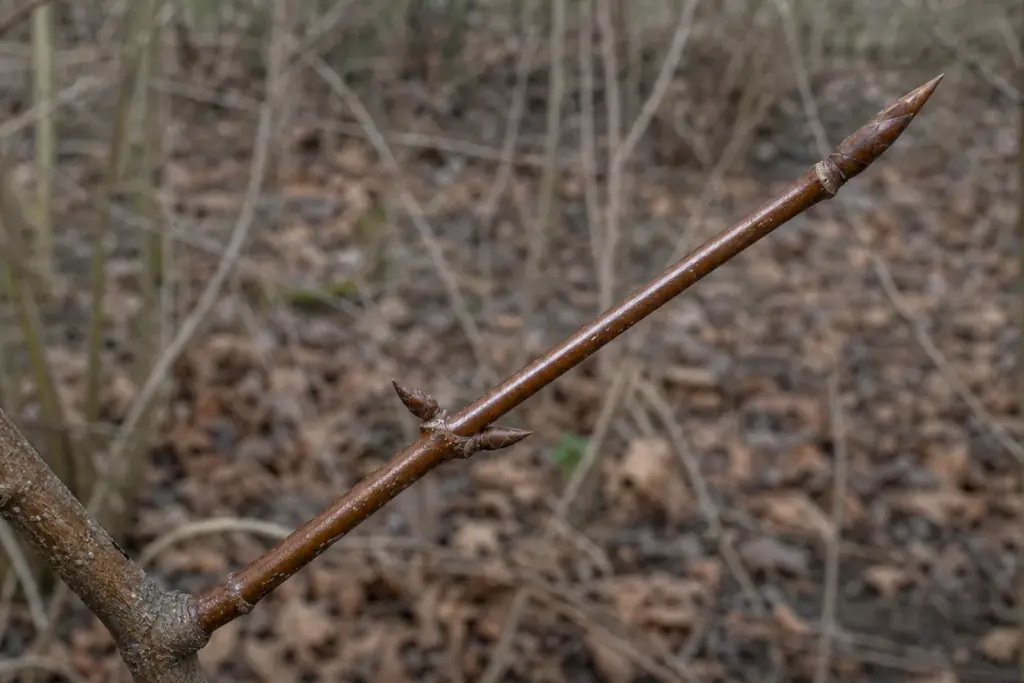
Even a leafless garden has examples. Bud and leaf-scar positions on woody stems preserve the previous season’s opposite or alternate pattern; reading winter buds and leaf scars makes that clue useful for identification. Conifer cones hold records of growth. Dried allium heads, teasel, echinacea cones, and ornamental-grass seed heads keep their structure after color has drained from the border. In a temperate winter, with fewer flowers competing for attention, structure is simply easier to see.
How pattern-watching helps a gardener
First, it sharpens identification. Leaf arrangement will not identify a plant by itself, but it can narrow the field. Opposite leaves may nudge you toward a maple or ash, or toward one of the many mints and honeysuckles, depending on every other feature. Alternate leaves are far more widespread, so there the buds, leaf type, margins, flowers, and fruit have to do more of the identifying work. A whorl is distinctive enough to deserve attention whenever you see one.
Second, it improves plant care. If a normally compact rosette begins stretching between leaves or leaning strongly toward a window, too little or strongly one-sided light may be involved; compare the change with the normal habit of that species before moving it. Distorted new growth is a reason to inspect tender shoot tips, buds, and leaf undersides for aphids and other causes, but shape alone is not a diagnosis.6
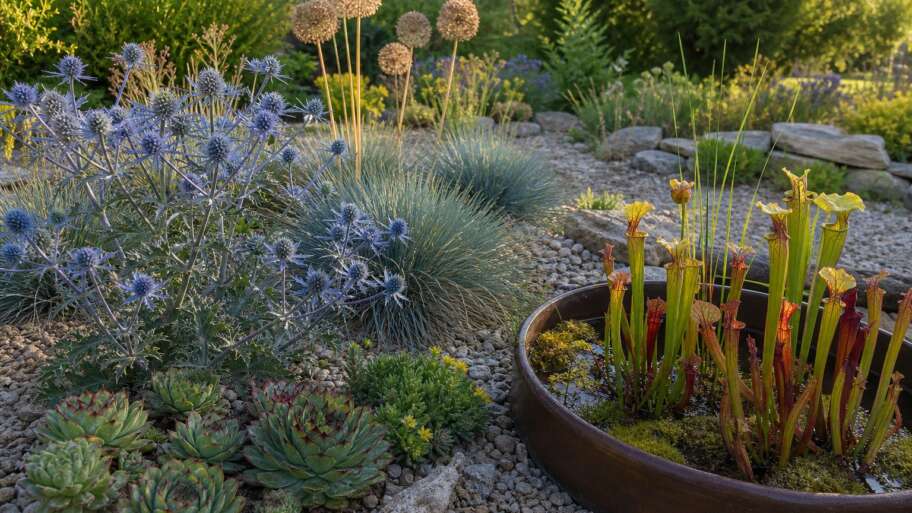
Third, it can give a design continuity. Garden design is often taught through color, height, and bloom time, but repeated forms can also connect a composition. A round allium head can echo a clipped shrub, another seed head, or a globe thistle. An agave rosette can visually rhyme with cabbages, hens-and-chicks, and the radial leaves of many perennials. The echo is visual, not evidence that those plants share cultural needs: each still has to suit the climate, light, drainage, and room available at mature size.7
Finally, it gives you a better sense of timing. Flower heads pass through pollination, fruit or seed filling, drying, dispersal, and decay. Maturity cues differ among species, and seed saved from hybrids or cross-pollinated plants may not reproduce the parent exactly.8 Standing heads on suitable, clean plants can feed birds, while diseased material, aggressive self-sowers, and stems that create a hazard may be better removed.9
A small spiral walk
On a dry day, take ten minutes and walk the garden without looking for blooms. Look only for placement. Follow the leaves around a stem. Count the visible spiral arms on a cone or seed head, but do not worry about getting the correct number. Notice whether a rosette is tight, open, flattened, or leaning. Look at buds on shrubs and ask whether they sit opposite each other or alternate up the twig.
Then make one small note: not a grand conclusion, just an observation. “Sedum rosette tighter on the sunny side.” “Maple buds opposite.” “Echinacea cone has two spiral directions.” Over time, this habit changes how you see. The garden stops being a blur of green and becomes a set of decisions, repeated beautifully and imperfectly in living tissue.
Useful pattern-watching supplies
- JARLINK 30x/60x illuminated loupe: a small lens for examining bud placement, seed heads, leaf hairs, and the tight centers of rosette plants.
- Carson MicroBrite Plus pocket microscope: useful for viewing fine surface details on seeds and leaves, though magnification alone cannot diagnose a plant disease or pest.
- Rite in the Rain weatherproof garden planner: a durable notebook for recording plant arrangements, seed head stages, and seasonal observations outdoors.
- Botany in a Day: a plant-identification book built around recognizing patterns, families, and repeated botanical structures.
Final thoughts
The quiet geometry of a garden is not there to make plants seem less alive. It does the opposite. It shows how life can be orderly without being mechanical, how a growing tip can make repeated choices and leave behind a pattern that looks inevitable only after it has happened.
Look for spirals, but do not turn every plant into a number puzzle. Look for leaf arrangement, but do not forget the weather, the soil, and the insect damage that bend the pattern. The reward is not proving that nature obeys a formula. The reward is learning to see growth as a process, one leaf, scale, bract, and seed at a time.
References
- North Carolina Extension Gardener Plant Toolbox: Help and plant identification terms
- Proceedings of the National Academy of Sciences: Auxin regulates the initiation and radial position of plant lateral organs
- Scientific Reports: Biophysical optimality of the golden angle in phyllotaxis
- Royal Society Open Science: Novel Fibonacci and non-Fibonacci structure in the sunflower
- Science: Cauliflower fractal forms arise from perturbations of floral gene networks
- University of Maryland Extension: Rose—identify and manage problems
- NC State Extension Gardener Handbook: Landscape design
- Penn State Extension: Seed saving basics
- University of Vermont Extension: Leave seed heads be