
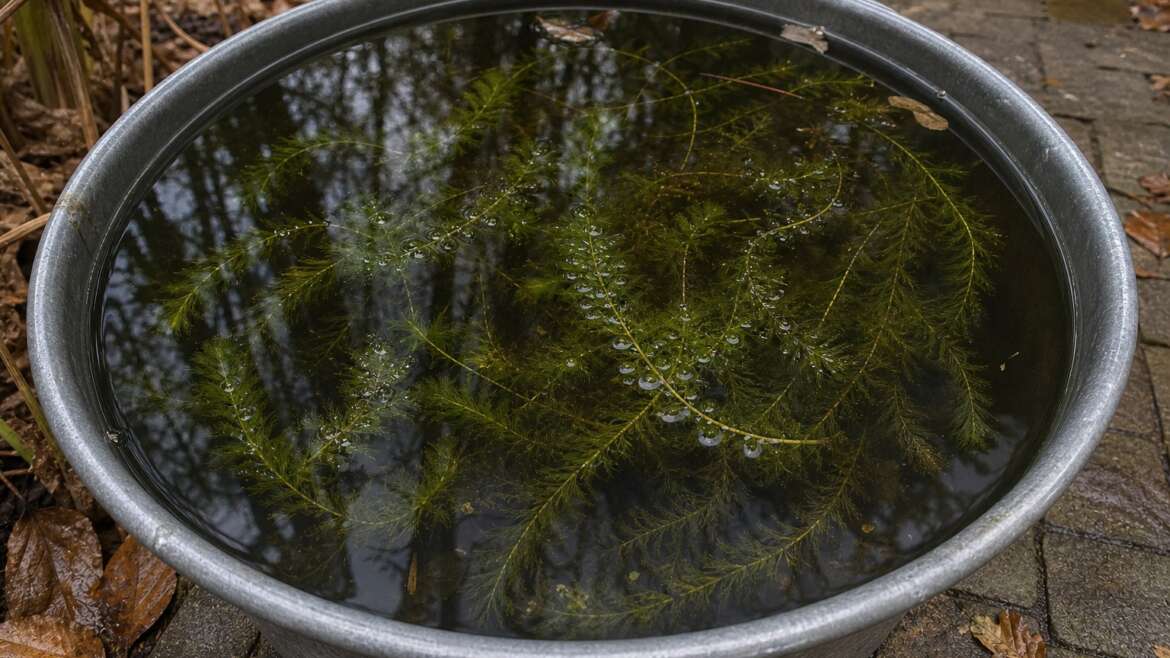
Most winter garden work happens above ground: cutting back blackened stems, emptying pots, gathering leaves, pretending the hose should have been put away last week. But one of the strangest small gardens you can keep is almost entirely hidden from that view. It sits in a tub, a half barrel, or a small pond, and its leaves do their work under the surface.
A submerged water garden does not need a fountain, koi, colored lights, or a fake heron on the edge. At its best, it is simply a clear container of water with a living green tangle below the waterline. The stems drift. Tiny bubbles cling to the leaves on bright days. Fallen maple leaves float above it like weather. It is gardening, but the air has been replaced by water.
This is not seaweed farming, aquaponics, or an indoor aquarium display. It is closer to making a little underwater meadow, using submerged aquatic plants as the planting layer in a patio tub or small wildlife pond. Done well, it gives you a living system to watch in a season when the ordinary garden is going quiet.
The plants are doing real plant work
Submerged plants are easy to underestimate because they do not give the gardener the usual signals. There is no flower border, no upright habit, no tidy mound of foliage. Much of the plant may look like a loose feathered cloud. But underwater stems are still leaves, nodes, growing tips, stored energy, and photosynthesis.
UF/IFAS describes aquatic plant communities in groups that include emergent, floating-leaved, submersed, and free-floating plants.1 The submerged group faces a different world from the geranium on your steps. Light is weaker underwater. Carbon dioxide moves differently. Water supports the stems, so many submerged species remain flexible rather than building the rigid, self-supporting shoots familiar from woody garden plants.
That is why underwater plants often look delicate but persistent. A stem of hornwort or waterweed does not need to stand up against wind. It needs to remain in light, exchange gases, and keep growing before algae claims the same space. In a container pond, that makes it less like a shrub and more like a living net.
What oxygenating plants actually do
The old garden-center phrase is oxygenating plants, and it is useful as long as we do not take it too literally. Aquatic plants release oxygen into the water during photosynthesis. UF/IFAS notes that algae and larger submersed plants release oxygen directly into aquatic environments, where animals and other organisms can use it.2
But they are not little underwater air pumps running all night. Plants respire day and night. After dark, photosynthesis stops, so oxygen consumption continues without plant oxygen production. Dense beds with little circulation can draw down dissolved oxygen after sunset, especially in warm water or in a pond loaded with decaying leaves. UF/IFAS warns that respiration at night can deplete dissolved oxygen in dense beds with little water movement.1
This is the first lesson of underwater gardening: balance matters more than abundance. A modest thicket of submerged growth can improve a small water garden. A container packed solid with plants, sludge, fallen leaves, and algae is not healthier because it is greener. It is just crowded.
Start with a tub, not a lake
A patio tub is a good scale for learning because the whole system stays readable. You can see the bottom, remove leaves by hand, shift the container into better light, and restart if you make a mess. A galvanized wash tub, glazed ceramic bowl, lined half barrel, or rigid pond container can all be adapted; Illinois Extension includes these sorts of repurposed vessels among container water-garden options.5 Laboratory leaching tests found galvanized materials were a source of zinc, with greater initial releases at lower pH.12 If aquatic animals may use the tub, choose an inert container or isolate the metal with a pond-safe liner. If wildlife will have access, design the water’s edge for safe footing and escape rather than leaving a steep, slick wall.
Choose a bright position with some protection from hard afternoon sun. Too much shade starves submerged plants. Too much heat and nutrient can turn the water into pea soup. Penn State Extension notes that backyard aquatic gardens include emergent, submerged, and floating plant communities, and that these plants can support water quality, habitat, and stormwater function when chosen and placed thoughtfully.3
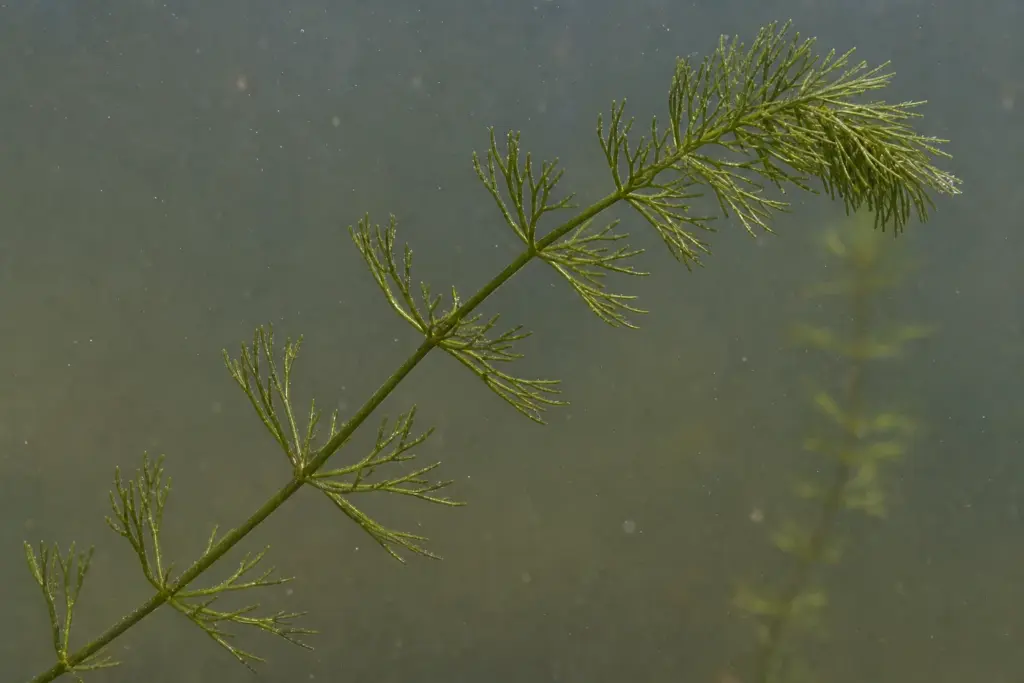
For the submerged layer, look for plants sold for ponds rather than aquarium-only tropicals. Names vary by region, and local rules matter. Coontail or hornwort, Ceratophyllum demersum, has no true roots and is native across much of North America, but it can still form dense nuisance mats.6 Verify the scientific name and local regulations before buying. Never release plants, water, or trimmings into a natural waterway or storm drain. Follow local disposal guidance: some aquatic plants can be composted safely, while plants that root readily from fragments may need to go in the trash.7
Planting without making soup
The easiest method is to keep the underwater layer simple. Match the method to the species: rootless coontail can float freely, while rooted submerged plants may be kept at their recommended depth in an aquatic basket. Some submerged plants root lightly; others drift or anchor loosely. Do not assume that one planting method suits every species.
If you add rooted marginal plants, keep them in their own baskets. Illinois Extension recommends heavy clay soil with a gravel cap and warns that ordinary potting-mix ingredients can float and cloud the water.11 The submerged stems can then occupy the water column around them. The goal is not to build an underwater flower bed with neat rows. The goal is to create layers: a few rooted edge plants, some floating shade if needed, and a loose submerged mesh where small aquatic life can hide.
Leave open water. A tub completely covered with floating plants stops being a window. It also reduces light for submerged leaves below. A tub with no plants becomes a sunlit bowl for algae. Somewhere between those two failures is the pleasing part: enough plant life to make the water feel alive, enough open surface to let the system breathe.
Algae is the underwater weed
Algae in a water garden is not a moral failure. It is the aquatic equivalent of weeds finding bare soil. Give sunlight, nutrients, and empty space to water, and algae will answer quickly. Submerged plants help by using some of the same resources, but they do not make algae impossible. They simply make the system more competitive.
Illinois Extension notes that roughly 20 to 40 percent aquatic vegetation can be beneficial in a larger pond, while excessive growth needs management.4 That range is not a formula for a patio tub. The useful principle is simply to avoid either extreme: bare, nutrient-rich water or a solid plant mass you can no longer see through.
The practical controls are ordinary and unglamorous. Skim fallen leaves before they rot. Avoid fertilizer runoff. Do not overfeed fish if you keep any, though a fishless tub is easier. Thin plants before they collapse into decay. Inspect still water weekly for wriggling mosquito larvae. If larvae appear and cannot be removed, Iowa State Extension describes larvicides containing Bti; use any product exactly as its label directs.8
When topping up, check whether the water utility uses free chlorine or chloramine. Free chlorine can be removed with sufficient aeration, but aeration does not remove chloramine. If fish, amphibians, or other aquatic animals are present, use a treatment labeled for the disinfectant present and follow its directions.9 Most of the work is not dramatic. It is the same old gardening job: remove excess, observe growth, and stop feeding the wrong thing.
The November version
November is a surprisingly good time to think about underwater gardens because the rest of the garden is honest. The container shows every leaf that falls in. The water cools. Growth slows. You can see whether your tub is a balanced little planting or a bowl of decomposing enthusiasm.
In cold climates, a shallow container may freeze solid. Winter survival depends on the plant, the container, and the local climate: some cold-tolerant aquatics can freeze, while others survive cold water only if their crowns or roots do not freeze.10 If your tub freezes hard, treat late autumn as cleanup time: remove excess plant material, keep only what you can overwinter safely, and do not leave a heavy load of leaves to rot under ice. Do not overwinter aquatic animals in a vessel likely to freeze solid. In mild climates, the underwater layer may simply slow down and wait.
This seasonal pause is part of the appeal. A summer tub can look lush and busy. A November tub looks like a small dark lens, with green stems still visible below the surface. It reminds you that not every garden retreats into soil. Some retreat into water.
Final thoughts
A submerged water garden is not a decoration added to a pond. It is a planting layer with its own rules. Light has to pass through water. Oxygen rises and falls. Leaves become pollution if you ignore them. A soft stem can be more important than a showy flower because it is doing quiet work in the dark green middle of the tub.
Start small. Use a clean container, a few safe submerged plants, and enough restraint to leave open water. Watch for bubbles on bright days. Thin before the thicket collapses. Keep trimmings out of natural waterways. If you do that, you will have something more interesting than a water feature. You will have a garden that keeps most of its life below the line where ordinary gardening stops.
References
- UF/IFAS Extension: A Beginner’s Guide to Water Management: Aquatic Plants in Florida Lakes
- UF/IFAS Center for Aquatic and Invasive Plants: Dissolved Oxygen
- Penn State Extension: Native Plant Selection for Backyard Aquatic Gardens
- Illinois Extension: Five Tips for Healthy Ponds
- Illinois Extension: Water Garden Containers
- Rutgers Cooperative Extension: Coontail, a Native Aquatic Plant
- Virginia Cooperative Extension: Winterizing the Water Garden
- Iowa State University Extension: Mosquito Control
- UF/IFAS Extension: On-Farm Transport of Ornamental Fish
- Illinois Extension: Seasonal Maintenance for Water Garden Containers
- Illinois Extension: Planting the Water Garden Container
- Penn State: The Influence of pH and Salinity on Metal Release from Pipe and Tank Materials