
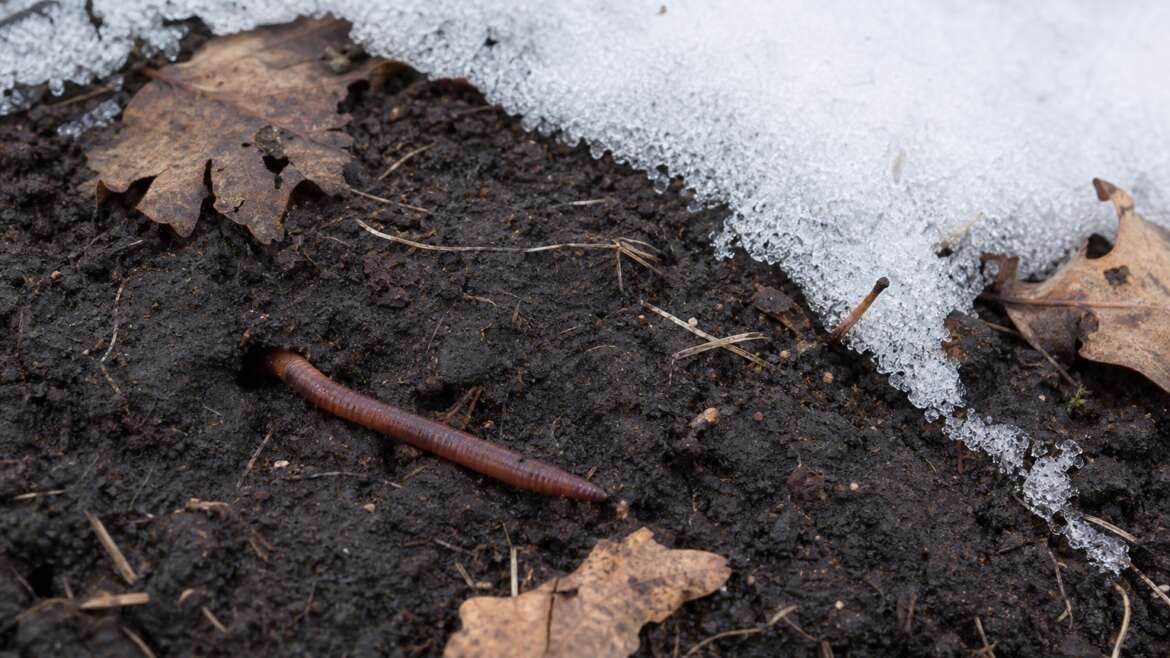
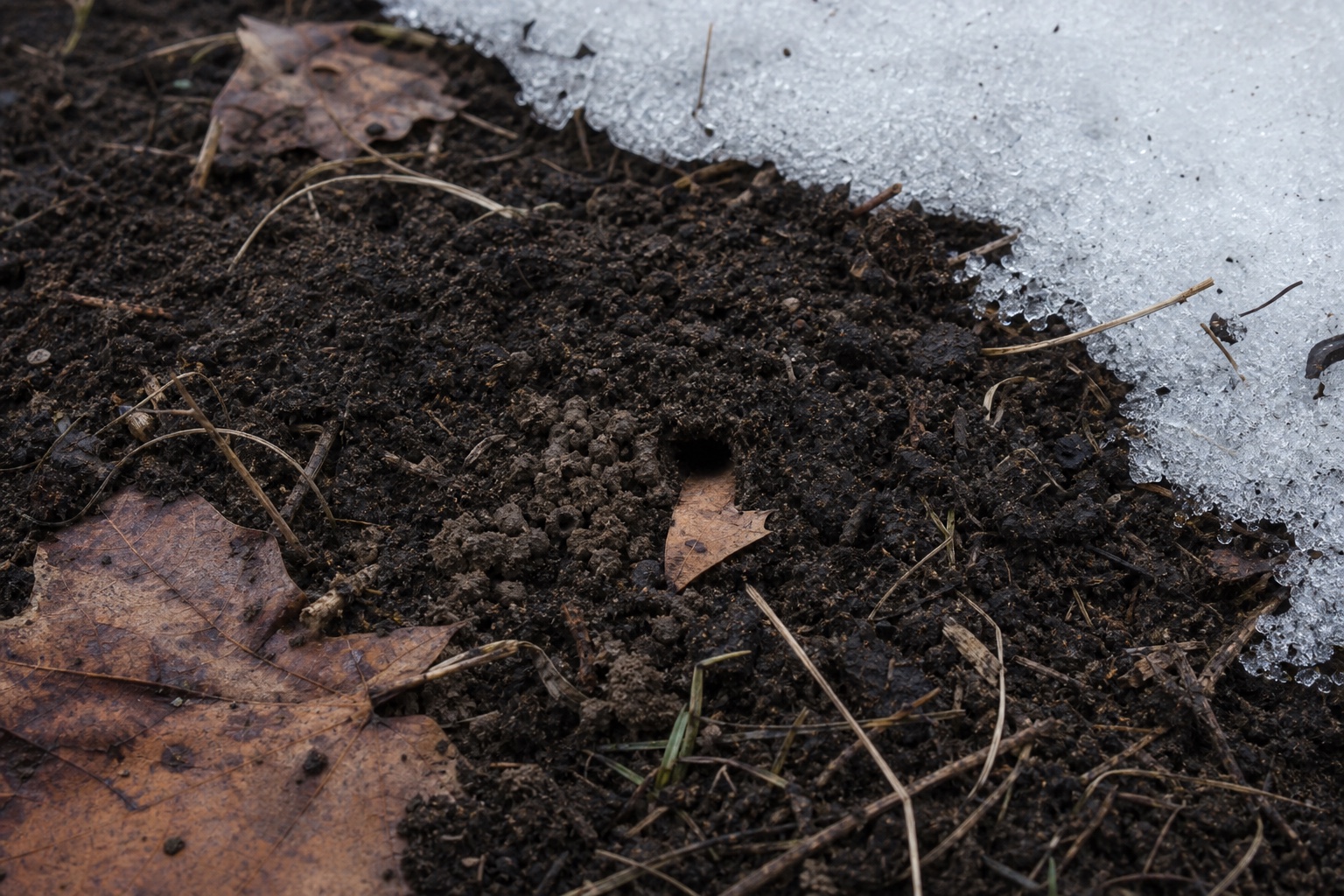
On a mild February afternoon, the garden can open in narrow strips. Snow pulls back from the south side of a bed. The soil beneath it is dark and glossy, last autumn’s leaves are pressed flat, and a few small casts sit at the mouth of holes that were invisible the day before. The ground looks paused, but the evidence suggests somebody has been moving through it.
So where do earthworms go when the ground freezes? The familiar answer is that they crawl below the frozen soil and sleep until spring. That is true for some worms in some winters, but it is not a rule for earthworms as a whole. A deep-burrowing nightcrawler, a worm that lives in the upper mineral soil, and a small litter-dweller do not face winter from the same address. Some retreat. Some slow down. Some remain active in unfrozen soil. In certain species, adults die while the next generation waits in cocoons.
Winter underground is not one long nap. It is a shifting map of temperature, moisture, food, snow cover, and depth. To understand the worms, you have to read the layers.
One garden can hold several winter strategies
Earthworm is a broad name, not a single way of living. Ecologists often group earthworms by where they feed and burrow. Litter-dwellers live at or near the surface among leaves and other plant remains. Soil-dwellers move through the upper mineral soil. Deep burrowers, including the common nightcrawler Lumbricus terrestris, maintain more permanent vertical burrows and come to the surface to pull down fresh litter. University of Minnesota Extension uses the plain-language terms leaf-litter dwellers, soil dwellers, and deep burrowers; the USDA Natural Resources Conservation Service describes the same three broad habitats.12
Those positions matter as soon as frost enters the soil. A worm already living deep has room to follow suitable conditions downward. A surface species may have only a thin layer of leaf litter between its body and hard cold. A topsoil species may survive by becoming inactive, tolerating some freezing, moving deeper than it does in summer, or leaving the season to its cocoons. Which strategy works depends on the species and the winter it actually receives.
This is why two neighboring beds can tell different stories. Soil texture affects how water and air move. A raised bed loses heat differently from undisturbed ground. A bare path freezes differently from a mulched border. Even within one square yard, the sheltered soil beside a foundation may remain workable while an exposed edge is solid.
The freezing front is a moving ceiling
The lower edge of seasonally frozen soil is a moving freezing front. The term frost line more often means the maximum or expected depth that frost reaches during a winter. The active freezing front advances during sustained cold and retreats during thaws. Snow, plant cover, soil moisture, exposure, and air temperature all change its position. As our look at snow’s insulating blanket explains, a deep, persistent cover can keep the soil beneath it warmer than bare ground exposed to the same air.
For an earthworm, that boundary is serious. The USDA notes that water makes up more than 75 percent of an earthworm’s body weight and that temperature, moisture, aeration, and soil texture all affect earthworm activity. Mulch moderates the soil microclimate and gives worms more time to move away from freezing or drying conditions.2 Moisture is necessary because worms exchange gases through damp skin.3 Water that turns to ice can damage living tissue, although the type and location of ice formation matter.4
Going below the frozen layer, then, is not like taking an elevator to a marked floor. The useful zone may move by inches over a week. It may be shallow under snow and much deeper in a windswept bed. It may also be wet enough to limit oxygen. For a worm escaping frost by migration, the useful compromise is unfrozen, moist, aerated soil with access to a burrow or resting chamber.
Nightcrawlers do not always sleep through it
Nightcrawlers are built for vertical escape. Their burrows can extend well below the surface, giving them access to soil that remains above freezing after the top layer hardens. But retreat does not necessarily mean hibernation. In a seven-year rhizotron study, researchers observed that Lumbricus terrestris typically remained active through winter. Many of its burrows shifted very little and were used continuously for years.5
That long-lived tunnel changes the picture. An established nightcrawler may not need to dig a new emergency bunker each November. It can move within a route that already connects deep, buffered soil with a feeding place at the surface. When conditions are mild enough, it can rise, gather a leaf, and withdraw again. When the upper soil freezes, the lower part of the same burrow remains a refuge.
A field study in boreal clay found nightcrawlers below roughly half a meter of frozen soil, apparently active at the bottoms of burrows that reached as deep as one meter. The soil around them was just above freezing. The same study found larger soil-dwelling earthworms burrowing much deeper during frost than they had during summer drought.6 It was one field, two species, and a particular set of conditions—not a universal winter script—but it shows why “all worms hibernate” is too tidy.
Some winters are spent inside a cocoon
Other earthworms place more of the winter burden on the next generation. Minnesota Extension notes that adults of some common soil-dwelling angle worms are killed by freezing, while cocoons deposited in summer and autumn survive and hatch in spring.1 The adult population disappears, but the population does not.
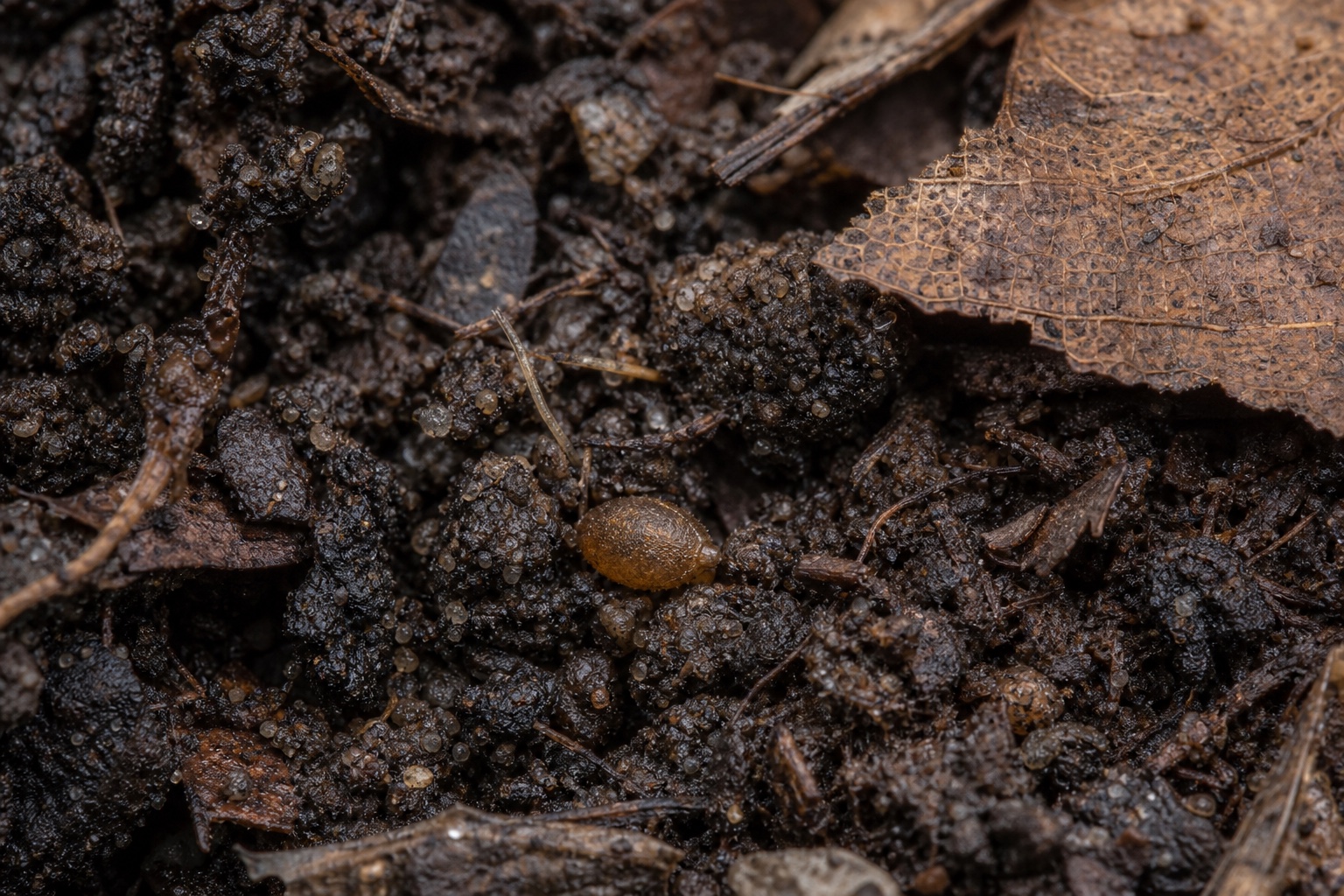
An earthworm cocoon is easy to overlook. Colorado State University Extension describes cocoons as lemon-shaped and slightly smaller than a pencil eraser.3 They are not piles of loose eggs. The small capsule encloses one or more developing embryos.
Cocoons are not universally frost-proof, any more than adult worms are universally helpless. Survival varies by species, temperature, exposure time, and moisture. In the boreal field study, viable cocoons of both Aporrectodea caliginosa and Lumbricus terrestris were recovered from the upper soil after it had been frozen for about a month.6 That result is more interesting than a simple claim that eggs survive winter. It shows that, for at least those species under those conditions, several life stages can carry the population across the cold season.
Cold can be endured as well as escaped
Moving downward is only one answer to freezing. Cold-soil research distinguishes between freeze avoidance and freeze tolerance. Some earthworms escape into deeper unfrozen layers or prevent their body fluids from freezing. Some species can tolerate ice forming outside their cells, within limits, while avoiding the far more damaging formation of ice inside cells. Earthworm cocoons can also lose water as surrounding soil freezes, a process called cryoprotective dehydration that reduces the water available to form harmful ice within the cocoon.4
These are physiological tools, not superpowers. A sudden hard freeze in bare soil is different from gradual cooling beneath snow. Saturated soil is different from moist, aerated loam. A cold-adapted species is different from a compost worm that evolved around rich surface material. The phrase “earthworms survive winter” is true only after you ask which earthworm, in which stage, in which soil.
Leaves and snow redraw the safe zone
Surface cover changes both food and temperature. The quiet work of fallen leaves continues after the leaves stop looking decorative. They soften, hold moisture, feed fungi and other decomposers, and give litter-dwelling organisms a buffered layer above the mineral soil. Snow adds another blanket. Together they can slow rapid temperature swings at the surface.
That does not mean every bed needs a heavy, airless mat. Thick wet leaves pressed over low evergreen crowns can cause trouble, and mulch piled against trunks is still poor practice. The useful cover is loose, appropriate to the planting, and connected to the soil rather than stacked like insulation around a building. Shredded leaves, plant residues, and an ordinary mulch layer create food and shelter without turning stems into compost.
The USDA links surface residue and reduced tillage with better earthworm habitat because both preserve food, moisture, and burrows.2 In a managed garden where earthworms already belong to the altered soil community, the gentlest winter care is usually indirect: protect the soil, leave some organic material, and stop rearranging the underground architecture simply to feel industrious.
A helpful garden animal can be a harmful forest invader
Earthworms are often treated as a universal soil-health badge. In farm fields and long-cultivated gardens, their burrows, casts, and mixing can increase porosity and redistribute organic matter and nutrients. The USDA describes their role in aggregation, aeration, infiltration, drainage, residue decomposition, and nutrient cycling.2 Those effects help explain why gardeners are pleased to find worms under mulch.
But an organism can be useful in one system and disruptive in another. In most of the Great Lakes region, glaciation eliminated native earthworms and forests developed without them.7 Many of the earthworms now widespread in those forests came from Europe or Asia.1 Minnesota Extension warns against dumping bait in woods.1 Introduced worms can consume the forest-floor duff that native plants, fungi, and seedlings use as habitat.
USDA Forest Service researchers report that nonnative earthworms negatively affect vegetation dynamics, soil biogeochemistry, understory regeneration, and canopy trees in northern hardwood forests.8 This is the necessary correction to the cheerful garden slogan that more worms always mean better soil. Context decides. Do not buy worms to “improve” outdoor soil, move them into natural areas, or release leftover fishing bait. If you vermicompost, keep the system contained and follow regional guidance for the species you use.
What to do when the beds begin to thaw
Mostly, wait. A February thaw is an invitation to look, not necessarily to dig. Soil that is thawed at the surface may still be frozen beneath, and saturated crumbs collapse into dense clods when worked too soon. The same restraint that protects wet spring soil also protects burrows, roots, aggregates, and the small air spaces that waking soil life needs.
Leave suitable mulch and leaf cover in place until the weather settles. Clear heavy mats only where they are smothering crowns or blocking emerging bulbs. Avoid walking repeatedly on soft beds. Direct downspouts and standing water away from places that remain saturated, but do not chase every worm cast with a drainage project. A few casts at the snow edge are a clue, not proof that worms were active during that thaw; melting snow can expose older casts.
If a worm appears on the surface during a thaw, there is usually no need to rescue it by carrying it elsewhere. Moving worms can spread nonnative species and their cocoons. Let the animal return to the soil on its own if it can, and keep bait, compost worms, and garden soil out of nearby woods and wild areas.
February is quieter than it looks
The frozen garden makes a clean picture above ground: white surface, brown stems, no visible hurry. Below it, winter is more uneven. One worm is deep in a burrow that may outlast the worm itself. Another is curled in a temporary chamber. Another survives only as a small cocoon tucked among soil crumbs. A mild interval may bring movement; a hard freeze may close the route again.
There is no single place where earthworms go because there is no single earthworm winter. The useful answer is a map: litter, topsoil, deep burrow, frozen layer, unfrozen refuge, cocoon. Snow and leaves shift the borders. Species and life stage decide what is possible. By the time a cast appears beside melting snow, the story has already been unfolding for months in the dark.
References
- University of Minnesota Extension: Earthworms
- USDA Natural Resources Conservation Service: Soil Quality Indicators—Earthworms
- Colorado State University Extension: Earthworms
- Hayashi: The Cold Vadose Zone—Hydrological and Ecological Significance of Frozen-Soil Processes
- Potvin and Lilleskov: Introduced earthworm species exhibited unique patterns of seasonal activity and vertical distribution
- Nuutinen and Butt: Worms from the cold—Lumbricid life stages in boreal clay during frost
- University of Minnesota Duluth Great Lakes Worm Watch: About the Forest
- USDA Forest Service: Exotic Earthworms Impact Forests