
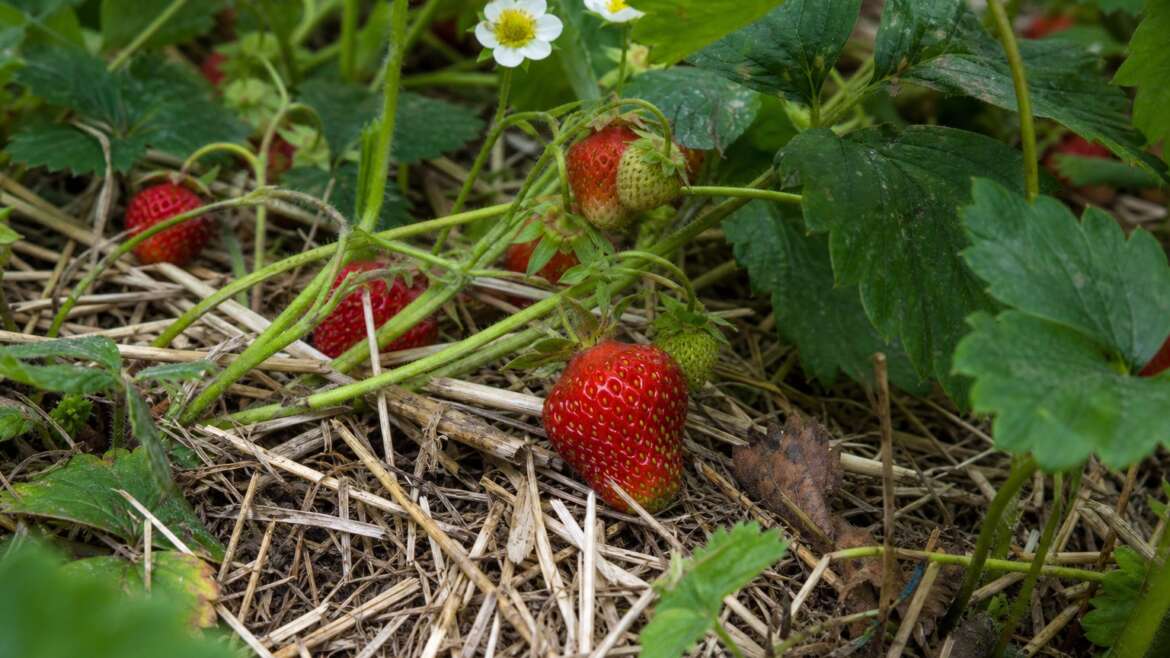
A June strawberry looks wonderfully straightforward until you look at it too closely. It is red. It is sweet. It fits between two fingers and leaves a little shine on the thumb. The plant itself sprawls low in the mulch, all trifoliate leaves, white flowers, green fruits, red fruits, and wandering runners that seem to be making private plans for next year.
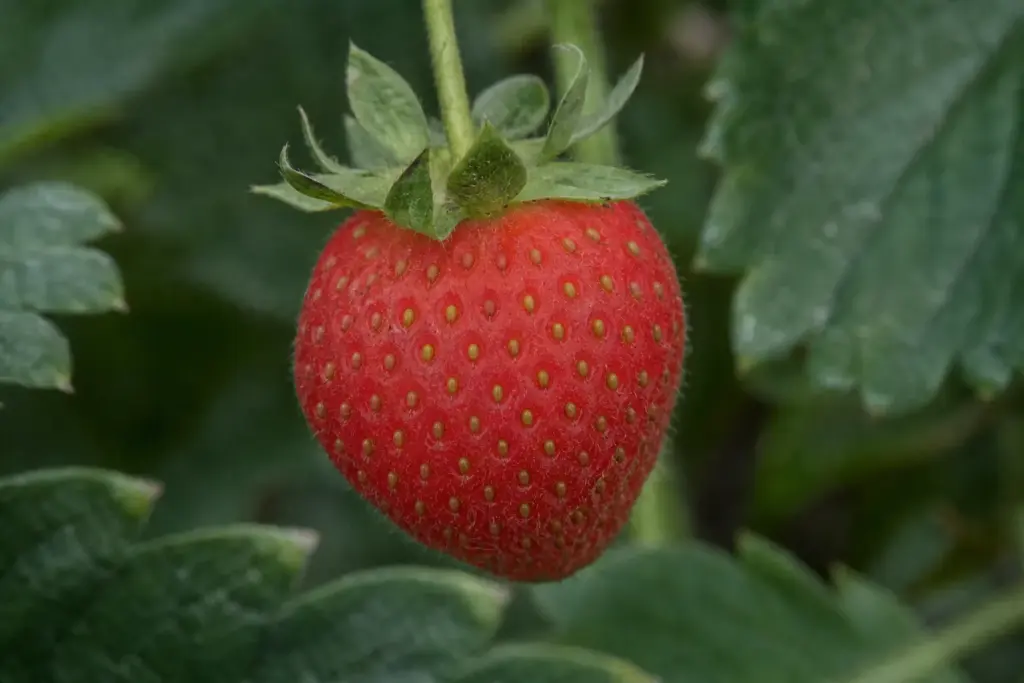
Then there are the seeds. They sit on the outside where seeds are not supposed to sit, each one tucked into a tiny dimple on the skin. Children notice this immediately. Gardeners notice it again when a berry ripens unevenly, or when one side swells while another side stays pinched and pale. A strawberry is familiar enough to eat without thinking, but odd enough to reward a closer look.
The little dots are the key. Botanically, they are not simply seeds glued to the surface of a fruit. They are tiny dry fruits called achenes, and each one contains a seed. The red part we eat is not the ovary of the flower in the usual fruit sense, but swollen receptacle tissue: the part that once held the flower’s many small ovaries in place.1 That makes a strawberry less like a peach with seeds inside and more like a flower base that has become irresistible.
The fruit is many fruits
A strawberry flower is built with many pistils gathered on a central dome. When pollination goes well, each fertilized ovary becomes one small achene on the surface. NC State Extension describes the garden strawberry as producing an accessory fruit that holds the true fruits, with each seedlike structure on the pitted surface being an individual achene developed from the flower’s ovaries.2
This is why the word “berry” becomes slippery. In ordinary kitchen language, a strawberry is a berry because it is small, soft, juicy, and eaten by the handful. In botanical language, a true berry is a particular kind of fruit formed from an ovary, with seeds embedded inside fleshy tissue. A grape and a tomato fit that definition better than a strawberry. A strawberry is an aggregate accessory fruit: aggregate because many small fruits are involved, accessory because the showiest edible part comes from tissue outside the ovary. The rose family offers another useful comparison: a rose hip is also an accessory fruit associated with many achenes, though its fleshy part is a floral cup rather than a strawberry’s swollen receptacle.
That does not make the kitchen word wrong. Gardeners live happily with both languages. The useful thing is not to win a terminology argument over breakfast. The useful thing is to understand that the red strawberry is a collaboration between many tiny fruits and the fleshy receptacle carrying them.
The dots help shape the berry
Those achenes do more than decorate the surface. When a strawberry flower is pollinated, the developing achenes help signal the receptacle to grow. NC State News explains that pollination triggers the receptacle tissue to enlarge and change, while the small dry fruits remain on the outside.1 In plain garden terms, the tiny dots are part of the reason the red part fills out.
This is why misshapen strawberries often tell a pollination story. A strawberry flower does not have one ovule that either succeeds or fails. It has many. Penn State Extension explains that each achene represents a pollination event and that the receptacle swells where fertilized achenes develop.3 If pollination is incomplete, the berry may still form, but it may be small, lopsided, buttoned, or pinched.
That is a satisfying piece of diagnosis because it keeps the gardener from blaming everything on disease. A funny-looking June berry may record a cool, wet bloom period and low pollinator activity, although frost injury, flower abnormalities, or tarnished plant bug feeding can also distort fruit. Oregon State Extension identifies cool or rainy bloom weather as one cause of pinched fruit through reduced pollination.5 The surface of the fruit becomes one clue, not the whole diagnosis.
Bees still matter on a self-fertile plant
Most cultivated strawberries are self-fruitful, so a second cultivar is not usually required for fruit set. But self-fruitful does not mean that pollen automatically reaches every stigma. A flower can accept its own pollen and still produce a smaller or uneven berry when pollen movement across its many pistils is incomplete.
Penn State Extension’s strawberry-pollinator guidance shows why open pollination still matters: wind and insects can move pollen among the flower’s many receptive surfaces, and more complete pollination produces larger, more symmetrical fruit.3 Honeybees, small native bees, and flies can contribute in different ways and at different times; the useful mix varies with weather, region, and planting system.
This gives strawberry care a pollinator dimension. Avoid broad-spectrum insecticides while plants are in bloom; if treatment is necessary, follow the label and choose a product and timing that minimize pollinator exposure. If you use row covers for frost or pests, uncover flowering plants when weather allows so insects can reach the blossoms, then replace the cover as needed. Let nearby flowering herbs, clover, native flowers, or early perennials bloom at the same time. A strawberry bed is not isolated from the rest of the garden. Its fruit shape is partly written by what can fly through it.
A low plant with a crown and runners
The edible oddity of the fruit is only half the plant’s cleverness. A strawberry plant is a low perennial with a short compressed stem called a crown. From that crown come leaves, flowers, fruiting stems, branch crowns, and runners. Oregon State University Extension describes runners as above-ground stems, or stolons, that produce daughter plants; when those daughters touch soil, they can root and become new plants.5
This is why a strawberry patch can seem to change its mind about borders. One year it is a neat row. The next, it is sending green cords into the path. The plant is not being messy for its own amusement. It is using a second reproductive strategy. The achenes offer seeds and genetic variation. The runners offer copies of a plant that has already found the place tolerable.
For gardeners, runners are both gift and management problem. If you want a matted row of June-bearing strawberries, you can guide some daughter plants into open spaces and let the row renew itself. If you want tidy day-neutral plants at the edge of a bed, or strawberries in containers, you will cut more runners off so the plant’s energy stays closer to flowers and fruit.
June crop or long season
The date on the calendar matters because not all strawberries behave the same way. June-bearing strawberries produce one concentrated crop in late spring or early summer. Everbearing types usually produce two crops, while day-neutral types can fruit through much of the growing season when temperatures are suitable. Oregon State Extension makes the same practical distinction: one approach gives a concentrated harvest for freezing, jam, and pies, while another spreads harvest over much of the season for fresh eating.5
A large June crop has a different feeling from a trickle of day-neutral berries. June-bearing plants are generous and briefly overwhelming. They are the type that sends you looking for bowls, freezer space, neighbors, and a better recipe for shortcake. Day-neutral plants are more conversational. They offer a few berries at a time, often over a longer period, and they suit containers, edges, and smaller households.
Neither habit is superior in every garden. If you want one gleaming season and enough fruit for preserving, June-bearing cultivars make sense. If you want children to find a few red berries along a path in July and August, day-neutral or alpine strawberries may be the better pleasure. The important thing is to buy the plant for the harvest rhythm you actually want.
Growing them close to the ground
Strawberries are not difficult plants, but they are unforgiving of a few bad conditions. They want sun, drainage, steady moisture, and enough space for air to move through the leaves. NC State’s plant profile lists full sun, moist well-drained soil, and high organic matter among suitable cultural conditions.2 Penn State’s planting guidance also shows why spacing is system-dependent: June-bearing plants in a matted row and individually managed day-neutral plants are not laid out in the same way.4 Plan for the planting system and mature runners, not just the small crowns set out in spring.
The low habit explains the mulch. Strawberries ripen where rain splashes, slugs travel, and soil can cling to soft fruit. Straw or another clean mulch helps keep berries off bare soil, conserves moisture, and makes ripe fruit easier to find. Penn State Extension recommends leaving clean straw in the rows as a bed for ripening berries after winter mulch is pulled back.4
Do not confuse mulch with neglect. A strawberry bed still needs editing. Remove runners where they are crowding the planting. Pick ripe fruit promptly. Remove overripe or rotting berries before they invite more trouble. After harvest, June-bearing beds often need renovation: thinning, removing old leaves and debris, and encouraging younger plants to carry the patch forward.
The first year asks for patience
The hardest strawberry advice is often the most sensible: let young plants build themselves before asking too much of them. But flower removal is not one rule for every strawberry and every region. Penn State’s matted-row guidance calls for removing first-year flower buds from June-bearers and removing buds from day-neutral plants only through early July.4 Oregon State’s Pacific Northwest guide instead says its June-bearers make little fruit in the planting year and need no flower pruning, while the first flower stem on new everbearing and day-neutral plants should be removed.5 Follow local guidance for your strawberry type and planting system.
The principle underneath those different recommendations is consistent: a new crown and root system need time to establish. How much early fruit to sacrifice depends on whether the bed is meant to make a matted row for next year, maintain individual day-neutral plants, or provide a one-season container crop. This is one of those moments when local detail matters more than a universal slogan.
The same patience applies when buying plants. OSU Extension advises choosing certified, disease-free plants from reputable nurseries rather than starting a new planting with daughter plants from an old patch, which can carry pests, soil problems, or viruses into the new bed.5 A strawberry plant is cheap enough that starting clean is usually wiser than inheriting trouble.
Useful strawberry supplies
- Fiskars micro-tip pruning snips: useful for cutting runners cleanly, harvesting berries with stems attached when needed, and removing damaged leaves without tugging at the crown.
- Dalen Bird-X protective garden netting: helpful when birds discover the patch before you do. Install netting carefully so wildlife cannot become tangled.
- Strawberry plant supports: optional, but useful in small beds or containers where lifting fruit slightly above damp mulch improves airflow and makes ripening berries easier to inspect.
Final thoughts
A strawberry is not simple because it is familiar. It is simple only in the way good garden things often are: the complexity is arranged so beautifully that we can enjoy it before we understand it. A white flower with many pistils becomes a red swollen receptacle carrying many tiny fruits. Bees and flies help write the shape. Runners make copies along the soil. Mulch keeps the low harvest clean. The gardener’s job is to notice the pattern and work with it.
That is why the first ripe berry of June feels like more than sugar. It is a small lesson in plant architecture, pollination, and timing, disguised as breakfast. The seeds are not really seeds on the outside. The fruit is not exactly the fruit. And still, when the berry is warm from the sun, the botany only makes it better.
References
- NC State News: Why Do Strawberries Have Their Seeds on the Outside?
- NC State Extension Gardener Plant Toolbox: Fragaria x ananassa
- Penn State Extension: Strawberry Pollinator Diversity, Significance, and Management
- Penn State Extension: Growing Strawberries
- Oregon State University Extension: Growing strawberries in your home garden