
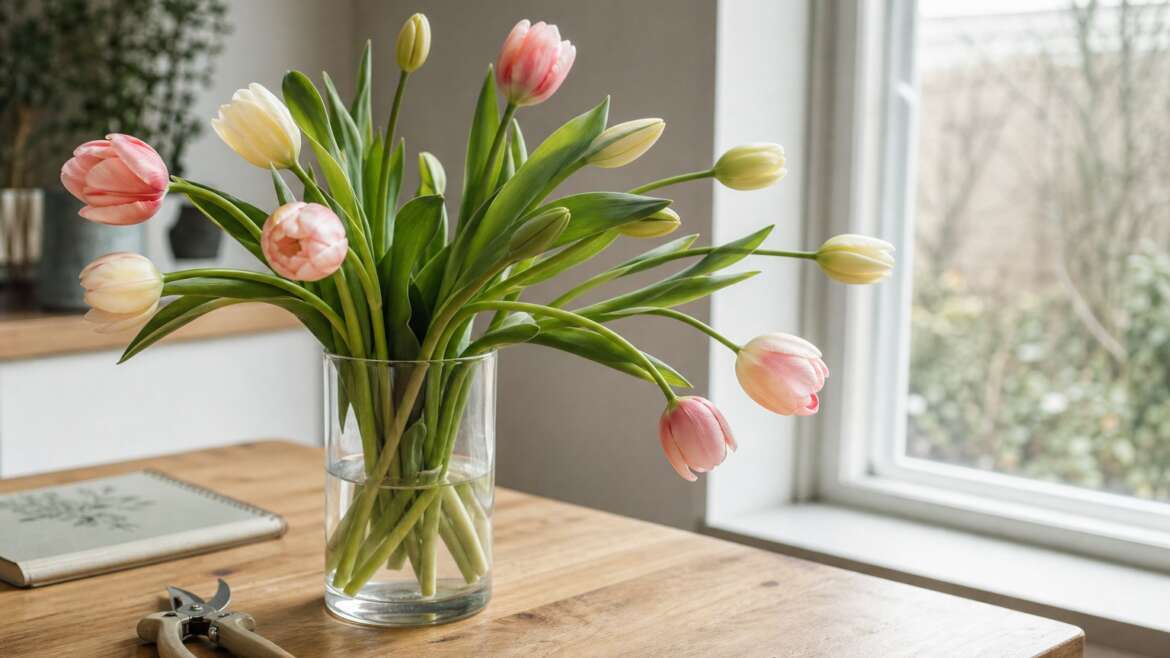
A vase of tulips rarely stays where you put it. Arrange it in the evening and the stems may look composed: upright enough, tidy enough, each flower holding its own small cup of color. By the next morning, one bloom has leaned toward the window, another has climbed above the rest, and a third has made a soft curve over the rim of the vase as if it has been reconsidering the room all night.
This is not just drooping. Tulips are unusually animated cut flowers. Their stems can continue to elongate after harvest, sometimes enough to change the whole shape of a mixed bouquet, and they respond strongly to both light and gravity. University of Maryland Extension notes that cut tulips can keep growing after cutting and may lengthen by as much as six inches in the vase.1 That is why a tulip arrangement can feel less like decor and more like a small, temporary houseplant with opinions.
The useful part, for gardeners and flower lovers, is that the movement is not mysterious once you know what the stem is still doing. A cut tulip is living on stored resources, drinking through a wounded base, and reading its surroundings with the same plant senses it used outdoors. If you understand that, you can decide whether to correct the leaning, slow it down, or simply let the bouquet become more interesting by the day.
A cut flower is not finished being alive
The first mistake is thinking of a cut flower as an object. It has been separated from its roots, but it has not stopped being plant tissue. Purdue Extension puts this plainly in its cut-flower guidance: a flower is still a living organism after it is cut, with water needs, stored food, and life processes that can be slowed or hurried by the way it is handled.2
A tulip stem is especially good at showing this. The cells in the flower stalk can keep expanding after harvest if they have water pressure, carbohydrates, and the right hormonal signals. Much of the visible “growth” is not the plant making a whole new stem from scratch. It is elongation of stem tissues that were already there, like a folded paper lantern being pushed open from inside. The result is real enough: the flower rises, the neck lengthens, and the arrangement changes.
That living quality is also why a neglected vase declines so quickly. If leaves sit below the waterline, they rot and feed microbes. If the vase is dirty, bacteria can clog the stem’s water-conducting tissue. If the room is hot, the flower burns through its remaining life faster. The tulip is not fragile because it is dead. It is fragile because it is alive with a very small pantry.
The window is part of the arrangement
When tulips lean toward a window, they are performing a familiar plant movement: phototropism. Shoots grow toward directional light because light changes the distribution of growth hormones in the stem. Biology LibreTexts summarizes the classic mechanism: blue-light sensing causes auxin to accumulate more on the shaded side, where cells elongate faster, so the shoot bends toward the light.3
In the garden, that helps a plant position its leaves and flowers in useful light. In a vase, it can turn a neat bouquet into a slow sketch of the room’s light map. Put tulips near a bright side window and the stems will often arc toward it. Put them in a room lit from several directions and the movement may be less dramatic. Rotate the vase once or twice a day if you want a straighter arrangement. Leave it alone if you enjoy the way the flowers keep editing themselves.
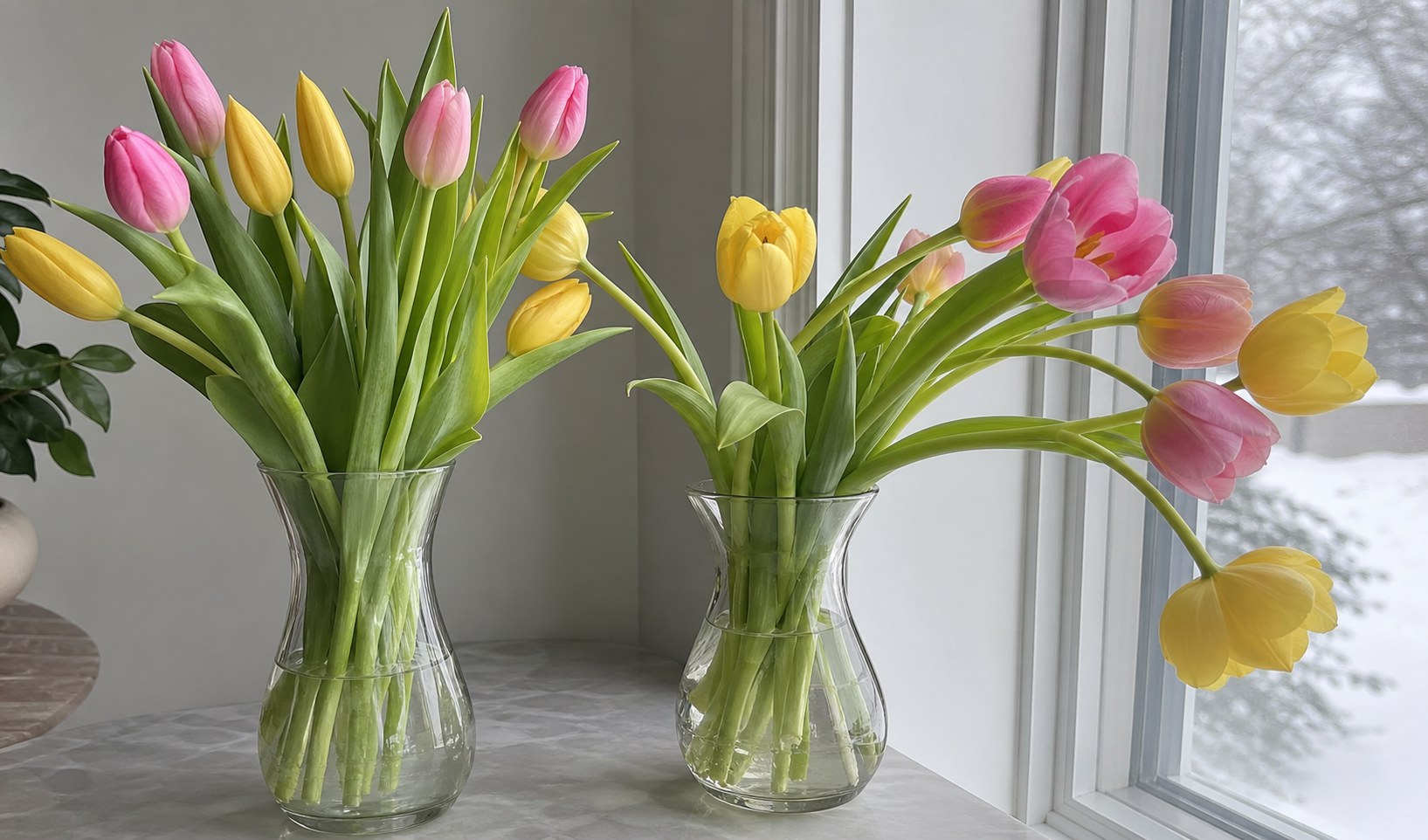
The caution is that bright is not the same as hot. Direct sun through glass can warm petals and water quickly, especially near a radiator or a south-facing window. Heat speeds aging and water loss. Tulips may lean more strongly in search of light, but the blooms will not last longer if they are being cooked while they do it.
Gravity has a vote too
Tulips also answer gravity. In postharvest handling, this matters before the flowers ever reach your table. A cut tulip stored flat can start to bend upward, growing away from gravity. A horticultural factsheet on cut tulip handling warns that dry tulips stored flat in trays will curve upward over time, and notes that upright, wrapped storage in buckets can keep stems in better condition than laying them flat.4
This is why a stem that looked slightly curved in the market sleeve may become more dramatic at home. The tulip is not being disobedient. It has simply been responding to gravity in transit, then responding to light in your room. By the time it is in the vase, those two histories can meet in one stem: a bend formed sideways in storage, followed by a new lean toward the window.
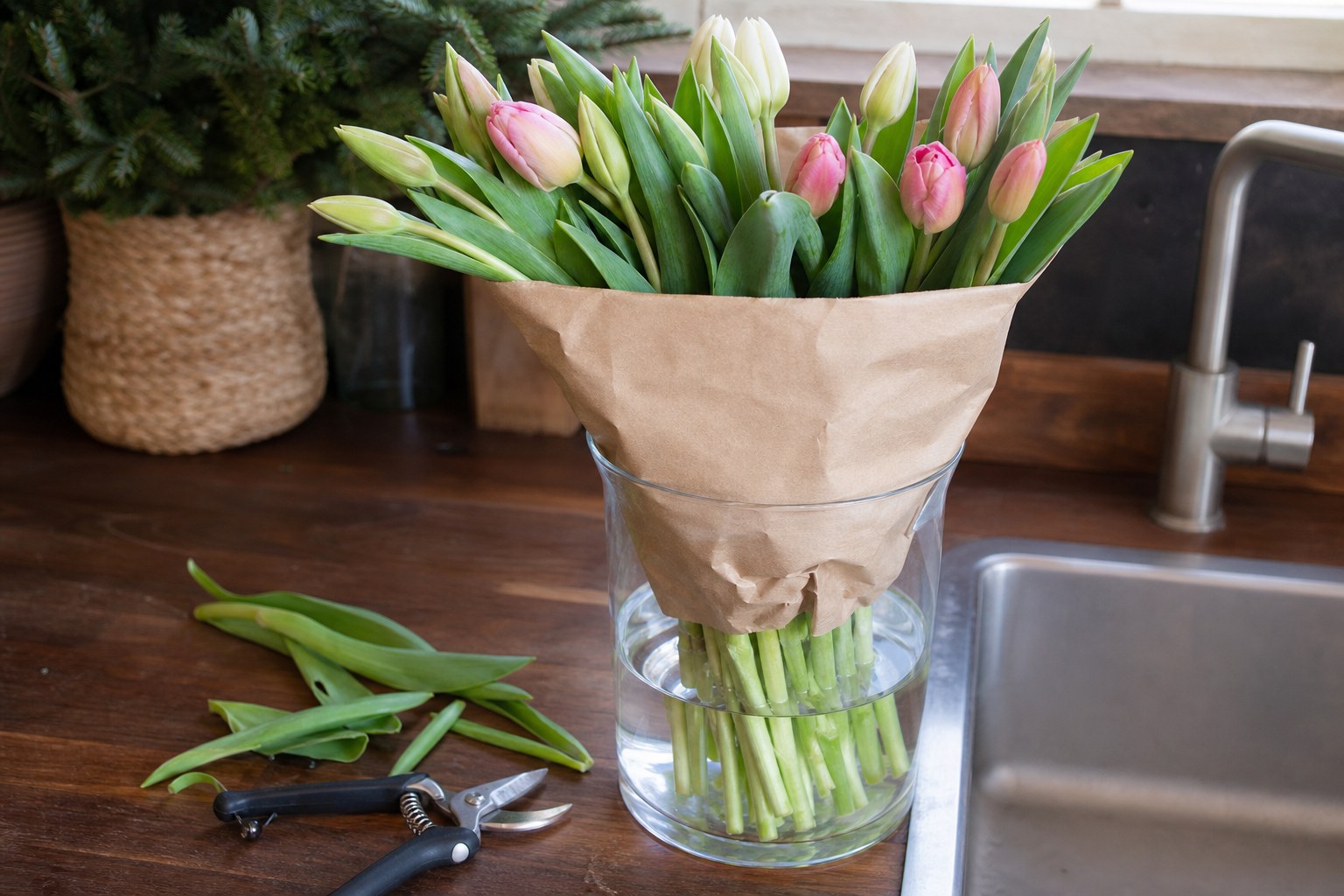
If you want straighter tulips, give them support while they rehydrate. Trim the bases, remove any lower leaves that would sit underwater, wrap the stems loosely but firmly in plain paper, and stand the bunch upright in a clean vase for a few hours. The paper is not magic. It simply keeps the stems aligned while the water columns recover and the cells regain pressure. Once the stems feel crisp, you can unwrap and arrange them.
Why they overtake the bouquet
Tulips are famous for misbehaving in mixed arrangements. Put them at the same height as ranunculus, hyacinths, or early narcissus, and a day later the tulips may be floating above the composition. The HDC cut tulip guide makes the same observation from the grower’s side: untreated cut tulips in mixed bouquets tend to keep growing and extend above the other ingredients.4
For a florist, that can be a nuisance. For a gardener, it is a useful design clue. If you want a formal arrangement, start tulips slightly shorter than the neighboring flowers, use a vase tall enough to support at least half the stem, and rotate the vase so the light does not pull everything in one direction. If you like a looser spring look, let them stand a little taller and give them room to curve. Tulips are often at their best when the arrangement admits that they are going to move.
The same growth explains the familiar tulip slump. As stems elongate, the flower heads become heavier and farther from the support of the vase. The flowers open, petals relax, and the whole top of the stem has more leverage. A tulip bending over the rim is not always thirsty. Sometimes it is simply long, soft, and mature. Fresh water helps, but it will not turn an aging bloom back into a tight bud.
How to keep the vase dance graceful
Start with the stage of the flower. Tulips for cutting are usually harvested when the petals show color but are not fully open.1 A tight green bud may fail to develop properly indoors, while a fully open tulip is already spending its last easy days. The sweet spot is a closed or almost closed bud with enough color to tell you what it will become.
Use a clean vase and clean tools. Recut the stems with sharp shears or a knife, then put them in water promptly. Strip off leaves that would sit below the waterline. Purdue Extension notes that submerged foliage decays and encourages microbial growth, while dirty containers can harbor bacteria that clog the water-conducting tubes of flower stems.2 Tulips do not need complicated household tricks to be beautiful. They need open plumbing.
Keep them cool when you are not admiring them. A night in a cool room can slow aging. Avoid radiators, sunny glass, fireplaces, and bowls of ripening fruit. Purdue’s cut-flower guidance warns that heat reduces flower life and that many fresh fruits and vegetables release ethylene, a gas that shortens the life of some flowers.2 A kitchen counter beside a fruit bowl is charming, but it is not a spa for tulips.
Change the water whenever it clouds, and give the stems a small fresh cut if the ends look slimy or sealed. If the tulips arrive limp, condition them upright in paper before arranging. If they are fresh but wandering, decide whether the wandering is a problem. A rotating vase is enough for straighter stems. A wider arrangement with a few low branches, grasses, or other spring flowers can make the tulips’ curves look intentional.
Cutting from your own garden
Garden tulips add one more decision: are you harvesting flowers, or are you trying to keep the bulb strong for next year? Commercial cut-tulip production often treats bulbs as a one-season crop, and University of Maryland Extension describes pulling field-grown tulips to gain stem length, then discarding the used bulbs after harvest.1 That is practical for a flower farm. It is not always what a home gardener wants.
If you want the bulb to have a chance at returning, be conservative. Cut the flower stem, but leave as much foliage as you can. Iowa State University Extension recommends removing spent flower heads after bloom while leaving bulb foliage in place until it dies back naturally, because premature foliage removal stops bulb growth and can reduce next year’s flowers.5
Many modern tulips are not reliable long-lived perennials in ordinary garden conditions, especially in wet summer soil, but the leaves still matter. They are the solar panels that refill the bulb after bloom. If you cut a long florist stem with most of the leaves attached, you have made a better vase flower and a weaker future bulb. That may be a perfectly reasonable trade if the planting is intended as an annual display. It is less reasonable if you are hoping a favorite clump will build itself year after year.
Let the movement be part of the pleasure
A tulip in a vase is not pretending to be permanent. It is a short performance by a plant that still remembers how to grow. It drinks, lengthens, curves toward light, resists gravity, opens, loosens, and finally lets go. The arrangement you make on Monday is not the arrangement you will have on Thursday.
That is the point. A rigid tulip would be less interesting. The leaning stem is the biology showing through the bouquet: water pressure, auxin, gravity, stored food, and the ordinary insistence of a living shoot trying to orient itself in the world. Give it clean water, cool air, and a little room, and let it draw its slow green line toward the window.
References
- University of Maryland Extension: Production of Tulips as Cut Flowers
- Purdue University Cooperative Extension Service: Add Hours to Your Flowers
- Biology LibreTexts: Blue Light Response
- Horticultural Development Council: Guidelines for the Post-Harvest Handling of Cut Tulips
- Iowa State University Extension and Outreach: Care of Spring-Flowering Bulbs after Bloom