

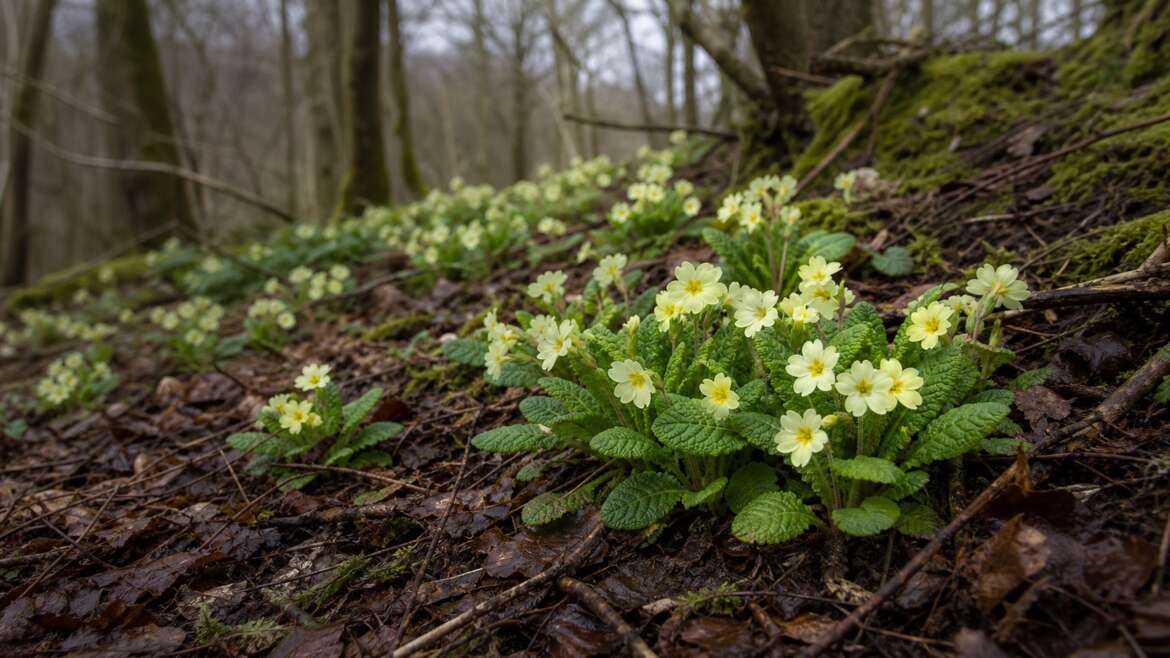
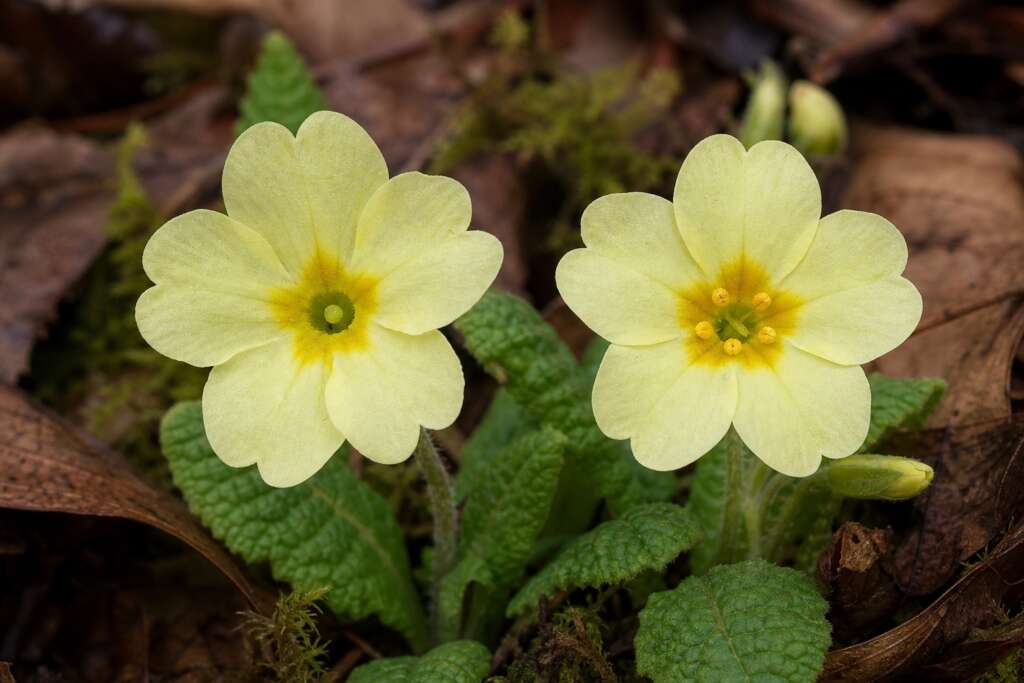
A bank of primroses can look almost uniform from the path: low wrinkled leaves, pale yellow flowers, and a scatter of gold across the last brown leaves of winter. Kneel down, however, and look into the flowers. Some have a small green button at the center. Others have a ring of yellow anthers. The difference is not age, weather, or chance. You are looking at two kinds of primrose.
Gardeners have long called them pin-eyed and thrum-eyed flowers. A pin holds its stigma high and its anthers low inside the floral tube. A thrum reverses the arrangement, displaying its anthers near the opening and keeping its stigma below. Each common primrose plant, Primula vulgaris, normally bears flowers of only one of these forms.1
This tiny difference is the visible part of an elaborate mating system. It guides pollen between compatible plants, rejects many of the wrong deliveries, and is a system botanists have investigated for more than 150 years and that modern genetics traces to a cluster of genes. A primrose flower is not simply facing upward. It is presenting one half of a two-part arrangement.
One flower, two floor plans
Both pin and thrum flowers are hermaphroditic: each contains male anthers, which produce pollen, and a female stigma, which receives it. The difference is where those organs wait inside the narrow corolla tube.
In a pin-eyed flower, the long style lifts the stigma to the mouth of the tube, where it resembles the round head of a dressmaker’s pin. The five anthers sit lower down and are difficult to see from above. In a thrum-eyed flower, the style is short, the stigma remains deep in the tube, and the five anthers form a conspicuous ring near the opening.1
The flowers outside remain remarkably alike. Both have the same soft yellow face and deeper golden eye. That makes the discovery feel private, as if the patch has been keeping two different plans behind one façade. Common primrose reaches its flowering peak in March and April in Britain, using the same bright interval enjoyed by other spring flowers beneath bare trees.7
The heights are arranged like a handoff
The mirrored positions have a name: reciprocal herkogamy. The high stigma of a pin sits roughly where a thrum presents its high anthers. The low stigma of a thrum occupies roughly the level of a pin’s hidden anthers. A long-tongued visitor probing both forms can pick up pollen at one height and brush it against a compatible stigma at the same height in the next flower.2
It is an elegant idea, but a real insect is not a laboratory swab. A pollinator’s body shifts, pollen sticks in several places, flowers vary, and visitors do not always move neatly from one morph to the other. Experiments with common primrose and oxlip found that heterostyly promotes pollen transfer between different morphs and reduces interference between a flower’s male and female functions, while also showing that the match is not mechanically perfect.3
That imperfection matters. The flowers are not two precision sockets that only one plug can enter. Pollen from the same morph can still land on a stigma. The plant needs another layer of sorting after the visitor has gone. Pollination is full of such layered signals and filters: in another strategy, flowers change color after pollination and redirect visitors before they arrive.
The shape is only half the lock
Typical heterostylous primroses also use self-incompatibility. Pollen from the same plant, or from another plant of the same morph, may reach the stigma but usually fails to complete fertilization. The strongest seed set normally follows a pin-to-thrum or thrum-to-pin cross.18
So the flower sorts pollen twice. First, the reciprocal heights improve the odds that an insect will carry pollen between unlike morphs. Then biochemical interactions in the stigma and style favor the compatible mating type. One system manages placement; the other manages acceptance.
It is safer to say “normally” than “always.” The genus Primula is large, cultivated primroses have complicated parentage, and mutations can alter both floral form and compatibility. Even within wild species, pollen movement and seed production vary with population, visitors, and weather. Pin and thrum describe a robust biological pattern, not a promise that every plant sold under a primrose label will obey it perfectly.
Darwin tested what gardeners could already see
Charles Darwin did not invent the names pin and thrum, and he was not the first person to notice the two forms. Gardeners and earlier botanists already knew that some primroses showed a stigma at the flower’s mouth while others showed anthers. His contribution was to ask what the difference did.
In crossing experiments with several Primula species, Darwin compared crosses between opposite forms with crosses involving the same form. He reported the work to the Linnean Society in 1861 and published it in 1862, arguing that the dimorphism favored union between distinct plants.4 A familiar garden oddity became evidence about how flowers encourage outcrossing.
The history is appealing because the observation is still available to anyone. No microscope is required to find a pin or a thrum. Yet the simple act of looking into a flower opens questions about inheritance, hormone chemistry, pollinator behavior, and population survival. The primrose kept giving geneticists new versions of Darwin’s question long after the crossing pots were cleared away.
A supergene builds the thrum
For decades, researchers knew that the suite of thrum traits traveled together in inheritance. Modern sequencing eventually exposed the machinery: a tightly linked cluster of five genes known as the S locus. In common primrose, that region is present as a single thrum-specific copy and absent from pin plants, rather than existing as two ordinary alternative versions of the same stretch of chromosome.5
One gene in the cluster, CYP734A50, helps produce the short thrum style. It encodes an enzyme that inactivates brassinosteroids, plant hormones that promote cell expansion. With less active hormone in the developing style, its cells elongate less and the stigma remains low in the flower. In experiments, supplying brassinosteroid to short-styled common primrose and Primula forbesii, or silencing the gene in P. forbesii, caused styles to lengthen.6
Later experiments in Primula forbesii showed that the same gene also influences the female compatibility type.8 This is a particularly neat piece of biological economy. The gene does not merely move a stigma to a different floor. It helps connect that position to the pollen the flower will accept. Other genes in the linked cluster contribute to features including the elevated anthers of the thrum.5
A supergene is useful here because the parts of the arrangement need to travel together. A short style without the matching anther height or mating type would loosen the coordination. Keeping the genes in a linked, largely non-recombining region helps pass the thrum package on as a package.
Sometimes a third form breaks the mirror
Not every primrose population contains only textbook pins and thrums. Rare homostyle plants hold stigma and anthers at similar heights and can be self-compatible. Genetic work indicates that some common-primrose homostyles arise through mutations affecting genes in the thrum-specific cluster, rather than by neatly recombining pin and thrum instructions.5
For a plant, self-compatibility can be useful when compatible partners or pollinators are scarce. It also changes the genetic consequences of reproduction. Outcrossing mixes genes between individuals; repeated selfing can reduce that exchange. Primroses are not alone in keeping more than one reproductive option on the table. Violets hide self-pollinating flowers below their showier open blooms, but they arrive at that insurance policy by a very different route.
Homostyles are also a warning against overconfident flower reading. If both stigma and anthers appear together at the mouth, you may have a homostyle, a horticultural hybrid, or a flower that needs a closer look. Record the observation; do not force it into the nearest diagram.
Why balance matters beyond one flower
In a large, freely reproducing population, pin and thrum plants are often expected to settle near equal numbers because successful crosses produce both forms.9 Small, fragmented populations are more vulnerable to losing that balance by chance. Once one morph becomes rare, compatible pollen becomes harder to find even if flowers and pollinators are still present.
A study of 76 cowslip populations, Primula veris, in the Swiss Jura found much larger departures from an even morph ratio in small populations; six of the smallest had lost one morph altogether. The authors linked biased ratios with reduced reproduction in small remnants.9 Cowslip is not common primrose, but it uses the same pin-and-thrum logic, and the study shows why preserving plants is not always enough. A population can keep its leaves and flowers while losing part of its mating system.
That is one reason wild primrose banks should be left intact. Do not dig plants from woods, verges, or old banks. A removed clump is not only a missing flower; it may be one of relatively few compatible partners in that patch. Buy propagated plants from a reputable nursery and treat wild colonies as communities rather than free divisions.
How to grow a patch that can make seed
If the goal is simply spring color, the morph may make little difference. One healthy plant can flower beautifully. If you hope to watch seed form and seedlings spread, grow several genetically distinct plants and look for both pins and thrums while they are in bloom. Dividing one clump makes more of the same genetic individual and therefore more of the same morph; it does not create a compatible partner.
Keep the species and source in mind. Many bedding “primroses” are complex cultivars or hybrids selected for large flowers and bright colors. Their mating systems may not match wild Primula vulgaris. For the classic pin-and-thrum arrangement, choose correctly identified, nursery-propagated common primrose and inspect the flowers rather than trusting a color photograph on a label.
Common primrose suits the conditions suggested by its woodland-edge life: dappled light, humus-rich soil, and moisture without stagnant water. The Royal Horticultural Society recommends naturalizing it in grass, beneath shrubs, in woodland-style areas, at a border front, or in shady containers, with leaf mold used to echo its usual habitat.7 Adjust that advice to local climate. A cool British bank and a hot continental garden do not offer the same “part shade.”
Let the patch make its own small geography. Avoid broad-spectrum insecticides around the flowers, keep a light organic surface rather than a deep mulch pressed over the crowns, and allow some seed heads to mature. If seedlings appear, give them time before editing the patch. The point is not to manufacture a perfect fifty-fifty display. It is to leave enough diversity and movement for the two forms to find one another.
How to spot a pin and a thrum
Choose a fully open flower and look directly into its throat in good light. A pin shows one pale green, rounded stigma at the opening. A thrum shows a ring of five yellow anthers dusted with pollen. Check several flowers on the same plant; they should repeat the same arrangement.
There is no need to pick or dissect the flower. A hand lens can help, but a phone camera often does the job if you shade the bloom from glare and focus on the center. Photograph one flower, mark the plant discreetly, and compare it with its neighbors. What first looked like a uniform yellow bank will begin to resolve into two interdependent morphs.
The small machine at the center of spring
Primroses reward two distances of looking. From the path, they are a soft sign that winter is loosening. From a few inches away, they are a coordinated machine: organs held at reciprocal heights, pollen screened by compatibility, hormones changing the length of cells, and linked genes keeping the parts together.
The green button and the yellow ring are easy to miss. Once seen, they change the whole patch. The patch is not merely repeating a single flower. Each primrose is holding one side of an old botanical conversation, waiting for an insect to carry the answer across.
References
- Li et al., 2011: Floral heteromorphy in Primula vulgaris
- Barrett and Shore, 2008: New insights on heterostyly
- Keller et al., 2014: Heterostyly promotes disassortative pollination and reduces sexual interference
- Darwin, 1862: On the two forms, or dimorphic condition, in the species of Primula
- Li et al., 2016: Genetic architecture and evolution of the S locus supergene in Primula vulgaris
- Huu et al., 2016: CYP734A50 underlies style-length dimorphism in primroses
- Royal Horticultural Society: Everything you need to know about primroses
- Huu et al., 2022: Female self-incompatibility type in heterostylous Primula
- Kéry, Matthies and Schmid, 2003: Demographic stochasticity in small remnant populations of Primula veris