
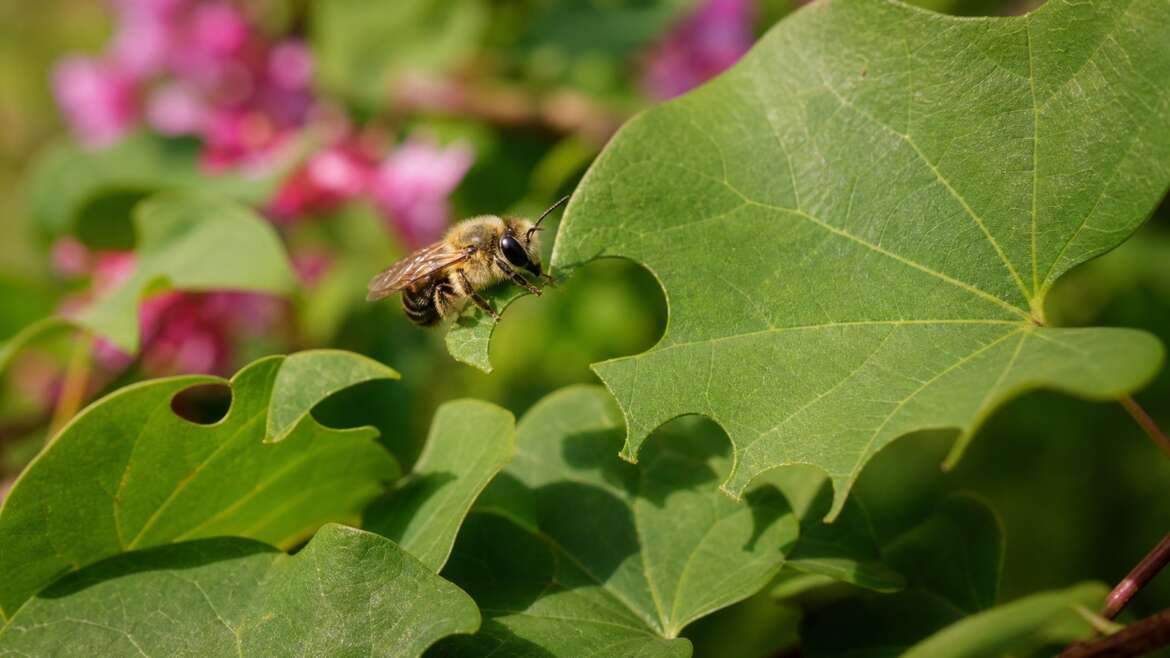
By late July, a rose leaf can look as if someone has touched it with a miniature punch. The edges are not shredded. The center is not speckled. Instead, neat half-moons have vanished from the margins, each one as clean as a bite taken by a very tidy pair of scissors.
It is easy to read this as damage, because technically it is. A piece of leaf is gone. But the pattern is also one of the gentler signatures a garden can offer. Those perfect circles are often the work of leafcutter bees, solitary bees that harvest small pieces of leaves and petals to build nursery cells for their young.
The useful thing, for a gardener, is learning to recognize the difference between a plant in trouble and a plant lending material to a pollinator. Leafcutter marks can look startling when you first notice them, especially on roses, redbuds, serviceberries, azaleas, or other soft-leaved plants. University of Maryland Extension notes that leafcutter bees cut circular pieces from plants such as Eastern redbud, serviceberry, rose, and azalea, then use those pieces to line nests in hollow stems, rotten wood, holes in solid wood, and other protected cavities. The same guidance is refreshingly calm: they do little damage and control is not necessary.1
The signature of a careful cutter
Many other leaf problems leave different clues. Chewing caterpillars may leave ragged edges, skeletonized tissue, or frass beneath the plant. Beetle feeding is often irregular. Disease commonly brings discoloration or spotting before tissue drops away. Leafcutter work is usually smooth, geometric, and taken from the leaf edge. A single leaf may have one missing crescent, or a row of tidy bites that makes the plant look as if it has been trimmed with a craft tool.
The precision is not decorative. A female leafcutter bee needs a piece she can carry. She cuts from the margin, grips the fragment beneath her body, and flies it back to a nest cavity. If you are lucky enough to see it happen, the whole act can feel improbable: a small bee departing with a green sail nearly as large as herself.
The best field clue is proportion. Leafcutter bees are not trying to strip a plant. They are collecting small, repeated building pieces. The leaf is a quarry, not a meal.
What the bee is making
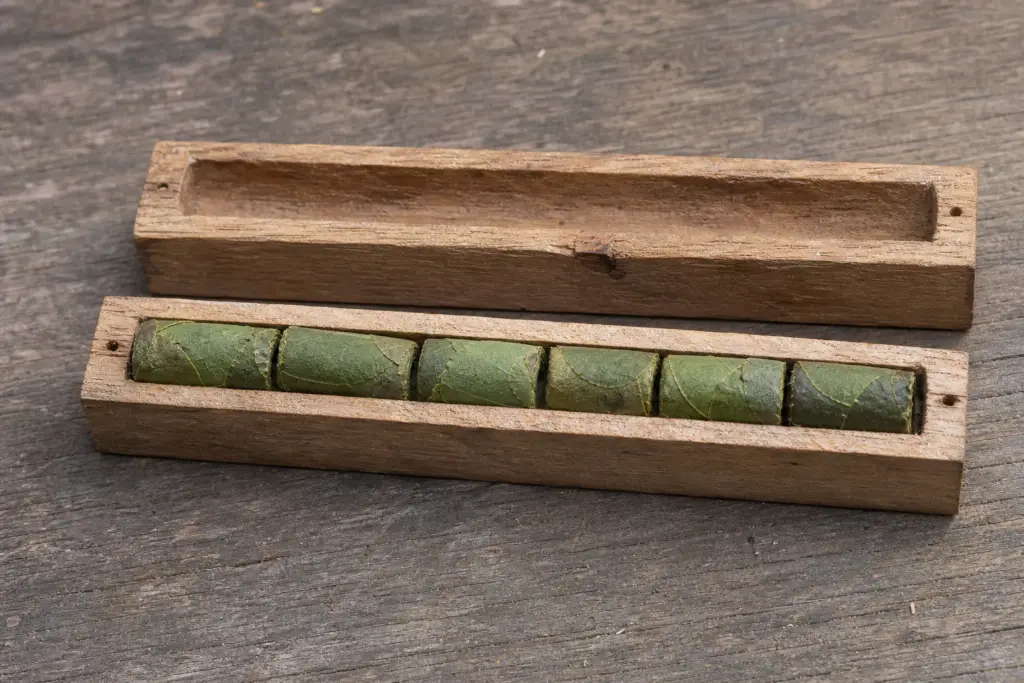
Leafcutter bees are solitary nest builders. Even when several females use the same patch of habitat, each female builds and provisions her own cells. There is no queen or worker caste and no communal honey store. A female finds or adopts a narrow cavity, brings in plant pieces, shapes them into cells, packs each cell with pollen and nectar, lays one egg, and seals it.2
NC State Extension describes female leafcutter bees as constructing cells from leaf and petal fragments, usually in narrow cavities. It also notes that leafcutter bees visit many flowers for pollen and nectar and seem to prefer leaves and petals that are not thick or stiff for nest building.2 This is why roses so often get blamed. Their leaves are common, accessible, and just flexible enough to become architecture.
Oregon State University Extension describes the construction in useful detail: the female overlaps leaf pieces across the floor, walls, and ceiling of a cavity, adds a loaf of pollen and nectar and a single egg, then closes that cell with more leaf pieces and begins the next.3 A gardener sees the missing circle. The bee is building a packed lunch, cradle, and wall in one.
Is it a pest problem?
Usually, no. On an otherwise healthy, established plant, ordinary leafcutter marks are generally cosmetic. The cuts may be conspicuous without removing enough tissue to affect the plant’s growth. The plant looks different because it has become part of another organism’s life cycle.
This is not a case for insecticide. NC State Extension notes that leafcutter bees are solitary, lack a nest-guarding instinct, rarely sting people unless handled carelessly, and do not require pesticide recommendations.2 Spraying a plant for a few neat leaf arcs would trade a small aesthetic nuisance for harm to pollinators, including the very bee that made the pattern.
A small, vulnerable, or high-value plant may occasionally need temporary protection. UC Integrated Pest Management recommends cheesecloth or other screening when leafcutters repeatedly collect from a small plant; the barrier can go on when cutting begins and come off when adult activity ends.4 Screening also excludes wanted pollinators, so cover only the plant that needs protection and remove it promptly rather than netting an entire flowering border.
How to garden around them
The easiest way to live well with leafcutter bees is to let a few plants be slightly imperfect. A rose with a handful of scalloped leaves is not failing. A redbud with circular notches is not being devoured. If the plant is otherwise vigorous, care for it according to its species and site, look for any additional symptoms, and let the season continue.
Flowers matter too. Leafcutter bees need pollen and nectar, not only leaf material. Build overlapping bloom periods with plants suited to the light, soil, moisture, climate, and ecology of your site; University of Maryland Extension recommends regional native plants and a sequence of overlapping bloom.5 Flowering herbs, asters, coneflowers, sunflowers, goldenrods, and native mints can contribute where they are locally appropriate. Avoid treating open flowers with insecticide.3
Then think beyond flowers. Many pollinator gardens are planted beautifully and cleaned too thoroughly. Oregon State’s guide emphasizes that leafcutter life cycles vary by species, while the common pattern is a sequence of individually provisioned cells sealed inside an existing cavity.3 If an occupied hollow stem is cut, shredded, and hauled away, the developing bees go with it.
University of Maryland Extension gives practical garden advice: do not prune dead plant stalks too early in spring, because leafcutter bees and mason bees nest in some hollow stems. If stalks must be cut, put the clippings in a less visible part of the garden where stem-nesting bees can still use them.5 The same selective principle shapes a less destructive fall cleanup: retain useful habitat while removing material that is diseased, unsafe, or genuinely in the way. The front border can look intentional while a back corner quietly keeps its tenants.
Bee houses, with a little caution
A bee house can provide additional cavities, but only if it is treated as habitat rather than decor. Many charming insect hotels are permanent, crowded, damp, and impossible to clean. Utah State University Extension warns that hotels can also attract parasites, predators, and pathogens, so regular inspection and maintenance are part of owning one.6
Utah State recommends breathable, removable, thick-walled tubes with one closed end. Leafcutter bees generally prefer openings from about one-eighth to one-quarter inch, with tunnel depth scaled from roughly three to six inches according to diameter; an overhanging roof helps keep the nest material dry.6 In other words, small, dry, and cleanable beats large and picturesque.
The same guide recommends replacing tubes, liners, stems, and reeds annually after their bees have emerged, and cleaning reusable grooved trays each year.6 Timing matters: discard nesting material too early and you discard living brood. Replaceable liners, split trays, or removable reeds are more manageable than bamboo or blocks permanently glued into place.
Natural nesting habitat is often the simpler solution. Preserve safe existing cavities in untreated dead wood and sound hollow or pithy stems rather than assuming every pollinator garden needs a hotel.3 Leafcutter bees do not need a monument. They need flowers, suitable cavities, leaf material, time, and a gardener willing to share a few leaves.
Optional habitat supplies, with caveats
- WHITEHORSE premium cedar bee house: a product marketed for mason bees, with replaceable six-inch tubes. Treat it as a managed nest rather than set-and-forget decor, and check that the tube diameters suit the cavity-nesting bees in your area.
- Rivajam mason bee house tube refills: cardboard tubes with paper liners for a managed bee house. Match tubes and liners snugly, keep them dry, and phase them out only after the occupants have emerged.
- Burpee wildflower seed mix for pollinators: a commercial mixed seed packet. Read the species list and check local suitability before sowing; a packet labeled for pollinators is not automatically native or appropriate in every region.
Final thoughts
The perfect circles in a leaf are easy to misread because gardeners are trained to notice damage. That training is useful. It helps us catch disease, drought, beetles, and caterpillars before a plant is overwhelmed. But not every missing piece is an emergency.
Sometimes the garden is simply being borrowed. A bee has found a flexible leaf, cut a green tile from its edge, and carried it into a hidden room where pollen, egg, and time will do the rest. The plant will keep growing. The leaf will keep its curious scallop. And somewhere in a stem or old piece of wood, a small summer architecture will be sealed away for the next season.
That is a useful kind of imperfection. It reminds us that a garden is not only a collection of plants under our care. It is also a workshop for lives we may never see directly, except by the beautiful clues they leave behind.
References
- University of Maryland Extension: Leafcutter Bees on Shrubs and Flowers
- NC State Extension: Leafcutter Bees
- Oregon State University Extension: Megachilid Bees in the Pacific Northwest
- UC Integrated Pest Management: Leafcutting Bees
- University of Maryland Extension: Pollinator Gardens
- Utah State University Extension: Making and Managing Wild Bee Hotels