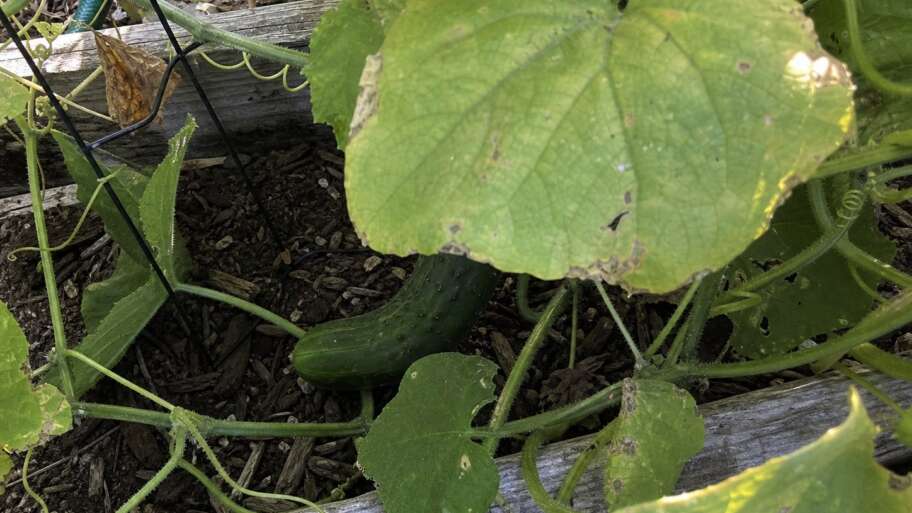

Powdery mildew often arrives looking almost harmless. A squash leaf that was green yesterday appears dusted with flour. A phlox stem has a pale bloom on its upper leaves. The cucumber patch still looks productive, the zinnias are still bright, and yet the garden has acquired a strange white weather of its own. The first instinct is usually to blame…
Christian Hägg
Christian writes about the hidden structures of the natural world: spirals, symmetries, adaptations, and the oddities that make plants fascinating. His interests include carnivorous plants, mathematical patterns in nature, and the science behind everyday garden life.
By June, a spinach leaf can begin to look as if something has been writing inside it. The surface is still mostly green, still cool from morning watering, but pale lines wander through the tissue in loose loops and narrow bends. They are too clean to be slug damage, too internal to be chewing, and too deliberate-looking to feel random.…
A June strawberry looks wonderfully straightforward until you look at it too closely. It is red. It is sweet. It fits between two fingers and leaves a little shine on the thumb. The plant itself sprawls low in the mulch, all trifoliate leaves, white flowers, green fruits, red fruits, and wandering runners that seem to be making private plans for…
Read more about Why strawberries wear their seeds on the outside
A spring shade bed can look as if it has learned to blush and cool at the same time. Lungwort opens with little pink bells, then the older flowers nearby settle into violet and blue. The spotted leaves are pretty enough on their own, but the flowers make the plant look like a small calendar. One cluster can hold yesterday,…
Read more about Why some flowers change color after pollination
April violets have a way of appearing in the parts of a garden where management loosens its grip. They collect under hedges, soften the edge of a path, settle into damp lawn, and rise between last year’s leaves before the taller perennials have fully remembered themselves. From a distance they read as color: small purple flags in the green. Up…
Most garden seeds are satisfied with ordinary invitations: water, air, a workable temperature, and enough contact with soil to feel that the season has turned. Beans swell. Lettuce stirs near the surface. A tomato seed, given warmth and moisture, behaves as if the world has made its intentions clear. Then there are seeds that seem to be waiting for a…
An April magnolia can look almost unreasonable. The grass is still thin, the perennials are barely showing, and the rest of the tree has not bothered with leaves. Then the branches open bowls of pink, cream, purple, or white into the cold air, as if the garden has skipped several pages and landed directly in bloom. That early display is…
A pea seedling looks simple when it first breaks the soil. Two pale halves of a seed have done their work below, a green shoot has hooked upward, and the first tendrils begin searching for something to hold. From above, it is all freshness and appetite. From below, if you lift the plant carefully a few weeks later, there may…
In an eastern North American woodland, a mild day in March or April can make the forest floor seem to wake before the trees have heard the news. The canopy is still a gray net overhead. Last year’s leaves are flattened and wet. Then, almost at ankle height, small flowers begin taking possession of the light: bloodroot opening like white…
Read more about The spring flowers that borrow light from bare trees
A fresh cut on a March branch can look unexpectedly dramatic. One minute you are doing the sensible work of late-winter pruning. The next, a maple twig or grape cane is shining with clear drops, and the cut seems to be weeping as if the plant has changed its mind about the whole operation. This is the sort of small…