

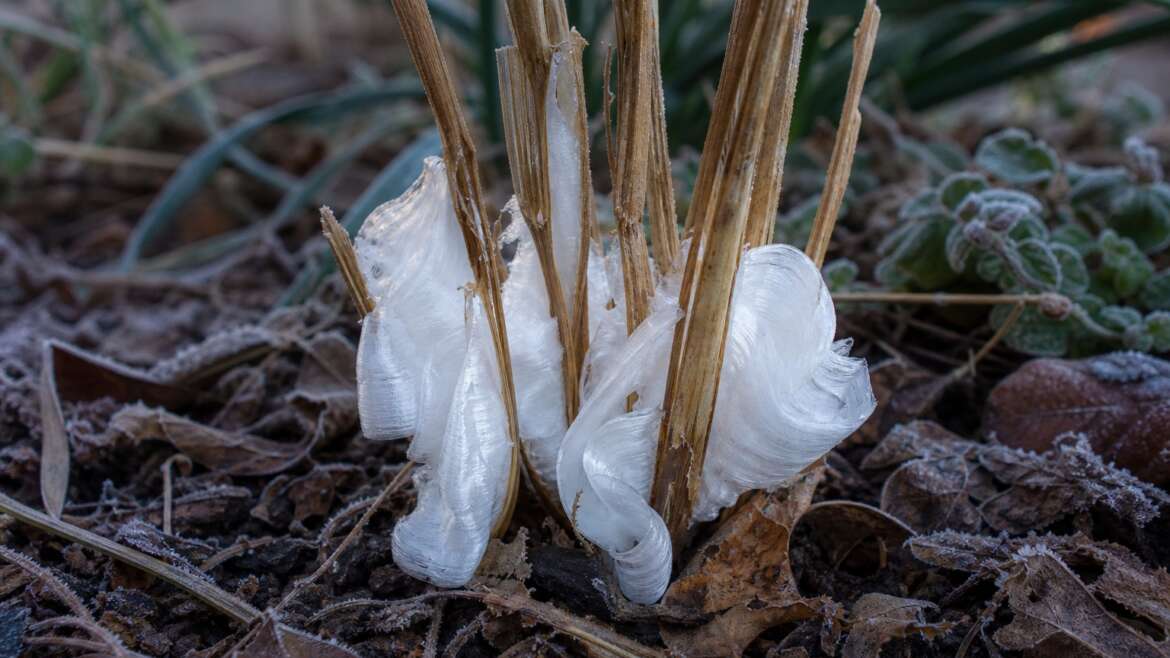
Most flowers announce themselves by becoming more colorful than the leaves around them. Frost flowers do the opposite. They appear when the flowering season seems finished, when the garden has gone brown and quiet, and when the cold has sharpened every stem into a small instrument.
On the right morning, the base of an old stalk can split and unfurl a white ribbon of ice as thin as tissue paper. It curls, folds, and gathers into something that looks floral, but it is not a flower at all. The Missouri Department of Conservation describes frost flowers as delicate ribbons of ice crystals that form on the lower stems of only a few plant species, usually after the first hard freezes while the ground is still warm enough to supply moisture.1
For a gardener, that makes frost flowers more than a pretty accident. They are a lesson in timing, plant anatomy, soil temperature, and the value of leaving some winter stems in place. A garden that can make frost flowers is not necessarily a tidier garden. It is a more observant one.
A Flower That Is Not a Flower
From a few steps away, frost flowers can resemble hoar frost, but they form differently. The National Weather Service defines hoar frost as interlocking ice crystals deposited directly from water vapor in the air onto objects below freezing.2 That surface process also helps explain why ordinary garden frost can appear after an above-freezing forecast. A garden frost flower instead grows from liquid water supplied through certain plant stems. The National Weather Service describes thin ice layers emerging through vertical slits and says the recipe includes freezing air, moist unfrozen soil, and a stem that has not already frozen through.3
The timing is narrow. The air must be cold enough to freeze water at the stem surface while the soil remains unfrozen enough to keep supplying it.3 When sunlight warms the ice, or the air climbs above freezing, the whole sculpture collapses into a few drops. By late morning, there may be no sign that anything unusual happened.
The process is often described as ice segregation. University of Illinois Extension explains that water moves through a porous medium, such as a plant stem, then freezes as it reaches the colder outside air. As more water arrives, it adds to the forming ice and pushes it outward. When the movement is limited to small cracks in the stem, the ice emerges as thin ribbons or sheets. Why only a small group of plants does this so readily is still uncertain.4
That is the science. The experience is simpler: one evening you walk past a dead-looking stalk, and the next morning it is wearing a collar of spun glass.
The Plant Behind the Ice
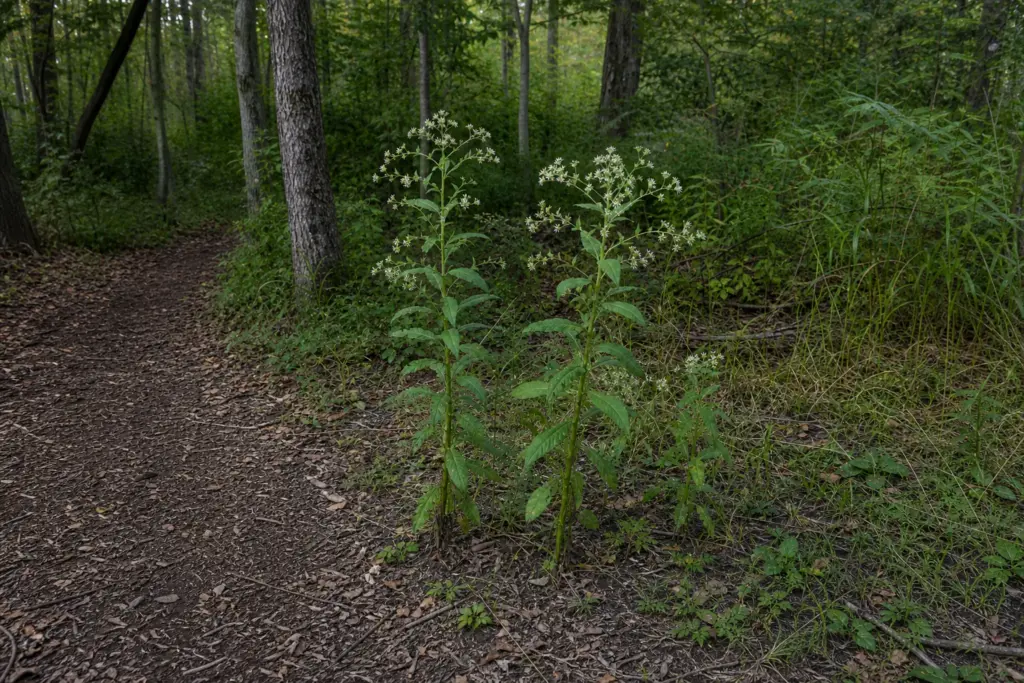
For gardeners in its native range, the plant to know for this phenomenon is white crownbeard, also called frostweed, Verbesina virginica. It is a tall perennial in the aster family, with narrow green wings running down the stems and loose clusters of white flowers in late summer and fall. Missouri’s field guide notes that it is called frostweed because of the strange ice formations that can appear at the stem bases after a sudden hard frost.5
Before winter gives it the dramatic name, frostweed earns its keep in the living garden. Its late bloom is useful at a time when many ornamental borders are fading. The same Missouri source describes white crownbeard as a rain-garden candidate where it can absorb runoff and support pollinators and other insects, which in turn feed birds.5
It is not, however, a polite little edging plant. Tennessee Smart Yards describes Verbesina virginica as a plant for part to full shade and naturalizing at the back of a garden, with wild habitat that includes moist forest edges, open woods, and streambanks. Its profile lists a height of roughly three to six feet and warns that it can spread rapidly by rhizomes and self-seeding; fall sowing and winter root division are propagation options.6
That tells you where to put it. Frostweed belongs at the back of a naturalistic border, along a lightly shaded fence, at the edge of a woodland planting, or in a generous rain-garden margin. In a tiny formal bed, it may feel pushy. In a wilder corner, it can become one of those plants that makes a garden feel connected to the larger landscape.
Designing for a Winter Sighting
You cannot schedule frost flowers the way you schedule tulips. You can only improve the odds. Start by confirming that white crownbeard is native and ecologically appropriate for your region, then use regional guidance for siting it. Give the colony room and match moisture and light to the site rather than assuming one universal recipe: Missouri records it in habitats from streambanks and bottomlands to upland forest, old fields, and roadsides, while the Tennessee profile recommends part to full shade and medium to moderately dry garden soil.56 Then resist the urge to cut everything down as soon as the flowers fade.
The useful weather sequence is moist, unfrozen soil followed by a sharp overnight freeze. Because the ice is brief, visit before breakfast on the first hard mornings and look low, right where the stalk meets leaf litter and soil.13 A wet autumn alone cannot guarantee a display; weather and the condition of each stem still have the final vote.
As a practical inference from that cold-air requirement, leave the stems you hope will perform uncovered. Frost cloth can protect nearby salad greens, young broad beans, or tender ornamentals, but a wrapped frostweed stem may not experience the freezing air needed to extrude ice. Uncovering it improves the setup; it does not promise a frost flower.
One small design trick is to plant frostweed where you already walk in the colder months. A side path to the compost, a gate near the mailbox, or the edge of a kitchen-garden path is better than a back corner you will not visit on a cold late-autumn or early-winter morning. The plant is tall enough to hold its own in summer, but the winter show happens at ankle height. Put it where your eye and your boots can find it.
A Better Way to Handle Old Stems
Frost flowers are also a good argument for changing how we think about winter cleanup. The old habit was to shear perennial beds flat in autumn, haul away the stems, and leave a smooth brown surface. A more selective fall garden cleanup can retain seed heads, shelter, and useful stem structure while still removing diseased material and keeping paths safe.
NC State Extension sampled nearly 3,000 stems across 20 gardens. It found no nests in intact, current-season stems during their first winter and advises cutting suitable first-winter stems to 12 to 24 inches, which opens hollow or pithy material that some solitary bee species may use later.7 The study did not test frostweed specifically, so this is general dead-stem habitat guidance, not evidence that every frostweed stalk will be occupied.
With frostweed, let the stems stand through the first hard freezes. After the likely frost-flower window has passed, you can edit the patch instead of erasing it. Where current-season stems are hollow or pithy, cut some cleanly to 12 to 24 inches. Leave older or previously damaged stems alone if they might already be occupied, and keep older bases through the following growing season where they are not in the way.7 New spring growth will hide much of the stubble.
In a mixed border, apply that treatment only to sound stems known to be hollow or pithy. Remove diseased foliage, stems that smother smaller plants, and anything that flops into a path. The result is not neglect. It is selective editing informed by the plant, the site, and the season.
Growing Frostweed Well
Think of frostweed as a plant for generous, living edges. Regional guidance varies with habitat and provenance: Tennessee Smart Yards lists part to full shade and medium to moderately dry soil, while Missouri records it in both moist low ground and upland sites.56 Read the drainage, light, and competition in your own bed rather than treating one moisture formula as universal. If your garden is small, plant one clump and learn its manners before letting it seed freely.
Because the plant can spread, maintenance is mostly a matter of editing. Pull unwanted seedlings while they are small. Divide a colony while dormant if it has moved beyond its allotted space. If you want more plants, sow seed in fall or share dormant divisions with gardeners who have room for a tall native perennial.6 Avoid planting it near natural areas outside its documented range.
If you are gardening mainly for the winter spectacle, remember that a single plant may not give you frost flowers every year. Weather has the final vote. A small colony gives you more stems, more chances, and a more convincing late-season floral display. Even in years without ice ribbons, a regionally appropriate planting can still offer late flowers, shelter, and winter structure.56
Useful Frost-Flower Supplies
- Luster Leaf digital soil thermometer: compare its soil reading with a nearby air reading or forecast to see how freezing air can arrive while the upper soil remains unfrozen; it is also useful for seed-starting decisions.
- 10x lighted jeweler’s loupe: a small lens makes the ice layers, stem cracks, and crystal texture much easier to study before they melt.
- Fiskars 6-inch pruning scissors: useful for clean winter cuts when you are shaping old pithy stems for a neater pollinator-friendly patch.
- Floating row cover frost cloth: useful for protecting nearby greens or tender ornamentals during the same cold nights, while leaving frostweed stems exposed if you are hoping for ice flowers.
Final Thoughts
Frost flowers make a gardener better at seeing. They ask you to notice the stem after the bloom, the soil after the frost, and the quiet hinge between autumn and winter. They also reward a kind of gardening that leaves room for process. Not every useful thing in a garden looks useful at first glance.
Where white crownbeard is native and suited to the site, plant it for late flowers, winter structure, and the chance to watch a striking physical process. Then, on the first hard mornings after damp weather, go outside before the sun gets high. If the garden has made a frost flower, do not touch it. Kneel down, look closely, and let the ice finish its brief bloom.
References
- Missouri Department of Conservation: Frost Flowers
- National Weather Service Glossary: Hoar Frost
- National Weather Service: Frost Flowers
- University of Illinois Extension: Nature’s Current Event, Frost Flowers
- Missouri Department of Conservation: White Crownbeard
- Tennessee Smart Yards: Verbesina virginica
- NC State Extension: Garden Cleanup for Pollinators