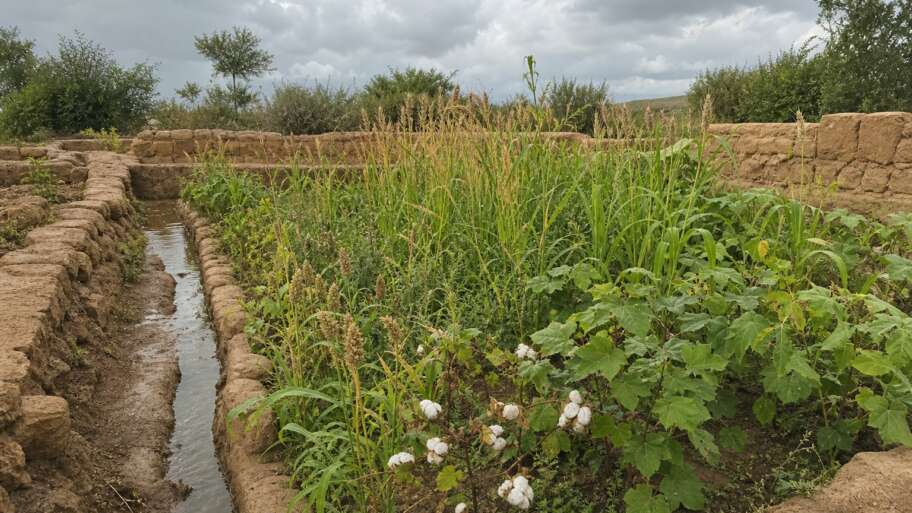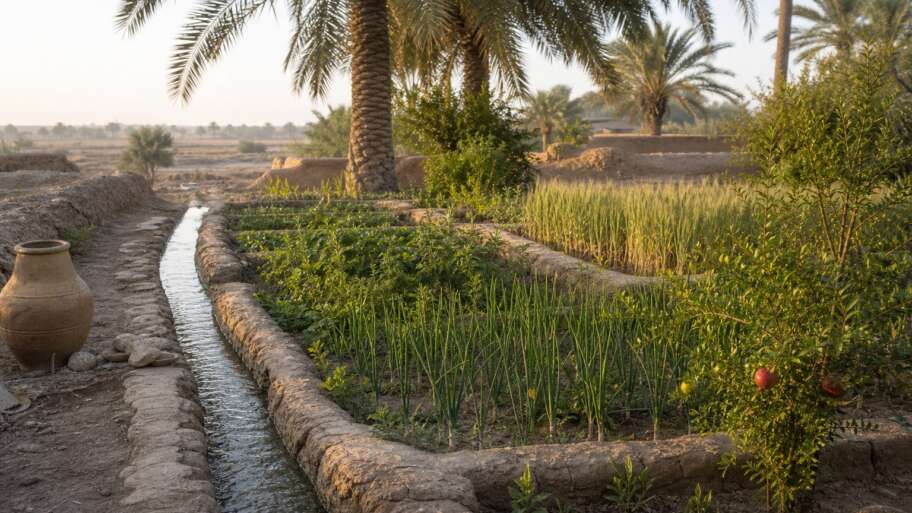

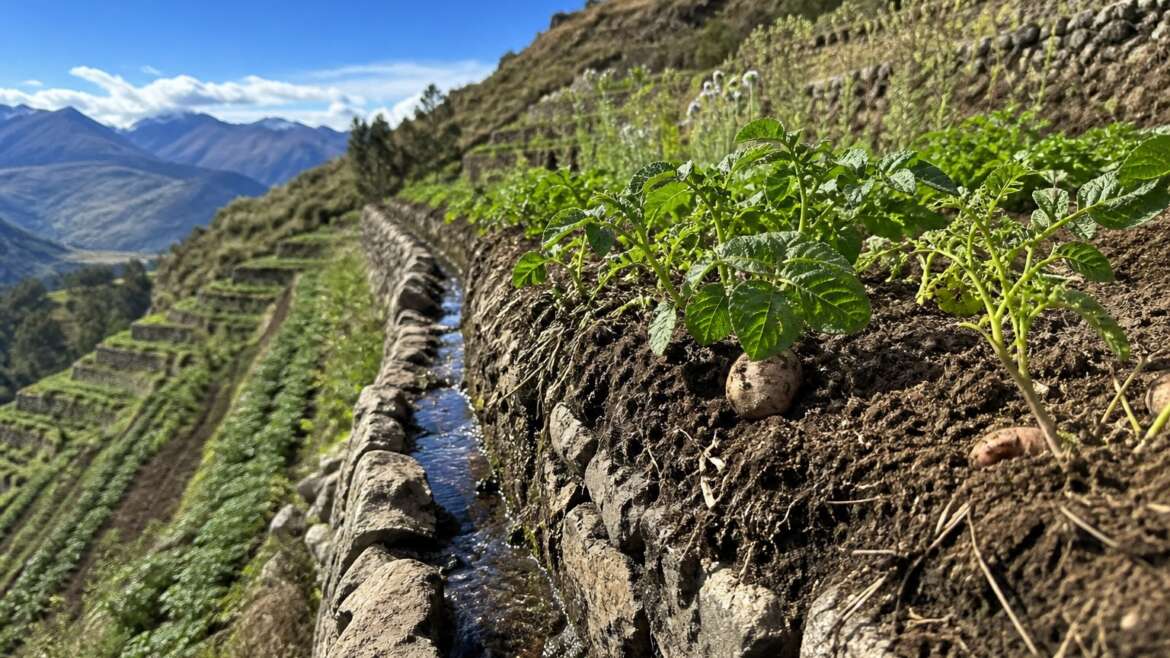
A terrace is sometimes described as a flat field cut into a hill. That is true in the same way a garden is a patch of dirt: technically correct, but not very helpful. A working terrace changes the route of water, breaks a long slope into shorter segments, deepens the usable soil, and gives people safer access. It can also alter exposure to sun, wind, and frost. None of those effects comes from a wall alone.
There is no single “Andean terrace.” Researchers distinguish level and sloping platforms, inclined and vertical retaining walls, irrigated and rain-fed forms, and even sloping fields shaped without a masonry riser. At Chicha Soras in south-central Peru, excavated terraces and irrigation works show intensive terraced agriculture in the Middle Horizon, centuries before Inka imperial rule.1 The useful question is therefore not who invented one perfect design, but how different communities made particular slopes workable.
A terrace is a water system, not a shelf
On bare sloping ground, runoff gathers speed and concentrates in hollows. A terrace interrupts that run. The platform shortens the uninterrupted slope; a wall or planted riser holds the change in level; and a channel, drain, or stable spill point gives surplus water a deliberate route. Some systems distribute irrigation along the contour, while others mainly slow rainfall. A terrace that admits water but cannot release excess safely is unfinished.
Level is not automatically better. A gently graded shelf may need to carry water toward an outlet, and a heavy clay fill behaves differently from a coarse, freely draining one. Water trapped behind an impermeable wall adds pressure; water pouring over one low spot can scour the face below. The soil, rainfall pattern, wall material, catchment above, and destination of overflow all belong in the design.
Field experiments on historical terraces in Peru’s Santa Eulalia basin found very low runoff on grass-covered, low-angle terraces and much more runoff on steep, bare surfaces. The same study recorded swelling and collapse in deteriorating walls on semi-abandoned terraces.2 Terracing can reduce erosion, but only as a maintained combination of landform, vegetation, and water management. Stonework is not a permanent substitute for observation.
The Inka inherited, expanded, and reorganized
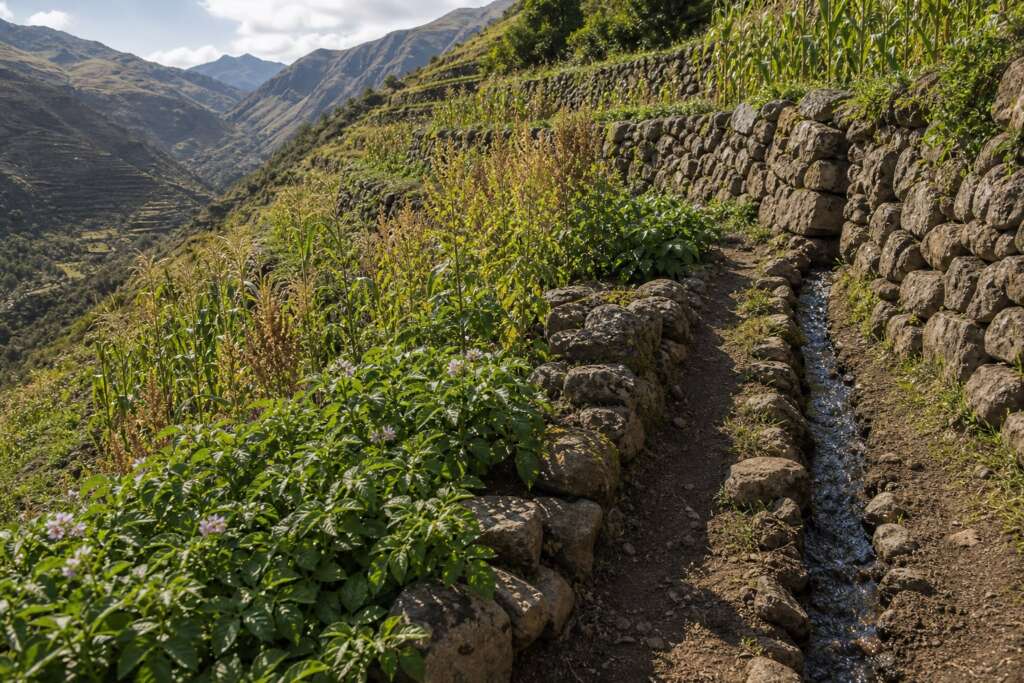
The Inka built spectacular terrace complexes, but Andean farming history did not begin with them. At Chicha Soras, the archaeological sequence includes earlier terracing, later expansion, and irrigation infrastructure modified over time. At Ollantaytambo, by contrast, hundreds of hectares of walled fields and extended canals formed a coordinated Inka estate landscape.3 Both cases warn against treating every stone stair on a mountain as the product of one period or authority. Our separate account of Inca terraces and the mountain as a garden looks more closely at that imperial chapter.
The infrastructure was social as well as physical. In Chicha Soras, archaeologists connect water sources and terraced systems with corporate lineage groups whose claims to land and water endured through profound political change.1 Canals had to be cleaned, irrigation turns coordinated, walls repaired, and rights recognized. A terrace visible today is evidence not only of a builder, but of repeated work.
Microclimates are real, but local
Terraces can change growing conditions without creating a miniature climate laboratory. At Ollantaytambo, researchers describe fields that retain solar energy, shed frost, regulate water flow, and level planting surfaces.3 A sunlit stone face may release warmth after sunset, while a sheltered shelf experiences less wind than an exposed slope. Cold air may also drain downslope rather than settle in the same way it would in a closed hollow.
These effects depend on aspect, elevation, wall height and color, soil moisture, night sky exposure, and local weather. A north-facing wall in Sweden and a sun-facing wall in the southern Andes do not receive light in the same way. The practical lesson is to measure and notice: compare spring thaw, first frost, wind damage, and soil moisture from one shelf to the next before assigning crops.
Farming a vertical landscape
Andean agriculture works across altitude as well as across a single hillside. FAO’s agricultural heritage profile for southern Peru describes a mosaic of terraces, raised fields, irrigation, crop rotations, livestock, and locally selected crops distributed through different elevation zones.4 Its altitude bands are a description of that particular heritage area, not a universal planting chart for the entire Andes.
Crop diversity is part of the resilience. The International Potato Center reports more than 4,000 native potato varieties in the highlands of Peru, Bolivia, and Ecuador, with varieties differing among communities.5 Potatoes share the broader Andean pantry with quinoa, maize, oca, olluco, mashua, and other crops, each carrying its own tolerances and uses. Our guide to potatoes, quinoa, and the Andean pantry follows those crops rather than reducing them to a list of “superfoods.” Diversity spreads exposure to weather and pests; it does not make harvests immune to them.
Maintenance is part of the design
At Ollantaytambo, routine canal and terrace maintenance required coordination beyond a single plot. When land use and labor organization changed under Spanish rule, parts of that agricultural system gradually deintensified; the infrastructure did not simply become “lost technology.”3 The history matters because it corrects a common fantasy: durable landscapes are not self-sustaining. Their survival depends on people having the time, knowledge, authority, and reason to care for them.
The same is true at garden scale. Silt reduces a channel’s capacity. Roots can dislodge loose masonry. Burrowing animals open new flow paths. A blocked outlet sends water over the wrong edge, and one failed riser can load the terrace below. Inspection after intense rain is not optional housekeeping; it is how the design continues.
Translate the principles to a garden slope
A home garden does not need archaeological-looking stonework to learn from Andean terraces. Start with the movement of water and the work of reaching plants. Iowa State University Extension recommends assessing slope, soil, drainage, existing vegetation, and inflows before choosing erosion controls; it also emphasizes contour planting and soil cover.6
- Walk the site during steady rain. Mark runoff from roofs, paths, driveways, and neighboring ground, plus every safe outlet.
- Try the smallest useful intervention first: a contour path, planted shelf, low edge, or several short steps may solve access and erosion without a high retaining wall.
- Keep soil covered with site-suited perennials, shrubs, grasses, or groundcovers. Roots and foliage support the earthwork; annual vegetables alone leave vulnerable periods.
- Give overflow a stable destination that does not damage a building, boundary, path, stream, or lower garden. Never assume water will politely disappear behind a wall.
- Treat tall walls, steep sites, and slopes near structures as engineering work. Retaining walls have specific stability and drainage requirements, and local codes may apply.7
The enduring Andean lesson is not a decorative style. It is a way of reading a slope as connected flows of water, soil, heat, crops, paths, and labor. A successful terrace does not defeat gravity. It makes gravity slower, more legible, and easier to work with—then earns that success again through maintenance.
References
- Meddens, F. et al. Where the Water Flows: Continuities in Water Management and Ancestor-Based Lineages in the Chicha Soras Valley, Peru. Latin American Antiquity, 2026.
- Inbar, M. & Llerena, C. A. Erosion Processes in High Mountain Agricultural Terraces in Peru. Mountain Research and Development 20(1), 2000.
- Hunter, R. A. The structural transformation of Ollantaytambo’s Inka ecology under Spanish rule. Antiquity, 2024.
- Andean Agriculture, Peru. FAO Globally Important Agricultural Heritage Systems.
- Native Potato Varieties. International Potato Center.
- Steil, A. Gardening on Slopes and Hillsides. Iowa State University Extension and Outreach, reviewed 2026.
- Water-Wise Landscape Design: Steps. Colorado State University Extension.