
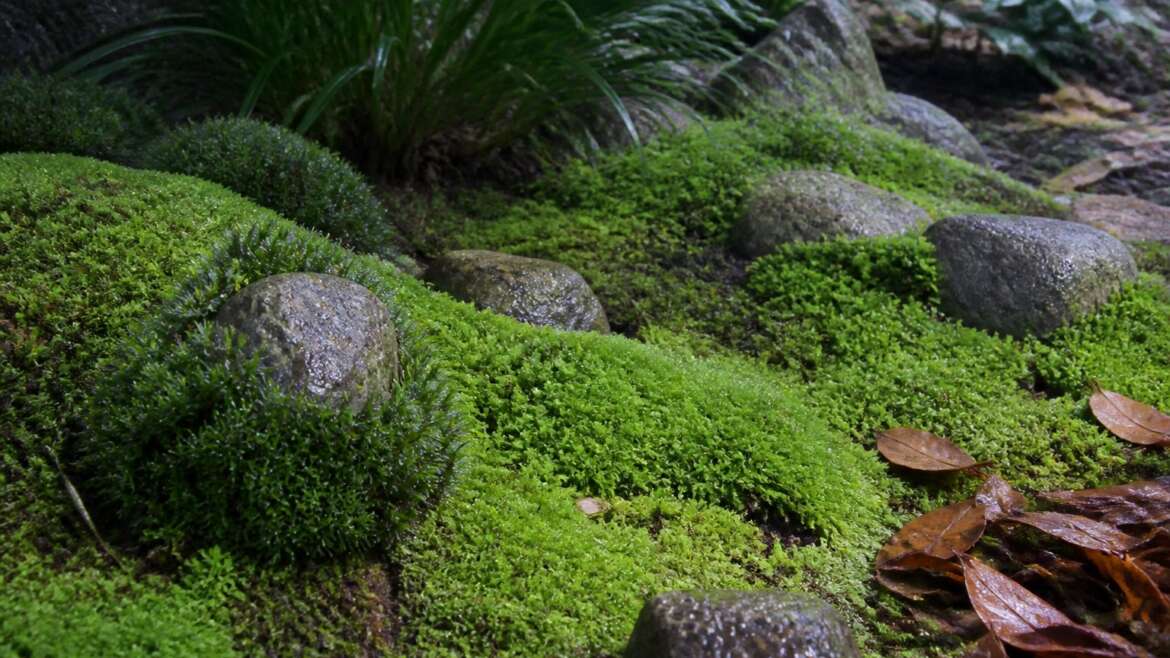
A moss garden looks quiet, but it is not asking to be ignored. It asks for a different kind of attention than a lawn or perennial border. The work is less about mowing, feeding, and deadheading, and more about moisture, debris, light, surface contact, and patience.
Mosses are bryophytes, nonvascular plants without true roots. Instead, rhizoids anchor them to soil, bark, stone, or wood, while water and dissolved nutrients are taken up across their surfaces.1 That biology explains most moss care. You are not tending a deep root system. You are tending the thin, changing boundary between a small plant and its substrate.
Read the surface before you water
Start by watching what happens during ordinary weather. Does rain soak in, bead on a hard surface, or carry silt across the moss? Which edge dries first? Is water dripping from a roof or concentrating at the foot of a slope? Two colonies only a metre apart can experience different conditions because one sits on porous soil and the other on a warm stone.
Newly placed fragments or patches need close, even contact with the substrate; curled edges dry faster and are easier for birds or runoff to disturb. Press them into a prepared surface rather than burying them, then begin with a small trial. Our guide to choosing and preparing a moss-growing surface explains why the moss already thriving on a site is often the most useful clue.
Hydration is a pulse, not permanent saturation
Most bryophytes obtain water through direct contact with their surroundings. Many can also dry substantially and resume normal function when moisture returns.2 That is a survival strategy, not a promise that every species will tolerate the same drought or look fresh through it. A dry colony may become dull, brownish, or tightly curled without being dead.
During establishment, water gently enough to wet the moss and the surface beneath it without lifting pieces or washing soil over them. A fine rose on a watering can or a soft hose setting is easier to control than a hard jet. Established moss should follow the character of its site: a naturally damp hollow needs less intervention than a shallow stone pocket. Constantly saturated soil is not the goal, particularly where poor drainage also threatens nearby woody plants or paths.
Keep the surface clear without sterilising it
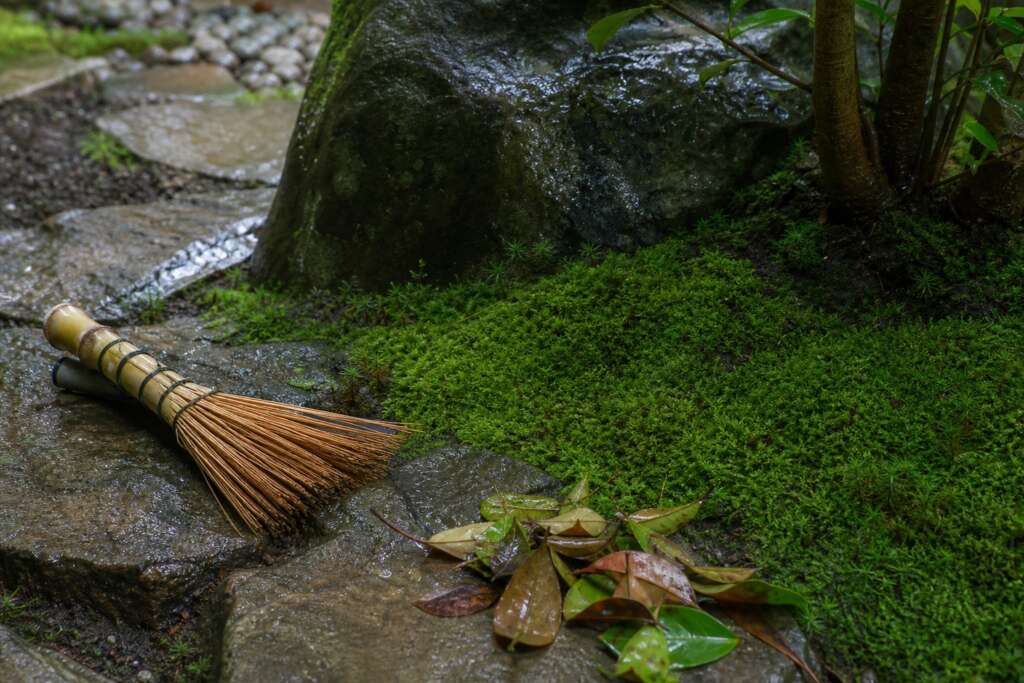
A few leaves look at home among moss. A wet, matted layer is different: it excludes light, presses down the shoots, and can conceal weeds until their roots are well established. Clear little and often during heavy leaf fall. Fingers, a soft hand broom, or a blower on its lowest useful setting can work, but stop if the colony lifts or grit starts to move.
The leaves do not have to become waste. Shift sound foliage to a shrub bed, use it in compost, or make leaf mould, while keeping slippery paths and drains clear. Fallen leaves can protect and feed other parts of the garden; the practical question is where each leaf can do useful work rather than where it happened to land.
Keep footsteps and runoff from rewriting the colony
Moss can survive conditions that defeat many taller plants, yet the living mat is easily torn by shoes, knees, pets, and repeated tool traffic. The National Park Service advises avoiding footsteps on moss and using durable surfaces instead.3 In a garden, a stepping stone placed where people already pause is more effective than repeatedly repairing the same flattened patch.
Water can be equally disruptive when it arrives with force. Look after storms for pale sediment, tiny channels, exposed patch edges, or splash from a downpipe. Redirect concentrated runoff before replacing moss, and keep loose soil upslope covered. The aim is not to make the site motionless; it is to prevent a small, regular disturbance from undoing weeks of attachment.
Light is species specific
“Moss likes shade” is useful only as a starting point. Mosses occupy very different habitats. In Canyonlands National Park, for example, they occur on exposed rock, in biological soil crusts, in riparian places, and sometimes on trees, with many colonies concentrated in cooler, shaded microsites.4 The species in a damp woodland garden is not automatically suited to a sunny wall, even if both are called moss.
Observe a colony across seasons before changing the canopy. Winter sun may reach a bed that is shaded once leaves open; pruning can turn dappled light into several hot afternoon hours. If browning follows a light change, supply temporary shade while you assess the site rather than compensating with endless water. More irrigation cannot always correct the wrong exposure.
Do not treat moss as a soil test
The presence of moss does not prove that soil is acidic, infertile, or badly drained. In turf, moss is associated with several conditions—including shade, compaction, excess moisture, low fertility, and acidity—that may occur alone or together.5 It often occupies space where grass is already uncompetitive; it does not diagnose the cause by itself.
Do not add lime, sulphur, or fertiliser to a moss bed on the strength of appearance alone. Test soil when a decision about pH or nutrients matters to neighbouring plants. Likewise, a lawn herbicide programme is not a care programme for wanted moss. Hand-remove an occasional seedling while it is small and the surface is moist, holding the moss down beside the stem so the colony does not peel up with the root.
Use a five-minute care circuit
Regular observation prevents most moss work from becoming heavy work. After rain, check for silt and pooling. During a dry spell, compare exposed edges with sheltered pockets before deciding whether to water. In leaf season, clear mats before they compress. After pruning, note the new light pattern. Watch the routes taken by feet and paws. These clues separate a temporary change—such as a dry, dormant-looking colony—from a recurring site problem.
A good moss garden feels ancient because it refuses hurry. It rewards the gardener who can clear gently, water according to the site, avoid unnecessary inputs, and let small green colonies knit themselves into place. It is a garden at the scale of attention.
References
- National Park Service: Mosses and Liverworts, Katahdin Woods and Waters National Monument
- U.S. Geological Survey: Bryophytes and lichens—small but indispensable forest dwellers
- National Park Service: Moss, Acadia National Park
- National Park Service: Mosses and Liverworts, Canyonlands National Park
- NC State Extension: Moss Control in Turf