
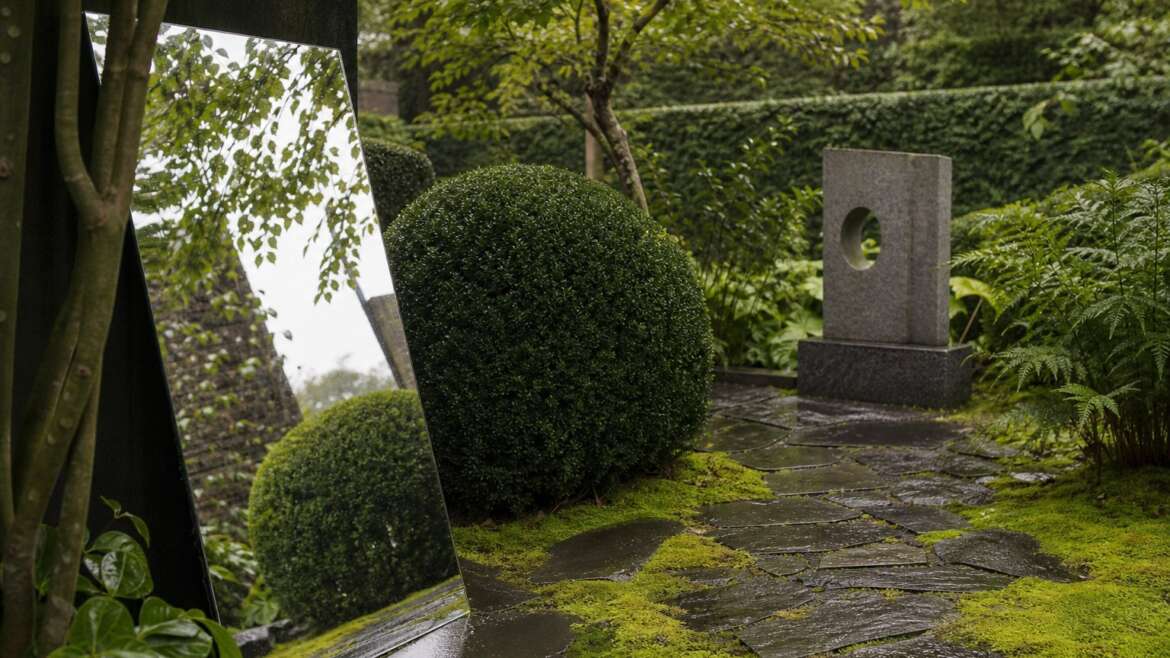
A surrealist garden is easy to imagine and harder to maintain. Mirrors, odd thresholds, tilted objects, clipped forms, unexpected scale, and dreamlike plantings can make a small space feel charged with possibility. Then leaves fall into the reflective pool, a vine eats the sculpture, and the mossy path becomes slick enough to argue with your ankles.
Surrealism itself was never just random weirdness. Tate describes it as a twentieth-century literary, philosophical, and artistic movement that explored the mind and championed the irrational, the poetic, and the revolutionary.1 Its dream logic can inspire a garden, but it does not supply a horticultural formula. The strange elements still need composition, context, and care. The site’s history of dream gardens offers useful background on how that idea moved outdoors.
Write down the rule behind each illusion
Begin with the intention, not the object. Is the mirror meant to borrow a distant tree, make a boundary vanish, or interrupt a familiar path? Does a red doorway frame one view, or simply add color? A short note and a photograph from the intended viewing point give future pruning and repairs a standard. Without that record, one gardener may preserve growth that another removes.
Make a second, less romantic record of how the effect is built: material, finish, supports, fasteners, drainage gaps, cable routes, and the plant names around it. Include the maker’s care instructions where they exist. This is especially useful when an apparently weightless panel depends on a hidden bracket or when a sculpture has a painted surface that should not meet a general-purpose cleaner.
If the garden is still being developed, the guide to building a surrealist garden without losing the plants starts with routes, drainage, and durable construction. Maintenance is easier when inspection access was designed in rather than improvised later.
Maintain the ordinary systems first
The more unusual the garden, the more important the basics become. Clemson Cooperative Extension notes that no landscape is maintenance-free; site analysis, suitable plant selection, and timely work can reduce avoidable labor.2 Surrealism does not exempt a garden from physics. A mysterious threshold still needs secure footing, and a concealed edge must not become a concealed trip hazard.
Walk the garden after rain. Check where water crosses paving, collects at the base of an object, splashes soil onto reflective surfaces, or keeps timber and metal wet. Clear drains and channels without sending sediment into them. Remove algae or loose debris from walking surfaces using a treatment appropriate to the material. If paving rocks, a mount moves, or electricity is involved, bring in the relevant tradesperson rather than disguising the defect with planting.
Edit growth without sterilizing it
A surrealist garden can use plants in uncanny ways: a loose grass beside a rigid frame, a weeping tree over a straight path, or an oversized leaf near a tiny chair. The contrast lasts only when the plants suit the place. UF/IFAS recommends matching plants to soil, light, water, climate, and mature size; after establishment, a good match can need less corrective pruning, irrigation, fertilizer, and pesticide.3
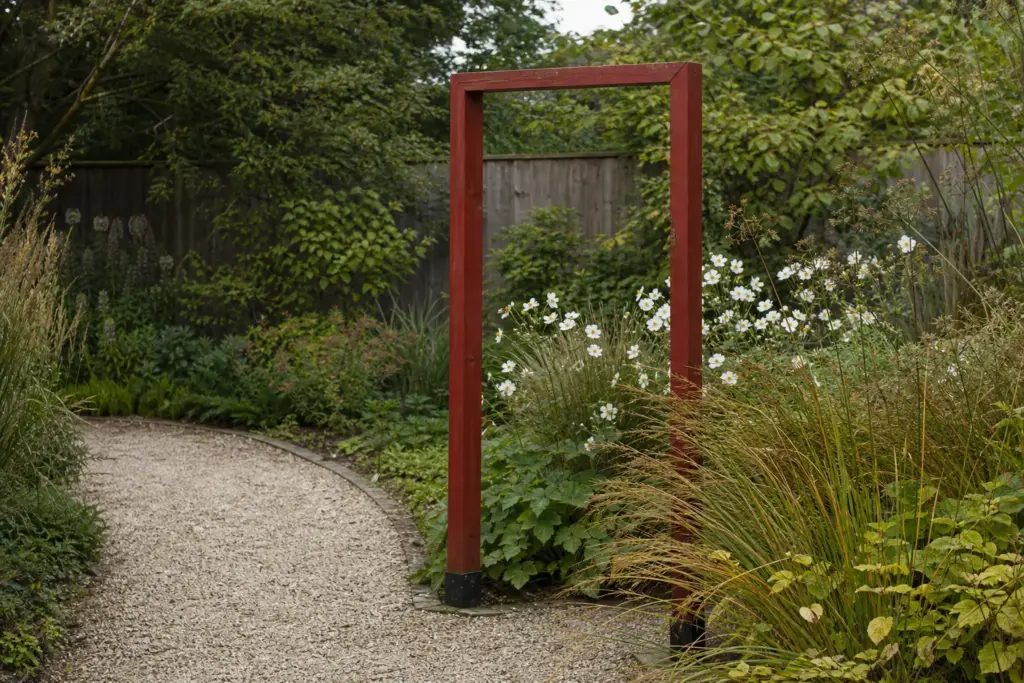
Prune to protect the relationship, not merely to make everything neat. Keep the opening through a frame legible, lift a branch that erases a deliberate sight line, and cut a climber back before it reaches joints or wiring. Elsewhere, allow seed heads, fallen leaves, or asymmetry to remain when they are part of the composition. The useful question is whether growth strengthens the intended tension or makes the construction unreadable.
Watch mature size as well as seasonal enthusiasm. A young shrub that frames a sculpture may hide it in three years, while repeated hard pruning may leave both plant and idea looking strained. Moving the plant or changing the composition can be more honest than forcing an unsuitable species to stay miniature.
Audit mirrors for birds as well as smudges
A clean mirror may sharpen the illusion, but it can also sharpen a reflection of sky and foliage. American Bird Conservancy’s guidance addresses windows rather than garden ornaments, yet the mechanism is relevant: birds can fly toward reflective glass when it appears to show open habitat.4 Treat any garden mirror that reflects a flight path, feeder area, dense cover, or open sky as something to assess, not as harmless decoration.
Look for collision marks or stunned birds and observe the reflection from several approaches. If the placement is risky, relocate or remove the mirror, or use an exterior bird-collision treatment designed to cover the reflective field. A few isolated decals are not a credible substitute for a tested pattern. The illusion is optional; preventing a recurring hazard is not.
Treat each object as a material, not a prop
Outdoor art is exposed to water, ultraviolet light, dirt, plant contact, temperature swings, and handling. The Getty Conservation Institute’s work on outdoor painted sculpture describes coating failures and rapid deterioration in uncontrolled environments, along with the need for specialized treatment strategies.5 Inspect painted metal for lifting or chalking coatings, timber for trapped moisture, masonry for movement, and fixings for corrosion. Do not sand, repaint, pressure-wash, or apply a sealant until the material and finish are understood.
Routine care can be gentle: remove leaf litter, keep plants from holding moisture against surfaces, and use the maker’s specified cleaning method. Photograph changes in the same light each season. If an artwork is valuable, complex, or already failing, ask its maker or a conservator for a treatment plan instead of trying to return every surface to an imagined brand-new state.
Light the route and leave the rest dark
Lighting deserves restraint for practical as well as theatrical reasons. National Park Service guidance recommends lighting only where and when it is needed, using recessed or fully shielded fixtures, controls, and warm-colored sources.6 In a garden, start with steps, level changes, gates, and working routes. Aim light down onto the task rather than across the planting, and use the lowest level that makes the route usable.
Then view the composition from its intended positions. One restrained pool of light can make a doorway or pale trunk uncanny while leaving depth beyond it. Floodlighting every object flattens that effect, produces glare, and erases the darkness on which the scene depends. Re-aim fixtures as plants grow so leaves do not redirect light into eyes or neighboring space.
Use the seasons as an editing schedule
Make a slow circuit at least once in each distinct season and after severe weather. In spring, check mounts, frost movement, new shoots, and blocked drainage. In the growing season, compare sight lines with the reference photographs. In autumn, decide which fallen material belongs to the mood and which makes surfaces unsafe. Before winter, follow the maker’s instructions for water-sensitive objects and confirm that cables, fixtures, and supports remain sound.
Not every change is deterioration. Moss may soften one edge beautifully; a self-sown plant may create a better interruption than the original planting; weathering may make an object belong. Keep the changes that strengthen the rule and correct those that obscure it. That is editing, not freezing the garden in its opening-day pose.
A surrealist garden is not maintained by preserving every original gesture. It is maintained by protecting the tension between living growth and deliberate impossibility. The dream should change, but it should not decay into accident. That is the gardener’s quiet role: curator, editor, and occasionally the person who scrubs the algae off the impossible path.
References
- Tate: Surrealism
- Clemson Cooperative Extension: Low-Maintenance Landscape Ideas
- University of Florida IFAS: Right Plant, Right Place
- American Bird Conservancy: Preventing Bird Collisions at Home
- Getty Conservation Institute: Surface Treatment Strategies for Outdoor Painted Sculpture
- National Park Service: Outdoor Lighting Principles