

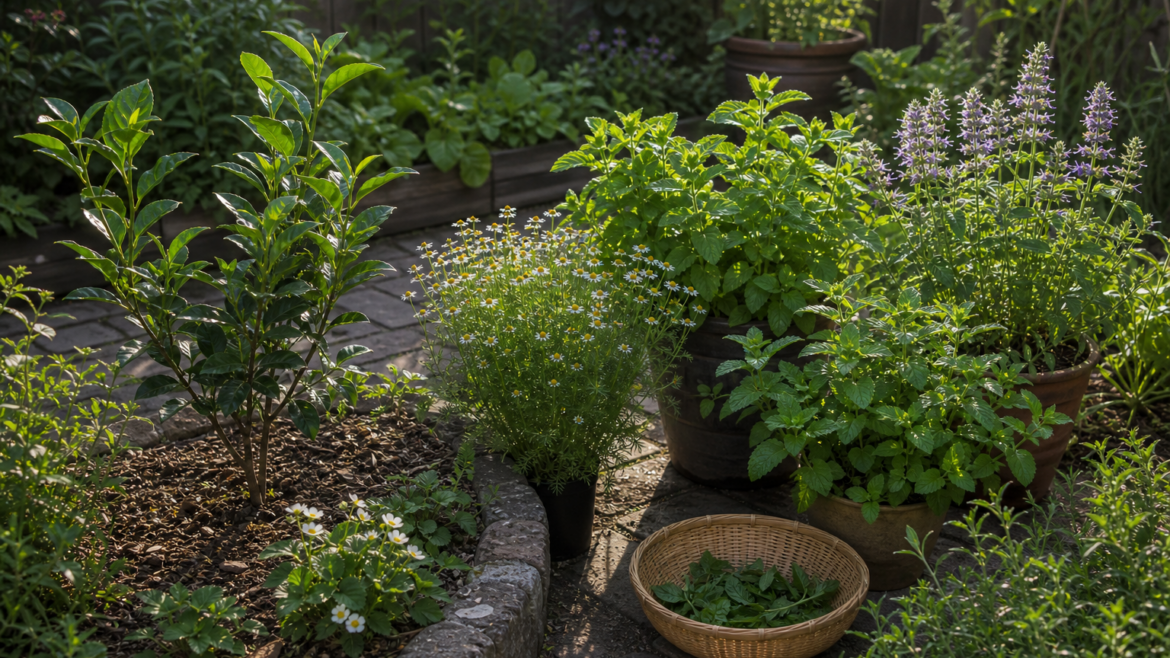
Dante’s seventh circle is not a place any gardener should romanticize too literally. In the Inferno, it is a landscape of violence, thorn, burning sand, and moral terror. As a design prompt, handled carefully, it offers a narrower lesson: harsh beauty is not the same thing as neglect, and atmosphere does not require living plants to suffer.
The seventh circle unfolds through three rings. The first is a river of boiling blood; the second is a pathless wood of gnarled trees; the third is a barren sand plain under falling fire. The University of Texas Danteworlds project traces those settings through Cantos XII–XVII.1 A garden should not reproduce their punishments. It can translate the poem’s movement from enclosure to exposure, its abrupt thresholds, and its severe palette.
Read the landscape before borrowing its mood
Canto XIII supplies the strongest garden image: a rough wood without a marked path, with dusky foliage, knotted branches, and thorns instead of fruit. Dante hears voices before understanding that the trees hold human souls. In Canto XIV, the wood ends at a plantless plain of dry sand where flakes of fire descend.2 The contrast is spatial as much as visual—confined shade gives way to exposed ground.
That source matters because a few “gothic” objects cannot carry the idea. Plastic skulls, imitation flames, and red mulch flatten a complicated poem into party scenery. More importantly, Dante’s treatment of people who died by suicide belongs to a medieval punitive vision; it is not a model for modern moral judgment. The responsible design move is to borrow sequence, texture, light, and unease without reenacting suffering.
Let the route do the storytelling
Begin with an ordinary site inventory. Mark sun and shade by season, soil, drainage, reflected heat, prevailing wind, existing vegetation, utilities, sightlines, and the way people already cross the space. University of Florida landscape guidance puts that analysis before theme or plant selection because the same conditions shape plant health and human use.3 A literary garden is still responsible for clear circulation and suitable plants.
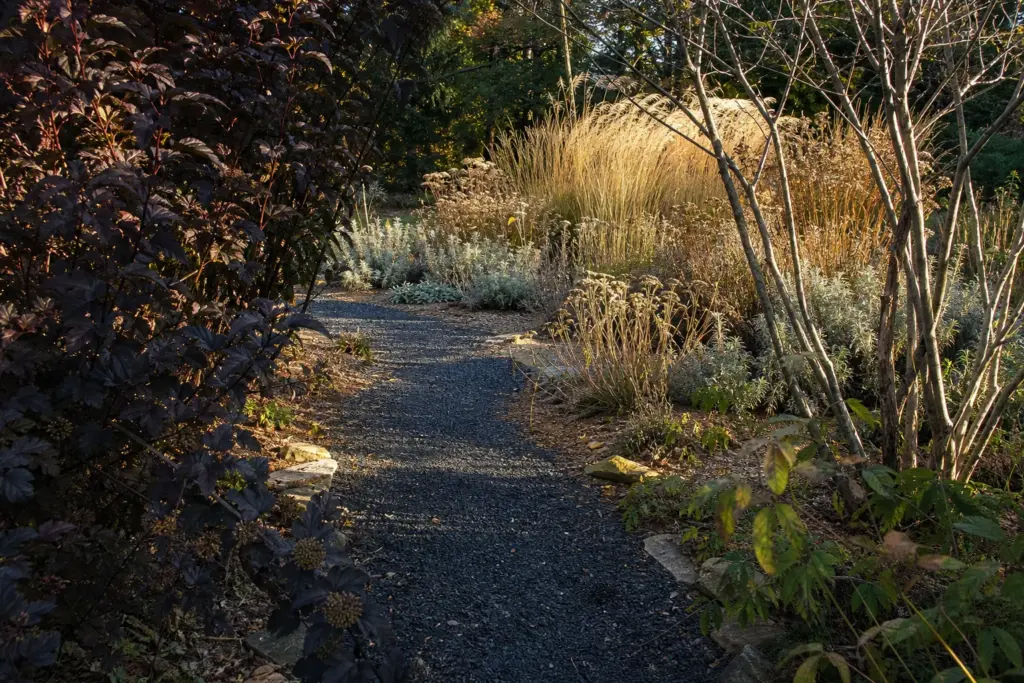
Then sketch two linked outdoor rooms. The first might feel enclosed through layered shrubs, overhead branches, and deep green or burgundy foliage. A bend can briefly conceal the next space. Beyond it, widen the view into a brighter bed of grasses, pale seedheads, silver foliage, and mineral ground. Our companion piece on diagnosing difficult garden sites explains why real shade and reflected heat need different solutions even when a story places them side by side.
Keep the path legible, stable, and wide enough for its users. Mystery can come from a partial view, not from a trip hazard or a branch at eye level. Repeating one paving material through both rooms makes the sequence coherent, while a change in path width or surrounding plant height announces the threshold.
Build the dark wood from healthy structure
The “wood” does not need tortured plants. Choose species that genuinely suit the available shade, moisture, winter cold, and mature space, then look for expressive traits: irregular but sound branching, dark stems, matte leaves, arching evergreen form, or seedheads that hold their outline. Do not force a sun-loving shrub into gloom or prune a healthy tree into a wound merely to make it look ancient.
Form and texture will work longer than flower color. UF/IFAS notes that form is a plant’s most enduring visual quality and texture is the next dominant one; layering and repetition give a planting unity.3 Repeat two or three silhouettes and let one coarse or twisted form act as emphasis. A mass of unrelated dark plants becomes visual noise. For a broader palette of near-black foliage, pale flowers, bark, and winter structure, see Gothic gardens without the gimmick.
Borrow the sand, not the fire
The open room should be based on the site’s real heat and water, not a generic “desert” recipe. In a dry climate it might use locally adapted grasses, subshrubs, and perennials grouped by water need. Somewhere cooler or wetter, the same sense of exposure can come from tawny foliage, pale stone, and widely spaced plants that tolerate the actual drainage. Drought-tolerant is not the same as native, and neither label excuses poor siting.
Mineral mulch can sharpen the dry effect, but gravel is not neutral. New Mexico State University Extension notes that rock mulch becomes hot and can limit or injure some plants, whereas organic mulch reflects less heat and retains more moisture.4 Match mulch to the plants and climate, keep it permeable, and avoid turning the whole garden into a reflective stone sheet.
Plan establishment water before planting. Even xeric plants need irrigation while roots develop, and some will need supplemental water later according to species, soil, weather, and design.4 A garden about resilience should show plants succeeding under appropriate care, not being starved for the theme.
Use thorn as a boundary, not a surprise
A thorny silhouette can be powerful, but placement is a safety decision. Keep spines, thorns, and irritating sap well away from walkways, play areas, gates, and maintenance access. University of California Cooperative Extension advises knowing the scientific names of potentially harmful plants, using protective clothing for maintenance, and setting injurious plants where they can be seen without being touched.5
Check local invasive-plant guidance before buying a vigorous hedge, and consider children, pets, visitors, and whoever will prune it. Thorn is optional: fine black twigs, rigid seedheads, serrated shadows, or a dense hedge behind a low wall can give the same visual tension. No poisonous or injurious plant earns a place solely because its common name sounds infernal.
Make the atmosphere survive the seasons
Test the composition without flowers. In winter, does the route still move between enclosure and openness? Are there trunks, evergreen masses, grasses, berries, or dry stems to hold the design? In summer, will the open bed still have enough living cover to shade some of its mineral surface? A severe garden becomes more convincing when its character comes from structure rather than one week of dark bloom.
Maintenance should preserve health and intention. Remove hazards from paths, inspect irrigation, weed open gravel before seedlings root deeply, and prune for sound structure rather than grotesque shape. Leave useful seedheads only where they will not collapse across circulation. As plants mature, thin or move them before the carefully planned threshold disappears into one crowded thicket.
The paradox is the point: a garden inspired by a harsh poem should still be a place where living things thrive. Shadow, thorn, dry light, and rough texture can make a memorable sequence, but resilience is not a costume. It is the visible result of matching each plant to its place and caring for it well enough to carry the story.
References
- University of Texas at Austin Danteworlds: “Circle 7, Cantos 12–17”
- Dante Alighieri, The Divine Comedy: Hell, translated by Charles Eliot Norton, Cantos XIII–XIV (Project Gutenberg)
- University of Florida IFAS Extension: “Landscape Design: Ten Important Things to Consider”
- New Mexico State University Cooperative Extension: “Landscape Water Conservation: Principles of Xeriscape”
- University of California Agriculture and Natural Resources: “Plant Safely in Drought-Tolerant Landscapes—Safety Guide”