

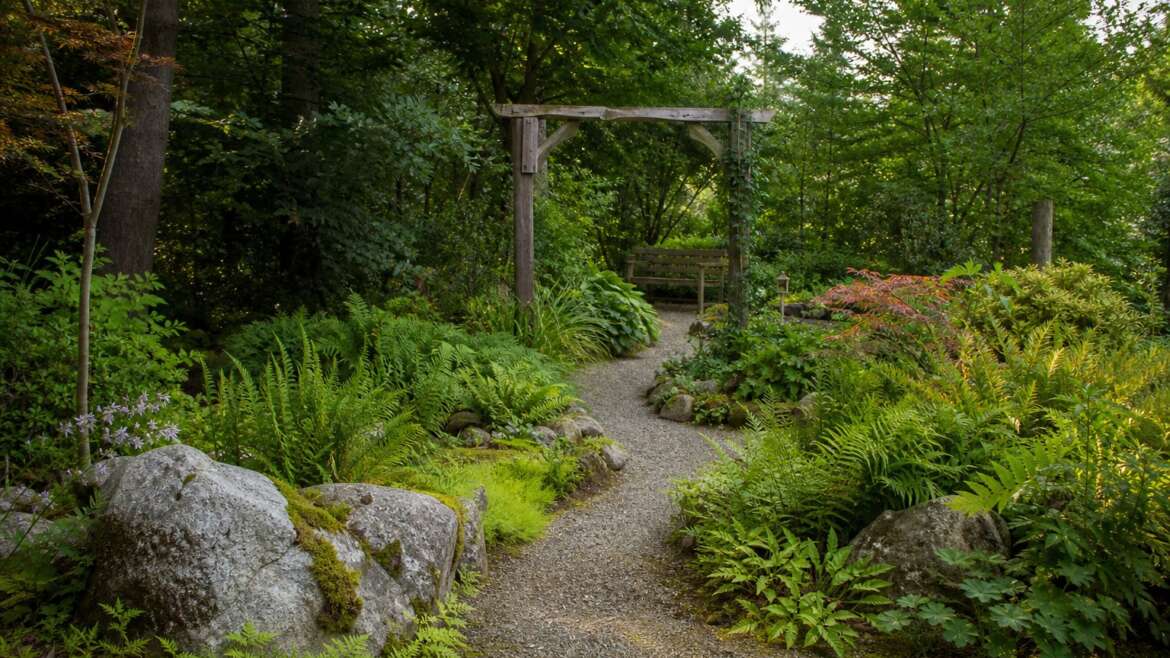
A game-inspired garden does not need plastic props, branded signs, or a bed shaped like a controller. The better version borrows what good games do with landscapes: they lead you forward, hold back a little information, reward attention, and make each area feel distinct without breaking the world. In a real garden, that means paths, thresholds, planting layers, texture, scent, shade, maintenance access, and plants that can actually live where you put them.
Think of the garden as a small playable landscape. There is an entrance, a route, a pause point, a reason to turn your head, and a reason to return in another season. The theme should be felt in the movement and atmosphere before anyone notices the references.
Start With The Route
The first design question is not which plants look most magical. It is where a person walks. UF/IFAS describes landscape line as a visual guide created by features such as bed edges, hardscape, fences, walls, and plant forms; spaces can also be connected by pathways, focal points, and repeated elements.1 That is exactly the design language a game-inspired garden needs.
A straight path says destination. A bending path says discovery. A narrow place between shrubs says threshold. A pale bench seen through leaves says there is something worth reaching. You can use these signals without making the garden theatrical. One curve, one visible resting place, and one partially hidden view can do more than a dozen novelty objects.
Keep the route useful. The main path should drain, tolerate foot traffic, and allow the work that keeps the garden alive: carrying compost, moving a hose, pruning shrubs, and kneeling at the bed edge. If the fantasy path is too narrow, muddy, or awkward, the gardener will eventually create a more convenient path by trampling one.
Build Levels From Real Site Conditions
Game landscapes often move through zones: woodland, ruin, meadow, marsh, desert edge. A garden can do that too, but the zones have to begin with the site. Map the sunny, dry, windy, shady, damp, compacted, and sheltered places before choosing a mood. A shady corner can become a ferny woodland passage. A hot strip beside paving might become a gravel garden with drought-tolerant herbs, sedums, yucca, or upright grasses. A damp low point may be better as a rain-garden moment than as a forced desert scene.
This is where the fantasy becomes more convincing, not less. UF/IFAS defines right plant, right place as choosing plants adapted to the location and situation, including environmental needs, function, and aesthetics.2 A fern that stays lush in shade will feel more enchanted than a sun-loving plant slowly failing under a tree. A silver-leaved herb thriving in gravel will feel more intentional than a thirsty woodland plant cooking beside a wall.
If you want the broader mood-board version of this idea, the companion article on how fantasy games can inspire a real garden is useful because it treats the game as atmosphere rather than a shopping list. For this design, the practical test is simple: can the plants, path, and materials still make sense after the first rain, heat wave, or round of weeding?
Use Thresholds, Reveals, And Pauses
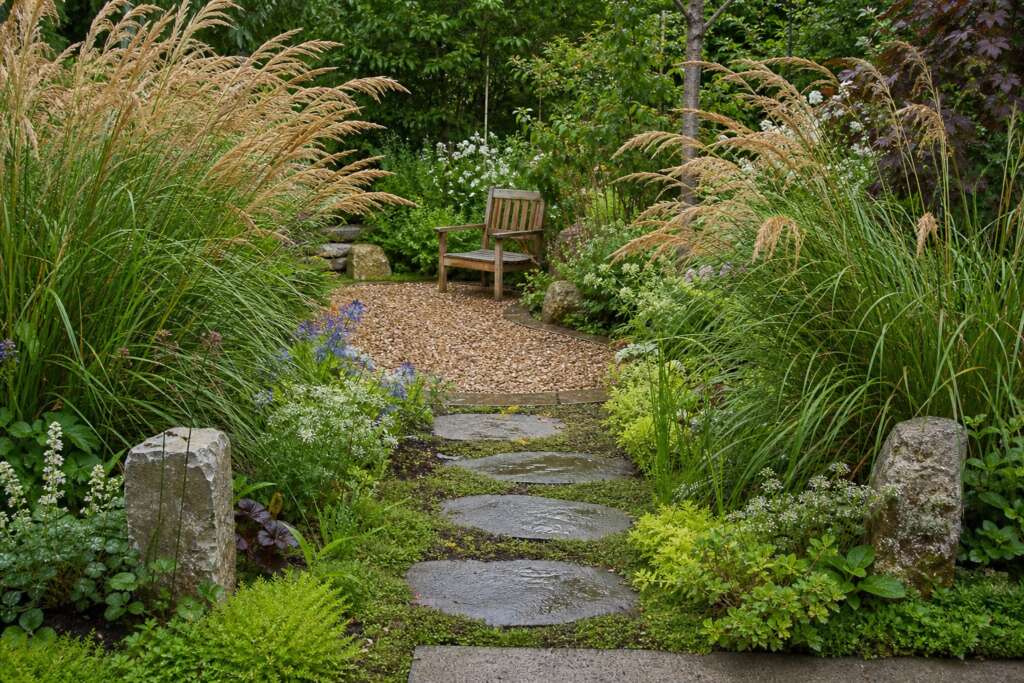
A threshold is any moment where the garden tells you that you have entered another space. It can be a gate, an arch, two clipped shrubs, a pair of tall grasses, a change from mulch to gravel, or the shadow line under a small tree. It does not have to be grand. In a small garden, a threshold works best when it is subtle enough to be crossed every day.
Reveals are just as important. Do not show the whole garden from the back door if you can help it. Let a path turn behind planting. Place a pot of dark foliage where it catches the eye from one angle but disappears from another. Use a boulder, birdbath, chair, or small tree as a focal point, then let the visitor find the next one. The garden begins to feel larger because it is experienced in sequence.
Every route also needs a pause. A seat, a flat stone, a wider patch of gravel, or a view across a low planting can act like a save point without announcing itself as one. The pause should have a reason: shade in the afternoon, scent from nearby herbs, a view of seedheads, a place to watch insects, or a dry spot to set down a cup.
Let Planting Do The Worldbuilding
Planting is where a game-inspired garden can become rich without becoming cluttered. Use plant communities rather than isolated specimens. A woodland passage might repeat ferns, sedges, mossy stones, foamflower, woodland phlox, and small shrubs. A sun-baked “ruin” might use thyme, lavender, santolina, upright grasses, weathered stone, and a few self-seeding flowers. A moonlit corner might rely on pale flowers, silver foliage, and fragrance instead of glow-in-the-dark gimmicks.
Repetition matters. UF/IFAS guidance on arranging plants emphasizes vertical and horizontal layers, then repeated patterns of form, color, or texture to connect garden spaces.3 That is a good rule for fantasy too. Repeat a fern shape, a grass plume, a gravel color, or a dark-leaved accent often enough that the garden feels designed. Too many unrelated “special” plants make the space read like inventory, not landscape.
Use color with restraint. Games can flood a scene with blue crystals, red lava, or gold treasure because they are not responsible for photosynthesis or neighborhood context. A garden usually needs a quieter base: greens, bark, stone, soil, and seasonal flowers. One strong color moment is memorable. Five competing color moments become visual noise.
Make References Secondary
Literal references age quickly. A painted sign may amuse for one season and irritate you by the third. Materials with garden logic last longer: a weathered arch, stepping stones, a small bridge, a carved post, a mossy trough, a circular bed, a dark-leaved shrub at a turn. They can suggest a quest, a village edge, a forest path, or a hidden room without becoming merchandise.
Sound, scent, and touch can carry the idea better than objects. Gravel changes the sound of walking. Thyme releases scent under a boot edge. Grasses move before the path turns. Ferns cool the eye. A small rill or basin, if it fits the site and water use, can make a threshold feel alive. These details make the garden interactive in the ordinary, physical sense.
Design The Maintenance Loop
A beautiful first season is not the victory condition. The garden has to remain legible after growth, drought, weeds, fallen leaves, and the gardener’s limited time. Build in a maintenance loop: a way to reach the back of the border, a place to stash tools briefly, hose access, compost access, mulchable bed shapes, and plants with mature sizes that do not erase the path.
This is the unglamorous part that decides whether the design survives. The companion post on how to keep a game-inspired garden alive goes deeper into watering, pests, pruning, and seasonal resets. In the design stage, the main point is to make care part of the layout instead of a problem you solve later.
The strongest game-inspired gardens do not copy a screen. They translate the intelligence of a good landscape: movement, tension, rest, repetition, and reward. Then they let soil, light, water, and time decide which ideas deserve to stay.