
Fast garden maintenance should not feel like a raid on your own yard. The best version is quiet, regular, and slightly boring: a few weeds before they seed, a watering check before plants collapse, a path edge before it disappears, and a small repair before it becomes a weekend.
Clemson Extension notes that no landscape is maintenance-free, but good planning, design, plant selection, and timely care can reduce the work needed to keep it attractive.1 That is the useful promise here. A fast garden is not one that gets ignored. It is one where the necessary work is easy to see, easy to reach, and done before it multiplies.
Choose a useful finish line
“Tidy the garden” is an endless instruction. Give a short session a visible finish instead: clear the front path, water the new plantings, pull every weed that is forming seed, or check one bed for pest damage. A defined circuit is easier to begin and easier to stop. It also leaves room for noticing a bee on the oregano or the first ripe strawberry, which is part of why the garden exists.
Sort jobs by consequence. First handle anything that could injure a person or plant today: a loose support, a dry recent transplant, a blocked step, or a split branch. Next stop problems that are multiplying, such as weeds about to seed or an irrigation leak. Cosmetic work—deadheading, sweeping, sharpening a formal edge—comes after those. On a busy day, finishing the first two groups is enough.
Design out repeated irritation
Look for the tasks you resent most. If the hose snags on the same corner every week, the problem is not your attitude; it is the route. If weeds always return in one bare strip, the problem is open soil. If a shrub needs shearing every month to stay out of a path, it is probably too large for that spot.
Plant fit is the deepest time-saving tool. UF/IFAS advises matching plants to the site’s soil, light, water, and climate, and considering mature size before purchase. Plants that mature at the desired size need less pruning; suitable plants may also need fewer extra inputs once established.2 “Drought-tolerant” is not a universal shortcut: tolerance still depends on establishment, local climate, soil, and drainage.
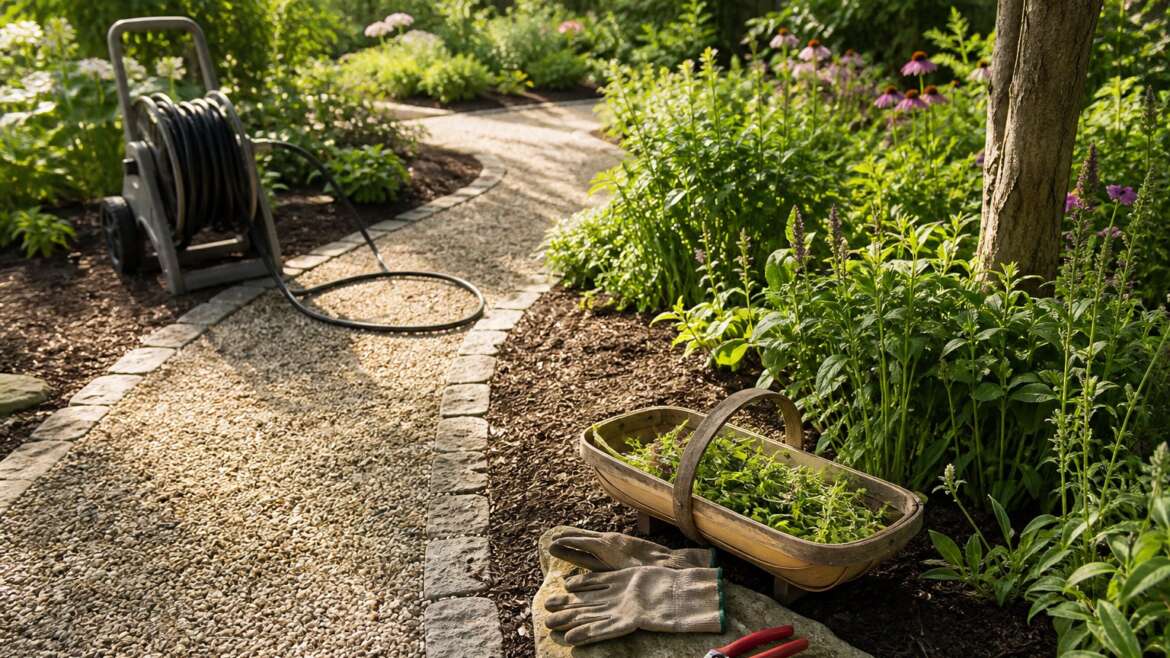
Access matters just as much as plant choice. A bed that can only be reached by leaning across wet foliage will be neglected or trampled. Add a flat stepping stone, leave a narrow service gap, move a hose connection, or keep the back of a border within comfortable reach. For the longer design view, see how plant spacing, ground cover, water zones, and access can make a lush landscape easier to manage.
Let mulch pay for itself
Mulch earns its place when it prevents several jobs at once. Oregon State University Extension reports that organic mulches can reduce surface evaporation and runoff, protect soil from compaction, and suppress many young weeds by excluding light.3 Use a material suited to the planting and local fire conditions, and check the existing layer before adding more. A yearly top-up without measuring can become a wet, airless mound.
Remove established perennial weeds first; mulch is much better at slowing annual seedlings than defeating bindweed, horsetail, or vigorous grasses. Keep it away from stems and trunks, and make sure irrigation reaches the soil below rather than merely wetting the surface. If fine mulch has crusted and sheds water, roughing the surface may be more useful than adding another bag. The point is less repeat work, not a permanently brown garden.
Inspect before you intervene
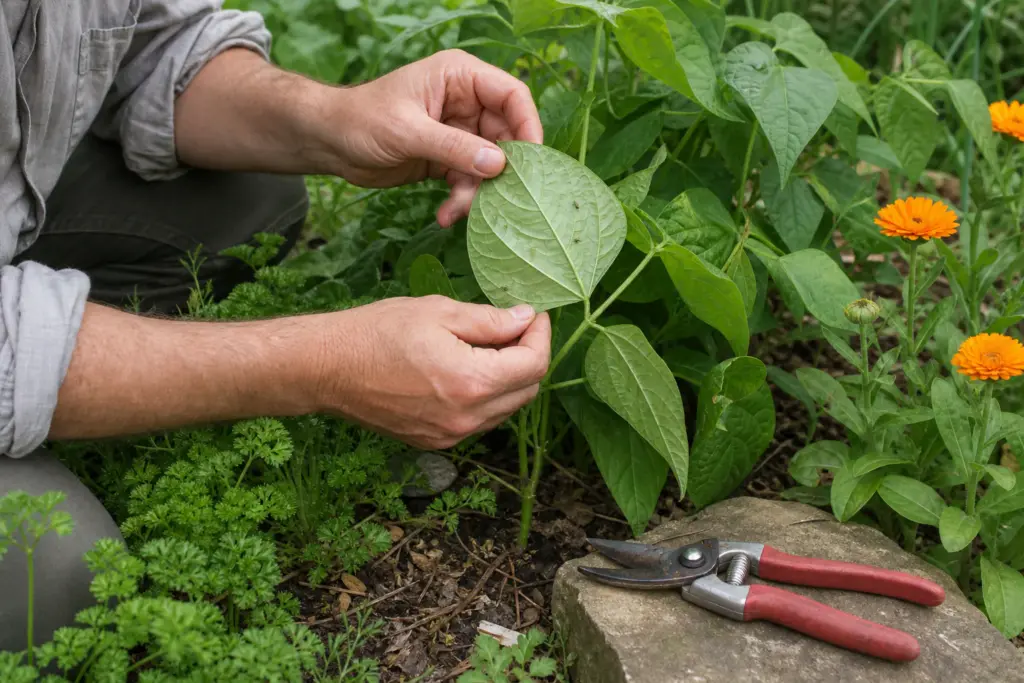
Make one five-minute route through the garden and use roughly the same route each time. Look at recent plantings, containers, known pest hot spots, irrigation fittings, ties and supports, path hazards, and weeds in flower. Repetition turns a vague impression—“this plant looks wrong”—into a comparison with yesterday. A fresh hole, a new wilt, or damage that has stopped spreading calls for a different response than an old mark.
Identification prevents busywork. UC IPM recommends looking for pests and their damage, identifying the organism correctly, and combining preventive, physical, biological, and—when needed—carefully chosen chemical methods.4 A few chewed leaves may need observation rather than treatment. A broken stem may need one clean cut rather than a full reshaping. Before spraying or pruning, ask what changed, whether the plant is actually being harmed, and whether the smallest effective action is simply to wait.
Water from evidence, not habit
Watering by the calendar can waste both water and time. Check moisture in the root zone, recent rainfall, weather, and the needs of that plant before opening the tap. The US Environmental Protection Agency advises adjusting irrigation with seasonal conditions, checking systems for leaks or clogged heads, and grouping plants with similar water needs into the same irrigation zone.5 Those checks matter more than owning an elaborate controller.
Watch what the water does. If it pools on clay or runs down a slope, divide the watering period into shorter cycles with time to soak in. If it races down the side of a dry container, pause and wet the mix gradually instead of counting the runoff as success. Soil type, slope, wind, sun, plant age, and local restrictions all change the answer; there is no single interval that fits every garden.
Match each job to its moment
Speed often comes from timing rather than force. Young weeds release more readily than rooted thickets, and weeds removed before seed matures cannot add that crop of seed to the soil. Pruning is more plant-specific. Iowa State University Extension notes that healthy spring-flowering shrubs such as lilac and forsythia are generally pruned just after flowering, while many summer-flowering shrubs are pruned in late winter or early spring.6 The wrong September pruning cut can remove flower buds already prepared for spring.
Work with conditions, too. Pull weeds when the soil is moist enough to release roots but not so wet that every step compacts it. Save noisy or strenuous jobs for a sensible hour and cooler weather. Group tasks that use the same tool—ties and supports, then dead wood, then spent stems—but do not give unrelated plants the same treatment merely because the pruners are in your hand.
End with a three-minute reset
The last minutes of a session determine how quickly the next one begins. Empty the weed bucket, return the hose without a kink, put the hand fork where it belongs, and leave any tool used on questionable plant material ready to be cleaned before it moves elsewhere. Make one note about the job that needs supplies, better weather, or a longer block of time. Memory is a poor storage shed.
The goal is not to make gardening efficient in a joyless way. It is to remove avoidable friction so the remaining work feels like care. A garden that takes less effort to inspect and maintain often receives better attention, because the gardener can arrive curious instead of already tired.
References
- Clemson Cooperative Extension: Low-Maintenance Landscape Ideas
- University of Florida IFAS: Right Plant, Right Place
- Oregon State University Extension: Mulching Woody Ornamentals with Organic Materials
- UC Statewide IPM Program: What Is IPM?
- US EPA WaterSense: Watering Tips
- Iowa State University Extension: Proper Time to Prune Trees and Shrubs