
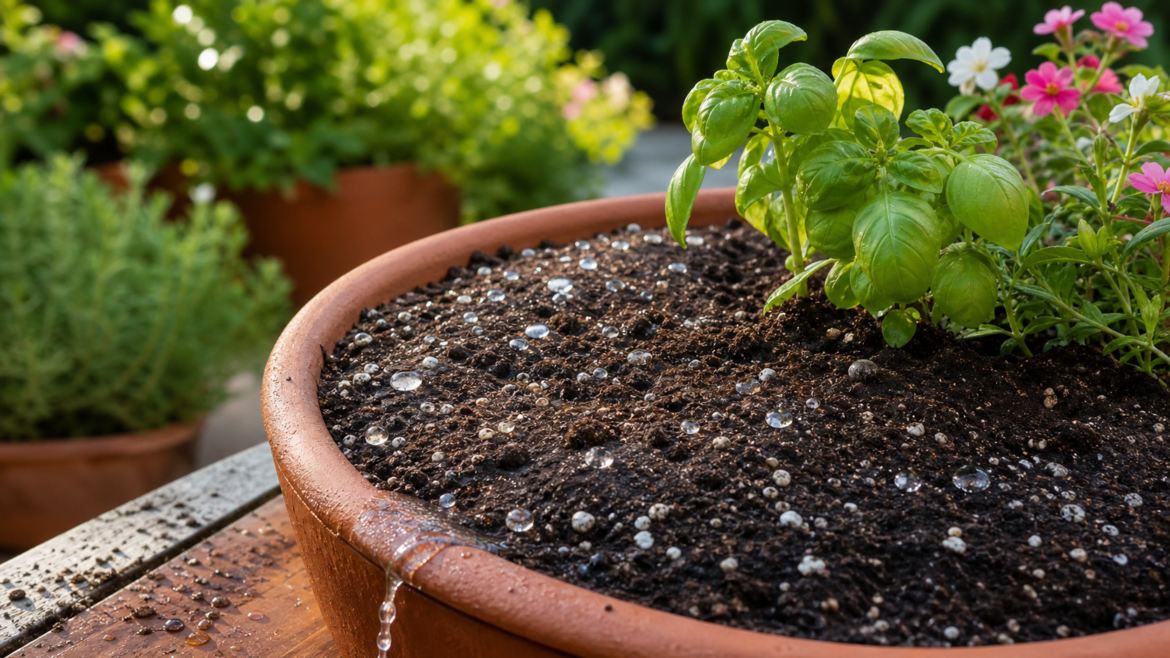
By late August, a container can look watered and still be thirsty. The surface darkens for a moment, clear beads gather on the potting mix like rain on waxed paper, and then water slips down the inside wall of the pot and appears at the drainage hole almost too quickly. The gardener has watered. The roots, inconveniently, may not have received much at all.
This is one of the stranger frustrations of dry weather: soil can become hydrophobic, which means it repels water instead of accepting it. UC Master Gardeners of Santa Clara County compare overly dry soil to a dry sponge and note that hydrophobic soil can waste water as it drains away from the root zone.1 The symptom is easy to miss because water is visibly moving. It is simply moving through the wrong places.
The cure is not panic watering. It is better contact. When water beads, races, or pools, the gardener’s job is to slow it down long enough for the surface to remember how to wet.
The bead test
A simple test can tell you whether you are dealing with water-repellent soil rather than ordinary dryness. Place a few drops of water on an air-dry bit of soil or potting mix and wait. The USDA Natural Resources Conservation Service describes this same water-drop test for hydrophobic layers: if the water beads after about a minute, the layer is water-repellent.2
In a pot, test more than the surface. A container can have a damp-looking top and a dry root ball below, or a shrunken root ball that has pulled away from the pot wall. Water then takes the shortcut down the gap, leaving the center dry. In a bed, the clue may be a dry patch under mulch, a glazed crust that sheds rain, or irrigation water that runs sideways before it sinks.
Not every hard, dry surface is hydrophobic. Clay can crack because it shrinks. Compacted soil has lost pore space and may shed water for a different reason. A slope can lose water simply because gravity is impatient. Still, the bead test is useful because it changes the question from “Did I water?” to “Did the soil receive it?”
Why dry soil can turn against water
Water normally enters soil through small connected pores and along wettable surfaces. When those surfaces are coated with certain organic compounds, droplets hold their rounded shape instead of spreading. The NRCS explains this clearly in the context of fire: waxy substances from plant material can coat soil particles and create a hydrophobic layer, and some soil fungi can also produce substances that make litter and surface soil repel water.2
A patio pot is not a burned hillside, but the principle matters. Organic materials dry, age, decompose, and sometimes present water with a surface it does not easily wet. Soilless mixes are a common example. University of Maryland Extension notes that dry soilless mixes can repel water and recommends working water through the medium before filling containers.3 Virginia Cooperative Extension likewise warns that peat- or bark-based media can become hydrophobic when dry, and that water draining quickly from a pot does not prove the root zone has been rehydrated.4
This is why a neglected hanging basket can be so difficult to rescue. The plant wilts, the mix dries, the root ball shrinks, and water poured from above behaves like a visitor that has found the emergency exit.
Containers need slow re-entry
For a potted plant, begin by moving the container to a bright, shaded work area so you can re-wet it without adding midday heat stress. Scratch the surface lightly if it has formed a crust, keeping away from shallow roots and the crown of the plant. Then water gently and wait.
That waiting is not laziness. It is the method. Add a small amount of water, pause, then repeat. The first pass dampens a few surfaces; later passes have a better chance of spreading through the root ball. Virginia Cooperative Extension recommends two or three slow applications for dry container media.4 This pulse-and-pause habit is useful outdoors too: UC Master Gardeners suggest a brief sprinkler run, a waiting period, and then a longer run to reduce water loss from hydrophobic soil.1
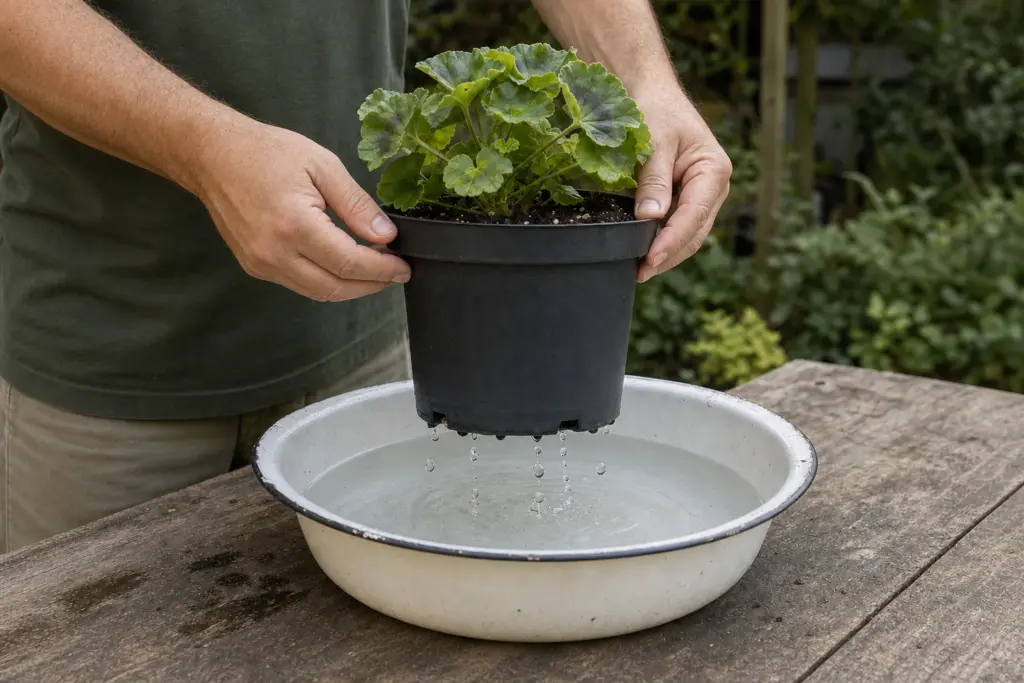
If water still pours through instantly, try bottom-watering. Set the pot in a basin holding two or three inches of water and let moisture enter through the drainage holes. Virginia Cooperative Extension suggests checking after 15 to 30 minutes; a severely dry root ball may need another soak, but a container should not stand in the basin for more than an hour. Remove it when the surface is damp or a check of the root zone shows even moisture, then let it drain freely.4
If repeated slow applications and bottom-watering still leave dry pockets, a wetting agent labeled for container media may help promote more even wetting; commercial soilless mixes commonly include one.3 Follow the product label, and treat it as a rescue tool rather than a substitute for checking moisture and watering before the mix repeatedly becomes bone-dry.
Beds and borders need contact, not force
In garden beds, the temptation is to blast the surface until it gives in. A forceful stream can displace fine soil, expose roots, and send water downhill before it infiltrates. A gentler approach works better: pull back mulch, loosen only a sealed upper crust with a hand fork, water lightly, pause, then water more deeply.
The goal is to open enough tiny entrances for water to begin moving downward. In annual vegetable beds, a thin topdressing of finished compost may help protect the surface from crusting as it is incorporated by soil organisms. In perennial borders, work shallowly and carefully. Many feeder roots live close to the surface, especially under mulch, and the point is to restore contact, not cultivate the bed into dust.
After watering, check with a trowel rather than trusting the surface. Dig a small inspection hole a few inches deep. If the top half inch is wet and everything below is still pale and dry, the water has not reached the working root zone. If the soil is damp below but dry on top, the plant may be better off than appearances suggest.
Mulch can be the lid or the problem
Mulch is usually one of the best defenses against summer dryness. Oregon State University Extension notes that organic mulches conserve water, reduce weeds, improve soil quality, and protect soil from compaction, which helps water infiltrate.5 A good mulch layer shades the soil surface and keeps the upper root zone from swinging between damp and brittle.
But mulch can also become the place where water stops. OSU Extension warns that decomposing organic mulches can develop waxy, water-repellent coatings, especially when fine particles compact or fungal mats form after drying. Its practical advice is simple: use coarser mulch, limit fine-textured bark to a modest depth, rough up sealed surfaces before adding more, and consider drip irrigation below the surface layer when infiltration is poor.5
This matters in late summer because a mulched bed can look protected while the soil underneath is receiving very little. After a dry spell, lift the mulch and check. If the mulch is wet and the soil below is still powdery, water is being intercepted by the wrong layer.
How to keep soil drinkable
The easiest hydrophobic soil to fix is the one you prevent. Pre-moisten dry potting mix before planting instead of expecting the first watering to do all the work.3 Keep containers from reaching the bone-dry stage, especially hanging baskets, fabric grow bags, and small terracotta pots. Group pots where they are sheltered from afternoon wind. Use saucers as temporary recharge trays, then empty them so roots are not left standing in water.
In beds, build a surface that resists extremes. Finished compost, leaf mold, living roots, and suitable mulch all help protect the soil surface and add organic residues. In Utah’s low-organic-matter soils, Utah State University Extension recommends organic matter to improve aggregation, drainage, aeration, water holding, and plant growth.6 The useful amount and material still depend on the existing soil and the plants being grown; this is steady soil care, not a reason to add rich amendments without limit.
There is a useful restraint here. Do not turn every dry surface into a deep digging project. The better habit is to observe, test, water slowly, and keep organic cover from becoming either absent or sealed. Soil is at its best when it is neither bare and baked nor smothered under a compacted mat.
Useful re-wetting supplies
- XLUX soil moisture meter: helpful for checking whether the root zone is actually dry after the surface has changed color.
- Dramm one-touch rain wand: a gentle shower pattern makes pulse watering easier without blasting dry mix out of containers.
- GS Plant Foods Yucca Wet: an optional wetting agent for stubborn container media; use label rates and treat it as a rescue tool, not a substitute for good watering rhythm.
Final thoughts
Hydrophobic soil feels like a contradiction because the garden looks as if it is rejecting the one thing it needs. But it is not moodiness, and it is not a moral failure of watering. It is surface chemistry, structure, dry weather, and container physics meeting at the worst possible moment.
Once you know the pattern, it becomes less mysterious. Water beads, so you pause. Water runs, so you slow it. Mulch sheds, so you roughen it. A pot drains too quickly, so you soak it from below and let it breathe afterward. The work is small, but it changes the whole conversation between water and root.
The best summer watering is not measured by how much leaves the hose. It is measured by how much the soil is willing, and able, to hold.
References
- UC Master Gardeners of Santa Clara County: Irrigation Tips
- USDA NRCS: Soil Quality Resource Concerns: Hydrophobicity
- University of Maryland Extension: Growing Media (Potting Soil) for Containers
- Virginia Cooperative Extension: Proper Watering Practices for Container-Grown Plants
- Oregon State University Extension: Mulching Woody Ornamentals with Organic Materials
- Utah State University Extension: Solutions to Soil Problems V. Low Organic Matter