
By late October, the garden begins to receive its own mail. Leaves arrive one by one, then by the basketful, sliding from maples, oaks, birches, cherries, serviceberries, and every tree that has decided the season is finished. They collect in corners, gather under shrubs, drift across paths, and make the lawn look as if it has been quietly written over.
It is easy to see fallen leaves as cleanup. They are, after all, everywhere. But a leaf on the ground is not simply litter. It is a packet of carbon, mineral traces, structure, shelter, and time. University of Illinois Extension notes that fallen leaves are one of the most available forms of organic matter for home gardeners, useful as mulch, compost material, and a way to return organic matter to soil.1 The autumn problem is also the autumn resource.
The trick is not to keep every leaf exactly where it lands. A thick mat on turf can smother grass. Diseased foliage sometimes belongs in municipal yard waste instead of the home garden. Leaves on paths and drains can become slippery or obstructive. The better habit is more thoughtful: move leaves from where they cause trouble to where they can do quiet work.
A leaf is stored summer
A fallen leaf has already changed before it reaches the ground. During senescence, the tree dismantles chlorophyll and remobilizes some nutrients to perennial tissues; carotenoids persist longer than chlorophyll and become conspicuous, while some species synthesize red anthocyanins. A peer-reviewed review of autumn leaf physiology describes those linked processes of pigment change and nutrient recycling.2 What drops into the garden is not a fresh green solar panel, but it is still full of useful plant material. The companion article on why autumn leaves change color before they fall follows the process from shortening nights to the abscission layer.
That carbon is why leaves behave differently from soft green prunings. They do not melt overnight. They resist, curl, mat, soften, and darken. Oregon State University Extension describes organic matter as central to improving soil structure, water movement, water storage, and biological activity in garden soils.3 Leaves are one of the easiest ways a home garden can keep adding that kind of material without buying it in bags. Keep a heavy layer of fresh leaves on the surface or compost it first rather than digging it into a bed immediately before planting; high-carbon fresh material can temporarily reduce plant-available nitrogen as microbes decompose it.3
There is poetry in this, but it is not only poetry. A bare bed loses surface structure to rain impact. A bed covered lightly with shredded leaves takes the weather more gently. Drops hit leaf, not soil. Oregon State’s mulch guidance notes that organic mulches reduce surface evaporation and runoff, protect soil from compaction, feed soil organisms, and moderate the soil environment.4 A leaf layer is not inert decoration or a guarantee against frost. It is a small form of weather moderation.
Leaf mold is not ordinary compost
Leaf mold is what happens when leaves are piled separately, kept moist, and allowed to decay. It is not the balanced, actively managed compost made from kitchen scraps, green weeds, and other nitrogen-rich ingredients. Penn State Extension describes finished leaf mold as dark brown, earthy-smelling, and crumbly; although low in nutrients, it can improve soil structure and water retention and support the organisms that decompose organic matter.5
That distinction matters because it changes expectations. Leaf mold is not primarily a fertilizer. It will not replace a soil test or a site-appropriate fertility plan for hungry vegetables. Its gift is texture. Finished leaf mold is dark, soft, crumbly, and faintly woodland-like. It can be used as a surface mulch, a soil conditioner, or one component of a suitable outdoor container mix rather than as a complete potting medium on its own.5
A leaf pile can look inactive for months and still be working. Fungi, bacteria, mites, insects, and other decomposers enlarge small spaces and consume what they can. Edges tear. Brown becomes nearly black. The process is slow because leaves are built to last longer than lettuce stems. That patience is exactly why leaf mold belongs in a garden that wants better soil over years, not just a quick flush of nutrients next week.
How to make a quiet leaf bin
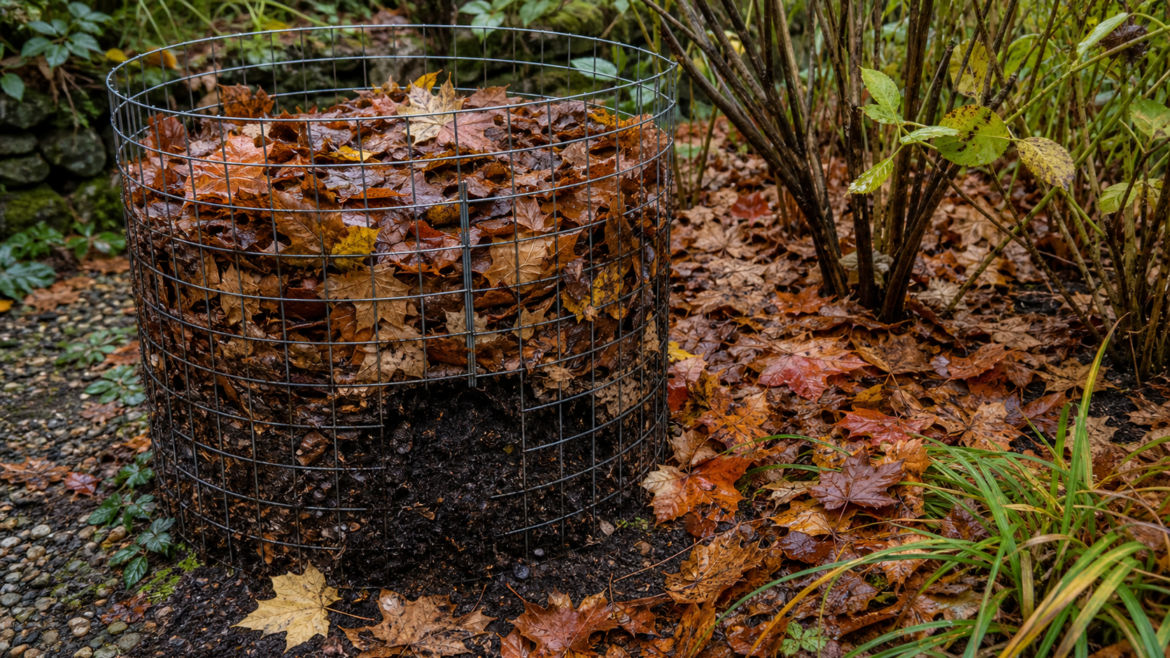
The simplest leaf-mold bin is a cylinder of wire mesh tucked into a sheltered corner. Fill it with leaves, moisten them if they are dry, press them down lightly, and let the weather help. A bin keeps the leaves from roaming the garden while still allowing air and rain to enter. It does not need to be beautiful. It needs to hold the pile without sealing it.
Shredding leaves speeds the process because it creates smaller pieces and more exposed edges. Illinois Extension recommends breaking leaves down with a shredder, mulcher, or mower because smaller pieces improve air circulation and increase surface area for decomposition.1 Whole leaves can work, especially in a loose bin, but large waxy leaves tend to stack like plates. Once they mat, water runs around them and air disappears from the center.
Moisture is the other important detail. A dry pile can sit for a long time in a state that feels more like storage than decay. Aim for leaves that remain evenly damp rather than dripping or waterlogged. If autumn is dry, water the pile as you build it. If the pile becomes compacted or develops an unpleasant anaerobic smell, loosen it and let excess water drain. A loose cover can slow drying or shed extreme rain, but it should not seal the pile from air.
Turning is optional, but it can speed an uneven pile by bringing dry edges and matted pockets into the middle. Timing varies with species, shredding, moisture, temperature, and how finished the material needs to be. Penn State’s low-input method asks gardeners to water a contained pile and wait a couple of years.5 Earlier material may already serve as rough mulch; finer, fully decayed leaf mold can be used as a soft topdressing. Do not rush the transformation. Leaf mold is the opposite of instant gardening.
Where leaves belong
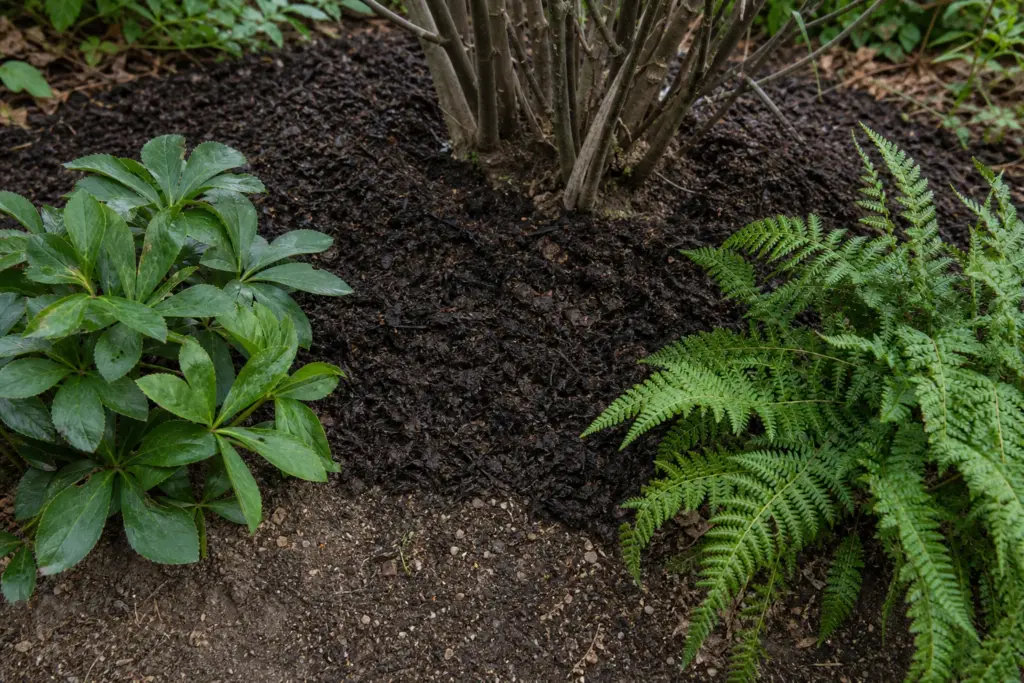
The best place for leaves is often near where trees put them, but not always exactly there. Under shrubs, around woodland perennials, along hedges, and in quiet back corners, a light layer of leaves can behave like a miniature forest floor. Oregon State University Extension notes that organic mulches can conserve moisture, reduce weeds, moderate soil temperature, protect soil from compaction, and improve soil as they decompose.4
Depth matters. A thin, loose layer is generous. A thick, wet sheet can be smothering. Around perennials, pull leaves back from crowns that are vulnerable to winter wet. Around trees and shrubs, keep organic mulch away from trunks and stems. The goal is a soft blanket over soil, not a damp collar pressed against bark. Add more only after checking how much of the previous layer remains.
Vegetable beds can use leaves differently. Oregon State recommends a 1- to 2-inch fall layer for annual vegetable or flower beds, where it can reduce raindrop impact and suppress winter annual weeds; it also advises reducing or omitting the leaves where a fall cover crop must stay uncovered.3 In spring, intact remnants can be raked aside before sowing small seeds, then returned between rows once seedlings are sturdy. In a windy garden, chopped leaves mixed with a little finished compost or held under netting are less likely to migrate.
Lawns are the exception that demands judgment. A light covering of dry leaves can be mulch-mowed until the fragments settle between visible grass blades.1 A heavy blanket blocks light and air. Oregon State Extension warns that a thick leaf mat under a tree can lead to sparse turf, weeds, and moss in spring.6 The answer is not always to bag leaves. It is to mow, move, or thin them before they become a sealed layer.
What not to keep
Not every leaf deserves a place in the leaf-mold bin. If a plant had a diagnosed disease that overwinters readily on fallen foliage, remove that material from the home garden cycle and follow local disposal advice. Oregon State specifically advises removing fig leaves with fungal spotting because spores can remain on infected leaves and infect new growth the following spring.6 Its soil guide also cautions that plant-disease organisms can survive ordinary backyard composting.3 Cleanup should follow the actual plant and pathogen rather than a rule that every spotted leaf is dangerous.
Leaves mixed with seed-bearing invasive weeds, pet feces, litter, or road grit are not a clean leaf stream. Penn State Extension’s current home-composting guide lists plant material with visible disease or insect infestation, and human or pet wastes, among the materials to exclude from a home pile.7 Follow pesticide labels and local collection rules for any material that may have been treated or contaminated. Most ordinary tree leaves are useful. The point is not to become suspicious of autumn. It is to keep the clean leaf stream clean.
There is also a practical limit. A small garden can use only so many leaves before paths vanish and crowns stay wet. Extra clean leaves can be stored in bags with air holes, shared with a gardener who has more beds, or sent to a municipal composting program that accepts them.1 Waste is not measured by whether every leaf stays on site. Waste is pretending the leaves have no value at all.
A winter room for small life
Leaves do more than become soil. They also become shelter. University of Illinois Extension notes that many insects overwinter in leaf litter, hollow stems, or underground, later emerging to pollinate plants and become prey for birds.8 Leaf litter, standing stems, hollow stalks, bark edges, and quiet corners can all be winter rooms.
This does not require turning the whole property into a thicket. A small leaf layer under shrubs, a back border left less tidy, a pile of stems set aside after spring cutting, and a leaf-mold bin that is not constantly disturbed can all help. If you plan to shred most of the leaves, reserve at least one low-traffic area of intact litter first; Illinois Extension specifically recommends allowing fallen leaves to remain on garden beds or in designated areas.8 The refined garden and the living garden do not have to be enemies. A skillful autumn cleanup edits.
Insects that survive winter become part of the next year’s garden economy. Some pollinate. Some prey on pests. Some feed birds. Some simply belong to the woven life of the place. A leaf on the ground may be mulch, future humus, or the roof over a tiny winter chamber. Usually it is more than one of those things at once.
Useful fallen-leaf supplies
- GEOBIN compost bin: a large, ventilated container that can hold a loose leaf pile together while admitting air. Check its expanded footprint against the space available before buying.
- WORX WG430 leaf mulcher: an electric shredder for reducing a large volume of dry leaves into smaller pieces. A mower is often sufficient for a modest quantity; whichever tool you use, first reserve some intact litter for overwintering wildlife.18
- Fiskars Kangaroo 30-gallon garden bag: a collapsible container for carrying leaves from paths or turf to beds, a leaf bin, or an accepted municipal collection. Let very wet leaves drain before lifting a full bag.
Final thoughts
Fallen leaves are one of the garden’s most generous materials because they arrive without ceremony and ask for almost no technology. You can shred them or leave some whole. You can store them in a wire bin. You can tuck them under shrubs, skim them from the lawn, or let a few corners remain wilder than the rest.
The important shift is mental. A leaf is not finished when it falls. It is changing jobs. It stops feeding the tree and begins feeding the ground. It stops catching sunlight and begins catching rain. It stops being canopy and becomes cover.
By spring, much of the evidence will be quieter: darker soil, fewer bare patches, a softer bed edge, a bin that has settled, and perhaps a few small lives that made it through winter because the garden was not scrubbed clean. Autumn gives gardeners a choice. We can export the season, or we can let part of it stay and become soil.
References
- University of Illinois Extension: Don’t rake fall leaves, recycle them
- Matile, 2000: Biochemistry of Indian summer: physiology of autumnal leaf coloration (PubMed)
- Oregon State University Extension: Improving garden soils with organic matter
- Oregon State University Extension: Mulching woody ornamentals with organic materials
- Penn State Extension: Leaves are treasure, not trash
- Oregon State University Extension: Should I leave my fig leaves on the ground?
- Penn State Extension: Home composting: a guide for home gardeners
- University of Illinois Extension: Managing your winter landscape to support wildlife