
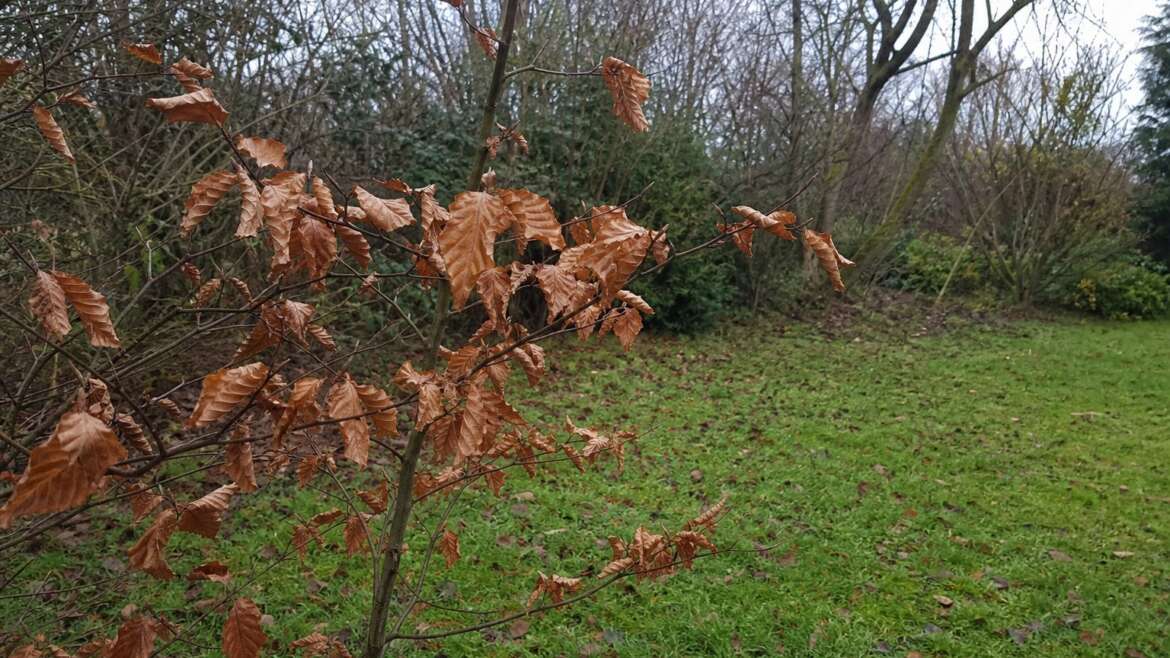
By November, most deciduous trees have become honest silhouettes. The maple has emptied itself. The serviceberry is bare. The birch has given its leaves to the path. Then, at the woodland edge or in a young hedge, a beech or oak still stands with dry copper leaves clinging to every twig, rattling softly whenever the wind moves through.
It can look like hesitation. It can also look like a problem, especially if you are used to reading brown leaves as a sign of drought, disease, or death. But in certain trees and shrubs, holding dead leaves through winter is normal. The botanical word is marcescence, from a Latin root meaning to fade or wither.
Marcescence is not the same as being evergreen. A marcescent leaf is dead, dry, and no longer feeding the tree through photosynthesis. The strange part is that it remains attached after the tree has otherwise gone dormant. The result is one of the quiet pleasures of the cold garden: a deciduous plant that keeps texture, sound, and a little privacy after most leaves have fallen.
What normally makes a leaf fall
Leaf fall is more than a leaf becoming tired. In many deciduous trees, an abscission layer develops near the base of the leaf stalk. As cells there separate, the leaf is released. In a marcescent leaf, senescence has occurred but this physical separation is delayed.1
University of Maryland Extension explains that in marcescent trees this separation does not happen in the usual autumn window. Oaks, American beech, hornbeam, Eastern hophornbeam, and witchhazels can hold dead leaves until spring, when new growth pushes the old leaves off.1
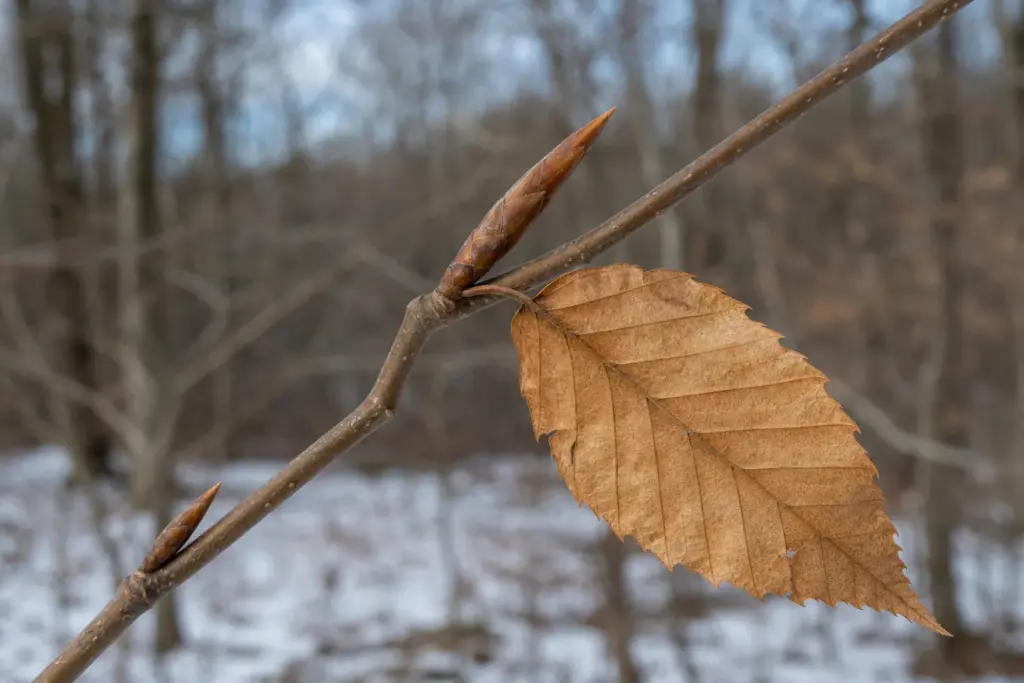
That is why a beech hedge can look brown but not bare in January. The tree has gone dormant, but the final letting-go step has been delayed. If you look closely in late winter, you may see pointed buds sitting beside last year’s papery leaves, ready to replace them.
Why young trees show it so clearly
Marcescence is often most obvious on young trees and on the lower, more juvenile limbs of older trees. Clemson Cooperative Extension notes that older deciduous trees may drop most foliage while juvenile trees, or lower branches of mature trees, keep some or all of their leaves. It also lists oaks, American beech, hornbeam, Eastern hophornbeam, and witchhazels as typical examples.2
This is why a woodland walk in winter can feel visually reversed. The canopy overhead may be gray and open, while small beeches at eye level are still clothed in tan leaves. A young oak in a hedgerow may look more leafy than the mature oak above it. The lower branches are not being stubborn in a human sense, but the effect is hard not to read that way.
Weather can complicate the picture. A warm autumn followed abruptly by cold can interrupt normal abscission in species that do not usually hold leaves so dramatically. In that case, retained leaves may be more of a seasonal accident than a built-in habit. Context matters: species, age, branch position, and the autumn weather all help explain what you are seeing.2
The uncertain benefits of not letting go
Gardeners like tidy explanations, but marcescence resists them. Several ideas make sense. Dry leaves may hide or protect buds from browsing deer. They may shade the soil and drop later as a spring mulch. They may protect buds from drying winds or frost. They may provide small winter cover for animals. Or the habit may be partly an evolutionary leftover, not an adaptation with one clear purpose.
A 2023 review in Ecosphere brought together six proposed hypotheses for leaf marcescence, including herbivore deterrence, bud protection, nutrient timing, and animal cover. The authors’ main point is refreshingly careful: no single hypothesis has complete support, and any advantage is likely to depend on species and context.3
That uncertainty matters. The dry leaves on a young beech may be doing several small things at once, or they may be the visible trace of developmental timing that has not been fully explained. The garden is full of useful mysteries, and this is one of the more audible ones.
The sound of leaves that stay
Marcescent leaves change the winter garden by sound as much as by color. Clemson Extension notes that retained leaves can be heard rattling in winter breezes.2 The sound is an observable consequence, not evidence for any one adaptive hypothesis. Along with their parchment texture and gradual weathering, it gives marcescent branches a presence even after their color has faded.
That is a useful design idea. Winter interest is often discussed as bark, berries, evergreen needles, seed heads, and branch structure. Marcescent leaves add a different layer: movement. They catch low light, filter views, and make the smallest breeze visible. In a quiet garden, a beech hedge can sound like paper being turned by someone just out of sight.
The effect is subtle, which is exactly why it works. A marcescent plant does not compete with holly berries or red-twig dogwood. It holds the middle tones: tan, copper, parchment, taupe, shadow. Those colors make winter evergreens look deeper and pale grasses look brighter.
Using marcescence in garden design
European beech, Fagus sylvatica, and common hornbeam, Carpinus betulus, are classic hedging choices in climates and sites that suit them. The Royal Horticultural Society notes that young and clipped beech commonly holds dead leaves through winter, providing seasonal screening, while hornbeam may retain fewer.4
This makes marcescent hedging useful where a full evergreen wall would feel too heavy. A beech hedge can mark a boundary in summer with green leaves, glow amber in autumn, then become a copper veil in winter. It does not block everything. It edits the view.
Site still matters. The RHS says European beech does poorly in excessively wet or dry soil and recommends the more tolerant common hornbeam for very heavy or wet sites and frost pockets.4 Those are species-specific cultivation notes, not a universal rule for every beech or hornbeam. Choose for climate, soil, drainage, mature size, and local ecology; the winter leaf effect should follow a sound site match, not override it.
When leaf retention is not marcescence
Not every brown leaf held in November is part of the same story. Clemson notes that a long warm autumn followed quickly by cold can interrupt abscission even in species such as maples that are not usually strongly marcescent.2 Other stress or injury can also leave brown foliage behind, so retention alone is not a diagnosis.
The pattern offers clues, not a verdict. Normal marcescence is more plausible on a familiar species, especially a young plant or lower juvenile branches, when dry leaves are evenly distributed and buds and twigs look sound. Sudden patchy browning during the growing season, dead buds, bark injury, canopy thinning, or progressive dieback deserves closer inspection. If the cause is unclear or large limbs are involved, use a local extension diagnostic service or a qualified arborist.
Do not strip marcescent leaves from a healthy tree. They will fall when spring growth begins or when winter weather loosens them. If you are shaping a hedge, prune for structure at the right time for the plant, not because the brown leaves offend the eye. They are not litter in the wrong place. They are part of the plant’s winter form.
Useful winter-structure supplies
- Fiskars bypass pruning shears: useful for light shaping on young hedging plants and removing small damaged twigs cleanly.
- Corona RazorTOOTH pruning saw: a practical hand saw for removing larger dead or damaged branches during dormant-season work.
Final thoughts
A marcescent tree is not late to the season. It is keeping a different schedule. While other trees reveal their branch architecture all at once, beech and oak saplings often keep a skin of last summer’s leaves, pale and dry, until the new buds swell.
That habit gives gardeners a useful way to think about winter. The garden does not have to be green to be alive, and it does not have to be bare to be dormant. Sometimes the most interesting plant in November is the one that has stopped growing but has not yet let go.
Listen for it on a cold morning. The leaves will tell you where the young beeches are before your eyes find them.